Tuesday, July 26, 2011

GOOD NEIGHBORS opens--Jacob Tierney's naughty, black "crimedy" from Canada

Last year Canadian writer/director/actor Jacob Tierney, gave us a mostly unheral-ded but fun little social/political comedy called The Trotsky (my review is here). This year he's back with another small film that, though it stars two good "Trotsky" actors, is a world away from the sweet and giddy joys of the earlier movie. That said, Tierney's new GOOD NEIGHBORS (ironic title!) arrives packed to the brim with some dark delights of its own.

"It's a terrible world we're living in," notes the inspector who pays a visit to the apartment house in which these good neighbors reside. And so it would certainly seem. Tierney, shown at right, has filled his film with bizarre and discombobu-lated subsidiary characters -- including some terrific cats you could die for -- but it is his three central characters who really seal the deal. There's a the goofy, can't-shut-up newcomer (Jay Baruchel, below, right), the angry-all-the-time young woman (Emily Hampshirebelow, center) for whom he carries a noticeable torch, and the actively unpleasant, cold-as-ice fellow (Scott Speedman, below, left) who becomes the sort of ringmaster to the goings-on. Let's call them the twit, the snit and the shit.

Mr. Tierney has a very interesting visual plan for his film (the cinematography is by the great Guy Dufaux: Stardom, Léolo, Jesus of Montreal), so Good Neightbors looks quite elegant-on-a-budget and is generally great fun to watch. The music is well-chosen, too. Set up into sections that are titled by the month we're in (it's all fall and winter, cold and colder) the movie divides basically into set-up, connection and climax.

The less said about plot the better, but I guess it won't hurt to know that a serial killer is loose in the city and that our three friends and their neighbors are all interested in this fact. Where the movie goes -- and how -- is bizarre and ugly. And yet there's a layer of very dark humor over the proceedings, and a sense, almost, of a kind of exercise going on here.

This sense we get of the author/filmmaker pulling strings has a dual effect. It keeps you distanced and less invested emotionally, so that you can chuckle during some of the nasty stuff that might ordinarily make you blanch. On the other hand, why should we care about any of these people? Finally, we don't. Tierney has adapted his screenplay from the novel Chere voisine by Chrystine Brouillet, so perhaps there was more real feeling within her pages than appears on screen.

Still, the performances are fine within this rather circumscribed framework: Baruchel (below, left) is gloriously goofy, Hampshire (above) finds all sorts of original ways to be annoyed, while Speedman (two photos above) is cold and sexy. There is plenty here to keep you glued, including two striking murder set pieces, one seen at a great distance, another up-close-and-very-personal. Like the inspector says, it is a terrible world. Thank god, it's only a movie, the black-comedic heart of which beats ice-cold.

Good Neighbors, 96 minutes long and from Magnolia Pictures, opens this Friday, July 29, in Los Angeles at Laemmle's Sunset 5, and in New York City at the Quad Cinema.  For other playdates, cities and theaters, click here. As with many Magnolia-released movies, this one, too, is playing via VOD. Click here to learn how you can get it -- and other titles.

Gideon Koppel's SLEEP FURIOUSLY (from 2008) finally gets a USA theatrical release


Sight and Sound called it a masterpiece. TrustMovies might not go quite that far, but SLEEP FURIOUSLY -- the visual tone poem from Gideon Koppel that takes place in the small village where his Jewish refugee parents found a home -- is an unusual and quietly stirring piece of work.

Filmed with a camera that remains stationary while each scene is being filmed but between scenes moves all over the village -- inside and out, filming in long shot and close-up, sun, rain and snow -- the movie is slow-going but never less than interesting and often much more than that. Mr. Koppel, shown at right, begins his film with a man in some kind of bright garb (the photo caption tells me that this is the Town Crier), walking up a hill followed by two little dogs. One thing you notice almost immediately is how neither the animals nor the people on view ever seem to notice the camera. That must be because the camera never moves, thus calling no attention to itself.

After that initial hill scene, we get several shades of muted colors across the screen, followed by a scene in school with young children and their aged teacher working with modeling clay. Then we're out in the field with tractors picking up bales of hay. These scenes -- and those that follow -- are brief but somehow pungent, while the vistas of rolling hills, valley and water (below) are ravishing, with Koppel's compositions of all this artful indeed.

The major problems in the village surfaces around the 20-minute mark: the village school is to be closed down, "reluctantly but finally," by the powers-that-be, and the villagers are not happy about this. Unless I missed noticing them, there are no televisions here. For entertainment, people read, and the traveling library, below, brings them a very interesting array of old and new books that range from Mary Renault's The Persian Boy to tomes on cooking.

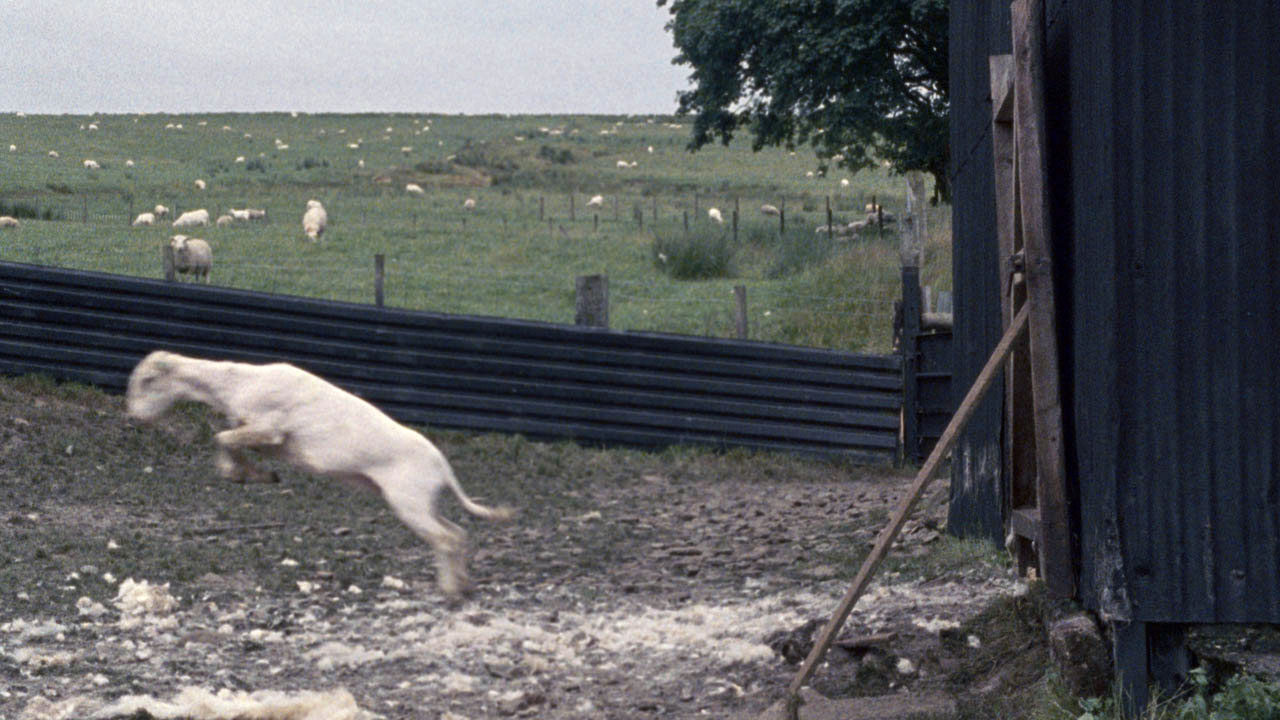
Work life entails everything from agriculture to sheep-shearing to auto repair and training those sheep to go through a gate (the scenes of the sheep jumping, below, are a particularly delightful sight). A chorale sings -- gorgeously (note the expression of the choral mistress' face when a wrong moment occurs) -- and we get a funny poem about a signpost, old and new.

There is no narration to the film, which proves just fine. Villagers speak to each other when the spirit moves them, often in reminiscence. Laundry is hung to dry, clouds roll by and some lovely music is heard on the soundtrack (by a fellow named Aphex Twin). That stationary camera and the many changes of scene provide a kind of consistency that is oddly reassuring. Toward the finale we see this quote: "It is only when I sense the end of things that I find the courage to speak.  The courage, not the words."  Well, let others find the words. Mr Koppel has certainly found the images.

Sleep Furiously (splendid title!) -- 94 minutes, in English and Welsh (with English subtitles) -- a Microcinema International release, in association with Fandor.com, opens this Friday, July 29, at New York City's Cinema Village. (Fandor.com will show the film online for an exclusive window of 24 hours on the opening day of this theatrical engagement.) Let's hope the film gets picked up for further theatrical play across the country and finds its way onto DVD eventually.

Monday, July 25, 2011

Gereon Wetzel's doc on EL BULLI, as that chic restaurant comes to its imminent close


TrustMovies suspects that many viewers will come away of two minds about the new documentary EL BULLI: COOKING IN PROGRESS. They will certainly, if they possess any interest in "cuisine," find this work of German filmmaker Gereon Wetzel worth a watch, if only for its crisp, clean cinematographical peek into the seaside Barcelona-based restaurant considered to be among if not the best in the world. At the same time they may better understand the meaning of a phrase that, until I saw this movie, I did not fully appreciate: food porn.

Mr. Wetzel -- that's he, I believe, shown at left (you're a hard man to find a photo of, Gereon!) -- follows in his film the several chefs of El Bulli, with emphasis on the "boss," Ferran Adrià and his cohorts Oriol Castro and Eduard Xatruch, as they plan the coming season's menu. Their restaurant is open for business spring, summer and fall but closed all winter so that the three can "create" their upcom-ing menu. This creation is by far the most interesting part of the film and takes up around half of its 108 and slightly overlong minutes.

From its opening-in-the-dark moment, the movie's a visual feast food-wise and otherwise. (Even the restaurant's seaside location, above, should take your breath away.) And though yours truly doesn't pay that much attention to his own cooking or eating, for people who do, the film could be a goldmine of education. How new dishes come into being provides several highlights. Often, when you hear a chef describing some screwy-sound combination of tastes, you want  to roll your eyes. Not here. Not, at least, during this first half of the film.

"But why?" One of the chefs asks about a certain dish at one point along the way. It's a question that ought to be asked more often. "It's not pretty!" notes Ferran later, which pretty much sums up the idea of "presentation." What we see one day as jelly turns into an exquisite vinaigrette the next, and later we discover a cocktail, above, with oil, like a soup: The top feels like silk, while the bottom remains liquid. And we go with two of our chefs to market, where, on one particular day, they purchase only five white grapes.

During the second half of the film, the new staff for the coming season is trained. While this portion will appeal most to those who plan to open their own first-class restaurant, there are some highlights here, as well. We see brilliance suddenly achieved out of a "goof": using the wrong water (carbonated rather than regular) has produced something magical. The preparation of food, at least in the hand of these chefs, seems to require a combination of science and art. And in the midst of all the planning/execution, at last there is mention of a dish I actually recognize: pine nut ravioli.


Your overall reaction to El Bulli - the film and the restaurant (which is slated to close for good on July 30 of this year) -- will depend, I think, on your overall reaction to food. Is it necessary nourishment or something to be treated as an art form, as a fabulous and tasty game to be played and won?  The last few minutes of the movie are devoted to menus -- with each dish, as above (coconut sponge), below (ice vinaigrette with tangerines and green olives) and at right (vanilla chips), named and pictured in all its bizarre glory. You may possibly be seized with a huge case of food envy at never being able to partake in these amazements. Or, like me, you will find yourself salivating at the thought of, tonight, grilling a simple burger seasoned with salt, pepper, garlic and parsley, with a side dish of perfectly steamed, al dente and sauce-less, green beans.

El Bulli: Cooking in Progress, from Alive Mind Cinema, begins a two-week run here in New York City at Film Forum on Wednesday, July 27. Click here for screening times.

Say hello to a craftsman of terrific thrillers: Fred Cavayé & a zippy/scary POINT BLANK

When TrustMovies first covered the knock-out little thriller POINT BLANK (À bout portant), it was during last spring's Tribeca Film Fest. Since then he has seen it again, in preparation for its theatrical release, and he is happy to tell you that it holds up quite well on second viewing. The best mystery thriller since Tell No One, but a good deal tighter and more economical (only 84 minutes) and utterly riveting from first wham-bam moment to impressive, hold-your-breath finale (the denouement's crackerjack, as well), the movie is the creation of a fellow we're sure to be hearing a lot more about: director/co-writer (with Guillaume Lemans), Fred Cavayé.

Back in 2008, the first full-length film from M. Cavayé (shown at left) -- Anything for Her (Pour elle) was released to much acclaim in France and then interna-tionally. We never saw it here in the USA because our own Paul Haggis bought the rights and remade it as The Next Three Days -- lengthening it by about a half an hour in the process. The Haggis version had its moments (and performan-ces), but I would love to have the opportunity to see the French original, particularly now that I've seen Cavayé's follow-up. Currently his earlier film is available via Amazon in both NTSC and PAL formats. You can also "Save" it in your Netflix queue, but these days, saving a film on Netflix can mean finally being able to view it anytime between next year and never. (What happened to this company that used to pride itself on the fact that, if a film was available on DVD, then it was available at Netflix?)

Back to the new film: What is it that distinguishes M. Cavayé's Point Blank? Certainly not its title, which will only put buffs in mind of the classic John Boorman movie with Lee Marvin. And yet this new Point Blank -- while having in common only the fact that, like its earlier namesake, it is part of the immensely popular (and populated) "crime" genre -- is every bit as good, in its own, much less "heavily stylish" but even more enthralling, manner.

As with his earlier movie, the filmmaker and his same co-writer set up a situation in which a man must protect his wife from harm, with a hospital used prominently in a scene or two. But here the similarities pretty much end. Cavayé and Lemans smartly travel the thriller road less taken: that of the situation in which, rather than simply having one set of good guys and another set of bad ones, the plot proffers three distinct sets: good, bad and questionable. This is a route taken by another fine French filmmaker, Florent Emilio Siri, in his exceptional thriller The Nest and his one American film Hostage. This "third party" does for crime movies what a "threesome" does for certain love stories: It adds immense interest and event to the situation, even as it increases both the risk and (less often) the reward.

Point Blank's team actually goes a step or two better by broadening the groups to include a fourth and even a fifth (though one of those last two turns out to simply be branch of the bad guys). What all this does is keep the audience, just like our hero (the wonderful French Everyman Gilles Lellouche, shown below, left, and in the photos further above), constantly on its toes.

Our second "sort-of" hero (from the "questionable" group) is played by that French institution Roschdy Zem (above, right. and at left, two photos up), who, in the last couple of years alone, has been seen to fabulous effect in everything from The Girl from Monaco to Tête de turc, Outside the Law and most recently at Rendez-vous with French Cinema in Happy Few. I can think of few French actors possessing more stature (metaphoric or actual) than Mr. Zem, and here, once again, he comes on like gangbusters, delivering the goods -- and then some.

The role of the wife-in-danger is played by Elena Anaya (above, left, and seen in NYC over the past year in Mesrine, Hierro and Cairo Time), who brings immense strength and specificity to a role that could -- until she is called upon to really struggle -- be merely passive. The top-dog policeman is played by Gérard Lanvin, (below, left) with Claire Perrot (at bottom) as the underling most intent on seeing some kind of justice upheld.

Cavayé films mostly in a gritty, grey-and-blue-hued universe, but even in his most dimly-lighted scenes, you'll understand exactly what is going on. And considering the amount of violence, both threatened and portrayed, the film is a lot more subtle and less bloody than expected.

The filmmakers' dialog is economical and believable, the action scenes are swift and smart, and the plot races along so tightly and urgently that it will be just about all you can do to keep up. And, god, that is so bracing and enjoyable.

The two quiet, relaxed scenes in the film are also done exactly right. In one of them, a pregnant woman must coax her man into having sex (he's worried about harming the baby; she knows better). It's the kind of real, lovely little scene you'd never find in an American film, and it sets up the tone and characters splendidly for what is to come.

So, yes, consider this a rave review for a film (in French, with English subtitles) that opens this Friday, July 29, in New York and the L.A. area -- courtesy of Magnolia Pictures. (You can view the complete set of upcoming playdates around the country, with cities and theaters, here). If Magnolia gives the film the push that Music Box Films gave Trust No One, the company could very well have a modest art-house hit on its hands.

Sunday, July 24, 2011

Straight-to-DVD: Dave Rodriguez's AMERICAN BULLY embarrasses badly


American Bully? More like a psychotic asshole who needs to be incarcerated forth-with. The original title of this shock-ingly unnecessary movie was Anytown (click on the link for the original poster), which should pretty much alert you to the subtlety-level on display through-out. (You mean, it could happen here? Sure could, kids!) Still, the movie is timely. Just this weekend, the new Mr. Norway snuffed out around 100 lives on the basis of some loony-tune political non-thinking. In his "new" film (made two years ago), director/co-writer (with Zak Meyers) Dave Rodriguez, pictured below, pulls out all the stops regarding bullying, immigration, terrorism, 9/11, the "Muslim menace" and America the ugly, and in the process creates so much noise and nonsense that you'll soon cry uncle.

Yes, bullying in high school can certainly lead to some nasty stuff, both at the time and later on, and you might even take our lead character (played with pretty much a single grim expression by Matt O'Leary, below) as a metaphor for the "red" half of our country. But so what? You'd still have to come up with a story that contained more than one thud-dingly obvious cliche after another in order to keep your audi-ence half-satisfied.

Here, the set-up is all bully, all the time, and Mr. O'Leary is as yet nowhere near an interesting, versatile or charaismatic enough actor to carry off a role like this. Consequently, his three friends (below) and the two girls who go off for a fuck-fest/trash-talk-the-immigrants afternoon are so poorly conceived that no real people can be developed. Lines of dialog are dropped into their mouths with little regard for consistency or character.

What we get for the first half of the movie is the usual boys behaving (very) badly scenario, followed by a second half that hands us kidnapping, murder, suicide, betrayal, the works. Except that, since we haven't remotely believed what's come before (except as a primer of cliche's seen in earlier, better films), putting us through the horror of what follows is like a near-constant slap in the kisser.

Technically, and construction-wise, the movie is a wasteland, too. The opening scene, involving an uncredited John Savage and a couple of sleek, lawyer-looking broads, seems inserted only to let us immediately know that something horrible has happened so we'll hang on through the slop that follows. Night scenes are so dark as to be a complete mystery, through which we have only some bad dialog to guide us. And the deserted house (below)? Is there a building in the movies of late that has called more attention to itself?

I cannot claim to fathom the motives of the people who made this movie, perhaps with what might be called the best of intentions. I can say, however, that what they've ended up giving us is a "kill-the-immigrants" movie that will most appeal to folk who want to do exactly that and who will happily watch and shout, "Right on!  But we're a lot smarter that these bozos, so we'll get away with it."

From Green Apple Entertainment, American Bully makes its straight-to-DVD debut this Tuesday, July 26 -- for sale or rental.

Saturday, July 23, 2011

James Dirschberger's HONEST MAN: The Life of R. Budd Dwyer. Why hasn't this fine documentary seen wider theatrical play?


His actual death by suicide -- national news when it happened back in 1987 -- is now shown on YouTube for "entertainment." But as the man's daughter notes toward the end of yet another in this year's remarkable run of first-class documentaries, perhaps seeing this "suicide" video will get at least a few of its viewers to look further into the life of a rather amazing guy. This late, lamented fellow is the "star" of (and reason for) HONEST MAN: The Life of R. Budd Dwyer, the infinitely sad, thought-provoking and oddly inspiring story of R. Budd Dwyer, who looks more and more like the last of that perhaps now nearly-extinct-species, the honest politician.

Filmmaker James Dirschberger (shown at left, he directed, produced and co-wrote the film with Adam Wroblewski), begins his movie with just a piece of that suicide, which of course hooks us and yet does not seem unnecessarily crass. This, after all, would appear to be what the man was noted for. One of the great accomplishments of the film is that, once you've finished it, you will find Mr. Dwyer notable for so much else that the suicide seems minor in comparison to the strength and honor of this man who, finally, felt he had to take that particular avenue. In fact, you may view the suicide as an almost rightful place in a history increasingly full of wrong-doing by others.

R. Budd Dwyer was, politically speaking, a Republican. (That's he, above, in a photo taken with, yes, Ron and Nancy; he's shown  to the left of Mrs. Reagan.) If you know anything about TrustMovies' current political leanings, you might expect me to be turned off by this fact. But, as I am now in my 70s, I can and do remember a time when there were actually some decent Republicans around the country -- people who did not march in lockstep with a bunch of would-be fascists and/or brainless tea-partiers with no understanding of history. When you see and hear the history and archival photos that director Dirschberger has come up with (thanks, no doubt to the Dwyer family), you'll understand something about what "an honest man" might have looked like a few decades back.

We get a good dose of Dwyer's family history (that's he as a fresh-faced youngster, at right, and early in his career as elected official, below), including the summer of '63 he spent in Poland, from which he returned shocked by what he had seen of the Communist dictatorship there. This was a guy, we soon learn, who believed in god, country and family, and actually seemed to have put those first in his life -- far above the materialistic values to which so many Republicans (and, sure, Democrats) then and now subscribe. The movie makes a good case for seeing this man as not only innocent of the charges eventually brought against him, but also as a genuine "innocent" -- someone whose life path had so far been filled with all good things gained honestly and directly, that when suddenly faced with conspiracy, lies and double dealing, he had not the political savvy or perhaps even the will to fight fire with fire.

These are assumptions on my part, but I don't think they're all that far afield. Nor perhaps will you, once you see this cogent and very well-organized film. There's a lot here: the Mafia, grudges, betrayals, press leaks and dirty politicians. Using intelligent and moving interviews with friends and family, and with one supposed friend, whom it would seem, lied to save either his skin or his family's, Dirschberger has put together a fine defense of Mr. Dwyer. The prosecution has already had its day, which we see from various testimony and newspapers (below). It seems also clear that grudge-bearing former Governor Dick Thornburgh (shown at left, three photos below) and other cronies were more than happy to get rid of a state treasurer who was the high-level honest man in a den of thieves.

A change of venue was ordered in the trial -- not, it seems, so that Dwyer could get a fair shake, but so the case would be taken out of the district in which he was greatly revered and placed in a venue of a "hanging judge, where the jurors were more likely to be swayed against him.

Dwyer was found guilty, but due to a technicality in Pennsylvania state law, he could continue serving until sentenced. In the time between, out of money due to the costs of the defending himself in the lengthy trial, Dwyer knew that if he waited until he was no longer in public office, his family would not get the pension it needed to survive. The filmmaker does not state this, but to me it seems clear that Dwyer, though he was greatly shaken and no doubt depressed at what he found a miscarriage of justice, would not have been considered the suicidal type. But faced with the possible ruin of his family (that's his wife, above, in the early days when the two kids were young), that pension and the procuring of it must have loomed very large in his mind. (It took some doing,  but the family did finally get that pension.)

I confess to being surprised that this film has not achieved a much higher profile and nationwide release. It is every bit as good in its way as the recent miscarriage-of-justice-themed documentary Crime After Crime. But perhaps being set in Pennsylvania makes it appear as only "local news." It's not. What this movie deals with is as important to our country, particularly now, as is the subject matter of any other documentary. Political corruption is endemic to, if not epidemic in, America. And Honest Man offers an interesting slice of this pie that we don't see often enough.

After a number of earlier screenings (not surprisingly, the film packed in more people in its run in Harrisburgh, PA, than did the combined audience for Inside Job and Waiting for Superman), the film has earned back in admissions nearly its entire budget.  It will open next in Los Angeles at the Cinema Speakeasy at the Royal/T in Culver City, this coming Friday, July 29, when members of the Dwyer family, James Dirschberger, and Trevor Moore (founder of comedy troupe The Whitest Kids U’ Know) will be on hand for a post-screening Q&A, moderated by Truthdig.com‘s Kasia Anderson. In conjunction with this L.A. premiere, Honest Man will soon be released across multiple digital platforms including Amazon VOD,  Hulu -- and eventually, we hope Netflix, although as yet, you cannot even "save it" there. Come on Netflix, do your customers a service and stock this film!

Photos above courtesy of Eighty Four Films