Friday, September 23, 2011

Gabor Kalman's THERE WAS ONCE... is a Holocaust documentary worth keeping

If the job of a good documentary is to document, then Gabor Kalman -- the director and co-producer (and also one of the subjects) of the very fine Hungarian Holocaust film THERE WAS ONCE... -- has done his job, and then some. His film tells of how Gyöngyi Mago, a present-day Catholic school teacher in Kalocsa, Hungary, discovers an interesting, some might say, shocking, part of her local history: a thriving Jewish community was once part of Kalocsa but has now vanished entirely.

As she researched, Ms Mago came upon Kalman's name and contacted the man (shown at right), who -- as have done literally all the Holocaust survivors from this town -- had gone on with his post-trauma life completely away from Kalocsa and even from Hungary itself. Kalman turned out to be a documentary film-maker, and so, as soon as Mago and he connected, this film began its formation. And while the film-maker may not be a grand stylist, he knows how to assemble a movie in which the facts stand out and the story comes together in a manner that grabs and holds you.

I say Kalman is no stylist -- yet even in this area, he has managed to give us a few memorable flourishes that should remain with your for a long while.  One of these, shown above, is a photo of an elementary school classroom in a Jewish school in which the lighted figures (five of them) are the only survivors. The rest, including the teacher, were lost to the Nazis. Kalman comes back to this shot, again and again, playing with it in ways that connect the figures and bring additional meaning, memory and poignancy to the proceedings.

As for school-teacher Mago, shown above, she keeps at her task of uncovering and exploring until she has unearthed and interviewed a number of survivors -- whose feeling about their "home town" range from angry to heart-breaking.  Ditto those of the non-Jewish townsfolk she interviews, many of whom claim there was no anti-Semitism experienced in pre-WWII Kolocsa. This seems an exaggeration; in any case, as we learn, there is plenty of it afoot currently, as a rock pierces the heads of one of the women at the present-day memorial service.

We get a good dose of Jewish-Hungarian history here: How the Jews first came to Kalocsa and slowly assimilated. We get reminiscences, some of which are hard to hear and even harder, one realizes, for the speakers to bear. We see what "objects" (a Herend porcelain figurine, for instance) mean to a survivor. Finally, the movie asks a pertinent question -- What is home? -- and allows one of the survivors to ruminate on the total dissolution of family ties that was brought about by the Holocaust.  "We were supposed to be living -- and dying -- in Kalocsa," he tell us.  This documentary is one for the books, an important addition to the historic record, and a moving account of discovery, memory and setting up safeguards.

There Was Once... opens today, Friday, September 23, or a one-week run in New York City (at the IFC Center) and in Los Angeles at Laemmle's Sunset 5.

Thursday, September 22, 2011

Cam Archer's SHIT YEAR gives Ellen Barkin quite a workout. Which she aces like a pro.

As one of those not overly impressed with the Wild Tigers that filmmaker Cam Archer has known, back when his debut feature of a similar name was released in 2006,  TrustMovies came to SHIT YEAR with no particular expectations.  (He does think the this is great title, however, and a great poster, too -- one he can imagine adorning dorm rooms from coast to coast, not to mention the walls of film buffs everywhere.)

Mr. Archer, pictured at right, has shot his new film in a kind of high-contrast black-and-white, and the fine cinematography (by Aaron Platt) goes a long way toward making the film as pleasurable to view as it often is. The rest of the way is provided by its star Ellen Barkin, who alternates from the fun to the bizarre to the sad throughout. The actress gives the film what focus it has, and if you find her -- and/or the character she is playing here -- as interesting as do I, you'll probably be hooked enough to continue for the movie's sometimes rather heavy-going 95 minutes.

Ms Barkin plays an actress named Colleen West, who, we learn has recently played in a piece of legitimate theater opposite an actor named Harvey West (a lean, lanky, very pretty and big-basketed Luke Grimes, shown below, right), with whom she has a goes-nowhere affair.

With a career on the skids, she gives a "good-bye" interview (below: Is this radio? TV?) and then retires to a very nice two-story "cabin" in the country.

There she meets an overly-friendly, doll-making neighbor, played with sweet and ditzy charm by Melora Walters, all the while having fantasies about her ex-paramour that involve (I think) having him cloned (below) -- or something approaching that -- by a group of sci-fi-like people (led by Theresa Randle) who evidently cater to this sort of thing.

Later in the film, her brother (an interesting Bob Einstein) shows up to hang out some neither dirty nor clean laundry that gives us a peek into her family history. Now, none of this is especially riveting. Nor is it boring. It's all quite watchable, hanging together (barely) thanks to Ms Barkin's commanding creation of character and the often beautiful and artistic photography (above and below).

Clearly, Mr. Archer means this to be a dramatic look at an actress trying to come to terms with age, obsession, identity and the like. We see that, but this sort of thing has been done much better elsewhere (Persona, for one example; Opening Night for another), and while this particular story is interesting enough and certainly different, it never involves us on any emotional level and -- except for that provided by the acting choices of Ms Barkin -- is very nearly bereft of any genuine humor. Not that we have to laugh, mind you. But there is something about the "fraughtness" of all this that is a bit of a drag.

Shit Year opened yesterday in Manhattan at IFC Center.  A run at the Texas Theater in Dallas will follow on September 30, and then the film will begin a limited national rollout.

Cam Archer's portrait, seven photos above, 
is by Cristina Grosanshot for NisiMazine
the 2010 Cannes issue.  TrustMovies regrets 
not listing this credit sooner.

Wednesday, September 21, 2011

TOAST opens -- to give us a taste of Britain in the 60s and the boyhood of Nigel Slater

Toast? Ah, TOAST! The movie and the thing itself -- which proves the only bit of food our hero's mom can prepare in an edible manner -- are utter glories. This is a film, the style of which is so perfectly suited to its characters, content and theme, that it seems to self-propel, from first frame to last. (All movies, of course, should manage this, but how few ever do.)  If there were an award for movie buoyancy, Toast -- which, though dealing with some very sad things, keeps putting a big, fat grin on your face -- would win it hands-down.

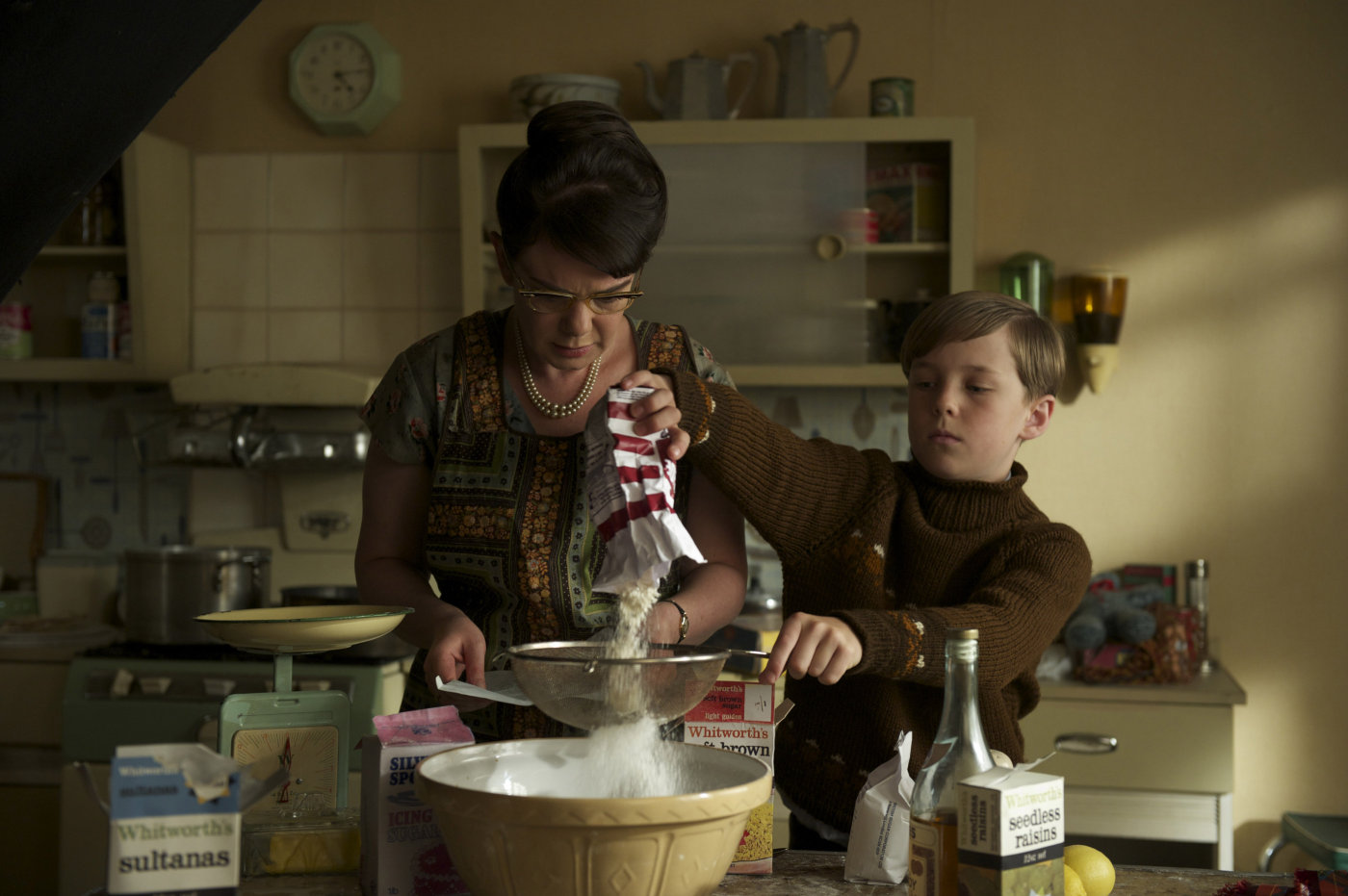
Toast is a joy that gives Helena Bonham Carter yet another plum role, which she goes at with gusto (what a versatile actress she is!). Ditto, Freddie Highmore (above and below, with dessert) and Oscar Kennedy, who play our hero, respectively, as a young man and young boy. In telling the tale of the coming-of-age of Nigel Slater, on whose memoir the film is based, director S.J. Clarkson, shown at right, gets just about everything right, leaving you on a kind of cloud nine that is leavened with a profound, alternately sad and joyful, understanding of how the world (well, sometimes) works.

One of the great strengths of the movie is that our hero, Mr. Slater, comes off as anything but heroic throughout the film. He must deal with a dysfunctional family, but one that is dysfunctional in very odd ways that leave him ill-equipped to handle most anything -- as a child or as a young adult. When Ms Bonham Carter is introduced as the not-really-that-wicked stepmother-to-be, she comes off as a woman simply putting her own welfare first but trying to be as fair as she can. That young Slater will have none of it, ever, makes him less sympathetic but infinitely more real.

As his distant dad, Ken Stott (above) is terrific, too, turning what could be an all too typical character into something strange, funny and little sad. The whole cast is on a par, and Lee Hall's screenplay (from Slater's memoir) seems to have chosen just the right incidents, giving them all their proper weight.

From the scenes of Nigel as a boy -- at home, cooking with mom (above) or shopping (below)

to those once Highmore takes over the role (below) and begin to discover his road in life, the movie never loses momentum.

There's a scene late in the film that I think I have never seen anything quite like -- when a character, in what seems like a single instant, discovers his sexuality, is turned on something fierce and then immediately hung out to dry.  It's an amazing few moments, and like so much in this fine, funny, intelligent film, leaves you, as it leaves the character, initially annoyed -- then wistful, thoughtful and maybe just a little bit more determined to succeed.

Toast, from W2 Media, opens this Friday, September 23, in New York City at the Angelika Film Center and at Cinemas 1,2,3.  Click here to see further playdates -- with cities and theaters -- all across the country.

Tuesday, September 20, 2011

Andrew Haigh's WEEKEND finally arrives, trailing beaucoup press and awards....

...which are, for the most part, deserved. It's been awhile since any movie showed us a relationship-in-the-making with such finesse and acuity. Before Sunrise, as has been noted elsewhere, comes to mind. Both films rely heavily on dialog, on the chemistry between the two lead performers, and on the filmmaker's ability to capture the parry/feint/thrust that goes on actively (or passively) in most burgeoning relationships.

Andrew Haigh, the filmmaker of WEEKEND (shown at right: he wrote, directed and edited the movie) has done a splendid job of  this, coaxing two tremendously real performances (or maybe he simply allowed his two leading actors to "be") that are spot-on for the film's entire 96 minutes. The movie has the look and feel of improvisa-tion yet the writing is full of smart, quick, well-chosen dialog that helps create character, even as it advances the plot (such as it is) and fills us in on people, place, time frame, history, the lot.

Oh, yes -- and our two protagonists are men: Russel (Tom Cullen, above, left) and Glen (Chris New, right). So this year's top "relationship" movie thus far is, ummm, about gays. Because of the skill with which Mr. Haigh has guided his film and brought it home, it is easy to understand what all the advance press and praise is about. And the film will certainly play well to intelligent gay audiences. It might also play as well to straight audiences -- if they will let it. I suspect not, but still, we must live in hope.

In passing, and via that very real dialog, we learn in what profession each man is employed, that Russel is still semi-closeted, while Glen is anything but, and that, as the relationship begins to build, how the two alternate places in the catbird seat. I do wish I could have understood more of that dialog, however. Because of the accents (Cullen hails from Wales and New from Britain), I missed a certain amount and so will rent the DVD when it appears and hope for English subtitles.

If there is to be any fault leveled against the film, it might be that it is so very small. But that, according to filmmaker, is what he wanted: " to explore some of the more subtle aspects of the gay experience, especially how people deal with the weight of being different and the choices they make because of it."  In this, Haigh has succeeded in spades: Why, perhaps, Russell (above) works as life guard or Glen (below) feels the need to be always so quick on the trigger.

Most of all, I believe, we learn what these men are afraid of, and -- even more haltingly -- what they want. The movie gets as close as anything I have seen to the heart of commitment, as well as to our innate fear of this. The final scene between Russell and Glen is extraordinary, and Haigh's ending is a real achievement. I could go on, but you need to see Weekend (forget the old Godard movie; there's no connection) as soon as you can, before you hear too much and either expect too much or have certain scenes spoiled.

The movie, from Sundance Selects, opens this Friday, September 23, in New York City at IFC Center -- with a national rollout to follow. Click here and then scroll to the right to see upcoming release dates, cities and theaters.

All photos are from the film itself, except that of Mr. Haigh which comes courtesy of indieWIRE and was taken by Brian Brooks.

Sunday, September 18, 2011

Rupam Sarmah's IN SEARCH OF GOD: a kind of religious-style 60-minute gourmet

Among the stranger theatrical releases in recent weeks (years?), IN SEARCH OF GOD -- a 60-minute documentary conceived and directed by Rupam Sarmahshown below, that has television written all over it (at least via its minimal running time) -- purports to show us the spiritual journey taken its protagonist, Kavita, an American girl of East Indian descent, from the depths of atavistic materialism into the realm of spirituality and god.

That our young lady looks (below) and sounds like the very personification of an East Indian "Valley Girl" adds immeasurably to the unintentional humor of the film. When she arrives in India, she gasps, "It's so beautiful!" in near-perfect Valley Girl intonation. Halfway through the film, after her consciousness has been considerably raised and upon visiting a new location, "It's so beautiful here!" she gasps again. Truthfully, either place sure beats out the scene of her strutting along the streets of Hollywood, as photographed in her more materialistic incarnation, below.

Though you may initially wonder if this whole thing is a joke or maybe a put-on, as the film progresses, it becomes clear that it is not. In Search of God may be a kind of "How I Spent My Summer Vacation" for would-be acolytes of eastern philosophy and religion, but it is serious. Or means to be. As Kavita wends her way around India, she hooks up with a young monk named Ram ("He's a lot cuter than most monks," she explains to us), who guides her from tribal villages to temples, dance and theater concerts to a crazy/holy man who lives, it is said, upon air (below).

In one of Kavita's more cogent moments, she tells us that this fellow's life style seems a bit extreme but that his words make sense. We watch as some cross-dressing monks perform an interesting dance, and later we visit an artist who creates fascinating masks and puppet-like characters (below). Then comes a museum tour in which Ram explains various objects. All along the way, with everything reduced to a kind of eastern-tinged sound bite, the philosophy (which may be true for all I know) still comes across as cheapjack. (The question, What is the purpose of life is actually asked here, and an answer given! Sorry: no spoilers.)

We get a gander at Gandhi (below), and eventually we visit Ram's home town and meet three generations: child, adult and senior. At one point along the way, a dog wanders into the camera frame and, for a moment, we get the kind of reality missing elsewhere. And although the movie and its spiritual seers keep making a point of how bonded all major religions are to each other in their final goal (it's just the pathway that differs), it may still come as some-thing of a shock to viewers later in the movie to hear one fellow tell us, "If you choose the right path , you go to heaven. If you don't, you go to hell." Really? And what religion is that, pray tell?

Finally all of this seems beside the point. The real question concerns Kavita's journey and change. Who is/was this girl? We really never know. And why is her story any better or more interesting than that of so many others who have journeyed to India for enlightenment? Truth be told, it is not. It's just another tale of faith pricked into some kind of consciousness. And faith, as we should know by now, is an awfully personal (maybe even private) thing on which to hang an hour-long movie full of the kind of heavy-duty philosophy and questioning that have plagued mankind of centuries.

The movie, if it works at all, might be best shown (and probably will be) as a training/propaganda film for possible converts. In Search of God, distributed by RJ International, opens this coming Friday, September 23, for a week's run at the IFC Center inNew York City and at Laemmle's Sunset 5 in Los Angeles.

Saturday, September 17, 2011

A don't-miss DVD: Jeff Shelove's & Michael Jaeger's THE BEST AND THE BRIGHTEST


TrustMovies is older by far than the director (Jeff Shelove) and co-writers (Shelove and Michael Jaeger) and so his first reaction to the title of their movie THE BEST AND THE BRIGHTEST of course goes back to the book of the same name by David Halberstam about the group of pompous twits who dug this country's grave in Vietnam. Once I got past that snafu and into their movie itself, I and my (we-don't-always-agree) companion were laughing our heads off at this very funny and very overlooked movie about the ins and outs of getting your child into one of Manhattan's better private schools.

The upwardly mobile young couple who arrives in NYC from Delaware, along with their apparently bright young daughter, have no idea that they can't simply apply to one of these schools and eventually have their daughter enrolled. When mom (a delightful and believable Bonnie Sommerville, above) shows up with kid in tow to one of the early meetings, she notices an entire pew of pregnant mothers, hoping for a spot for their not-even-born-yet offspring. She's aghast. We should be, too. This is crazy, stupid. But that's life in New York's fast lane.

It's at this moment that the movie's path becomes clear: anything goes. Nothing the filmmakers (shown above, with co-writer Jaeger on the left) can shovel at us could possibly be crazier or stupider than this single quiet little scene in which these pregnant moms are told that only half of their unborns can be admitted. So shovel, they do -- coming up with an utterly crazy but very funny farce about power, politics, and scratching each other's back that is as amusingly on-target as it is dirty (the film's "R" ratign is richly deserved). And yet, as dirty as it is, never once does it manage to cross line that separates -- no, not good taste from bad, but the line of demarcation between good and bad entertainment. The Best and the Brightest is pure gold: a looney-tunes lark about how to get around the power-brokers in the big city. (That's Christopher McDonald, below, left, as the movie's Mr. Big.)
 
 On the DVD commentary track -- a good one -- the filmmakers note that they were trying to come up with a farce like their favorites: Tootsie and A Fish Called Wanda. While this movie reminded me of neither, it works just fine on its own. Starting with its protagonists' genuine "need," then slipping slowly into crazier and crazier ways in which to see that this need is satisfied, the film grows funnier and nuttier as it moves along.

Starting out with one of the wittier jokes in quite awhile (about a man's wish that his child grow up to see... no spoilers here), the movie then goes on to tackle poetry (what it is and who can do it), fidelity, friendship, politics, high-rolling bankers and lots more. The scenes in which the poetry surfaces, one funnier than the next, involves everyone from the admissions officer of the school (the terrific Jenna Stern, above) to various board members, each with his own agenda. The funniest (member and agenda) belongs to actor John Hodgman, below, who is simply hilarious as the bow-tied Henry, explaining self-abnegation and the need for golden showers to his peers.

How "Poetry" is used and abused may bring to mind modern artists such as Andy Warhol -- who, while he taught us to view art differently, still managed in the process to create little of lasting value (except, of course, dollar-wise and investment-wise). Shelove and Jaeger's movie makes good, honest, dirty fun of eveything from art to faux Gucci, bankers to politicos.  Mr. Big's wife, played with fierce finesse by Kate Mulgrew (below, right) is one of those politicos, and her deeply cynical attitude is held up to scrutiny quite well here. Her campaign poster, never commented upon but seen in plain view behind the actors in the film's climactic scene, is simply a hoot that grows funnier each time Mulgrew contradicts its sentimental image.

Yes, that Neil Patrick Harris is the still, above, left. He plays the Delaware dad, the movie's "straight man" and sudden poet to whom everything happens. At one point Harris tells his wife, "I'm getting better," and indeed he is. He nails this role with complete aplomb, as the lynch pin around which the whole ensemble circles.

That ensemble, which could hardly be better, also includes Amy Sedaris (above, right) in what may be her best movie role yet, as the "enabler" who helps parents get their kids into these schools; Peter Serafinowicz, as the Harris' old but none-too-reliable best friend; and Bridget Regan, below, as an old high-school flame hoping for a rekindle.

I haven't enjoyed a comedy as much as this one since  Women in Trouble, Electra Luxx or Kaboom. If it's a goofy good time you're looking for, I can't see how you'd go wrong here. Why the review in The New York Times was so utterly demeaning, I will never understand.  It's as though that reviewer witnessed an entirely other movie from the one we laughed our heads off viewing.

In any case, The Best and the Brightest is available now for sale or rental from the usual suspects.