Tuesday, January 24, 2012

Valérie Donzelli's and Jérémie Elkaïm's DECLARATION OF WAR -- France's submission for "Oscar" bait -- opens


How odd -- and a little unsettling -- to have found nearly irresistible the first feature film by up-and-coming French movie-maker Valérie Donzelli (that was The Queen of Hearts [La reine des pommes] shown at last year's Rendez-vous With French Cinema--my review is here; click and scroll down) and now to find myself so heavily resisting her second feature work, DECLARATION OF WAR, a film that proved much more popular than her first in her native France. (So popular in fact, that it became France's submission for this year's Best Foreign Language Film, though it made neither the final nominations nor even the short list).

Since first viewing Declaration of War a couple of months back, I've been asking myself why I could so easily resist it, and I think I understand at least some of the reasons. Fortunately (or maybe not), most viewers will not be in my shoes, for they will not have had the opportunity to see The Queen of Hearts. (Though I hope they do, as it is delightful and original.) Ms Donizelli's style (the filmmaker is shown above) in both movies -- hectic, quirky and extremely self-involved -- is quite unusual, and I found this worked exceptionally well for the first film (a rom-com with enormous psychological smarts) and much less so in this new film, which details a pair of young parents whose child develops a life-threatening illness.

Donizelli and Jérémie Elkaïm (above, right, who co-wrote and co-stars in the film) -- are (or were) real-life partners who, we are told, went through an experience quite similar to the parents in the film. Initially Donzelli locks you into things via fast pacing and plenty of incident. I wonder, though, if the couple could have been quite so frenetic and ever on-the-move.

From the super-cute names the pair give themselves (he's Romeo and she's, you got it) to the soundtrack that never shuts up to the super-energetic non-stop movement of the actors and editing, the movie soon begin to seem a little -- no, a lot -- overboard and cute. Eventually, I swear, it could further curdle your buttermilk.

The filmmakers are quite right in their insistence that the movie be about the parents. It is their responsibility, after all, to see that their child survives. The kid himself, at his young age, can do little more than look sweet and get our sympathy. Yet I think Donzelli and Elkaïm mis-step by concentrating so thoroughly and heavily on themselves and their quirks. After a time, they seem to be, above all, prime narcissists.

The two leads are certainly up to snuff with their energy, and their supporting cast  -- which includes some fine French actors like Frédéric Pierrot, Anne Le Ny, Brigitte Sy and Elina Löwensohn (the latter's actually Romanian) -- does a great job with barely sketched-in roles.

Voice-over, slow-motion, a musical number and more -- Donizelli has packed it all in, and while some of this indeed works, it is finally too much. For me, anyway. You might have quite a different opinion. And since, at this point, I don't know that America will ever get to view The Queen of Hearts, I hope you do see Declaration of War. At the very least Donizelli's style, I think, is sure to seem unique.

The film, from Sundance Selects, opens this Friday, January 27, in New York (at the Lincoln Plaza Cinema and the IFC Center), San Francisco (good luck trying to search the web for the specific theater!) and Los Angeles (at Landmark's Nuart Theatre) -- followed by a national rollout beginning on Friday, February 3, which also marks the day the film will be available nationwide via Video On Demand.

Monday, January 23, 2012

Eric Schaeffer's AFTER FALL, WINTER probes pain, death, love and relationships

AFTER FALL, WINTER opens in Paris with a scene of a sick, maybe dying woman, who says to the man caring for her, "Call Sophie." He does. Turns out Sophie is a beautiful young caregiver-to-the-dying, and as the phone conversation proceeds, we get one whopper of a surprise which, if it doesn't immediately glue you to this film, you had better check your pulse. The movie then cuts to New York City, where our hero, Michael, played by Eric Schaeffer (shown below) who also wrote, produced and directed the movie, is having a very bad time.

Michael's latest book can't find a publisher, the guy just sold his NYC co-op at a huge loss, he's moved into a crummy third-world apart-ment, and he's over $600,000 in debt. (But is he happy?) So, when a good friend calls him from Paris and suggests he come visit for awhile, why not? As you might surmise, Sophie and Michael are going to get together. How they do and what happens makes up the meat of the movie (and an exceedingly meaty one it is).

Since 1993 Mr. Schaeffer has made eight full-length films, beginning with his debut effort, the OK-ish, sort-of-real-life comedy about trying to make a movie entitled My Life's in Turnaround. He followed this with the rom-com When Lucy Fell (featuring his starriest cast -- before they were stars), and then the darker Fall, followed by Wirey Spindell -- his exploration of bi-sexuality and romance as an adult and youngster. Then came the Jill Clayburgh/Jeffrey Tambor older-folk rom-com Never Again, and his ensemble rom-com-dram Mind the Gap, and then the follow-up to his first film, this time called They're Out of the Business.

For me, Schaeffer's movies have always been up-and-down affairs, promising more than they delivered. When I say that this is also true for his newest film, I must add that After Fall, Winter is far and away his best work, an often brilliant exploration of modern love-and-need that goes deeply into territory that is primal -- sex, love, pain, death -- and more often than not does that territory full justice. His dialog is real, witty, amusing, and deeply felt. And his situations, as bizarre as they sometimes are, work surprisingly well.

Performances are excellent all-round, with his luminous leading lady -- Lizzie Brocheré (above and below) in her first mostly-English-language performance, proving herself once again an actress of immense talent and beauty. Seen six years ago in the 2006 fraught, French teen-age transgression One to Another (her character here, Sophie, could almost be seen as the outcome of her character Lucie in that earlier film), Ms Brocheré was also first-rate in The Wedding Song (2008). The chemistry between the two leads is simply terrific, whether they are circling each other warily, bonding, spatting or screwing.

I've mentioned the word pain twice already, but I hesitate to go into detail for fear of spoiling things. As a filmmaker, and I suspect as a human being, Mr. Schaeffer wants us to refrain from judging his characters -- any of them. To that end he has arrayed before us their best and their worst qualities (and a lot in between). We're privy to some pretty awful stuff here, and to his credit the filmmaker lets us understand it better than almost any other movie I can think of that dares to go where this one does. From the gypsies to the mistresses of pain, the movie makes us understand things from a very different perspective than we are used to.

Schaeffer continues to learn about film-making technique, as well. After Fall, Winter is certainly his most beautiful movie to date. By using those spectacular Paris locations -- even the deserted warehouses look good -- perhaps this was not so very difficult to achieve. In any case, bravo.

But now: about the ending that Mr. Schaeffer has contrived. By the time we arrive there -- there may be a spoiler ahead -- the filmmaker has taken his story to a crescendo of drama and suspense. He has also painted his "hero" into the kind of corner from which there would appear to be little escape (his heroine perhaps even more so). When I say that we are in Romeo and Juliet territory, I mean it in both a good and bad way. How you'll react to the finale is anyone's guess. But just try to remember all the great stuff that has come before.

After Fall, Winter opens this Friday, January 27, in New York City at the Quad Cinema. Digital distributor FilmBuff (created in 2008) is releasing the film on VOD and Cable on January 31st. The film  will play at the Quad through next week, at the Cinekink Film Festival at the Anthology Film Archives on February 8, and at the FACETS CINÉMATHÈQUE in Chicago on February 27. Any DVD release is not yet confirmed.

Sunday, January 22, 2012

Norbert López Armado's & Carlos Carcas' architecture doc opens: HOW MUCH DOES YOUR BUILDING WEIGH, MR FOSTER?

Architects are more and more in the movies these days. Over the past few years, we've had the likes of Louis Kahn, Frank Gehry (and why isn't the Gehry film listed on the IMDB or as part of the oeuvre of its director Sydney Pollack?) and Charles Eames getting their very own movie (though Chas had to share his with wife Ray). Now comes Sir Norman Foster, a knight of the British realm, whose name is new to me -- clearly, TrustMovies doesn't follow architecture: at least, not until a movie is made about that architect -- but whose work, when you see it all together as you do here, is pretty damned impressive.

Filmmakers Norberto López Amado and Carlos Carcas (shown above, with Señor Carcas on the right) have put together a relatively short but slick and quite enjoyable documentary, HOW MUCH DOES YOUR BUILDING WEIGHT, MR. FOSTER?, about the man, his history and work to date, which takes in an enormous array of projects -- office buildings to airports to bridges -- worldwide.

Beginning with (and repeating again at nearly the end) a group of skiers, Foster among them, the movie shows us why this odd skiing event takes on rather incredible meaning, once we have gotten to know the man and his mission for himself and his buildings. Mr. Foster (above) is one of those rare British birds who have managed to escape their "class" and rise to the pinnacle of their field -- no mean feat for a lower-middle-class boy who loved everything "airplane" but who managed to become one of the word's great architects rather than an airline pilot (though he does, now, pilot his own plane).

López Armado and Carcas connect some of the larger dots along Foster's route to stardom (how he came to apply for architecture school in Manchester, England, eventually ending up here in the U.S. at Yale University) but spend even more time showing us his generally wonderful work (one of which, the Swiss Re Building, is above), explaining with brevity and fine visuals, why it's so important. (The end credits give a helpful listing of each building shown -- under an even more helpful heading of the country in which each has been built.)

Along the way, we see and/or hear from an interesting array of other architects and personages -- the ubiquitous Bono, Buckminster Fuller (who is responsible for the film's somewhat bizarre title), Richard Rogers (Foster's former partner, above, and no, not the late Broadway composer), Paul Goldberger (who has called Foster the "Mozart of modernism") and artist/sculptor Richard Serra, among them.

But mostly, it's the building (above), the bridge (below), the airport (two photos down) -- what they are, where they are, and how they came about -- that count. As befits Foster's work and career, the film seems more than a little international. (In these difficult financial times, "Building a global practice is the key to survival," the architect notes.) Certainly his largest and most spectacular edifice is the airport in China, but Great Britain's Sainsbury Centre for Visual Arts or that HSBC bank in Hong Kong (in its time, the most expensive building in the world, and one that nearly bankrupted Foster's business) are pretty special, too.

From almost the first, Foster has been concerned with the environment, building the first British hi-tech office building, and using 20 per cent less steel -- most of it recycled steel, at that. These days the fellow is working on creating the first carbon neutral city in the world. A dream? Maybe. Certainly a wake-up call. And if anyone might do it, it's this guy.

The film has been written and narrated (the latter quite well, in a quiet, almost whispered voice, as though some important secrets will be revealed -- which perhaps they are) by Deyan Sudjic. In addition to its Spanish co-directors, there are some estimable members of the Spanish film and television community associated with its production: Joan Valent (composer), Imanol Uribe (associate producer, and a fine director in his own right) and Elena Ochoa (who these days doubles as Mrs. Foster).

Oddly, it's the Foster building closest to me that I find the least impressive (and only from a exterior, visual aspect): that very modern tower atop the old Hearst Building at Eight Avenue and 56th Street in Man-hattan (shown at right). I've only been in it once or twice and can't vouch for what it's like to work in, but visually, from the exterior view, it does not at all fit into its surrounding environment and so stands out like the proverbial sore thumb. The AOL-Time Warner building just a couple of blocks away, on the other hand, works better -- if only by virtue of being able to dwarf everything around it into de-sign submission. However, as befits Foster's insistence on "green" architecture, the Hearst Tower is the first office building in NYC to receive a Gold LEED rating from the US Green Building Council, and so, environmentally speaking, it is way ahead of the game.

How Much Does Your Building Weigh, Mr. Foster?, yet another fine documentary from First Run Features, will open this Wednesday, January 25, in New York City at the IFC Center, having already played Chicago, Boston, Seattle, San Francisco and Cary, North Carolina.  Click here for all currently scheduled upcoming playdates.

All photos are from the film itself except those of the directors, courtesy of the San Sebastian International Film Festival
and of Richard Rogers, which is by Andrew Zuckerman
and Hearst Tower, cribbed from the web.

Saturday, January 21, 2012

Korean Cultural Service hosts free series of films by up-and-coming filmmaker Jang Hun

NEW YORK CITY -- The Korean Cultural Service's 2012 film series began last week at New York City's Tribeca Cinemas, with the East Coast premiere of Korea's submission to this year's Academy Awards, The Front Line on January 10th and will continue, with a movie shown every other Tuesday night at 7pm, through February 28.  (This Tuesday's movie is Rough Cut -- see below.) All screenings are free and open to the public -- a situation that TrustMovies dearly loves -- and this initial series is dedicated to the work of up-and-coming Korean filmmaker Jang Hun (it's titled, poetically, Jang Hun Plus One). Details are listed below:

Korean Movie Nights at Tribeca Cinemas
from January 10, 2012 - ­ February 28, 2012
Courtesy of the Korean Cultural Service

Screenings take place every other Tuesday @ 7:00PM
Tribeca Cinemas, 54 Varick Street, Manhattan
(on the corner of Canal Street, one block from the A, C, E, and 1 train Canal Street stops)

Admission is free, but all seating is first-come, first served. Doors open at 6:30PM -- so arrive early!

Series One: Jang Hun plus one!

Starting out as an assistant director to Kim Ki-Duk, with his first film, Rough Cut, Jang Hun (shown at right) is said to have established himself as Korea's answer to Steven Soderbergh: a director making big budget movies with an independent sensibility. Three of the films shown in this series -- Rough Cut, Secret Reunion, and The Front Line -- have all become massive South Korean box office hits without making compromises or talking down to their audiences. The series will be rounded out with the North American premiere of a film that's in a similar genre as Jang's but directed by Park Shin-woo: White Night.

Tuesday, January 10 @ 7PM 
THE FRONT LINE (East Coast Premiere, 2011) 

(Yes: this screening has concluded but the film itself just opened and so can still be seen)

One of the biggest Korean hits of 2011, The Front Line is the simple story of a hill: Aerok Hill, a small rise on the Eastern Front of the Korean War that changed hands 30 times over 18 months of fighting. A military investigator is dispatched to see if allegations that the South Korean soldiers tasked with taking the hill are collabora-ting with their North Korean enemies to deliver letters to their families. It turns out that they are, and that's the least of it. A movie about men (and some women) trying to hold onto their humanity in the midst of war, The Front Line is Korea's official submission to this year's Academy Awards. The film opened this past Friday, January 20, in New York City at the AMC Empire 25 and in New Jersey at the AMC Loews Ridgefield Park 12, and in Los Angeles at the CGV Cinemas and in Monterrey Park the AMC Atlantic Times Square 14.


Tuesday, January 24 @ 7PM
ROUGH CUT (2008)
Kim Ki-Duk wrote this wonderfully high-concept (Asian-Mafia-meets-moviemakers) genre-mash-up that's part thriller, part love story, part identity-changer.  It concerns a spoiled actor, famous for playing gangsters, who, for reasons that make excellent sense when you see the film, hires a real-life gangster to appear in his new movie. Filmmaker Jang probes personality, how we see ourselves, and how others see us -- while layering his movie with humor, anger, social comment and fights aplenty. 

"Acting" (indeed the whole moviemaking process) gets a good going-over, and both leading men -- So Ji-Sub as the gangster (above, right) and Kang Ji-Hwan as the actor (above, left) -- are gorgeous, sexy and charismatic. This is probably as good an introduction to Jang's work as any, so if you're interested and live in the Tri-State area, try not to miss it.


Tuesday, February 15 @ 7PM
SECRET REUNION (2010)
TrustMovies hasn't seen this one yet, so the below is what the film's publicist has to say about it:  I'll post my own thoughts here, just as soon as I've had time to watch  the screener....  

Two of Korea's best actors face off in this blockbuster action flick that manages to be sly, subversive and really funny while delivering white knuckle thrills. Song Kang-Ho (The Host) is a South Korean secret agent who fumbles a sting operation on a North Korean spy. Pop star Gang Dong-Won (Haunters) is the North Korean assassin who has been embedded in the South. After the botched operation, both men are cut loose by their respective agencies and Song becomes a private eye, while Gang sinks into deep cover, trying to survive long enough to go home. Years later, they cross paths and what audiences are treated to is a buddy movie to end all buddy movies.


Tuesday, February 28 @ 7PM
WHITE NIGHT (North American Premiere, 2009) 
TrustMovies hasn't seen this one yet, so the below is what the film's publicist has to say about it:  I'll post my own thoughts here, just as soon as I've had time to watch  the screener.... 

White Night is a sprawling, evil epic about an unsolved crime that happened 14 years previously that has spilled its poison out over the subsequent years. Based on a best-selling Japanese novel, and featuring a riveting performance by Ko Soo, star of The Front Line, director Park Shin-Woo turns this movie into a slick, beautifully realized film about true evil, as a detective refuses to let go of this single case, instead insisting on following its threads for years no matter where they lead. And where they lead is dark and truly shocking. This hit film has been called the best Korean film of 2009 by several critics and once you've seen it, it's hard to forget.


Currently, only The Front Line is viewable anywhere except this Korean festival, though both Rough Cut and Secret Reunion can be saved to your Netflix queue (whether "saving" on Netflix means eventually "getting" is debatable these days). White Night is available nowhere on DVD (in a North American NTSC version) that I could find, but maybe, after this premiere screening, some company will get wise and pick it up.

DVD surprise: J. Singleton's ABDUCTION is not the worst movie of your year/lifetime

So what's with the near-zero score that ABDUCTION rates on Rotten Tomatoes? (Only four critics out of nearly 100 had anything good to say about it.)

TrustMovies is not necessarily going to recommend it, either. He only watched it because Blockbuster, in its usual obtuse fashion, neglected to stock Dirty Girl this week, so there was practically nothing new to take out of the local store. (Yes, TM has gone back to BB, after receiving a free month during which the company promised to show him how much better its "Total Access" program is now than when it first began trying to compete with Netflix some years back. How's it doing? Not so well, but more on this later.)

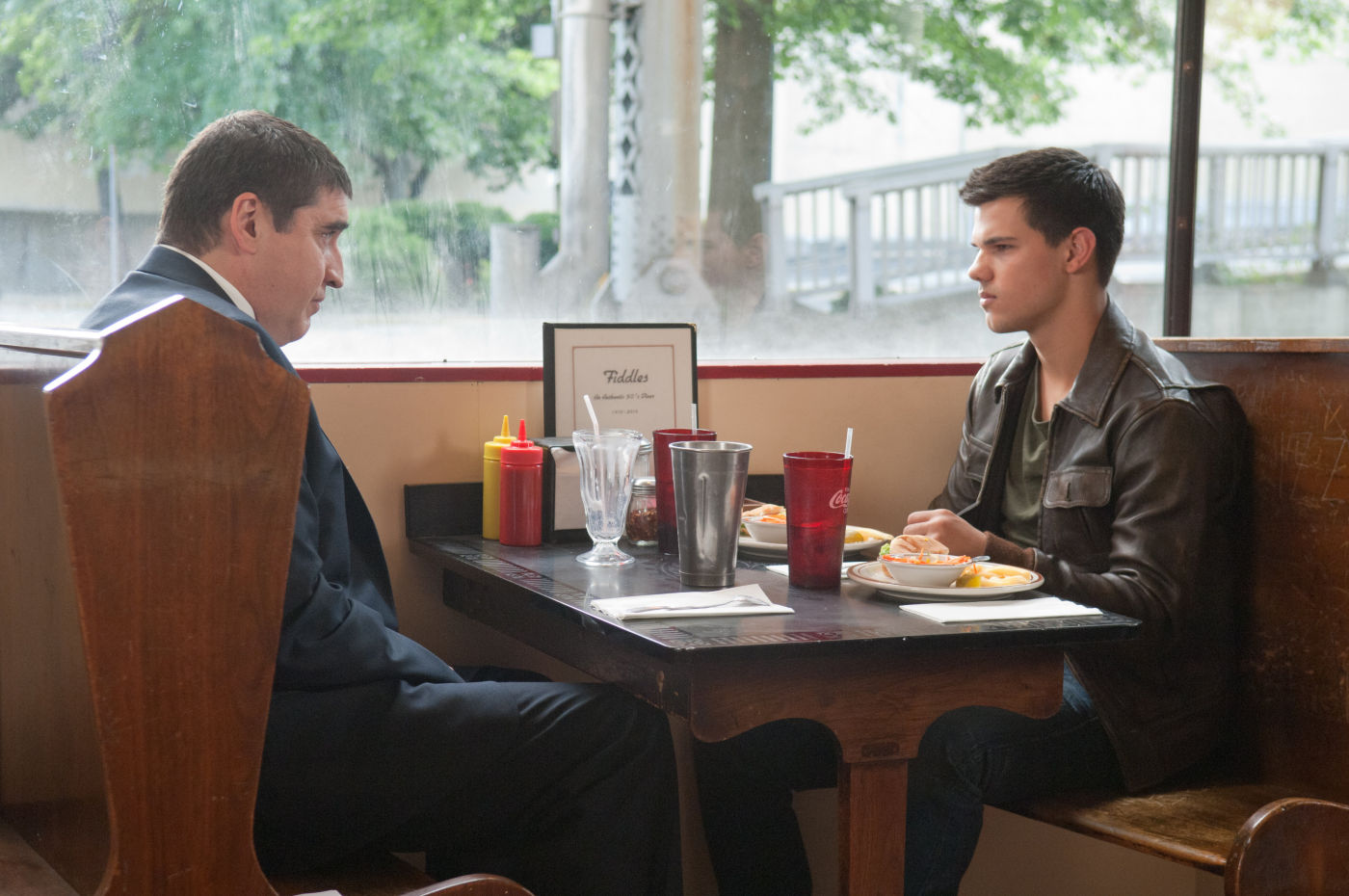
Meanwhile, back to the movie that was to launch Taylor Lautner's post-Twilight-franchise career. Abduction is slick, shiny, silly, by-the-numbers, fast-moving fun -- boasting  a cast of supporting players much better than it has any right to possess. Isn't that Maria Bello (above)? Yes, and there's Jason Issacs, too (below).


And oh, my: Signorney Weaver (shown at right), Alfred Molina (at bottom, left) and Michael Nyqvist (the hero of the original Girl With the Dragon Tattoo, though, here, he's something less of a good guy).  Really now -- how bad can watching these people be? Not bad at all, once you realize how by-the-book this enterprise is. Then you can sit back, relax and enjoy the "moments."  And there are a number of fun ones.

My point is, should there be a teenage family member dead set on seeing this movie, don't worry: You can have a good time, too. Enjoy the slickness of the look and the fast pacing that director John Singleton, shown at left, provides (for my money this one's the most fun he's given us since his Shaft remake). Savor the little moments the keep happening when high school kids try to look and act like action/
adventure stars. That's what makes the movie both silly and a little endearing.

The two ostensible leads, Lautner (above, left) and Lilly Collins (above, right), are good-looking youngsters who may someday impress us. For now, they're serviceable but little more, and their would-be love-scene in the compartment of a fast-moving train is a real hoot. These kids strike love-making postures/poses they've clearly seen adult actors handle with aplomb, but when they do it, it's closer to funny. (Not to worry, parents: The two stop before anything untoward happens -- which is itself not particularly believable).

Much of what makes the movie watchable is its sense of kids out of their element and over their heads into everything from espionage to murder, car chases and sex. At one point, their friend Gilly, nicely played by Denzel Whitaker (above, right), asks if these two on the run will be all right, and Ms Collins simply crosses her fingers, as if begging heaven for some good luck. Very childlike, very sweet. It turns out that playing at being grown-ups can still be fun.

Abduction, from Lionsgate, is available now, on Blu-ray or DVD, for sale or rental.

Friday, January 20, 2012

2nd annual MyFrenchFilmFestival.com has smart art/mainstream movies & nice price

It's back -- and it's better than ever ("ever" being its first appearance last year). MyFrenchFilmFestival.com is the brainchild of UniFrance, Allocine & its partners, who are currently bringing much of the world some of the sharpest French films from the past couple of years, which you can watch via computer or TV monitor -- if you've got the hardware for such a set-up. In French, of course, but with subtitles in the language of the country in which it is being shown, each feature-length movie in the 12-film feature series (there are also 11 short films you can view) costs less than $3 when viewed individually. You can get the entire 23-film series for less than one buck a shot (only $21.11 for the whole shebang). This has got to the be one of the best deals of the year for film buffs, particularly those with a Francophile streak.

Whoops --did I say 23 films? For U.S. audiences, there are only 22, because one of the best of the bunch -- Valérie Donzelli's The Queen of Hearts (La reine des pommes) has not been licensed for U.S. rights.  I hope this means that some distributor has picked the film up for U.S. distribution because it is a prime example of what the French do best: rom-coms based in psychological and other real-world truths, done with style to spare. The film -- that's Donzelli and her co-star Jérémie Elkaïm, above -- was first shown here in last year's Rendez-vous with French Cinema but has not been seen in New York since then, and it ought to be because it is even better than Donzelli's about-to-break Declaration of War, which was France's selection for this years Best Foreign-Language Film award (but did not make even the shortlist). I'll have more to say about her new film next week.

Other worthwhile films from this year's group include 8 Times Up (8 Fois Debout, above), Love Like Poison (Un poison violent, below) and Living on Love Alone (D'amour et d'eau fraîche, at bottom of post). For a capsule review of each, click on the title links just above, then scroll down until you hit the film.

This year's festival began over a week ago, but I was not informed of it until just recently, so I apologize for the late post. There are a number of other good movies on the program which I'll hope to see -- and hope that you will, too. Meanwhile, click here to view the entire schedule and to order films.