Thursday, September 25, 2014

Matthew Warchus/Stephen Beresford's PRIDE; New GLBM film will set audiences to cheering


What -- you haven't heard of the GLBM movement (and no, it's not of the 'bowel' sort)? GLBM stands for Gays, Lesbians and British Miners, and if there's one movie that folk will remember as best representing the Margaret Thatcher era in Britain, it's likely to be PRIDE, in place of that 2011 bio-pic, The Iron Lady.

The product of screenwriter Stephen Beresford (shown at right), director Matthew Warchus (below, left) and a simply splendid cast of British film and stage royalty plus a handful of fine newcomers, Pride is indeed, as the poster tells us, based on an inspirational true story. But thank god Beresford and Warchus conspired not to inundate us with the triumph of the human spirit, but rather give us incredibly spirited, funny, moving and
absolutely real characters, whom their gifted cast bring to soaring life. It is one after another of these rich and memorable people whom you're likely to remember, for at least as long as you're able to watch and appreciate the kind of movies that say something important -- and say it so vitally well that the message and its messengers become one joyful delight. Pride is the kind of popular masterpiece we rarely experience in cinema.

Where gay and lesbian movies are concerned, I have often claimed that they are far too insular, concentrating on GLBT issues at the expense of reaching out to and addressing the wider world. This ability is exactly what sets Pride apart from the pack -- that, and the filmmmakers' grasp of how important is real and rounded characterization.

Not that Pride slights gay issues: It tackles everything from love and relationships to equality and prejudice, the experience of coming out and, of course, AIDS -- all hot-button subjects back in the 80s (and to a large extent remaining so today).

The movie tells of an incident during the Thatcher reign in which a gay and lesbian group (we hadn't widened at that point to include bisexuals and the transgendered), pushed hard by its leader, Mark (a benchmark performance from young actor, Ben Schnetzer, above right) to start raising funds for the beleaguered miners -- even though, as Ben readily admits, "these are the guys whose kids used to beat us up in school."

The movie is honest about how difficult it was to build gay support for this endeavor, not to mention the further and greater difficulty from the miners themselves, who didn't want to accept contributions from this "outsider" group. What happens and how it changes attitudes and minds becomes the heart of the movie -- and what a big-hearted film this is. (My companion for the evening, one of the more cynical gays I know, went into the screening with a very large chip on his shoulder -- he'd seen the trailer for the film, which is evidently a bit much -- but by the time he emerged from the theater, Pride had won him over completely.)

In the crack cast are leading lights like Bill Nighy (center, right, above), who gives as contained and quiet a performance as I've ever seen from this very talented man; Imelda Staunton (at left, center, dancing), as one of the women in the mining community who initially balks but whose sense of fairness is such that she simply must proceed; Paddy Considine (center, left, two photos above, also surprisingly subdued and all the more moving for it) as the miner's representative; and Dominic West (above, dancing with Ms Staunton) as the older lover of one of the younger gays, whose performance would single-handedly steal the movie were it not such a rich ensemble piece. If Mr West doesn't get an Oscar nod for his galvanizing, moving and wonderfully entertaining work here, there ain't no justice.

The younger (and/or maybe less known) set, in addition to Mr. Schnetzer, includes Jessica Gunning, as the Considine character's joyful wife; George MacKay (above, right) as the youngest gay, having the most trouble with that "closet" situation; Andrew Scott (below, extreme right in the middle row, and yes, the Moriarty of the Cumberbatch Sherlock series!), as the West character's lover. I am leaving out so many other absolutely wonderful performers because time and space won't permit, so I hope they will forgive me. There is not a ringer in the huge cast because the writer and director have seen to it that each character is given enough time, words and care to register strongly. This is a huge achievement.

So is Pride in its entirety. If there comes a better mainstream, feel-good film in which every last laugh, tear and surge of anger and/or joy is absolutely earned, then we are in for one fucking banner year at the movies.

Pride -- from CBS Films and running just under two hours -- opens this Friday, September 26, in New York City (at the AMC Lincoln Square, Regal Union Square, and BowTie Chelsea Cinemas), Los Angeles (The Landmark and the Arclight Hollywood) and in San Francisco at Landmark's Embarcadero. Don't worry: It'll hit your city soon, as well.

Wednesday, September 24, 2014

New rom-com royalty: Miles Teller & Analeigh Tipton in Max Nichols' TWO NIGHT STAND


Regenerative as all hell, that's the rom-com for you. After making a surprise comeback via last month's oddball The One I Love, here it is again in an utterly beguiling delight that makes you feel as if the genre were brand new. TWO NIGHT STAND is the work of first-time, full-length director Max Nichols (who I'm told is the son of Mike), from a screenplay by first-time screenwriter Mark Hammer. The two have struck movie gold. This is as much due to Hammer's clever writing and Nichols' deft direction (the apple has not fallen far, it seems) as to the two actors cast in the leading roles: Miles Teller (of The Spectacular Now) and Analeigh Tipton (of Damsels in Distress). It is difficult to imagine two performers with better chemistry, charm and smarts to bring these roles to life.

Mr. Nichols, shown at left, has kept this sweet and funny tale of a one-night-stand, set up via Internet, rolling along with almost indecent speed and grace. It all feels very au courant, as well, dealing with the mores of today's dating crowd -- hook-ups, easy fucks and condoms at the ever-ready. For his part, Mr. Hammer sees to it that the dialog does not simply sparkle, it's also quite in-your-face funny and real. It doesn't mince. (The movie's R-rated, though I think it's a shame that middle teens can't see it.) The two actors are able to handle that dialog with ease, while moving from anger to humor and back again (often both simultane-ously), while making inter-mediate stops, too.

There is no young actor currently working who comes close to filling Mr. Teller's shoes. This guy, above, right, and below, is really special: beefy rather than buffed  but so comfortable with his body and brain that he comes across as utterly natural and very sexy, to boot. Every moment and movement seems effortless, but then, suddenly, when effort is called for, Teller rises mightily to the occasion.

Ms Tipton, below, bounces off Teller's disposition with remarkable agility. She's cute and sexy in her own way, but her character is needier (or so it initially seems) and not nearly as secure in herself. Yet the rapport the two eventually reach is so real and earned that it keeps the audience at one with the pair every step of their journey.

The relatively simple story involves a hook-up that, due to very inclement weather, must go on, and far beyond the "thanks for the nice night" note that the Tipton character plans to leave behind. That's basically it -- for the first two-thirds of the film.

In fact, the movie seems like it might simply play as a two-hander exercise, once the characters have met -- which we wouldn't mind, given the talent of this twosome. But Hammer has a surprise or two up his screenplay's sleeve and so there's more.

Fortunately, and again, thanks to the actors involved, the movie does not degenerate. Instead it plays out to become a genuine and quite lovely rom-com -- with all that this genre requires.

In the good supporting case are Jessica Szohr (above, left) as Tipton's roommate/friend, Scott Mescudi (above, right) as their other friend, and Leven Rambin (below, right) as a special someone. I don't want to overpraise what is simply a very fine example of a popular genre movie. So just go, relax, laugh and enjoy.

Two Night Stand -- from Entertainment One and running a sleek 86 minutes -- opens this Friday, September 26, theatrically in a limited release and then hits VOD the following Friday, October 3. At which theaters in which cities? Don't know, and the film's web site page has yet to give us any of this info. Keep clicking here in the days or hours to come, and perhaps it will let us know. And even if we don't find the theater listing, we all know how to access VOD, right?

Tuesday, September 23, 2014

Ari Seth Cohen & Lina Plioplyte's ADVANCED STYLE offers the aged looking good -- if you're a fan of clownish costuming, that is...


In these cultural times of rule-by-youth (every other kind of rule is by wealth, power and Supreme Court fiat), who wouldn't welcome the opportunity to see "fashion" from another angle? The angle chosen by writer/blogger/ fashionista Ari Seth Cohen, who co-wrote this film (based upon his writing and blogging), along with its director Lina Plioplyte, is the celebration of the older female segment of our population who are, in their own way, keeping up with fashion and still looking good in their 60s, 70, 80s and -- yes, even into their 90s.

ADVANCED STYLE, the 72-minute movie made by this first-time-filmmaking pair, concentrates on a number of older women who have dedicated their remaining years to looking good, with major focus on maybe half a dozen of these. Plioplyte, shown at right, and Cohen (below) move back and forth amongst the women, letting us into their lives piecemeal, some more than others. We see them at home, negotiating the city and/or park, and spending time with their loved ones (those who still have
any left), occasionally at work (one or two of them seem to own a boutique). One svelte number (below) hangs out at Harlem's Apollo Theater, where she used to dance, and where in front of the wall/mural of photos of famous performers who have also played the Apollo, she tels us that she is now legally blind so can no longer see the faces of these people. Another oldster, hanging out in on Cape Cod, introduces us to her friend, who is having heavy-duty memory problems.

Given the ravages of old age, it's not surprising that these women might turn to fashion for relief and respite, but one does question Mr. Cohen's taste in offering up as "fashion" clothes that often look more like clown costumes than anything fashionable.

(One woman even tells us that, regarding her first date with the man with whom she's now lives, he later told her that she looked like a clown.)

Super-bright colors, odd shapes and heavy-duty make-up highlight many of these ladies. Only one of them (shown below) seems to have a penchant for darker colors, together with a classier, retiring personality.

We spend some time with this woman and her grand-daughter who, no surprise, is also interested in fashion. But then, when the group makes a trip from New York City to Hollywood to appear on Ricki Lake's TV show, even this lady manages to go a little bizarre when given the chance to "perform." Whew-- what happened to all that "class"?

A couple of our gals are indeed chosen to be part of a Lanvin campaign celebrating fashion and aging (at least I think there were two of them, although the lady in red above seems to want to keep it all to herself).

Well, that's life. And age. And fashion. I suppose. Advanced Style, given its short length, is over just around the time it begins to outstay its welcome. But one wonders: Yes, these women are certainly sweet and undoubtedly old. But are they really the best examples of fashion that Mr. Cohen could find?

The movie opens  this Friday, September 26, here in New York City at the Quad Cinema. Next week it hits Miami, and then another half-dozen cities on October 10. Come October 17, it opens at the Laemmle's Music Hall 3 in Beverly Hills. For a complete listing of screening venues and playdates, click here.

Monday, September 22, 2014

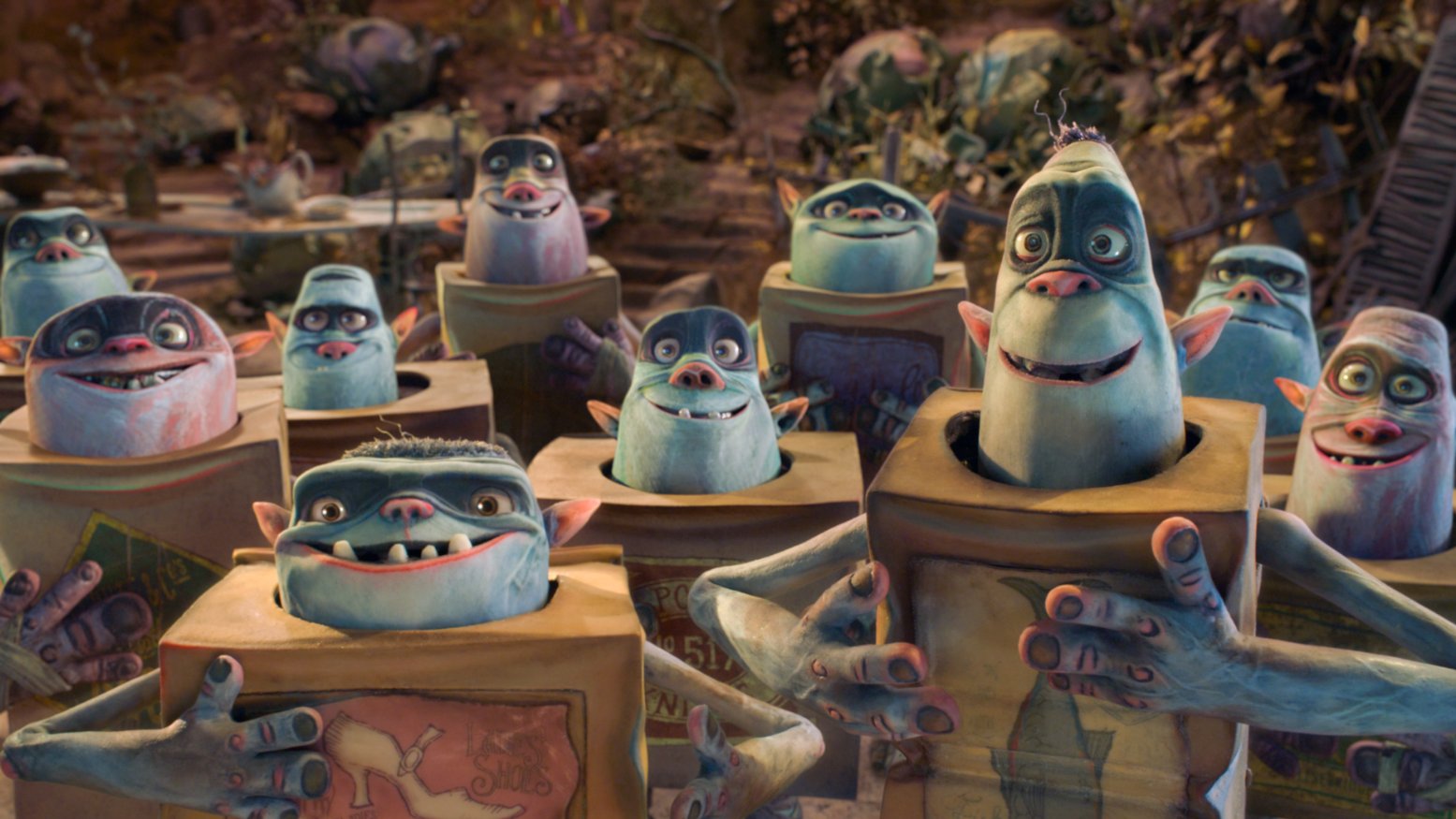
Animation heaven: Graham Annable/Anthony Stacchi's THE BOXTROLLS hits theaters


Real imagination in animation is wondrous and something we actually get all too seldom. Sure, there are plenty of OK animated films, but it takes one as rare and original as THE BOXTROLLS to point up what we've been missing. In it, the co-writers (Irene Brignull and Adam Pava, from the novel by Alan Snow titled Here Be Monsters!) and co-directors (Graham Annable and Anthony Stacchi, shown below at ComicCon, with Mr. Stacchi on the left) join forces to create a world we've never experienced -- in a style we've not seen in quite this same manner.

While the movie may remind you, stylistically at times, of both Coraline and ParaNorman, it possesses its own special look and color palette. Best of all, it creates its own place and time and then plops you down in the middle of this and almost immediately makes you feel at home as a part of it.

The story imagines a rather European city set back in time (think Louis Quinze or some such) in which the citizens are divided into the rich and poor, and in which a race of trolls have taken to living underground and hiding in boxes -- hence the movie's title. A nasty exterminator -- who has convinced the citizens that these trolls are dangerous, blood-letting monsters out to steal all their children -- has vowed to destroy the trolls.

Of course, the BoxTrolls are anything but dangerous, which we quickly learn, via our hero, Eggs, a young boy (below, right) who has been raised by the trolls (each of whom bears the name of the box or carton that he wears) and Winnie (below, left), the daughter of the town's leading citizen -- who join forces to educate the citizenry and stop the trolls' destruction.

Shot in the kind of 3D that proves less in your face than made to fill the dimensions around the nifty animation, bringing everything to gorgeous, sometimes wacky life, the movie is very nearly non-stop action and fun -- with a smart range of subsidiary characters aimed at amusing both the adults and kids.

The voice cast is sterling, too: Sir Ben Kingsley, Elle Fanning, Isaac Hempstead Wright and Jared Harris voice the leads, with the funny supporting roles taken by Nick Frost, Simon Pegg and Richard Ayoade.

As with so many movies, animated or otherwise, it's the details that count, and here two of them -- cheese and white hats -- stand out, providing humor, symbolism and resonance to the story.  In addition, the running commentary by two of the villain's henchmen concerning philosophy, free will and whether they represent good or evil offers some prime laughter for the older set.

So don't fret, should you have to escort a youngster to the movies in the weeks to come: The BoxTrolls will offer a wicked good time for you both. Not coincidentally, the film also looks to be the front-runner for this year's animation "Oscar." From Focus Features and running 96 minutes, it opens this Friday nationwide.

A delicate little flower of a movie, Hong Khaou's precious LILTING, well... lilts!


Dancing takes up a certain amount of screen time in LILTING, the first full-length film (after five short ones) from Cambodian-born writer/director Hong Khaou. So does music, movement, and especially the manner in which the film's most special character -- a young man named Kai -- weaves in and out of the story. So Lilting is indeed a lovely and appropriate name for both this movie and its "action," so to speak. In the very first scene, a mother gets a visit from her dear son, and as they chat and laugh and spar with each other, we get a wonderful sense of the strong bond of love that joins them. Then a third party enter the room -- and everything changes.

These lovely opening moments from filmmaker Hong, shown at right, make a fine precursor of things to come. Suddenly, and quite delicately, he has taken what we imagined to be the case and changed it totally so that we now see things quite differently. The movie continues in this vein, as it weaves together present, past, dreams and imaginings, telling its tale of the forms that grief can take as we try somehow, and often hesitantly, to move beyond the loss of something precious.

"Lilting" also reflects another important part of this film. Much of the language must be translated from Chinese into English, so that two of the important characters can communicate with each other. For those of us who do not understand the Chinese dialect or the Cambodian used here, what we get instead is the lovely "lilt" of the language.

When Richard (Ben Whishaw, two photos up and on poster, center, top) and Junn (Pei-pei Cheng, just above) are brought together by the accidental death of her son (who was also Richard's lover), neither can communicate with the other. So Richard hires a lovely young woman named Vann (Naomi Christie, below) to translate -- both for the conversations between Richard and Junn, and between Junn and Alan (Peter Bowles), the older man she has become somewhat entangled with in the senior residence where they both live. (The film takes place in Great Britain.)

Because of the hugely important and often emotional-if-buried goings-on, Vann becomes, as most of us would, involved in all this, sometimes asserting herself and her views into the picture, to ends both good and not-so. The need for and effect of this translation mirrors quite beautifully the stylistic distancing, as well as the delicacy of the situation at hand.

As we begin to know and understand the characters of Richard and Junn, and as they begin to understand each other (her son never had the courage to tell his mother that he was gay and that Richard was his lover), the movie deepens and touches us in odd and memorable ways. It rarely gives in to outright soapiness, however. Hong keeps his situations grounded; anger is just as likely to surface as sorrow.

By the finale, a door or two have been opened. Characters have learned and grown a bit and will keep moving on. There's certainly nothing like "closure" happening, but in a film this delicate and measured, the writer/director's tact proves wise.

Performances from all concerned could hardly be better. Whishaw is as fine -- specific and emotionally on-target -- as he always is, Cheng withholds and keep things buried just enough to make us root for her even more, and Ms Christie is charm, sweetness and honesty incarnate.

But it is Andrew Leung as Kai (above, left, with Whishaw, and below, right, with Cheng), who pretty much steals the movie. With his gorgeous face and graceful body, he lilts through the proceedings with an unassuming gravity, wit and beauty that binds the film. He, of course, is the one character here who's not alive, and yet his liveliness, together with the place he occupies in the hearts of our two protagonists, transcends everything.

Lilting -- from Strand Releasing and running 91 minutes -- opens this Friday, September 26, in New York City exclusively at the Village East Cinema, and in the Los Angeles area on Friday, October 3, at Laemmle's Playhouse 7.

Sunday, September 21, 2014

TRUEBLOOD: Vampire for Political Junkies -- Our Monthly Sunday Corner with Lee Liberman


Bloodlust is Howard Fineman's (HuffPost Editorial Director) word-picture for the Republican Party's ecstatic tirades against the Obama administration. The parody of political and social bloodlust makes HBO's TRUEBLOOD true fun for the politically inclined, particularly LGBT politically inclined. Too bad the 7-season series doesn't pull its weight entirely. I didn't throw in the towel because the political satire and main charac-ters earn their keep.

Turns out it was creator Alan Ball (shown below, of Six Feet Under and American Beauty) who attracted Academy Award winner Anna Paquin and her British co-star Stephen Moyer to vampire fare based on the Sookie Stackhouse vampire mystery novels by Charlaine Harris. Moyer and Paquin met and fell in love
while making the pilot in 2007 and now are married parents of twins. These confluences led me to follow Ball and his irresistible crazies and pretty people into the bloodlusty world of vampire and get as hooked on Trueblood as on the Colbert Report for outlandish social and political commentary (Congressional hearings are like Christmas morning!) Unfortunately Trueblood's serrated edge turns into a dulled knife in the last few seasons (while Colbert continues to deliver).

But at times the series provides a belly-laugh funny parallel universe to U.S. political and social goings-on as the characters hurtle through over-the-top politically and socially relevant situations flung at them in the fictional red-neck town of Bon Temps, Louisiana (and environs). Through its supernaturals ('supes'), the series takes on discrimination, civil rights and child abuse, evangelical extremism, tyranny, political corruption, big business, drug addiction, PTSD, AIDS, and family relations.

Tru Blood (as opposed to series title TrueBlood) is the so-called Japanese-made synthetic blood served on tap or in beer bottles (above) that enables vampires to avoid feeding on/draining humans. The beverage has launched a progressive vampire movement to 'come out of the closet' and mainstream in everyday America. TruBlood splits vampires into two camps --mainstreamers who campaign for citizenship and equal rights versus their opposition who slavishly follow an evangelical origins myth ( 'the true word and blood of God' -- here, Lilith) and harbor a virulent obsession to rule over human society. Throw in some KKK-like human racists and exploiters of the public, werewolves, shapeshifters, fairies, and nihilist vampires who thrive on anarchy and it's a heady mix -- confounding the hopes of liberal vampires who seek to live peacefully with humans ('can't we all just get along').

Stephen Moyer (above, right) plays courtly Bill Compton whose ancestors hailed from Bon Temps. Compton was on his way home to his young family after soldiering for the Civil War South when he was waylaid and made vampire by a predator beauty. He now hopes to put behind him years of his own pre-TruBlood savagery and re-claim some humanity in his ancestral home. There (briefly) he plays good citizen and we find him graciously lecturing to the local church ladies about their civil war ancestors with whom he soldiered in the 1860's. He is restoring the fallen-down Compton estate when he and Sookie Stackhouse (Paquin, above, left) lock eyes at local hangout Merlotte's and the action launches into full gear.

Sookie is a perky waitress and telepath, later to be revealed as half-fairie. Bill is thrilling to her because she can't read his (vampire dead) mind. ('It's exhausting having everyone's thoughts coming at you'.) Their love percolates with sadness and longing through the seasons as their relationship founders; she wearies of being a "danger whore" as Bill gets unwillingly drawn into Vampire Authority internal conflict. Will Bill and Sookie ever reunite? This is one case where the avidly-followed off-screen lives of the actors plus the screen chemistry between Paquin and Moyer gets mixed up in the viewer's mind, making one hope for love to conquer all by series end.

The Vampire Authority, muscularly led by 500-year-old Roman, Christopher Meloni (a much more charismatic role than Meloni's Law and Order character), represents the progressive vampire wing. These mainstreamers aim to co-exist with humans and contain the Sanguinistas, the charismatic evangelical wing. Horrifically, the Sanguinistas win control over the vampire hierarchy in season 5, launching a ruthless regime that puts one not a little in terror of supremacy by the demogogues in our own political/evangelical right wing. (Hey folks, do vote on November 4 to save the Democratic Senate majority.)

One season is devoted to local evangelical church, 'Soldiers of God', led by Steve Newlin, a baby-faced Ralph Reed type (Michael MacMillan) and his flirty, narcissistic blond wife Sarah (Anna Camp, above). The church marquee, 'God Hates Fangs' reprises the real Westboro Baptist church -- 'God hates fags'. The Newlins take their playbook from our abortion-and gay-hating racist and militaristic gun cults; they protest vampires in public and train in secret to murder them. Unfortunately the vamps on parade around town are flagrant taunts -- picture the flamboyant gay/transvestite culture of the AIDS era and the gay-bashing and murders that still occur. Soldiers of God seeks to kill decent vampires like Bill and others like Sookie who consort with vampires. Sarah seduces Sookie's brother Jason Stackhouse murmuring: 'God tells her to', as she tears his clothes off. Her preacher husband Steve turns up later as a proud gay vampire who is also hot for Jason, and well-suited to his new job as the public relations face of the new Sanguinista regime.

Hot-body charming Australian, Ryan Kwanten (above, left), plays Jason Stackhouse, a dumb jock and perpetual naif who has had sex with every girl in Bon Temps and comes to find himself in a soul-less muddle. Kwanten inhabits the none-too-bright Jason with such sweet humility, it's no wonder the girls fall all over him. In one memorable sexcapade, Jason hooks up with Amy, a V (vampire-blood)--addicted girl played by the wonderfully talented, pretty, and charismatic Lizzy Caplan (current Showtime Masters of Sex lead). In another of many hapless efforts to find himself, Jason is drawn to the military wing of the Soldiers of God where he excels at training, is irresistible with his shirt off, and takes much too long to figure out he's on the wrong side of peace and justice.The Soldiers of God have plenty of vamp-hating company. Led by Bon Temps retired police chief now 'grand dragon', a group of thugs ride out at night wearing rubber Obama masks in search of vamps and shifters to murder.

Daily life in Bon Temps focuses on two establishments -- Merlotte's, run by main character, Sam Merlotte, everywoman's ideal, compassionate boyfriend and boss and shape shifter (usually to a dog but not only -- a rat or a bug if needed for a tight spot) played by NY stage actor Sam Trammell (above).  FANGTASIA is the local vampire hangout. (Vampire motto: "We suck like everybody else".) The club is owned by handsome main character Eric Northman, a Norseman turned vampire 1000 years ago to save his life following mortal wounding on a battlefield in Britannia, played with ruthless calculation and seductive insoucience by Alexander Skarsgard (below).

The backstory of Eric's 'maker', Godric, (young Danish actor/singer Allan Hyde) is too fascinating to be relegated to on line background material. Godric, born First Century, BC in Gaul and tortured by Roman soldiers, deserved more screen time to flesh out his evolution from violence to peace maker/savior. Meanwhile he's taught Eric to be ruthless, and now Eric could care less about appearances. Hence Fangtasia is a hopping joint with a dungeon managed by Pam, Eric's vampire offspring who was his former lover (an elegant prostitute/madam, she convinced Eric in 1902 San Francisco to turn her, thus halting her aging out of her profession). Eric persistently and deviously inserts himself between Sookie and Bill and eventually wins over Sookie for a time.

Two brilliant black Juilliard graduates are series regulars -- Rutina Wesley is Tara, (above, left) whose comic talent rivals comedian Wanda Sykes, and Nelsan Ellis (above, right) is Lafayette, a vampy queer played with such nuance and charisma that actor Ellis must be gay -- but isn't. Ball errs in gradually easing Tara and her gifted wit out of later seasons leaving a hole as big as that left by Joan Rivers -- gone too soon. (Both Wesley and Ellis deserve brilliant acting careers.) Lafayette is a busy entrepreneur -- his job as Merlotte's short-order cook leaves him time to run a gay porn site, service the sexual needs of the gay mucky-mucks in Louisiana-politics, and deal black-market drugs featuring V -- vampire blood -- the highly addictive, illegal drug of choice on which the Bon Temps police chief, among others, is hooked.

A number of terrific star-turns appear throughout, headlined by Denis O'Hare (above) as Russell Edgington, a 3000-year-old vampire said to be the most powerful and craziest in existence, a chancellor of the Authority and master of chaos. Russell's thinking goes: "Why would we seek equal rights? You humans are not our equals." (During WWII, he helped Hitler put a dent in the human population.) His singular and fateful weakness is that he killed Eric Northman's family in 900 AD and now has an extremely dangerous enemy in Eric.

Alfre Woodard plays Lafayette's schizohrenic mother, Evan Rachel Wood is a Vampire Queen, Lucy Griffiths (Maid Marion in BBC's 2006 Robin Hood series) plays Nora, who become's Eric's vampire sister when Godric turns her to stave off death. (Nora got infected by the plague while caring for victims in the 1600's.) Rutger Hauer appears too briefly as Sookie and Jason's Fairie grandpa. Currently enhancing his ripped-ness for upcoming 'Magic Mike 2', hunk Joe Manganiello (above, right) plays werewolf Alcide and brief love interest for Sookie with little charisma, although his build (and rumored affair with Sofia Vergara) speaks for itself. Renowned stage actress Fiona Shaw commands season 4 as a Wiccan possessed by a healer burned at the stake in the 1400's. No wonder her name appears almost nowhere in the credits, as a story line that could have sizzled with the politics of witch burning and woman shaming, or more currently, big pharma vs natural healing, fizzled into nonsense.

A lively digression offers up British actor James Frain as a manic, psychopathic vampire who kidnaps, chains, and obsesses hysterically over Tara, desperate to turn her so they can live in perpetuity. (I'd only seen Frain in sober British fare such as the 'Tudors' and 'The White Queen' -- he is wildly exciting with so much craziness to chew on.) Arliss Howard plays Louisiana Governor, Truman Burrell, whose vampire-obsessed regime is Nazi-esque, including 'vamp camps' where vampires are studied, psychoanalyzed, experimented on and eventually poisoned by the contrived adulteration of Tru Blood with Hep V, (evoking the AIDS epidemic).

TrueBlood's winning formula suffers from too many forgettable sideshows that weaken the whole, and a failure to leverage the talents of some of the best actors. (Lizzy Caplan's Amy should have resurfaced as Jason's eventual love.) Edited down, TrueBlood could have left a legacy as brilliant and durabled as the original Star Trek. Instead, the political and moral impact got sabotaged. But once the decision was made to conclude with Season 7, the writers did a fair job of bringing together disparate story lines in which at least some humans and non-humans have evolved normal family relationships together.

This pleasantness does not include Eric and Pam, who go out with a bang of the opening bell on Wall Street. They have now become corporate masters of giant company, Nu Blood, which sells a canned beverage that staves off death for Hep-V sufferers -- if, for financial gain, it does not cure them entirely. A poignant denouement for Sookie and Bill evokes tears but was only a half-way acceptable outcome of all that had gone before, given the devotion of viewers who plodded through 7 seasons needing them blissed out together at the end. For all its disappointments, though, the viewer develops real attachments to characters, making TrueBlood worth a go for them, its rich Southern redneck texture, and the tornado of ribald satire of politics in present-day USA.

If Alan Ball's eyes or others on his team should fall on this review, they should consider that the TrueBlood series could be redeemed entirely with a big screen production. It would require choosing a moment in time that can involve its best characters, more juicy politics, and Sookie and Bill having some romance their fans crave. Meanwhile, the complete TrueBlood is available on HBO and in several forms at Amazon.

The above post is written by our regular 
guest reviewer, Lee Liberman