Thursday, February 20, 2020

Is Ryan Lonergan's KILL THE MONSTERS one of the weirdest, wittiest, most unusual gay movies ever made? You've got to see this one.


It does not usually occur to TrustMovies, when he is viewing a new film -- particularly, and I will probably be pilloried for saying this, a gay film -- that the filmmaker is so much brighter than myself that I probably should not even be covering the movie in question. Yet regarding KILL THE MONSTERS and its filmmaker Ryan Lonergan, who wrote, directed, produced, edited and -- fucking hell! -- even stars in one of the leading roles, that conclusion is simply inescapable.

Mr. Lonergan, shown at left (and occasionally below) has a nice-looking face and a great body, but it's what's upstairs that counts most, and how this young man could have conceived, let alone brought to amazing life, this 77-minute movie that consistently does double duty -- as a funny, witty satire on current American mores, and (as its subtitle has it) "an American Allegory" in which the exceedingly hot, sexy and (in the case of two of the three young men involved) very bright ménage à trois shown here stands in as a kind of microcosm (politically, historically, morally, socially) of our country today -- is, well, downright staggering.

The three leading actors (shown above and below: from right to left, Garrett McKechnie as Sutton, Jack Ball as Frankie, and Mr. Lonergan as Patrick) play together so well, you'd swear they're family, and the smart, witty, off-the-cuff dialog Lonergan has created keeps things bouncing merrily along, as the threesome leaves NYC for an very oddball road trip to L.A., thanks to some sort of not-terribly-well-diagnosed malady young Frankie has. Well, the medical profession!

The road trip takes us across the USA and features some glorious black-and-white cinematography (by Andrew Huebscher) -- the movie is such a treat to view you'll not want a return to color -- but what really sets the film apart lies in its arranged-by-year chapter headings, beginning with 1776, during which Frankie leaves his nasty, taxation-without-representation British boss (Julia Campanelli, below) and declares his independence. (1803's Louisiana Purchase and the Compromise of 1877 find their equivalents here, too; history buffs will have a field day, I suspect, while the rest of us can simply bask in the brisk and juicy repartee.)

If I am not mistaken, every last supporting character in this film is played by a woman, and extremely well, too: As oddball as things get, there's not a single moment here that rings false. By the time we get to The Civil War (as our threesome threatens to come undone) and the entry of Germany and Russia into the mix (World War II, you know) via a marvellously staged poker game (below) where the stakes are very high, and later, with the appearance of Iraq and Iran, you'll be holding on for dear life.

Yes, Donald Trump makes his manifestation, as well, and while not in the way you might expect, it's a perfect lulu all the same. None of our sexy threesome gets off the hook, either. And so smart and on target is Mr. Lonergan that you'll wish he had come up with some sort of cure for what ails us. But this is history given modern-day currency, not prognostication.

Along the way, we're made aware of a number of issues, personal and political -- as in the rights of the individual against that of the greater societal good, and of course the "morality" of business. Toward the end we get the world reduced quite delightfully to the microcosm of an apartment building run by America and Russia, in which the various countries are simply tenants (and very problematic ones, at that).

As I say, all of this works from both an historical angle and as a completely engrossing tale of gay men trying their best to make a love triangle work -- economically, sexually, healthily (how important is diet here!). A word must also be said about Mr. Lonergan's skill at editing. He's as fleet-footed as you could wish, giving you barely time to digest one idea before moving to another. What he does with Mr. Huebscher's terrific cinematography should in itself win some awards.

Is Kill the Monsters clever? Absolutely, but it is infinitely more than that, too: sexy, alert, beautiful, even finally, in its own strange way, compassionate, After watching it once, you may very well want to turn right around and view it all over again. I'm in awe.

From Breaking Glass Pictures and running only 77 minutes, the movie -- after opening in very limited theatrical release last year -- hit DVD and digital this past Tuesday, February 18, for purchase and (I hope) rental.

Tuesday, February 18, 2020

In CORPUS CHRISTI, Jan Komasa and Mateusz Pacewicz explore what religion could be and do


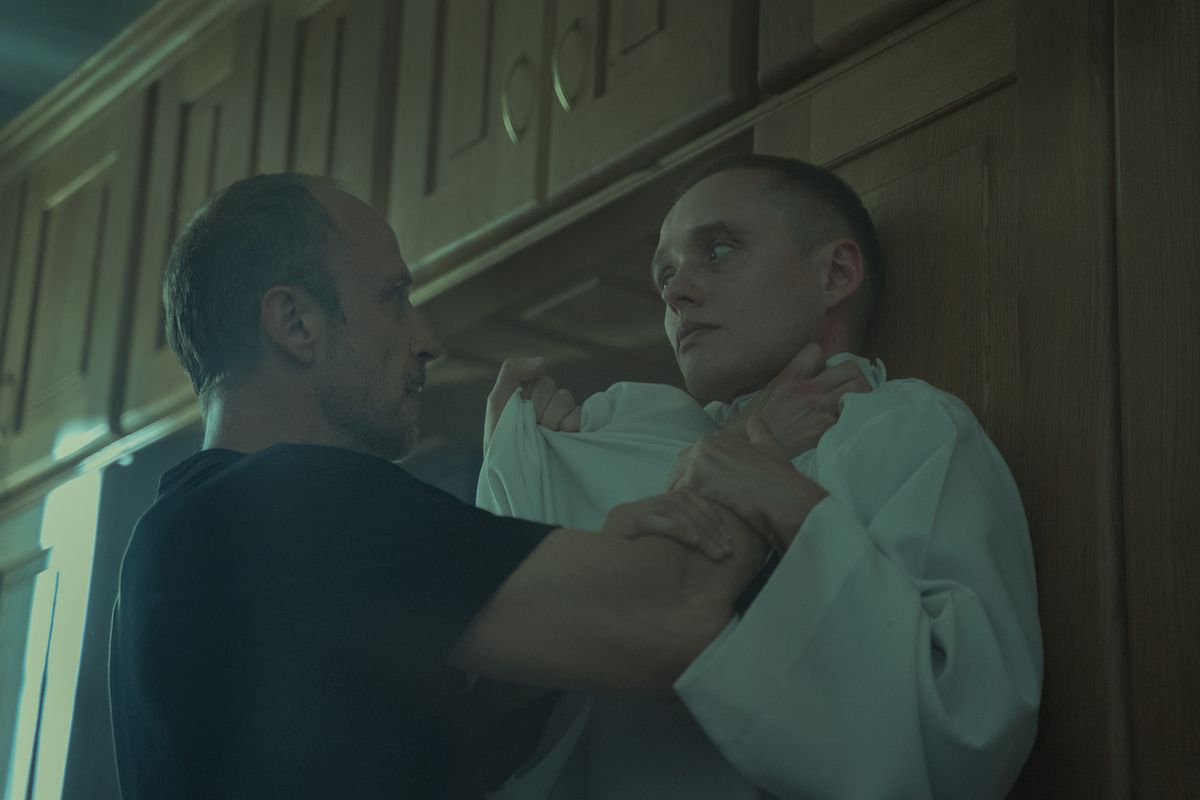
At the beginning of CORPUS CHRISTI -- the Polish film nominated as one of the five best "International" films of 2019, as the former Best Foreign Language Film category has been re-christened the movie got lost, as did the other three nominees, via the now legendary Parasite hammer-down) -- a young prison inmate stands lookout as a group of young prisoners, led by the prison bully, of course, torture another inmate. They "pants" their victim, place his ball sac inside a drawer, and then repeatedly slam that drawer shut. Yeah, real nice.

Our young "lookout," Daniel, turns out to be the hero of this film and quite a hero he proves. In addition to his helping with the torture -- you get the sense that he was himself probably once a torture victim -- he assists the priest who officiates the prison mass. Poland is, and evidently long has been, a hugely Catholic country; its antisemitism -- now and historically -- is legendary, while the hypocrisy of its worshipers is most likely on a par with that of any other country, worldwide, the USA included.

The film's director, Jan Komasa (shown at right), and screenwriter, Mateusz Pacewicz, certainly assume that their Polish audience knows all this, and perhaps Americans with any sense of history, in particular the history of foreign countries, will know it, too.

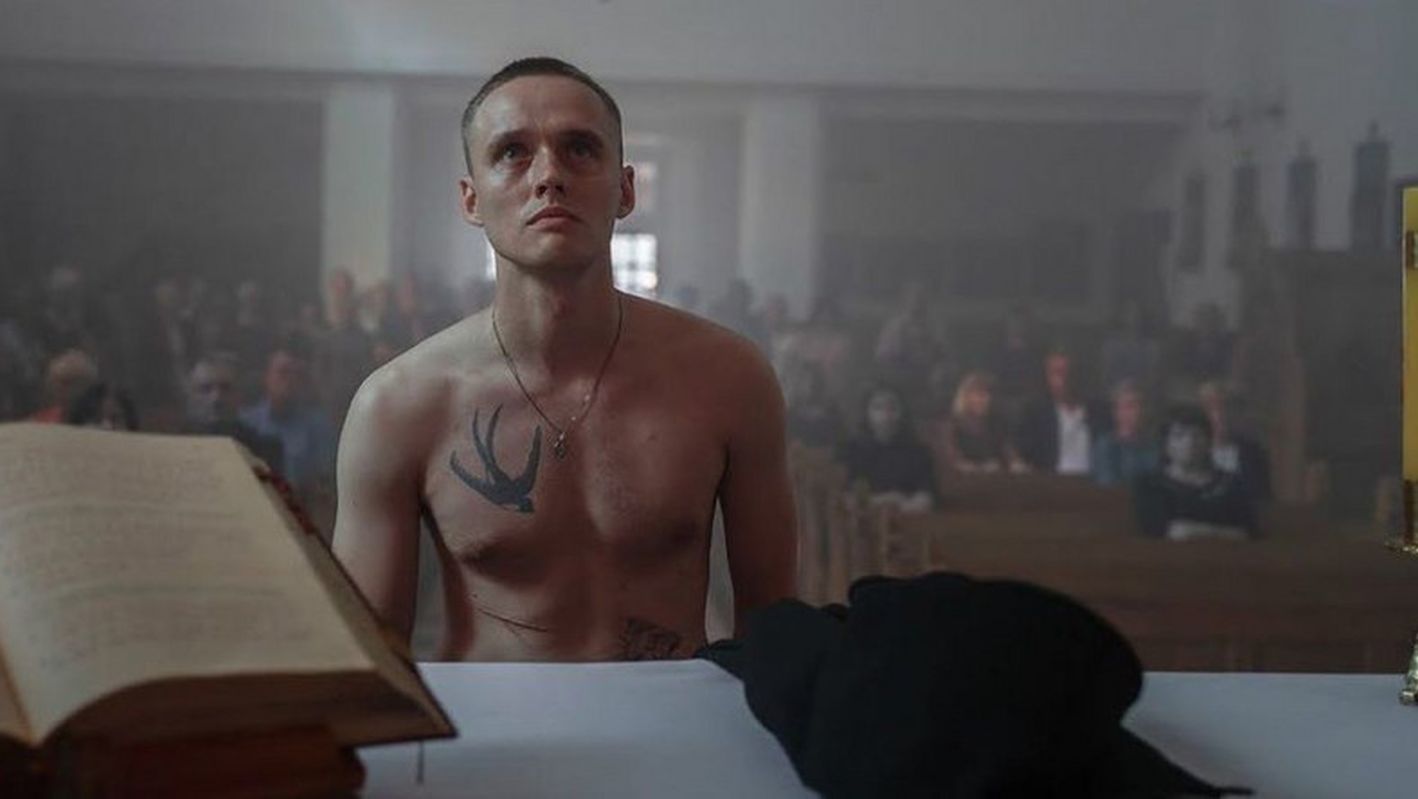
In any case, Daniel -- played with a remarkable and surprisingly believable combination of ferocity, intelligence and adaptability by Batosz Bielenia (above), an actor new to TrustMovies' purview -- has listened well to the sermon by the priest (it is actually pretty damn good: the young prisoners, as well as we in the audience, can learn from it), and once he is released back into the "free" world, Daniel visits the saw mill (below) at which he is supposed to find work, decides that he wants no part of this, and goes to the church in the nearby town to figure out what happens next.

Thanks to a combination of appropriate costume, his own quick-thinking/lying, and the gullibility of the townsfolk, including even the local clergy, where things "religious" are concerned, Daniel has soon become the town's new, if temporary, priest. Where he takes this priesthood is what makes Corpus Christi such a special movie and Daniel himself such an invigorating and original character.

The young man does not change as much as simply grow into his new profession, while retaining his insistence on challenging authority, especially when it proves to be power masquerading as truth/right. In the process, he offers his new community the kind of religion of which Jesus himself might have been delighted and proud.

Daniel's growth is shown in numerous way, but none is any richer or more redolent than those of his fucking. Early on he screws a young woman -- she's undoubtedly doing it for the money -- fast and hard, cognizant of nothing more than getting his own rocks off; how different, toward movie's end, when he fucks someone he has learned to care for.

What brings Corpus Christi to a head, placing Daniel on collision course with the town's powers-that-be, is an automobile accident that happened prior to his arrival, but that has pitted the entire community against the widow of a man involved in that accident. How this plays out is full of irony -- not of the easy sort  --  and hypocrisy, forcing the townspeople to confront things they would rather keep at bay.

Subsidiary characters are thankfully created with the same full-bodied, multi-faceted view that is our Daniel. Nothing, save for how the original premise comes into being, is easy here, If you are expecting a happy Hollywood ending, look elsewhere. But if you want a challenge, especially one that stands up to the usual cliche-ridden look at religion -- any religion -- this fine little movie is for you.

From Film Movement, in Polish with English subtitles and running 116 minutes, Corpus Christi opened this past Friday at the Music Box Theater in Chicago, and will hit New York City at Film Forum tomorrow, Wednesday, February 19, and Miami at the Tower Theater this Friday, February 21 and here in Boca Raton at the Living Room Theaters on March 13. In the weeks to come it will play most other major (along with some minor) cities across the country, as well. To view all currently scheduled playdates, cities and theaters, click here and then scroll way down.

Sunday, February 16, 2020

February's Sunday Corner With Lee Liberman: Revisit GET ME ROGER STONE (GMRS) and Other Deadly Serious Issues


This post is written by our 
monthly correspondent Lee Liberman

This particular Machiavellian life has been halted for now — Roger Stone has been out of gas by order of the court. On 11/15/19 he was convicted in the US District Court for the District of Columbia of all of 7 counts against him including lying to Congress and witness tampering. He faces jail time without a pardon; and the president, lacking the sympathy gene, enjoys watching his acolytes twist in the wind. Feb 20th is Stone’s sentencing date after postponements. Trump has just weighed in. In the overnight hours of 2/10-11, he tweeted: “horrible”, “miscarriage of justice” at career prosecutors’ recommendation of 7-9 years of prison. In an unprecedented blurring of boundaries, Attorney General William Barr hinted that the term should be less than half that. Four career prosecutors swiftly quit in protest, one left the Justice Department entirely. Legal watchers call it a “break glass in case of fire” moment because of the fouling of Constitutional checks and balances; they assert that U.S. Justice is “on life support.”

But we go back to the beginning with a revisit to Netflix’s 2017 documentary on the brazen Roger Stone. The film bookends the rise of Donald Trump and his election, abetted by Stone, a premier dirty trickster and decades-long vamp of anarchy politics. Directed by Daniel DiMauro, Dylan Bank, and Morgan Pehme, Get Me Roger Stone relives the grisly path to Trump (plus Nixon, Bush I and II) whom Stone also aided. But GMRS does not help us think about what to do next.

Stone is the peacock of his breed of political action figure -- a body-building dandy. He describes himself as a jockey on the make for a champion horse who identified Trump in the late 1980's as prime horseflesh -- "one who has the size, the courage, and the balls" to achieve the presidency. Stone prodded Trump to run for years. Although a consultant to many races, Trump horseflesh has been what Stone loved best.

Reporters Jeffrey Toobin and Jane Mayer and conservatives Tucker Carlson and Paul Manafort (an acolyte now twisting in jail) help narrate Stone's story. But Stone does his own peacocking on film and in his political career. Trump didn't suffer him for long during the 2016 campaign, no doubt piqued by Stone’s preening on Trump turf.

Among his early deeds, Stone identified the 'Reagan Democrat' and created the superpac to circumvent individual contribution limits. He sabotaged the Reform Party, after a 3-way race (Bush, Perot, Clinton) elected Clinton. Reformers have not run an effective third party challenge to the two parties since Perot, thanks to Roger Stone. He also orchestrated the human bull-dozing of the Florida recount vote in 2000, the surprise, forceful faction aiding GW Bush's win over Al Gore. He ruined Dan Rather's career in 2004 by forging documents that discredited Rather's investigation of GW Bush's military record. Eliot Spitzer's demise is another trophy. In fact Stone has engineered perhaps the most sustained regime of dirty tricks in recent history, not to mention being a magnate for scandal on his own (below). He's a best-selling author of many book-screeds against opponents. When Hillary Clinton spoke of the "vast right-wing conspiracy" for its enduring attacks on Bill and herself — it was Roger Stone on the beat.

A signature of this era of Republican politics is professionalizing the use of the lie. Lying is now a tool in the toolbox for producing a wanted result. Stone describes his discovery of this in grade school: one man's dirty trick is another man's civic action. The Biblical commandment forbidding the bearing of false witness, or lying, a precept agreed to by the community at-large, has had no relevance in the working life of Roger Stone -- truth-telling is for losers.

The liars' brigade has had other prominent practitioners. Roy Cohn, Joseph McCarthy's sidekick, was a fixture in Stone and Trump's orbit before Cohn's death. Lee Atwater led George HW Bush's successful defeat of Michael Dukakis with racist advertising about Willie Horton, a black felon, who benefited from weekend furloughs from prison at Dukakis’s later great cost; and Karl Rove, Roger Ailes, and Steve Bannon fit the bill. (Below, once partners, from l, Paul Manafort, now in jail, Stone, and Lee Atwater, who repented for misdeeds on his deathbed.)

The 'trickster' thrives on pounding nails into accepted norms for the attention it gets. Agent provocateur Milo Yiannopolis threw out red meat defending pedophilia, then curled his face into a smirk at return fire. Ann Coulter courts outrage. Perhaps this breed of contrarian hit paydirt from childhood by being bratty and the behavior not being shut down. (Mary Trump, with half smile, described little boy Donald’s strategy for corralling all the blocks: he glued his blocks to his little brother’s pile.)

But domestic political warfare is evolving, taking cues from Russians and other foreigners. A new star, 6’8” viking raider Brad Parscale (below), now heads Trump’s campaign. Parscale is described by McKay Coppins in a must read ‘Atlantic’ piece HERE.

Parscale is not a Stone-style provocateur but a digital master. He and his minions are perfecting the jamming of social media and drowning of truth: “censorship through noise” — normalizing Russian-style election interference.  Coppins describes in lurid detail coordinated bot attacks, fake news sites aimed to discredit trusted local media, micro-targeting, and anonymous mass-texting in which truth is hard to discern for all the jammed signals and confusion. Coppins quotes Breitbart’s Matthew Boyle: journalistic integrity is dead: the tool of the day is ‘weaponized information’. The Trump campaign will spend $1 billion — “the most extensive disinformation campaign in U.S. history.” Its rigor suggests that Democratic railing against ‘big money’ is passé and self-defeating. As MSNBC’s Chris Matthews has asserted, we now need a candidate who is just going to bring us home.

Evolution appears to produce lethal numbers of sociopaths and provocateurs. It isn't as though discrediting McCarthy yesterday or the fall of Trump tomorrow will have stopped evil-doing for good — only for now. Why are dark opponents always with us? Could it be that the only way for humans to stay fit, as in survival of the fittest, is having mountains to climb, opposition to thwart?

Roger Stone says we live in the age of Stone. A reflection of the liar's bad judgment is that Stone's favorite horseflesh governs with indifference to both allies and the public welfare, and Stone, himself, is convicted of crimes. But for now Trump commands the field until we mobilize our own digital army.

Democrats raged ineffectively until Trump stepped over the line into the Ukraine bruhaha, triggering House Speaker Nancy Pelosi and even a few Republicans.. While the genteel Grand Old Party has become the party of dirty tricks — a virtual 'slash and burn cult‘(Owen Gleiberman, Variety), the Democrats have been too disbelieving to develop an effective counter-strategy. Michael Dukakis and John Kerry failed to knock back incoming fire. Kerry allowed the Swift-boat attacks on his exemplary military career to soften his support. Hillary Clinton's campaign needed rapid, repetitive, memorable memes to counter lies. In contrast, both Bill Clinton and Barack Obama had war rooms at the ready to lob return fire at untruth. (So far Mark Zuckerberg is unconvinced that as Facebook publisher, he has a civic duty to censor political speech that lies). Democrats have not yet fully embraced digital options, hoping that plain truth satisfies. It should, but it doesn’t. Only Mike Bloomberg shows that he gets it with his new ads, which he can afford to focus-group, road-test. (See one at the end of this post.)

Psychologist John Watson (1878-1958), founder of the objective science of behavior, emphasized the importance of repetition: “The more frequent a stimulus and response occur in association with each other, the stronger the habit will become.” An old rule of advertising says that it takes as many as 16 exposures for a piece of information to sink into the subconscious.

Republicans use behavior modification principles in advertising. Trump is a master — he repeats information over and over and over threatening our institutions — the press, the congress, the judiciary, the armed services (he has an enemies list to warm Joseph McCarthy’s cold dead heart). But repeating information over and over to convince others is not in itself a bad thing — the science of human behavior shows that behavior is changed through repetition — it is how learning occurs from infancy to death. Repetition must be used by Democrats for goodTake the 'RAPE' T-shirt below on Stone.

Let’s say we use single words/phrases on Trump posters: LIAR; FATTY; MALIGNANT NARCISSIST; PUTIN’s PUPPY; DEMOCRACY KILLER. Run them over and over until they seep into muscle memory with multiple exposures. And direct some version of Trump’s own words back at him: “evil and corrupt”,”leaker and liar”,”vicious and mean” “Trump can’t take it”…..so that he begins to hear everything out of his mouth back in his own ears. (Blue blood former MA governor, Bill Weld, the only Republican left in the race against Trump says: “If they go low, we’ll go lower”.)

Tom Steyer, San Francisco billionaire, prepared the ground with his repetitious pro-impeach campaign; he softened resistance, predisposing public favor to House impeachment. One wishes he and/or other deep-pocketed patriots would now drop dimes on targeted, behavioral ad campaigns that will sour and shame Republican base voters on their beloved. 

Get Me Roger Stone is worth watching for its description of the problem. Stopping the handwringing and taking steps to unseat a president is progressing, in part. The Constitution provides a structural framework that may need to be invoked again, but not until the public has been prepared first with direct, repetitive advertising to dissuade Trumpdom from its slavish, self-defeating adoration. Otherwise the Republican party’s own repetitive advertising and digital misdeeds may push him over the finish line again. Watch this.

Tuesday, February 11, 2020

Dimitri de Clercq's YOU GO TO MY HEAD: high-end and somewhat tony travails in the desert

Update: This film is being released today, 
February 9, 2021, via VOD

It certainly seems appropriate to open on Valentine's Day the new film being billed as a "psychological thriller," YOU GO TO MY HEAD. This is, after all, a love story. Of sorts. But a thriller? I don't know. If so, this has to be one of the slowest-moving in the entire history of the genre.

Co-written and directed by Dimitri de Clercq, shown below, the movie seems more interested in continuous visual displays of architecture, the desert and the very lithe and attractive nude body of its star, Delphine Bafort (on poster, left).

The plot, such as it is, begins with the aftermath of an automobile accident, shown below, and the difficult trek of our heroine, Ms Bafort, across sand, sand and more sand until she find a well -- but no way to draw the water from it. No wonder she gives up in anger and submission.

To go much into what happens next will give away just about everything and anything there is to spoil about this movie -- so minimal is the plotting and, most especially and unfortunately, the characterization.

Basically what the film industry calls a two-hander, the movie slow dances around Bafort and her

"savior," played by Yugoslavian/Serbian actor, Svetozar Cvetkovic, as the audience comes to terms with what is actually going on here and why. It is not that the plot is in any way difficult to follow. No, the real question is whether we give a hoot about any of it -- including the outcome.

You Go to My Head moves so slowly that it does give us time to consider various possibilities about who these characters really are and what they might actually want -- other than the very obvious stuff we see and hear going on in front of us. The alternate scenario that you come up with will probably be more interesting that what you're watching. (Mine was.)

Injury, memory loss, obsessive love and lots of swimming all play into the game, as we wait and wait for both something to happen (a couple of minor things occur that may jerk us awake) and for much of anything approaching actual character to be revealed.

Little comes of all this and to accept the film's finale, you'd best pay major attention to a line of dialog that one very subsidiary character tells the heroine late in the game: Everything happens for a reason. Oh, of course! Thanks so much for that little gem.

From First Run Features and running an unconscionably lengthy 116 minutes, the movie -- which features that classic 1930s title song during the opening and closing credits -- hits theaters this Friday, February 14, in New York City at the Quad Cinema before opening in L.A. on February 21 at Laemmle's Glendale.

Sunday, February 9, 2020

Coming to terms with the fate of Chile: Patricio Guzmán's THE CORDILLERA OF DREAMS


Cordillera -- a Spanish word appropriated into English -- signifies an extensive chain of mountain/mountain ranges. In Patricio Guzmán's new film, THE CORDILLERA OF DREAMS, the word applies to one of several South American Andes ranges, specifically the Chilean Coast Range.

Documentary film fans will have no trouble linking Señor Guzmán (shown at right) to Chile: For some fifty years this filmmaker has been making documentaries about his homeland and the 1973 military coup (helped along in no small part by the USA) that removed the democratically elected President of Chile, Salvador Allende, from office and installed in his place a dictator by the name of Augusto Pinochet.

From The Battle of Chile, detailing the fight against the right-wing coup, through later docs such as Nostalgia for the Light and The Pearl Button, offering poetic, historical and hugely troubling looks at the murderous work of the "Pinochettes" (perhaps the Pino-shits?), Guzmán has continued to mine history, memory and cinema, looking for ways to come to terms with his own history and the home and country to which, post Pinochet's coup, he has never returned.

In several of his most recent movies, the filmmaker has turned to landmarks that double as symbols -- such as the sea that entirely borders one side of his homeland, the moon (via that titular pearl button), and the Atacama Desert (which houses both the bones of those murdered by Pinochet and the famous observatory that is able to look so precisely at the stars). Via a combination of poetry -- visual and verbal: Guzmán writes and narrates his own movies -- history and memory, the filmmaker weaves documentaries unlike most others.

In The Cordillera of Dreams, the symbol is the Andes mountain range itself and (wisely, TrustMovies believes), perhaps in obeisance to that grand and gorgeous cordillera, Guzmán's subject here moves from the utter horrors of torture and death to a look at Chile today, socially, economically, politically. And while the picture the filmmaker and his interviewees offer up is certainly not a pretty one -- as glass veneered and "contemporary" as the country's more glamorous cities have now evolved -- we are spared the tales of murder and the constant struggle of parents to discover what happened to their "disappeared" offspring.

Still, what the people he interviews here have to tell us may seem to many Americans a kind of warning of what is to come, should we return the corrupt and ever-more dictatorial Trump administration to office in 2020. When one woman talks about what she felt as a child, witnessing her parents' sudden confusion and fear during the right-wing coup, we can only shudder in anticipation. And perhaps in shame and disgust at America's participation in that infamous coup.

Later in the film, as we see and hear how Pinochet's wholesale adoption of the economic theory of the Chicago School has led to neoliberalism and the 1980 Chilean Constitution and now to a society in which literally everything must be profitable -- not merely business but art, culture, health and education. Sound familiar? Chile is now the South American test case for neoliberalism and globalization. Foreign investors are welcomed here, where their investments are "safe"; there are no trade unions and, hence, no risk.

So Guzmán, although he shows us "the ruins of my childhood," remains an ex-patriot (he lives in France), as does his artist friend whom we see and hear early in the film and who now lives in Spain. Both men reflect on how, while the cordillera protects Chile, it also isolates it. And so we view and listen to this lovely, sad combination of poetry, history, memory, politics and economics. The movie closes with a mention of what Guzmán calls his country's ghost trains. They movie at night and on no actual schedule because, "in Chile, what can't be seen, does not exist."

From Icarus Films, running 85 minutes and in Spanish with English subtitles, The Cordillera of Dreams opens theatrically this Wednesday, February 12 at the IFC Center in New York City, and on February 21 at the Lumiere Music Hall in Los Angeles and the Gene Siskel Film Center in Chicago, followed by cities across the U.S. and Canada.

Special Note:
Five of Patricio Guzmán's other documentaries including 
THE BATTLE OF CHILE (1975), THE PINOCHET CASE (2001), 
SALVADOR ALLENDE (2004), NOSTALGIA FOR THE LIGHT (2011), 
and THE PEARL BUTTON (2014) are available 
on the OVID subscription streaming service.

Saturday, February 8, 2020

For Cher-lovers everywhere, I GOT YOU BABE: The Best of Sonny & Cher, 5-disc set hits DVD


Those of us who watched The Sony & Cher Comedy Hour back when it was originally aired on CBS in the early 1970s probably remember it somewhat fondly -- as a platform for the fine singing voice and comedic talent of Cher, as well as one for the much more mediocre performer known as Sonny Bono. Of course, the mediocrity was a large part of the fun, as Cher razzed her then-husband about everything from his looks to his singing voice to, well, you name it.

If you plan to partake of the new five-disc set entitled I GOT YOU BABE: THE BEST OF SONNY & CHER, I suggest you space out your viewing of the segments with some time in between. Binging on this series, no matter how much you love the lady in question, may leave you a tad annoyed, as so much of the banter between the two performers comes down these constant and eventually tiring put-downs. Sure Sonny was mediocre. But enough already.

Instead, concentrate on things like just how good

Cher looked even pre-plastic surgery and her former nose, and how terrifically well she could sing, clown, and act in the various sketches in which she plays all kinds of people -- including Pat Nixon, in a skit set in the 1960s, as Pat visits a would-be swami high in the Himalayas to learn if her husband is going to win the next election. This is one of the funnier sketches to be seen in the series, with a punch-line ending that is simply terrific. (Sonny even holds his own here!)

And of course you'll appreciate the fabulous Bob Mackie-designed costumes Cher wears -- amazing in both their numbers and their looks -- and the many guest stars who appeared on the show. (That's Tony Curtis, above, left, already looking a little long-in-the-tooth.) You'll see everyone from Carol Burnett to Carroll O'Connor, Jimmy Durante to Jerry Lewis, Joe Namath to The Supremes -- without Diana Ross, however.

You'll hear The Righteous Brother sing one of the greatest songs ever recorded, You've Lost That Lovin' Feeling, as well as watching what may be the least-comfortable-on-camera child-of-the-famous (above, center) being made to take part in her parents' TV show. Yikes.

All told there's 503 minutes of material here (nearly 8-1/2 hours), with most of it in reasonably good shape -- visual- and sound-wise -- although much of the humor will be relatable only to folk who lived through this particular time period. (Look closely and you'll even see Steve Martin in a very small role on one of the shows.)

From Time-Life, for purchase (and, I hope, somewhere, for rental, too), the five-disc set arrives on DVD this coming Tuesday, February 11. (That's Jerry Lewis, shown above, second from left, in a third-rate parody of The Three Musketeers, from one of the 1973 shows.)

Thursday, February 6, 2020

Marco Bellocchio's THE TRAITOR offers a great Italian filmmaker working at his height


How many marvellous movies can one man direct -- and still keep them coming very late in life? Marco Bellocchio will turn 81 later this year, yet his new film THE TRAITOR (Il traditore) is not simply one of his best, it is also one of the best movies dealing with the Italian Mafia that I have seen in many a year.

The director, shown at left, comes at his subject from an individual angle, concentrating on a single, powerful, complicated man and his world -- which is, while expanding, simultaneously closing in on him.

That individual is Tomasso Buscetta (who will soon be going by one alias or another), and he is portrayed by one of Italy's most impressive actors -- in appearance, talent and versatility -- Pierfrancesco Favino (probably best known to American audiences as Marco Polo's fucked-up father from that not-quite-popular-enough-for-a-third-season Netflix series.

Signore Favino (shown above, right, and below) has demonstrated his skill over decades -- in roles as disparate as those in The Last Kiss, El Alamein, The Unknown Woman, Saturn in Opposition, Piazza Fontana and the amazing Suburra (on Netflix) to name just a few -- and here he possesses the screen thoroughly yet surprisingly quietly.
He overdoes nothing.

Favino has a commanding presence, and, boy, does he know how to use it. As the titular "traitor," his motives are hardly pure. Buscetta pretends that he comes from a time when the Mafia was a better and more just organization. Hah: phony and hypocritical nostalgia, which he is called out for by the smart and caring prosecutor (a fine Fausto Russo Alesi, below, left) who becomes as much of a friend as can be expected from these oddball alliances.

Bellocchio gets it all right. From the Mafia killings, as one nasty family is replaced by an even nastier one, to the several courtroom scenes that provide the movie's standout moments, to all the betrayals (one in particular is shocking and disgusting) -- and through it all, Favino's performance nails us. So specific and "felt" is it that you will almost consistently feel that you understand, not only what this character is saying and feeling, but even what he is thinking.

If you already have an acquaintance with  Italy's history, criminal procedure and courtroom habits, you'll probably be somewhat ahead of the game. But the filmmaker wisely and helpfully fills us in on some of this via the written information that begins his film, along with an early identification -- the names are both spoken and plastered across the screen -- of the various characters we'll need to know.

The finale may put you in mind of the current Irishman. Except that here, for all of Buscetta's faults and very mixed motives, we have a character actually worth an entire, two-and-one-half-hour movie (let alone a three-and-one-half-hour film). How splendid to find Signore Bellocchio still working in tip-top form. (That's Fabrizio Ferracane, above, as our non-hero's longtime friend and Mafia associate, Pippo Calo.)

From Sony Pictures Classics, in Italian with English subtitles, The Traitor opened last week in New York City and will hit South Florida (next Friday, February 14 -- for Valentine's Day!) at at the Coral Gables Art Cinema in Miami, here in Boca Raton at the Living Room Theaters, and at the Movies of Delray and Movies of Lake Worth. Wherever you live across the USA, to find a location near you, click here.