Tuesday, January 14, 2020

CINEMATTERS: NY SOCIAL JUSTICE FILM FEST opens and Adam Zucker's AMERICAN MUSLIM screens at the JCC Manhattan


Presenting "impactful films that engage the community toward a more democratic, inclusive, and just society," as its press release states, the new CINEMATTERS: NY SOCIAL JUSTICE FILM FESTIVAL opens this Thursday, January 16, in New York City at Manhattan's JCC, and runs through January 20. The line-up here looks quite promising, with one after another film that TrustMovies, had he a lot more time, would want to see. (You can peruse the entire festival schedule by clicking here.)

The one film I was able to view is a very necessary documentary entitled AMERICAN MUSLIM, which is directed, produced, filmed and edited by Adam Zucker. Given all that Mr. Zucker, pictured at right, is responsible for, I must say that his documentary has turned out quite well, in just about every department.

The impetus for this movie was the election to the Presidency of Donald Trump, along with our new era of, as Zucker calls it, "sanctioned bigotry."

While we've always had and always will have bigotry, this newly sanctioned idea comes from the vile and disgusting Mr. Trump and his accompanying, noxiously goose-stepping Republican Party.

You will not be surprised to learn that Zucker's doc is determined to show us American Muslims in some of their many other, much more numerous forms, rather than what our current right-wing nationalists are determined to make us imagine -- that all are terrorists.

To this end, he offers up five different American Muslims, originally from places as far afield as Palestine, Indonesia, Algeria, Yemen and Bengali/Bangladesh, and now all -- unless I misunderstood something -- have become American citizens. (Among the facts we learn here is that the majority of Arab-American Muslims are not Muslim but Christian. I had this sort of backward in an earlier version of this post.)

We view these people at work and with their families, and at the many political demonstrations as they try to raise support against Trump's infamous Muslim ban. As we watch them doing everything from condemning the terrorists who took down the World Trade Center (thereby giving the lie to the question so often heard, Why don't we ever see Muslims rallying against terrorism?) to helping other immigrant families in need of support, they will seem exactly what they are: not simply good citizens, but pretty damned exemplary ones. Were we all as helpful and caring as the folk we meet here, our unnecessarily divided country would be a better place.

Zucker moves his doc along at a good clip; there's not a lot of repetition or unnecessary rah-rahing. He has chosen his subjects well, so that each one offers a different look at Muslims, their religion and their primary concerns. We learn from and like all of these subjects. They're enjoyable to be around, and their movie is encouraging, upbeat, positive -- often joyous -- until we reach the point at which our Supreme Court votes (by a margin of one) to uphold Trump's Muslim ban.

Still, our subjects vow to continue their fight to help Americans better understand and appreciate their Muslim brethren. Consider this documentary an important part of that fight. American Muslim, running 82 minutes, plays the Manhattan JCC this Friday evening, January 17, at 7pm. To view the entire program for Cinematters: NY Social Justice Film Festival, simply click here.

Sunday, January 12, 2020

January's Sunday Corner With Lee Liberman Gerwig's LITTLE WOMEN: the Jewel Box Effect


What pleasure to see LITTLE WOMEN (LW) at Brooklyn’s famed Brooklyn Academy of Music (BAM), a multi- venue cultural center first founded in 1861, seven years before LW was published, with a multi-generational group of 15 including some men dragged by sisters and wives to the winter season’s chick flick. Ecstasy promptly broke out, amped by Q & A that followed with the writer/director herself.

Beyond the exposition below, the result in chief was a completely exuberant experience in front of any screen, large or small. And a unique and smart one: an emotionally and intellectually provocative version of the girls epic that Greta Gerwig (above) artfully, ingeniously kaleidoscoped with bits of Louisa May Alcott’s own life and with Jo March’s own novel. The writer/director plunges you into the golden youth of the March sisters who pile on one another like puppies snarled in a heap of play, rambunctious furies, set against their young adult selves who in cooler light and with mature restraint, bear poverty, suffer loss. Rich neighbor, Laurie, lacking parents and family warmth of his own, is the fifth sister — Timothée Chalamet as his nattily-dressed, tousled, whimsical self. It’s not traditional linear story-telling of LW but you’ve been there/done that. You just have to go and see what Gerwig has accomplished (HERE, the film trailer.)

As Gerwig explained in an interview for Indiewire.com, for her, the novel is the golden snow globe of childhood and memory, and she wanted the film to feel heightened, as though you were opening a jewel box you’d want to live inside of because there was magic to it -- like the world was right in its coziness. Gerwig invests nostalgia with a modern edge in this lively 2h 15m of pure entertainment.

HERE for your comparison are the major earlier films of LW. The 1994 version with Winona Ryder, following the women’s movement, was the first to take Jo seriously as an ink-fingered scribbler underwriting her own independence writing fiction and prose, and Susan Sarandon’s Marmee as a woke woman. Gerwig unpacks empowerment even further — Saoirse Ronan’s Jo makes it plain that money is freedom; the film is threaded with her negotiations over the price and value of her writing. Amy, the family brat (brilliant Florence Pugh: “I got to...be this most delicious naughty hungry little flirt”), declares later as a young adult her practical intention to take control of her life by marrying well — her femininity is her currency in a world where women and children are property.

Gerwig mixes up the time frames — the story flashes back and forth between the March sisters’ charmed if genteel poor childhood and their twenties with the sobering of maturity. Even lesser players are eye-candy here: handsome Brit James Norton as sister Meg’s (Emma Watson) suitor, John Brooks, and French heart throb, Louis Garrel, as Professor Bhaer — the husband Alcott reluctantly coughed up for Jo to marry in order to satisfy her readers (who clamored for Laurie as groom).

A particular Gerwig contribution was for us to see the March’s as part of their own civil war era but in slight offset to its social conventions — essentially a hippie family. (Credit to Amanda Hess, NYT, for her illuminating interview with Gerwig ) The director filmed sunny golden youth using for reference the art of 19th century painters. The young adult Amy, in the company of old Aunt March (a crusty Meryl Streep on par with Maggie Smith‘s Countess Grantham) falls in love with Laurie in the Paris of Leslie Caron’s Gigi (below).

My own homework was to re-read the best-selling original (1868), that as an adult, felt something like a dreary dinner of tiresome moralizings. The truest emotion in the novel was evoked by sister Beth’s decline, Alcott’s paean to the demise of her own sibling. This emotionally rich story line was skimmed rather lightly, surprisingly, as otherwise Gerwig pinged your memories of LW over and over.

Alcott herself was unhappy with the novel, she called it “moral pap for the young”, marrying off Jo at her editor’s insistence that women in stories must end up married or dead and writing ‘‘at record speed for money’’. Her preferred gothic romances (she called them her “blood and thunder tales”) temperamentally opposite her idealistic father, didn’t pay. She went for the money, writing stories for girls; at 40, ‘Little Women‘ made Louisa comparatively rich, family debts paid and money leftover for good carpets and a ‘modern’ kitchen now on view in the famed New England colonial in Concord, MA (below). Louisa became the sole support of the Alcott household. She had produced near 300 works by her death at 56 in 1888, 2 days following her father. In real life it was Louisa who went to war (as a civil war nurse) not Bronson; her death was likely brought forward by her having contracted typhoid pneumonia and treated with a formula containing mercury.

Bronson Alcott, a founder of the Transcendental movement, is a story of his own, so modern a school teacher he couldn’t keep a job; parents withdrew their children because he opposed corporal punishment, enrolled an African-American child, and fostered classroom dialogue and argument. The transcendentalists, at their height in the 1830’s, emphasized the inherent goodness of nature and humanity leading to Louisa’s inclusion of such churchy homilies in LW as “Be comforted,dear soul! There is always light behind the clouds;” or “hope and keep busy, that’s the motto for us”.

Bronson Alcott’s compatriots were Ralph Waldo Emerson, Henry David Thoreau, and Henry Wadsworth Longfellow; their ideas of simple food/simple living have come forward to this day in their writings, radical in their support of abolition and women’s and labor rights. The Alcott’s and their associates were early day Woodstock generation types and the fictional March’s basked in their glow.

A provocative piece of Louisa May’s own story is whether she was gay. Gerwig talks about it in an interview HERE. Louisa herself wrote: “I believe I am more than half-persuaded that I am a man’s soul, put by some freak of nature into a woman’s body...because I have fallen in love in my life with so many pretty girls and never once the least bit with a man.”

In contrast to Gentleman Jack's Anne Lister, denoted as the first English Lesbian some decades earlier (1791-1840), Louisa (above) is adored by girls today foremost as an author who supported herself as a writer; available readings don’t hint she acted on her predisposition. She and alter-ego Jo March are gay icons today, but they are also iconic to every young person who dreamt of supporting her/himself with pen, typewriter, or computer.

On its release Christmas Day 2019 Little Women became an instant film classic because of the magic in Greta Gerwig’s jewel box. When you finally see it you will surely enjoy if you are a woman or have a woman in your life. (Below, Laura Dern’s Marmee with the four March daughters)


The above post was written by 
our monthly correspondent Lee Liberman

Friday, January 10, 2020

Alex Gibney's back with CITIZEN K, his look at Russian ex-oligarch and current political dissident, Mikhail Khodorkovsky


For any documentary fans lucky enough to have seen the 2011 KHODORKOVSKY -- German filmmaker Cyril Tuschi's movie about the then-imprisoned Russian oligarch, Mikhail Khodorkovsky -- the new film, CITIZEN K, by prodigious documentarian Alex Gibney (90 producing credits and 47 for directing), which brings the Khodorkovsky story pretty much up to date, will be a must-see. Even, I suspect, for doc fans who may not know much about the life and career of this very unusual fellow who went from being one of the wealthiest people in the world to a Russian political prisoner in Siberia for ten years and has now become the Kremlin's most famous critic-in-exile, from his these-days home in London.

Given the murderous yen of current Russian dictator Vladimir Putin for doing away with his political nay-sayers, both in Russia and abroad, your biggest question while viewing either of these Khodorkovsky-themed docs will probably be: How come this guy is still alive?

Best guess, since neither director goes into this question head on, is that making a martyr out of this man might do more harm than good to Putin and his hold on power. Either way, Mr. Gibney, shown at right, does his usual job of intelligent, professional movie-making that pulls us in, gives us plenty of information and ideas to keep us involved, and does not settle for simple hagiography in offering up Khodorkovsky (shown above and below) as a possible hero. Sure, what this man has done -- some of this certainly odd but also oddly heroic -- was in many ways good for Russia and its populace, even while making him a very rich fellow.

Gibney lets Khodorkovsky's great intelligence, discipline and bravery shine through, never more so than when he accepts his arrest and prison term (on utterly jacked-up and ridiculous charges that are shown to be even more stupid via his subsequent "trials"), rather than fleeing the country, as other Russian oligarchs immediately did when Putin revealed his true, power-hungry colors.

One of Gibney's smartest moves is to offer some fairly recent Russian history, along with the country's change from Communism (via Gorbachev and then Yeltsin) to a form of Capitalism, Russian-style, complete with beaucoup bloodshed that soon morphed into another under-the-thumb dictatorship (thanks to Putin), which has proven less crazy and murderous than that of Joe Stalin but nonetheless is a nasty, nationalisitic white/male/heterosoexual dictatorship all the same -- unfortunately one that seems to have the approval of far too many Russians.

Via archival footage and current interviews with journalists, politicians, and the man himself, we learn how Khodorkovsky dealt with his time in prison, and how, after it, he became even more of the political dissident than before. On the debit side, the man maybe has a lot to answer for, including his possible involvement in the murder of the mayor of a town near one of his oil fields. We learn about this in degrees, but I wish Gibney had asked Khodorkovsky directly whether he had any involvement. Not that we would learn the definitive answer, but it might have been interesting to watch and listen to him and what he has to say.

Otherwise, by the time we reach the conclusion of this 126-minute movie, we've seen and heard enough to place us pretty firmly in Khodorkovsky's corner. The earlier and shorter by-15-minutes documentary gave us quite a bit more of K's family/childhood history. As I stated in my review of that film and stand by after seeing this second one, the man seems to me to be a genuine Russian patriot -- not in the vile, nationalistic sense but in a manner that cries out for something approaching a more real democracy, available to all. Which these days, come to think of it, we could use here in the USA, too.

Distributed theatrically via Greenwich Entertainment, in English and Russian with English subtitles, Citizen K is said  to have opened in Los Angeles this week and will hit New York City on Wednesday, January 15, for a two-week run at Film Forum. Elsewhere? Click here to learn more about where and when. As you can see from the poster, top, the film is billed as an "Amazon original," so if you can't view in a theater, you can probably catch it eventually via Prime.

Wednesday, January 8, 2020

GENÉSE: Philippe Lesage's first-love film makes U.S. home video debut


Were the first hour and a half of Canadian filmmaker Philippe Lesage's movie, GENÉSE, not so very fine, I am not sure we'd forgive or even put up with his near-shocking switch at that point from the story and character's we've been viewing to something completely other. Yes, the theme remains the same: how fraught first-love (hell, any love, really) can be. But the switch baffles us and certainly takes some time to get used to and sort out.

If this is a spoiler, so be it. But I suspect you'll appreciate the warning so that you won't waste much time worrying over this confusing switch. Up until this 90-minutes-or-so point, we've been involved with a group of high-schoolers and their difficult love lives. M. Lesage, shown at right, who both wrote and directed the film, has also cast it quite well.

It's easy to watch and enjoy both the appearances and the performances of the young, attractive cast, each of whom brings something special to his/her role.

And if Lesage is some-times a tad slow-paced, even repetitive, in his visuals, what we're looking at is usually pleasant, while giving us enough to think about, that we go along.

The longer and first-seen tale features a brother Guillaume (Théodore Pellerin, above, left) and sister Charlotte (the beauteous Noée Abita, above, right), each of whom has a first-love problem. His will work itself into being and acceptance as the film moves along; hers stems from the kind of male rejection via boyfriend (Pier-Luc Funk, below), shown early on, that leads to an all too typical and saddening response.

We view and come to feel and empathize with these two characters hugely, thanks to Lesage's own empathy and ability to engage us via fully-rounded characters who open their layers to us in degrees. Charlotte repeats and repeats her negative response, while Guillaume tries to come to terms honestly with his. The result is a declaration of his love, in the classroom, that is the first such I've seen in movies and is so very well done that the scene becomes a kind of instant classic.

When we switch to the second part -- involving even younger children toward the end of their season at a summer camp (above) -- the time spent is shorter and the involvement less. Yet because the theme is the same, there's enough intelligence here to hold the movie together, while performances are again, in this second story, quite good. Lesage always tosses us into the middle of things, using his documentary style, which makes what happens seem real, even "normal" -- including those singular actions on display, together with the enormous emotions aroused in the various characters.

This in media res style forces us to figure things out for ourselves. The result may take some time, but the effort is edifying so that Genèse proves an unusual but worthwhile movie experience. From Film Movement, in French and English with English subtitles, and running 129 minutes, the film hit the street earlier this week on DVD, Blu-ray and digital. (That's Paul Ahmarani, above, center left, who plays Guillaume's very smart, egotistical and nasty instructor.)

Monday, January 6, 2020

Mark Gatiss and Steven Moffat's BBC-produced DRACULA comes to Netflix streaming


Do we really need another version of DRACULA? Absolutely, when it's as witty, intelligent, mysterious, dark, bloody, sexy and -- can you believe it? -- even (and most unusual) as charming as is this new series produced for the BBC and streaming now in the USA via Netflix. But is it original? Come on: How can it be? It's Dracula, for god's sake!

What makes this new "take" so terrific are the ways in which its creators, Mark Gatiss and Steven Moffat (shown at left, with Gatiss on the right), have cleverly and intelligently drawn on just about every earlier source, from Stoker to Lugosi to Hammer and onwards and yet have come up with something wholly their own: a three-part series, which each part comprising its own 90-minute movie, that together makes up the best Dracula I've yet seen. The first part is hugely dark, often ugly and possessing a sadness earlier versions missed; the second something akin to a Ten Little Indians set at sea (with the murderer quite obvious, but the how, why and when of the victims' demise providing the fun); the third, an enormous surprise, provides the wittiest chapter, as well as bringing it all to a satisfying, unusual close.

In Danish actor Claes Bang (above and below: remember him in The Square?), we've got a great vampire Count: smart, sexy, horrible and irresistible. His line readings are as apt and delightful as you could want, and Gatiss and Moffat have given him countless succulent lines to chew on with relish. Bang does all this with such gorgeous subtlety, confidence and the proper innuendo that you hang on every word.

Dolly Wells (below, of Can You Ever Forgive Me?) proves equally splendid as Dracula's antagonist, a semi-lapsed nun possessing a very special name. My spouse noted that Ms Wells' accent is right out of Ingrid Bergman, and it and she are as delightful as you could want -- as well as providing the series with a character equal to our ravenous Count.

The perfectly-chosen supporting cast is chockablock with the kind of talent and energy needed to bring the tale to massive life. Particularly amazing is the very fine John Heffernan, below, who gives us the richest and saddest Jonathan Harker we've yet seen. In a sense it is Harker who owns the initial chapter of this series.

There are so many fine performers in use here that I do not have time or space to mention them all, but you'll be aware of how well-cast the series is as you're viewing it. Look for Lydia West (below, of Years and Years) as this version's Lucy,

and Matthew Beard (below, of Elizabeth Harvest) as one of several lovesick pawns the series so interestingly presents.

If you're the sort of viewer who just wants a bloody, gory Dracula, the high intelligence on offer here will be wasted. (There is a good deal of blood to be seen, however.) But if you're looking for something special, something that takes a legend and does it up proud by adding even more to its original grandeur, don't miss this new version -- on Netflix streaming now.

Saturday, January 4, 2020

Revenge is bitter in Paul Kampf's Puerto Rican love story/incarceration tale, IMPRISONED


The anti-capital punishment message is worthwhile, production values are high, and the Blu-ray transfer quite good for the 2018 melodrama, IMPRISONED, which makes its home video debut this coming week. If only the story and screenplay -- credited to Paul Kampf, who also directed -- were not quite so paint-by-numbers: You can see just about every would-be twist and turn coming prior to the curves themselves, which makes watching the movie something of a slough.

Mr. Kampf, shown at right, draws decent enough performances from his attractive and talented cast. But his set-up, continuation and finale are all marked by such obvious "pointers," made even more so by a heavy-handed framing device during which we're told too much about the awful things that will occur, so that we're primed, milked and practically pasteurized by the time resolution arrives. You rather want to call out to the filmmaker, "Hey, could you let us think for ourselves and maybe work a little harder, please?"

The story is one of revenge by a prison warden (Laurence Fishburne, above, left) on a former inmate (Juan Pablo Raba, below) who has paid his debt to society and been released to the loving arms of his wife (Juana Acosta, two photos below), who now owns a very nice local restaurant named for her hubby.

However, because this ex-prisoner was responsible for the somewhat accidental death of the warden's wife and unborn baby during a botched robbery, happiness is not in the cards for the poor fellow (for either poor fellow, actually).

The film allows us to root for our beleaguered hero and against our near-hissable villain to the point at which not much sense of justice (or sense, period) can be served. And so, after a time, we place our brain on hold and just go with the flow.

The film often cuts to public demonstrations against capital punishment, usually led by the wife, trying to head off the hangings scheduled by the nasty warden, which she want the territory's governor (Esai Morales, above) to prevent.

Hangings, whether taking place in prison or out, are illegal in Puerto Rico, but the filmmaker excuses his use of same by claiming that they "serve as a visceral and effective representation for (sic) the film's deeper conflicts and themes surrounding rehabilitation and punishment." Not really, because once you realize this misuse, it makes the movie even cheaper and more slipshod. (That's prison inmate Edward James Olmos, "noosed," above.)

Well, the movie is pretty to look at, its heart is in the right place, and I admit that the final scene (above), with characters we have not seen until now, is sweet, sad and even moving. From Cinema Libre Studio, running 104 minutes, in English (and Spanish with English subtitles), Imprisoned hits the street on on Blu-ray and DVD, as well as via digital streaming (Amazon, Vimeo and Hoopla) this Tuesday, January 7 -- for purchase and/or rental.

Thursday, January 2, 2020

So what's with the ridiculous critical response to CATS (which is actually quite a bit of fun)?


Come on now: Didn't you just know that most, if not all, of our critical establishment were gunning for CATS? Yes, you did -- even if you were loathe to imagine that anything like that might occur in the critical home of the brave and the land of the free. From the release of the initial trailer for this film, which had both critics and internet trolls (I don't care what you've heard: These are not the same thing), up in arms about how horribly creepy these cat-bodies-on-human-faces appeared to be, any halfway intelligent reader knew that something stupid was afoot. Turns out it was not the movie itself.

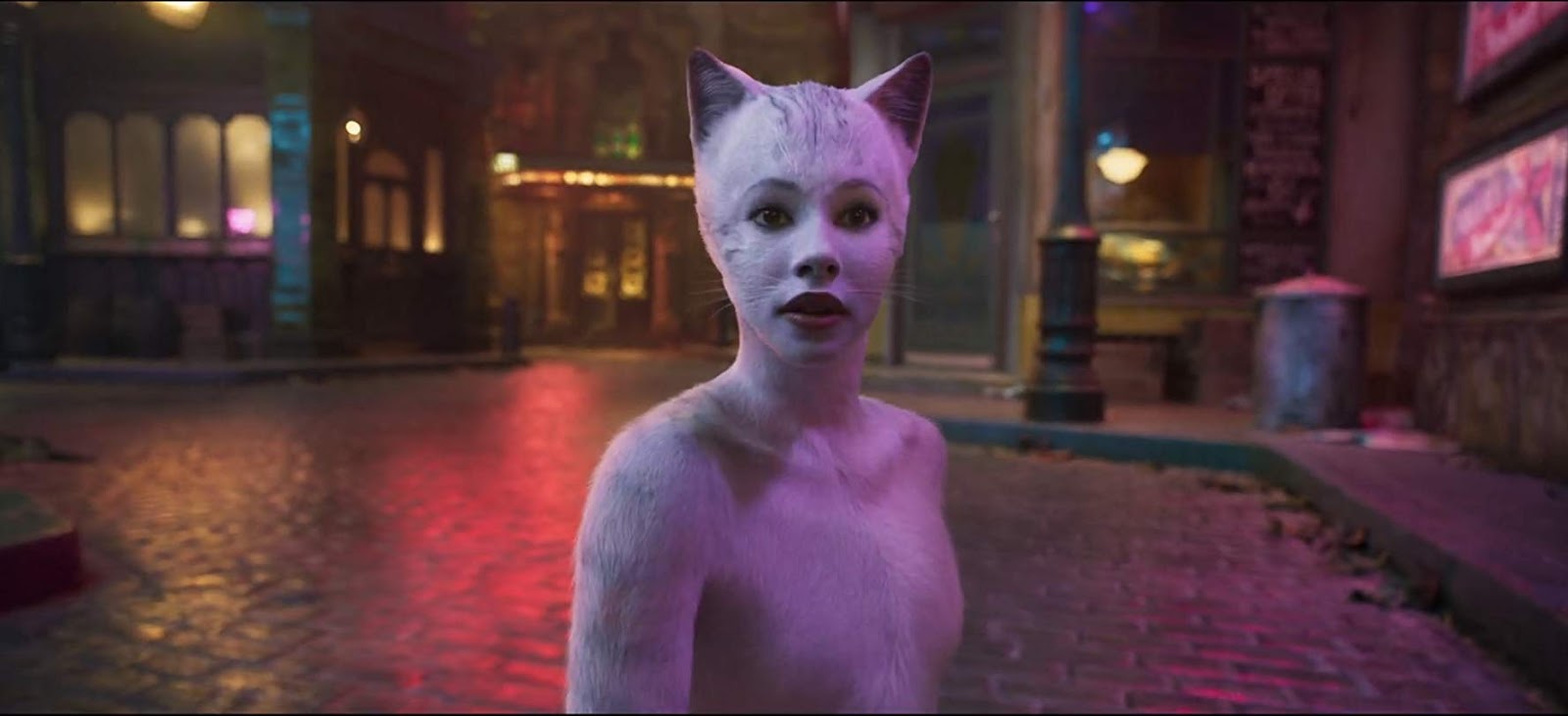
What in god's name was anyone expecting from a film based on the mega-hit musical -- in which all the actors appeared onstage in cat costumes that obscured everything but their faces? Naturally we now, via the movie, get even better-known actors with CGI-effect cat bodies grafted onto their famous faces. Those CGI effects, by the way, are pretty damn good, too.

Could one of the problems here be the film's director? Back in 2011 Tom Hooper (shown at right) -- never a critical establishment favorite -- won a Best Director Oscar for The King's Speech (which also won Best Picture). His Les Miz movie was also somewhat frowned upon by many critics. Ditto The Danish Girl. Yet as director and co-writer (with Lee Hall), Mr. Hooper has given CATS a terrific opening hook (as the sole human we view in the film, abandons a large, sealed up bag that clearly has something moving inside it), along with a much stronger storyline/plot.

That last would not be difficult, as the hit musical on which the film is based (by Andrew Lloyd Webber, based in turn on cat poetry from T.S. Eliot) had no plot whatsoever. Individual "cats" each did their signature numbers, there was a couple of fancy dance routines, and an old, grizzled kitty sang the hit song Memory and then ascended to heaven. Huh? Yup.

Hooper and Hall have gussied-up the story so that the initial abandoned kitty (played quite beautifully by the exquisite dancer Francesca Hayward, above, aloft, and below) must learn, sort of, the lay of the "jellicle" land into which she's been tossed. (Don't worry about the meaning of that word; it's mostly used for nonsense fun, so far as TrustMovies can tell.)

Now, I do not mean to imply that Hooper has given CATS some kind of Knives Out plot complexity, but he has indeed improved upon the musical theatre piece. The filmmaker further turns this low-wattage tale into a kind of Kittyland's Got Talent contest, as each star does his or her number, most of them only to be whisked away black-magically by the movie's now villain, Macavity (played with sexy, grinning menace by Idris Elba, below).

All this adds some frisson to the feline fun, and if the first few numbers may not exactly grab you as musical highlights -- neither James Corden's (staged so darkly you can barely see his face) nor Rebel Wilson's (in which she's upstaged by CGI cockroaches) works all that well -- worry not, for prior to midpoint, the movie has already offered first one spectacular set piece, followed by another better one, and then another even better. By the time the end credits roll, you may be applauding, as were many in the Delray Beach theater in which we saw the film on opening day.

A word must be said, too, about the flat-out commitment to character and speech offered up by cast members like Judi Dench (above) and Ian McKellen (below), and to song by Jennifer Hudson (two photos down, whose singing of Memories is quite wonderful).

So why these incredibly nasty reviews (which, together, makes such stunningly stupid and cliched use of words like "catastrophe," "hairball" and "litter box"? (I can only hope that John Oliver is currently preparing one of his And Now This... segments to make fun of it all.) Other than jumping on this year's Here the movie to kill! bandwagon, I can find no good reason for this excessively nasty response.

CATS may not be your cup of catnip, but it's a long, long way from terrible on any level. In fact, it is often so downright bizarre, near-crazy yet visually wonderful in its production design and imagination that it will never numb your brain, as do so many of the Star Wars franchise.

If you want to read a really delightful, funny, keenly observant review of the film -- the best I've seen anywhere so far -- check out this critique for Salon written by Mary Elizabeth Williams. It may remind you of what was sometimes said about the writing of Pauline Kael: Reading her is better than seeing the movie (not quite, in this case -- but close!).

Meanwhile, CATS is playing, for awhile longer, at least -- maybe word-of-mouth is picking up -- at a theater near you. Click here to learn where.