Showing posts sorted by relevance for query Is Anybody There?. Sort by date Show all posts

Thursday, April 16, 2009

A Talk with BILL MILNER and JOHN CROWLEY re method, movies and stage


So. Rex Reed in this week's New York Observer has come down heavily against IS ANYBODY THERE? While I don't think this alone will sink the film's chances at finding its audience, I must admit that an earlier retiree/rest home movie, also featuring its title in the form of a question (How About You?), did not set the world on fire during our last Christmas season. Still, I'm counting on intelligent foreign/independent film audiences to seek out a movie like this and give it a chance.

At the press event for Is Anybody There? (the lion's share of which was posted yesterday), our final meeting took place with Michael Caine's co-star, young Bill Milner, and the film's director John Crowley (shown above, left, with Sir Michael). Here are highlights of that conversation between Crowley, Milner and six of us bloggers, all sitting around a very large conference table at the Regency Hotel:

Q (to Milner, shown just below): How was this movie different for you from Son of Rambow?

Milner: Son of Rambow, I think, was about growing up and about living. This film is more about death and letting go.

When you first met Caine, did you know who he was and what his stature was -- that you were working with one of the top 20 actors in the whole world.


Yes! I was aware, but at the same time it was quite exciting.

When you answered the question about the differences between Son of Rambow and Is Anybody There? you were very analytical. I am wondering how that analytical part of you functions when you are on the set. What are you thinking about?

I don't know. I think…. I don't know if I can answer the question…

Crowley: I can help you out with that....

Questioner. No -- let him. (To Milner) When you go onto the set and are about to play the scene, what are you thinking about? That particular, isolated moment? The longer story? What? Or does all that disappear?

I don't know…That's a tough question. First, you have to really get a sense of what the character has been through before, and then you understand how he is feeling. You have to understand the scene just before that one and what he has done then. And then that scene takes you in the next.

Crowley: This boy takes his brain with him onto the set. Then, somewhere along the way, his instinct takes over. Directing him is not like directing other kids. He's never let me down.

(To Crowley) What is the biggest difference between British and American humor?

I think the British is flinty and tough, with an irreverence toward death. That's probably the main difference.

How do you find the right balance between entertaining the audience and provoking them into emotion?

There is no easy answer to that. You spend a lot of energy and a lot of time trying things out. It's like three-dimensional chess -- played in the dark. Editing, of course, is there, too, and to me this is the most purely cinematic part of the whole thing. It is astonishing how meaning can develop through editing. You have to keep doing it and doing it and then step back and get a pair of fresh eyes to look at it. I was very lucky to have had producers who allowed me the time to get it right.

How long were you working on this film?

We finished it completely just before Christmas last year. We actually finished editing it last August.

Do you find it is even more difficult because of all the extra footage after editing, and now, with the DVD to consider, how you can put in so much of that footage as "extras" on the DVD?

No. Because you are always after the best version of the film. It's horrible, of course, what you lose in editing those scenes. But the one consolation is that those scenes are not lost forever because you can put them on the DVD.

To Milner: After making the two films, have you thought that you might want to get into something like directing or writing?

Well, I have written and I do have a camera I like to take out with me.

Crowley: And he's very good!

(To Crowley) Regarding how the movie keeps changing focus -- from Clarence and the boy, to the boy's parents to the occupants of the retirement home -- was this planned more in the original script, or did much of it happen in the film's editing?

The movie was always planned to be about the main character Clarence and the boy, but to find the emotional through-line you must weave in these other characters so that you feel they counterpoint and mirror the difficulties and the choices that Clarence faces. You have the boy, who's on the threshold, the father in his mid-life crisis, and Clarence who is wrestling with the end. Within that you have all these other stories of the residents, and you could pick any one of them and it would a major one, equally rich.

Can you talk about the difference between your work on the stage and now on film.

There is something incredibly satisfying about capturing on film a particular moment. On the stage, it can be equally brilliant, but then it is gone. But if you've caught it on film, it is there forever.

What other film directors do you admire?

I am impressed with work of Steven Soderberg, Ang Lee and Peter Weir. They never seem to make the same film twice. Being a film director seems a bit like being somewhere between a creative force and a gun for hire. I mean, look at John Huston's career!

What is the difference between what a live audience gets from a legitimate theatre play and what a film audience gets?

Obviously in legitimate theatre, it is an event, and something that is being shared by the audience. The audience is involved is a very subtle way because the audience is also informing the event -- by silence, by laughter. Maybe not consciously. With a new play, there is nothing as exciting as the first performance in preview. I found that true both in London and here in NYC with The Pillowman. The audience does not know what it is in for -- and there is that sense of discovery, moment to moment. That is very, very special. It is an incredible thing to have helped engineer that event. But film is so much more about internal emotional landscape, and in subtle ways. It's like you are trying to get behind somebody's eyes. It is not so much about the event in the room. There is nothing better than to stand in the back of the auditorium during a screening in which people are really "getting" the film, whether they are quiet or laughing . I don't see the need to have to choose one or the other of these art forms. I am lucky enough to be able to go between them.

Wednesday, April 15, 2009

IS ANYBODY THERE? Yes! A meeting with Caine, Milner, Crowley & the producers


So many worthwhile movies sneak in under the grid these days, languish briefly in a theatre or two and then disappear, reappearing on DVD much later (often after their small but interested audience has forgotten that it even had wanted to see them). When a small film manages to garner attention, celebration is in order, and so it is with this quiet little tale that features a very big star: Michael Caine.

IS ANYBODY THERE? tells the story of an elderly retired magician (Caine) who places himself in an old-age home run by the parents of a young boy (Bill Milner from Son of Rambow) who is obsessed with the after-life and the possible presence of ghosts in the home.

The film's focus keeps changing -- from the relationship that develops between the characters played by Caine and Milner to the parents, who are having their own problems (David Morrissey, from the original State of Play) and Anne-Marie Duff of The Magdalene Sisters), and finally onto the aged tenants of the home -- starry geriatrics who include Rosemary Harris, Leslie Phillips (Jimmy Blake in the Chancer series and Venus), the late Elizabeth Spriggs, Peter Vaughan (Tom Franklyn in Chancer, The Remains of the Day), Ralph Riach (chauffeur Willy Stebbings in Chancer) and the amazing Sylvia Syms. With its constantly shifting focus, the movie puts us in touch with a lot of people and events -- and the connections and feelings that rise from these. It proves an interesting way to tell the story: removing us somewhat from any heavy identification with its two main characters while putting us nicely in touch with the entire world that they inhabit.

Caine is wonderful (he seems to get better with each new role), bringing such a rough, alternately-in-and-out-of-touch reality to his character that it's almost as though the viewer has never seen this actor before. Young Milner, quite accomplished considering his few years and short resume, make a fine foil for Sir Michael. The entire cast is equally accomplished and my only quibble is that I'd like to have seen more of each of them. The movie -- at 94 minutes including credits -- is short yet covers a good deal of territory. Screenwriter Peter Harness has based his story on his own life growing up in a retirement home run by his parents, and he's done a creditable job of giving us enough information to carry us along without overloading.

Is Anybody There? has a lot to say but never shouts. It tells its story, whispering between the lines and leaving us to draw our own conclusions with feelings that, though mixed, should contain many more positives than negatives. There's an abundance of humor here, some of it pretty quirky and dark (the magic show with Caine and Peter Vaughan -- whew!) and sadness, too, often coming nearly on top of each other. All in all, a nice little movie.

<><><><><><><>

Granted, I've only been working the review route for a few years now, but the press experience with this particular film was unlike anything else I've had. Press time lasted longer than any I've experienced, with a full roster of producers, stars and director on hand.

Our little group of six bloggers gathered around a long and wide conference table in Manhattan's ritzy Regency Hotel. (It was pouring rain that day, and when I departed the doorman graced me with a classy black umbrella. That's what I call courtesy.) At one end of the conference table sat three of the film's producers: David Heyman, whose credits run the gamut from a classic indie like The Daytrippers to the Harry Potter film franchise; and Peter Saraf and Marc Turtletaub, who have produced a number of films from Little Miss Sunshine and Sunshine Cleaning to Chop Shop and Sherrybaby. For reasons perhaps more obvious to others than to me, film journalists seem to care little about producers. While I admit they may not be as creative (in a certain fashion only) as directors, writers and actors, we wouldn't have our movies without them. There are all kinds of ways to be creative, after all.

First the three men told us the tale of how the film came into being, starting with a single page of a story/reminiscence from the screenwriter Peter Harness, about his growing up among a flock of seniors in a retirement home run by his parents. One of the producers gave this page to another of them, who took it with him on his way to the "loo." When he came back he told the other that he'd quite liked it, and there began what ended up as Is Anybody There?.

One of the unusual things about this project, explained the threesome, was that at several points along the way, when the script seemed to be getting out of hand, the producer actually asked Harness to go back to an earlier draft and work from that. This evidently is not the way screenplays often take shape. It is usually: forge ahead with changes, changes and more changes. Here, instead, what the writer has put on that original page contained the idea and spirit that the producers most wanted to remain. And, yes, Michael Caine was the first major name attached to the project, and no other real possibilities were ever floated to essay the leading role.


Following our Q&A with the producers, a few minutes later Sir Michael arrived. "Class" was never the first word that came to my mind regarding this actor -- who, in the early 1960s, made his major film debut in Zulu, followed by the first in the Harry Palmer franchise, The Ipcress File, followed by Alfie -- and was suddenly a major star. Yet class was the only word that seemed to fit this leonine fellow who, utterly gracious without appearing to give it a thought, sat down, smiled at us all, and proceeded to effortlessly answer questions and tell funny stories about his youth, his mentors, and his early learning of the acting craft via the legitimate stage.

Q: What was the biggest difference in how you approach acting now and how you approached it w hen you were starting out?

Caine: When you become a star pretty much overnight, which I was lucky enough to have done, you tend to show a great deal of yourself and your own personality. Plus, you tend to get pictures which are pretty much the same. You get the girl, you lose the girl, and you get the girl again -- and it's all very glamorous. Then you get to a certain age where, what happened to me was that a producer sent me a script, which I read and sent right back to him saying, the part's too small. . He sent it back to me with a note that said, Don't read the lover, read the father. So I rushed over and looked in the mirror and thought, Oh my god, he's right. At that point you stop being the movie star -- who relies on personality -- and you start becoming the movie actor. And the point of all this is that for you people out there in the audience, you don't look at Michael Caine and say, "Oh, isn't he a wonderful actor. If you do that, I have failed. Instead, you should be sitting there watching and thinking, Oh, I wonder what's going to happen to Charlie Smith -- or whatever character I am playing. The actor should disappear, and so should the acting .And that's been the major difference for me now. Really, for the actor, this is a necessity. Because at my age you're not going to get the girl, anyhow. (You might get the odd widow, of course….)
Q: Since this movie is about a kind of mentor/apprentice kind of relationship, have you ever had a mentor like this in your own youth?

I started out at about the age of 7 at a little country school where and the head mistress was single and she decided that I was something like her son and she adopted me -- not legally but, still I was always at her house, spending more time with us than with my own mother on many occasions. She taught me to read, what to read, and I got an incredible education. She was a tremendous influence on me, as was my grammar school English teacher, Mr.Watson. My greatest influence was the cinema itself. I loved it! I am one of the biggest film fans anywhere-- whether I was in the movie or not. It was for me an escape from where I was. I grew up in a very tough project in South London.. It was very, very hard. At the movies, I could escape anywhere, I was fascinated by movie acting, and so I became an amateur actor. What happened was I did nine years of theatre, very small theatre . And when I finally got my first very big play in the West End, a producer saw me and signed me to do Zulu. And I never went back to the stage again. Ever. And I don't want to now. .I have become completely a movie actor.

Do you miss working before a live audience at all?

No, not at all!

What movies have you seen recently that you would recommend to us?

A French film called Tell No One which I think is the best thriller I have seen in my life. I thought it was wonderful. Really I have seen practically every movie via screener. I am a member of the Academy over here and in Europe, and so I get those too. I also loved The Lives of Others. I enjoy all sorts of films, blockbusters included.

How did you find working with your co-star Bill Milner, who is relatively new to films?

He is the most self-possessed little boy I have ever seen. And I think this is because he did not go to theater school. He was in an amateur dramatic society, and so he had no wrong ideas about movies acting nor any suggestions to make about anything. He was just a little boy! And he is highly intelligent. And his mother is not a stage mother, either and she is also highly intelligent. We rehearsed a little and became very close friends. He was a treasure to work with, and you can imagine what we would have gone through if we have gotten the wrong boy. The picture would have gone into the toilet!
What is the difference between American comedy and British comedy?

The Americans don't have much of a sense of irony. My favorite comedians are the great American Jewish comics. They are the best in the world, I think -- Milton Berle, George Burns -- they have a basic Jewish humor which is always self-efficient. But I also love the British humor like Monty Python!

You strike me as actor who is always growing and changing. How did you grow on this film?


I had some unfortunate help, actually, because while I was making this film, my best friend was dying of Alzheimer's. So I knew exactly what I was doing and where I was coming from the whole time I had been involved with my friend and Alzheimer's for four years before I stared this film. Really, this was the greatest training in how to be an Alzheimer's patient. I tend to choose roles like this. My next film, a small British called Harry Brown , I play a man who I much tougher than Clarence the magician, whose best friend is killed, and he must go out to avenge him.
Do you plan to retire?

That is generally a decision we actors do not make. This business retires you!

That does not seem to be happening in your case.

No. I don't plan to retire, and fortunately I have another Batman movie to make! But it could do, you know? If they decide not to make another Batman, and I sit here waiting for the next script. If it happens, I would not make any official announcement, of course. I would just not work again.
Are you interested in initiating your own projects at this point?

No, no. Too much hard work! But the reason I am here, doing this PR business is that I believe in this little movie. It's quite an obscure picture, really, and what do you say to someone who asks what's it about? Well, an old peoples home? People are not going to say Oh, I must see that! I want to show people this movie so that they see that it is not just this! If you can make a movie in which audiences roll with laughter and then cry their eyes out, as I have seen them do with this film, then, well…

If you could remake any of the movies you did earlier, how would you do it and whom would you cast in it?

I've never really been asked this question nor have I thought about it. (He does now.) Which? Hmmmmm. It would have to be one of the failures, rather than the successes, I think. (He thinks hard.) I' ll tell you what I'd remake: Gambit, and I would play the Herbert Lom part. The older man part. You know, I think I am saying this because I just heard form somewhere that the Cohen Brothers have bought rights to that script!

Do you think you could sink your teeth into pretty much any kind of role at this point in your life?

Well, yes, given the age and physicality of the role, of course. But yes, pretty much any kind!


After the heads-up from the PR contact that our time is up, Sir Michael stands and shakes each of our hands warmly and thanks us individually. As he departs for his next session down the hall, in comes young Master Milner and the film's director John Crowley.

My eyes are now boggling from sitting at the computer all day and evening, so the Milner/Crowley episode will have to wait. (But not too long, as it's too good not to transcribe and share.) Meanwhile, go see
Is Anybody There?

Sunday, September 27, 2009

Sally Potter's RAGE opens all around us -- and TM gets a private Q&A w/filmmaker


RAGE, the new movie from Sally Potter (Orlando, The Tango Lesson, Yes) is suddenly everywhere: on cell and iPhones, the internet, DVD and even theatrically (in Britain, at least). So what is it? And is it any good?

If you're going to entertain us with a stunt, as I think Ms Potter (shown just below) has done this time 'round, there's nothing intrinsically wrong

with that so long as the stunt is a good one. Rage, as a matter of fact, is a very good stunt: smart, swift, nasty, funny and entertaining as all hell.

The cast alone will make the movie a must-see for many: Simon Abkarian (shown at close of this post), Bob Balaban, Steve Buscemi (shown below), Judi Dench (two photos below), Eddie Izzard (three photos below), John Leguizamo and Diane Wiest -- plus several newcomers like Lily Cole (five photos below), Patrick J. Adams and Riz Ahmed (four photos below), who should be going places fast. Ah, yes: and Jude Law in what is his best -- and certainly most unusual-- performance in several years.

The only cast member who seems out of his element is David Oyelowo as a Shakespeare-quoting police detective who looks about a decade too young for the job. Samuel L. Jackson would have been perfect here, but Mr. Oyelowo seem entirely too green and immature: posing in the role, rather than inhabiting it. Otherwise, everyone's just about right, and they're all having immense fun with these characters -- from Ms Dench as a top fashion scribe to Mr. Balaban as a marketing professional, from Mr. Leguizamo, who plays the bodyguard to Mr Izzard, to Ms Wiest as a member of the family who owns the fashion concern.

There's a reason this movie is debuting via the "new" media. It's about the new media: how we use it and how it uses us. In a famous NYC fashion house, a young fellow is recording the goings-on and sharing them with you and me and everyone we know. I thought this character -- his name is Michelangelo and the art connection, I think, is no coincidence -- was an intern in the workplace, but Ms Potter (see the interview below) says no: He's younger than that. The entire movie is made up of talking-head interviews, against a background screen, during which Michelangelo quizzes various members of the fashion staff and its retinue about all that is going on. While the interviews are in progress a lot of interesting stuff happens - and the movie becomes a mystery, a satire, a thriller (a very cerebral one, I grant you) and an exploration of capitalism, globalization, fashion and especially the new media. By the end of its speedy 95 minutes, you'll be hanging on every word and (spoken about) deed. And then Potter really throws a monkey wrench into the works.

With nothing more than these interviews (we come back and back again to each cast member, from one day to the next, as a fashion shows commences and protests mount in the streets outside). The mystery, suspense, fun and havoc that this young, unseen blogger has managed to create (or perhaps he is only reporting) is quite a little feat. As Ms Potter notes in her interview below, she wanted to see how large an imaginative space she could create from a mere skeletal form. A pretty big one, I would say.

It's amazing how much fun, energy and sheer delight the writer/director can wring out of her plot and characters, considering that all (or almost all) is done with simply a camera, a background screen of different colors, a smart script and a bunch of expert performers (casting counts for so much here). Potter creates a whole world with about as minimal effort and expense -- but not minimal intelligence -- as would seem possible. While watching Rage on your cell phone or computer might seem enticing (this certainly fits the movie's modus operandi), I'd still suggest renting the DVD and viewing it on as big a screen as possible. Actors this good deserve to be seen in all their wonder.

********
Sally Potter has been with us -- and on the radar -- for some time now. Her breakthrough film Orlando came out in 1992, and her first short Thriller appeared in 1979. TrustMovies has always enjoyed her work and looked forward with anticipation to what she might try next (her movies do not resemble one another in any obvious way), so the chance to speak with her in person -- rather than via one of those lucky-to- get-a-word-in-edgewise blogger roundtables -- was too attractive to pass up. She proved a wonderful interview: quick, sharp, funny and appealing. Here's the gist:

TrustMovies: I have to say I was initially shocked to learn that Rage is not getting a theatrical release here in the U.S. The release pattern for this film really takes the cake: Debuting on cell phone and iPhone, simultaneously released to DVD here in the USA, but appearing theatrically in Britain! But then I realized that everything is changing now, distribution-wise…

Sally Potter (that's she again, at right, on the set of Rage): But the film is getting something even more exciting than a theatrical release: it’s the first-ever feature film to be released on cell phones. You know: It’s a choice. And this is so much a part of the story itself -- the grasping of the nettle, of the new technology out there, and then finding out where we can go with that.

If there was ever a movie I’ve seen that worked with this new technology, it’s this one!

It’s the story: And you can’t really separate the story from its method of release.

Right.

So for me this is not disappointing at all! Theatrical releases: I’ve been there, done that. The Angelika and... da-da-da. But all that is an old model, in a way. Mind you, I am not saying that this is the end of movie theaters or anything like that.

No, don’t say that!

I don’t think so. It can’t be. What it might do – just like the debut of photography stimulated painters to find new ways of exploring paint, and so this was not the end of painting but the beginning of new painting -- maybe an internet/cell phone release can be the revival of a thrilling, collective cinematic experience. Where cinema becomes somewhere to go for something you can only uniquely do in that way.

We saw Rage on our home TV -- which has a nice, big widescreen -- a few weeks ago, and we really enjoyed it that way. It’s a fun movie!

Well, I hope so.

I had thought of you as much more prolific, but then when I went on IMDB, it has only been five films in the past 17 years.

Six. This is my sixth. The Gold Diggers was before Orlando.

I was surprised because in my mind there were a lot more.

It’s because I am a writer/director, so the cycle is a long, slow one. If you are a director for hire, somebody else has spent the year or two working on the script, so you can come in and do the preparation for the shoot, then the shoot, the edit and then you move on. That way, you can do a film a year. Of course, there’s Woody Allen…. But I don’t know how he does it. But when you are a writer/director – which I have become: I don’t think most people start out to be that. You just end up there because I found there was no one writing scripts that I wanted to do -- then the cycle is slow. You can’t write a good script in less than a year, in my humble experience, so by the time you have written for a year or two full-time, and then you shoot and then you edit and find out what you’ve got, that’s a four-year cycle.

Do you find that you film changes at all from the writing to the shoot to the edit.

Does it change?! Yeah -- you try to keep the film changing at the rate that you as a human being are changing. In a way. But sometimes it just has to be what it is. By the time is has arrived, it has got its own life, which you have to obey and follow. I think this cycle is very similar to that of a novelist. I don’t think most novelists turn out a book more than every few years. It’s a kind of marathon runner/stamina thing – in the middle of which there is a sprint called “the shoot.” But, really, it’s a long haul.

Because your films are so different, one from the next, do you have a guiding force that drives you in certain directions: Or is it just exploration of the possibilities of narration and film?

Joan Allen in Potter's YES

The guiding principle, the choice of projects, is really intuitive, I think. What I do know is, because it is going to take so long, it must be a subject that I am really enthralled with, passionate to explore more of, and feel that it will sustain me through the ups and down of a long period of time. It must have enough in it to keep me feeling that it will be worth spending this long period of time on.

Yes. That four-year period is a long one, particularly as we get older.

Earlier in my life I imagined, hey, a movie a year, maybe a movie every two years! I’ve got all these movies in mind, waiting to be done. And so there was a great feeling of frustration and disappointment that I could not do more. And it has been a struggle. Well, in the end, then I think of a film that comes to mind: The Third Man by Carol Reed. And it’s as though I can’t think of anything else he did.

Odd Man Out? Oliver?

(She laughs.) Yes, yes, I know he did those, but for me it’s The Third Man that counts. So when people think of me and my work….

Ah — I see what you mean. Now I am thinking of Rage, but I would think first, I guess, of Orlando. That was the film that introduced me to Tilda Swinton.

Yes, and I suspect most people might think of that one first. But not everybody. For some people it’s Yes. That’s the one that really stands out. For others, it’s The Tango Lesson. People find their own “one.” But I think this business of somehow, "more is better"… Well, I am trying to adapt to the idea that this is not the case. We’re in the age of “too-muchness”

And also, if, like me, you are doing films where each appears very different from the last, you have to go back to zero point where financing is concerned. After Orlando, they all wanted me to do Orlando 2. Son of Orlando, Daughter of Orlando. Or history, or costumes….

Christina Ricci, left, and Johnny Depp in Potter's The Man Who Cried.

How did you go about assembling such a nifty cast? Rage is cast so well with wonderful choices and each does a fine job.

First of all, I love casting. It’s a process I enjoy: the alchemy of that moment and how this actor is going to fit with that scene. And I really love working with actors -- the process and the nature of the process. I have never had a problem of getting people I really wanted for a film.

So all of these people were handpicked by you?

Absolutely. I worked with two wonderful casting directors (Editor's note: Irene Lamb and Heidi Levitt), but each actor was my choice.

Did they all work for scale?

Yes they did. They were all shot for two days, exactly. Some had a bit more preparation and some a bit less. And they were all paid the minimum union rate.

What is that?

The exact amount I don’t know, but it must be pretty small. More in the range of I think about perhaps $350 per day.

Where will you go from here? Any plans for the next film?

I always have "dreams and schemes." Something floating around in my mind. And indeed some are already in treatment or outline. But until this one, Rage, is out there in the world -- maybe a couple of months more -- well, I am a monogamous devotee: Right now, there is only Rage.

There is something I’ve got my eye on. But I want to know, first, if this latest experiment, if you can call it that, this kind of “barefoot film-making” with a global reach….

Yes. Your movie is global, and it’s about so many things: the fashion industry, globalization, capitalism -- but it is also about the new media more than anything else.

It is -– you are absolutely right.

And this is so interesting and exciting – and scary.

I think a lot of people find this scary. The whole film industry is in a paroxysm of terror about it.

Tilda Swinton in Potter's Orlando

That’s probably the only reason I am even here. I started reviewing on my own, and after a time got asked, “Would you like to work for us? We can pay you in DVDs and a little bit of money.” So I said, yes, and I loved doing it, but after a couple of years, the money ran out and the gig shut down. So now I am doing it all for free. But – I am getting invited to so many films and getting to meet people whose work I have admired. And since I am old enough now to perhaps retire and live on my savings very frugally for a few years, until the end…

You know what: Those of us who have never made huge sums of money out of what we’ve done are freer. We are freer! Those who are terrified are the ones who have made huge sums of money and are frightened of losing it. I have never made much money, so I have nothing to lose and everything to gain from the new media. And so you find that you are suddenly ahead of the pack and waving, as you go shooting through the gate!

When you were making RAGE did you worry about never being able to show anything but talking heads? This worked for me, but it’s quite a gamble.

No. That was my choice. I am a huge fan of minimalism, anyway. Not for its own sake, but there is something about the purity of a skeletal form that enlarges the mental space around it. I wanted to see how big an imaginative space I could create.

You really have done this. Before we close, is there anything you’d like to talk about that journalists never seem to ask?

No. I loved your questions and I don’t think there is anything missing.

Do you want to soapbox about anything? Like they do in London Parks and talk to the crowds?

I actually did that once. I was quite young at the time. I am trying now to remember the subject…. Probably it was one of the more abstract things I was thinking about. Perhaps I did it as a kind of performance art. I generally try to say the things I want to say in my films and through my characters rather than anywhere else. But I am very excited to find that after 30 years of experience since my first film -- slightly more, really -- that I have ended up being one of the first to use this new technology. There is some sort of sweet revenge there. I mean I am the first person to have ever had her film debut on cell phones!

That’s true. Other films have debuted via streaming and such.

But this is the first on cell phone. Ever. Can you believe it?!

When I first heard that kids were watching movies like King Kong on their cell phones, l just thought, Oh, please! How stupid! All those neat special effects on a 3-inch screen? But your film seems perfect for this media.

Yes: designed for it.

I saw a bit of it on an iPhone, and it looked simply beautiful!

And what people often don’t seem to plug into about the new media is that is that these new things always seem to build on the old. Looking at these small things: they are miniatures, and the history of miniatures is the history of painting.

Were you an artist originally?

Well, I did a foundation course at St. Martin’s School of Art in London, but I really started out in movies. Where I found the exploration of scale was often a thrilling thing.

Yes, and once you have sat through two or three movies on an IMAX screen, you really crave something small. And the idea of miniatures is so part of the younger generation now. Even the leading character, though unseen in your film, seems like a miniature. He is what –about 16 or 18 years old.

You mean the off-screen character, Michelangelo? No --I imagine him to only be about 12.

12 years old?! That never even occurred to me. Well, then he wouldn’t be an intern.

No, but they never call him an intern. They say things like, Why aren’t you in school? Or they refer to him as small or young. Really, anybody can invent their own age for him, but in my mind he was 12!

It’s time for the next journalist’s turn, so we say good bye to one of our favorite interviews so far – wishing Ms Potter great good luck for the success of her new film.

Tuesday, December 1, 2009

Adrián Biniez's GIGANTE is a little movie with a big scope


An almost model “small film” -- writ-
ten and directed by a first-time film-
maker who casts his leading roles with novice actors and tells a story so slight it threatens to float away – GIGANTE nonetheless delivers the goods. It never seems less than real as it takes us be-
hind the scene at a large supermarket in Montevideo, Uru-
guay, that looks something like a Latin American Walmart. Here, a burly guard work-
ing the night shift notices one of the young cleaning women, and the chase is on.
Or not.

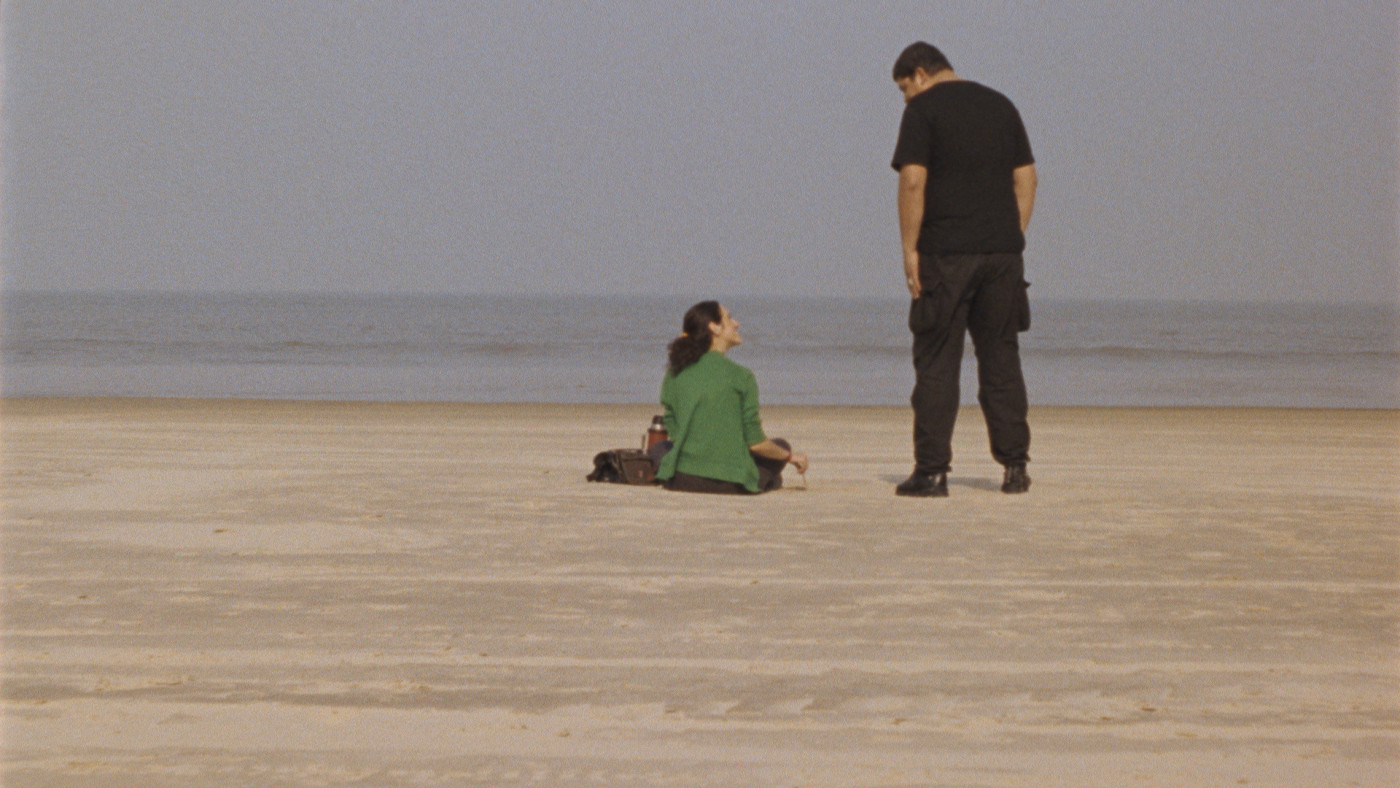
You can’t really call this a "chase." Nor even a “stalk.” More like a “showing some interest,” due to the guard’s extreme shyness and difficulty with the opposite sex. We viewers assume the role of a kind of camera, watching Jara, the guard, watch Julia the cleaner. We go with Jara to work, follow him home and meet his family. Then back to work where he takes his place watching multitudinous video cameras and begins to spy on Julia. All this would be creepy were he not such a likable, decent guy. About Julia, we learn precious little but enough to keep us, like Jara, on the hook. The girl has possibilities.

As does the writer/director Adrián Biniez (shown above), whose first full-length film this is. At only 84 minutes, the film’s pacing moves nicely, and its incidents involve us in various small work-related hassles -- some suspenseful, some funny, and one which has quite the surprising outcome -- yet keep us on track regarding this budding non-relationship. There is little exposition; everything we learn flows naturally out of what we see and hear. And Biniez gets wonderful performances from his two leads, Horacio Camandule and Leonor Svarcas, and from each of his supporting players.

Then the film is over. The final scene, all visuals, with lips moving but no dialog heard, drove me up the wall. Appearing to deliberately withhold information we could just as well learn, after an arbitrary change of POV, the scene goes on and on past endurance and left me angry. Yet I very much enjoyed Gigante and recommend it highly. (In the interview below, I talk with the director about this ending, so there is a major spoiler ahead. I’d suggest seeing the film first and only then perusing the interview.)

The estimable Film Movement (will it ever release an out-and-out loser? Doubtful. The company is coming up on film # 84, and while I've not seen them all, I've seen most) is releasing Gigante theatrically, first in New York City, this Friday, December 4 at the IFC Center, and then the following month at the Nuart Theater in Los Angeles. Watch for other eventual playdates, and of course being a Film Movement movie, it will find its way to DVD, as well.

***********

Speaking with Adrián Biniez, Gigante’s writer/director (also on hand is Film Movement's lovely Rebecca Conget for translation purposes, if necessary), is a little bit like being with his leading character, though Adrián, while perhaps just a tad on the beefy side, is nowhere hear the XXL size of his character Jara. Yet both have a directness and a sweetness about them that is charming indeed. I explain to Señor Biniez that, while I liked his movie very much, I did find the ending pretty annoying. He smiles and waits, expectantly, and so I charge ahead:

TrustMovies: I really, really liked the film right up until the very end. And then I found, as I sat there watching the two of them converse on the beach, him seeming to talk a mile a minute when, until this time, he has not talked much at all thru the entire film, I really wanted to know what the two of them were saying. We had his POV for the entire more the suddenly we’re pulled back and into another POV. So I want to ask you, Why did you decide to do it this way?

Adrián Biniez: For me the end of the movie is when they say hello on the beach .From there starts a new movie. The movie is about this guy trying to approach her, and the movie is from the POV of him, you know? For me when he starts to talk with her, we have a new… a new…

Chapter?

Yes, a new chapter, a new equilibrium for the characters, For me it’s about the intimacy of the characters, and from the beginning, I feel it is a very sentimental shot, so I knew it was a risk to go in that direction for the last shot.

What if you had simply gone to black after he say hello?

If I cut the movie in that moment, it would have made it a very “conscious” art-house, festival movie. Yeah—I believe that then I would have had a perfect ending, without risk. A very neat, perfect art-house film.

So then your ending makes it a little more mainstream?

Not really. Not for the audience, or for me. With this ending I felt I was taking more of a risk.

You’re right, because I sat there getting angrier and angrier. Unless you do a sequel, of course, which I usually don’t ask for. I was really interested in these characters. Even her, which is interesting because we really know so little about this woman.

For me it was, I knew from the beginning that if I cut in this place I would have a perfect history. But by going one stop more, I take more risk.

Did you ever consider letting us hear what they are saying?

No. I never did. Because there is something about the ethics of the situation. With the characters and with me. For me, it is a shot, it is not relevant what they are saying. Maybe it is only small talk.

Probably. But we’ve never seen Jara make much small talk at all. We don’t even know that he knows how to do small talk. You know what I mean? What a treat it would be to have that chance. Sorry: Trust me, I don’t do this very often. I never argue with the filmmaker or tell them, Oh, you should have done it this way. But I was so with the movie until this point. But then I sat there getting annoyed. So you’re right: Your ending was risky. My companion, he didn’t like the ending either, although he, too, enjoyed the movie as a whole very much.

Rebecca Conget: I really liked it, too, but I’m not part of this conversation.

TM: No, you are -- you are!

RC: I thought that if we had heard them, we were almost…. It was a private moment, and we would have been voyeurs

TM: But we’ve been voyeurs all along.

RC: But not for both of them. We are suddenly there for both, and so we are suddenly breaking that wall. So we are not given that satisfaction.

AB: Yes! Yes, she said it better than me!

RC: That’s how I interpreted it. We are now the ones looking at the story from a distance, and we are not allowed to go further.

TM: That makes sense to me.

AB: But it is a little risky, maybe often sentimental. Maybe it is a little kitsch.

TM: The movie does border on something like that all the way through, but it never crashes through to kitsch. Anyway, I just wanted to find out about that ending. So thank you. And it is about POV -- which is always important in a movie, but not always as important in the way that it is here. So thank you for exploring this with me. What was your budget for this film?

$500,000.

Wow—that’s pretty high. Is that more of less the budget for most film in Uruguay? That seems high compared to some of the small independent films I’ve covered, even here in the USA.

Well, because if the producers don’t have the money to pay everybody who has worked on the film, then they will not make the film.

So everybody involved in the film got paid for their work? That’s great!

It is part of the ethics of being a filmmaker. Maybe you can make a lot of movies without paying anybody, but it is difficult.

RC: Did you get money from Argentina?

AB: Yes, we did. And from Germany, too. It is impossible to finance a movie just from money from Uruguay. In Argentina, it is easier, But not in Uruguay.

TM: How did you cast your film? Where did that leading actress come from?

She’s my ex-girl-friend.

RC: You didn’t tell me that: You said she was just a friend!

(Laughter all around.)

AB: Yes. I started to write the movie with her in mind from the very beginning. But during pre-production, we broke up.

TM: But she still stayed in the film? Good. What about the actor who plays the lead?

At the beginning, I have this idea about an overweight guard who is attracted to one of the cleaning women in the supermarket. But I don't know what to do with this. So I start to write, and use my friend who is a very large, tall guy. So we began to rehearse. But my friend, he is a terrible actor. Very bad! So I start casting people, and the actor who ended up with the role was the first to come to audition. Seeing him was like getting some fresh air. This was his first film. He is a teacher of primary school in his regular job!

Well, he sure was good! Are you originally from Uruguay?

No, I am from Argentina but have lived since six years ago in Uruguay, in Montevideo.

We don’t hear that much about Uruguay – which is the nicer of the two “guays,” right? Is Paraguay still very dictatorial?

No, they have a democratic government right now. More or less. But, yes, maybe we are the nicer one….

When you’re as old as I am, so much of your life is in the past, and often the bad things you hear about a country stick in your mind. So, always, when I would think about Uruguay and Paraguay, I would have to think, now—which is which? I never had to be confused about Argentina, though! So you’ve lived there for six years. How long have you been making films?

This is my first.

Wow. You haven’t made any short films.

Oh, yes, I have made two short films. But the thing is, I already have wrote the script for this movie first. But the producers tell me, you never go to film school, and you have no training in film. So they say, OK: Maybe we can make this thing. If we produce for you first a short film, and if it is good, then we can produce your movie. So I made a short film called 8 Horas, 8 Hours, and when they saw it, they said, OK: Go ahead and make the movie.

Good. I guess things like that can happen in a small movie-making environment. And Uruguay is pretty small, movie-wise, right?

It only 3-1/2 million inhabitants – just like three neighborhoods of New York. So yes, it is very small: A small group of friends who make films. Even the producer is a friend of mine.

Do you have anything planned for your next project?

I am working on two new scripts, but I have only some ideas, and I have not yet the structure of the film.

You wrote and directed Gigante, right?

Yes.

RC: And he did the music, too.

The music!

RC: Yes, he’s almost like Chaplin! (Adrián does a little Charlie imitation)

How did Film Movement come to pick this up?

RC: We saw it in Berlin at its first screening. So it was the first film that we liked in Berlin. We only liked three films

What were the other two?

Storm, which we bought, And The Maid.

I loved both of those, particularly The Maid!

So we bought Gigante: We made the offer and were able to close the deal in Berlin before it won the award there.

Which Award?

The Silver Bear.

(To Biniez) Well, you’re in very good hands with Film Movement. So you have been living in Montevideo for six years doing films for all that time?

No, I wrote the script in 2004, and we released the movie in 2009 in Berlin. But I am working in regular jobs like bartender, things like that.

Oh, right, don't all young filmmakers do that?

RC: But you worked on other people’s films, too?

I also worked on a film called Acne.

TM: Yes, that was at the recent FSLC's LatinBeat fest.

That was my first time on a set. So in 2005 was my first short film was made.

RC: It is pretty amazing. And then he makes this film that wins three awards!

TM: How old are you?

35.

There really does seem to be a resurgence, or maybe just a “surgence” in Latin American film-making. Argentina and Chile have been making good movies for quite awhile now. It was funny, seeing The Maid, a Chilean movie that does not bring up Allende or Pinochet or anything that’s overtly political!

Yeah, yeah! This was a big problem for Latin American films in the 80s and 90s.

RC: And it was a big problem for Spanish filmmakers, too.

TM: Yes, with the Spanish Civil War. I remember that Félix Viscarret, the director of Under the Stars -- the film the opened the Spanish Cinema Now festival two years ago -- said something similar to me about Spanish filmmakers and the Civil War. “Yes, the war was horrible, and yes it needs to be addressed. But we don’t have to do this all the time, when there are so many other things to talk about.” But maybe for the older generation, there isn’t so much to talk about because the Civil War still festers. But then of course, when you see something like Gigante or The Maid, even we older folk realize that, yes, there are other things to talk about.

When I was a child, it was hard because in the 80s and the beginning of the 90s, it was a horrible time in Argentina. There were a lot of movies being made – political and artistic but mostly all bullshit: just pretentious movies. I was afraid to even go. Except to maybe one film a year -- they were all so bad. Oh my god- -pretentious movies but without a sense of filmmaking. Then started a new wave of film-making in Argentina. So now we fell there is something happening in the rest of Latin America, too.

I saw recently an Argentine film called Green Waters about a family that goes to the beach -- a father, who has a 13 year old daughter -- and they bump into a motorcyclist during the vacation. The guy is a very nice fellow, but the father starts to become jealous of his daughter. It a wonderful comedy with sort of thriller themes. Really good!

Our time is up, so we thank Senor Biniez for his time
-- and Ms Conget for hers.

Friday, July 31, 2009

THE COVE: destined for classic documentary status; filmmakers' Q&A


Once in a great while, a documentary comes along that does it all: informs, activates and entertains. Many docu-
mentaries manage this to some extent, but few -- if any -- have done it as skillfully, with as much full-
throttle excitement, as THE COVE. This is activism of a very high order: a film that pulls you in via its shocking subject and events, fascinating characters and super-smart


handling of both style and content. Expect to emerge from the experi-
ence shaken and angry.

Over the years many documentaries that set out to explore -- and help right -- wrongdoing have been able to manage this to a certain degree (Errol Morris' The Thin Blue Line comes most quickly to mind). Usually, the filmmaker lays out a scenario that explains the problem (with talking heads, some of which may try to de-explain it by and giving us the "other side") and then goes about attempting to "get the goods" on the bad guys, often with only partial success. The Cove gets these goods in spades, and its "money shot" is as sensational as it is ghastly.

You've probably heard that the film's subject is the small, beautiful but deadly cove (shown below) in Taiji, Japan, where, over the years, tens of thousands of dolphins have been slaughtered with stunning, bloody regularity. Why? Several reasons: the capture and sale of dolphins to amusement parks world-wide, together with Japan's tendency toward over-fishing and the "competition" that dolphins give its fishing industry. The Japanese government is clearly culpable here but every Japanese official interviewed on record waves away any responsibility (and any knowledge of same is kept secret from the Japanese citizenry).

For years now, marine mammal specialist and former "Flipper" trainer Richard O'Barry has been on a mission to stop this slaughter, and the movie tells his story. It also shows how the film's director Louie Psihoyos (seen above with his striking, silver-gray hair; anyone remember Jeff Chandler?) and his crew became involved and how, together, they accomplish what no one has so far been able to manage: recording the ugly slaughter.

The film has plenty of thriller elements, provided by producer Fisher Stevens, shown right, after he came aboard the project. It was Stevens' idea to merge the film itself with the "making-of" movie that the director was shooting simultaneously, thus providing a very different film -- one that tracks events as they happen and nets a number of jolts, thrills and surprises. (You can find out more about how the movie came into being in the Q&A round-table interviews, transcribed below -- with Stevens and Psihoyos, and then with O'Barry -- held shortly before the film's opening.)

The commercial release of The Cove, it is believed, will be the beginning of the end of this slaughter. We can only hope, along with the filmmakers, whose achievement -- it's a splendid, horrifying one -- opens today, distributed by Roadside Attractions, on screens in New York and Los Angeles, with another 70 theaters across the country to be added in the coming weeks. You can find release dates, with cities and venues here.

(All photos below are courtesy of The Cove.)

TrustMovies and a half dozen other film bloggers met with three major players in The Cove's filmmaking team -- director Louie Psihoyos (pronounced to rhyme with "sequoias") and producer Fisher Stevens, and then with the man who first took the action that set the ball rolling, marine mammal specialist Richard O'Barry -- in a conference suite at New York City's classy Loew's Regency Hotel. It was Mr. Stevens who took the first question regarding how he'd become attached to this movie.... (Note: Blogger's questions appear in boldface; filmmakers' answers in normal type.)

Fisher Stevens : I got involved about a year and a half ago -- through Jim Clark, founder of Netscape who started Silicon Graphics and Web MD among other things. He was a good friend of mine and of Louie's. We’ve all been diving on Jim's boat a number of times. When I first met Louie, I asked what he was doing, and he said, 'I’m involved in a making a documentary,' so on a later trip on Jim's boat, we screened the doc I had recently made, Crazy Love. And then six months later, Jim said, 'Look, I'd really like you to come aboard and help out on this epic journey that Louie is involved in.' I looked at some of the footage Louie had shot and was blown away: There was an amazing film here.

Our idea was to make this, not just a documentary, but also an action thriller. The ramifications of what The Cove stands for was much bigger than just the cove itself. So I brought on Geof Richmond who edited Sicko and Murderball, and Mark Monroe, with whom I had made another doc, Once in a Lifetime. Then we sat with Louie in Boulder, Colorado, and came up with what you’ve now seen.

A question to Louis: Where did you get this.. what seems like almost a lifetime calling?

Louie Psihoyos: I've been working in media, as a photographer for National Geographic for 18 years and as a photographer for Fortune for about five, where I met Jim Clark. Though I was a success-
ful still photographer, I feel like I’ve been walking in the wilderness until now. Filmmaiking is such a much more powerful experience. I wish I had started this 20 to 30 years ago! Like, for instance, I had never seen a businessman cry, certainly never working for National Geographic but I have seen every audience for this film react like that now. Crying and screaming and cheering and asking 'How and where do we go to help?' When Jim gave me the money to make this film, he said, “Just make a difference.” That's his philosophy He wants to change the way we think and live and work.

Ric O' Barry was supposed to be a keynote speaker at a conference I attended, then all of a sudden they pulled him off the ticket. The sponsor did this; it was Sea World. So I called up Ric and he told me about the dolphin slaughter in Taiji. I couldn’t believe it. So I took a three-day crash course on film-making, hiring a producer who showed me how to use the camera, and so on. Like everybody else, I watch films and see how they are structured. But I needed to learn the basics.

How many hours did you shoot?

About six hundred. With a feature picture, it's usually 50 or 60 to one hour that you end up using, but with cinema verité you shoot 200 to one.

How did this whole kind of sleuth undercover dimension to the film enter into it?

We were shooting two movies at the same time: the movie and the “making of” -- both at once. Fisher came along and had the idea of putting both movies together into one.

Fisher Stevens: I had never seen anything like this before. When I saw it, I thought, These guys are amazing. And because Louie was already a photographer, the look of the film was incredible. But I had to convince him to be in the movie. He didn’t want to. Originally none of the team were in the movie: Not Louis or Mandy or Kirk. Then we brought Mark Munroe in to kind of help plot things out. We were screwing around about getting a narrator, maybe like Bill Murray -- you know: do a kind of Steve Zissou - -but then we thought, why not make Louie the narrator. It’s perfect. It made such sense.

Louie Psihoyos: I didn’t want to be like a Michael Moore and call attention to myself. I come from a journalistic background. I wanted to keep myself out of it -- not being an actor.

Fisher Stevens: It's the "mercury" element of the story that was kind of key. And Louie said, "No matter what, we have to tell the mercury story. But there was like an hour’s worth of mercury -- big chunks of it -- and mercury is not the most dramatic thing. So we had to find how to incorporate it -- which was difficult but it became one of the most powerful parts. When it is revealed that they are considering feeding this fish full of mercury to schoolkids, and then when they manage to stop this.... It took a lot of finessing to get all that in.

Mercury?! Did Jeremy Piven ask for a private screening?

Fisher: He did. He actually did.

Louie: And I took over Jermey Piven’s apartment here in NYC, too! Weird coincidence.

Fisher: Piv is an old friend of mine, and when I went to see the show Speed the Plow, he said to me, "Oh, man, I‘ve got mercury poisoning. And I feel like crap."

I told him, 'I am doing this movie The Cove' (we were just cutting it then). He said, 'I’ve got to see it!' I did advise him not to leave the play, by the way. But he was really sick. I've had mercury poisoning myself, and so has Louie. I do know for a fact that Jeremy has very high counts of mercury.

How do you get this mercury poisoning – just from eating fish?

Louie: Eating fish that are high on the food chain. Mercury in the most toxic, non-radioactive element in the world. You do not want this in your system. It is very difficult to get rid of it. Eat lower-on-the-food-chain fish; these have as much Omega 3 but not nearly as much mercury.

Fisher: I was eating tons of sushi and tuna and was not feeling well at all. I had quit eating meat and was eating almost only fish. I went to a nutritionist and took these standard tests -- hair and blood -- and two weeks later out of the blue the NY Board of Health called me and told me that I had extremely high counts of mercury, and to not have a child for at least six months. So I immediately cut out all high-on-the-food-chain fish. They asked if I was eating sushi. Yes: three time day, and tons of canned tuna, too.

Louie: I went to Minamata, Japan, where the first big outbreak of mercury poison was in 1956. All the doctors there are very versed in all this. So I went there to interview them and met with them and took them all out to dinner. I had ordered, in advance of the dinner, sushi. Of course: what else? And none of the doctors would eat it. I asked, What’s with this. Japanese eat more fish than anybody: 66 kilos per person ever year, they eat their weight in fish. So the head doctor there told me, We did this experiment, where we ate tuna everyday, 200 grams, which is less than half a can, and the cheapest cut we could find. By the end of two weeks, our mercury levels had doubled. Once doctor dropped out of the study immediately. The other five pushed on, but they said, 'Let's get sushi-grade fish from now on.' So they did, and their levels went up eight times! The doctor then asked me, Do you eat a lot of fish? Sure, I said. That’s all I eat now. You better get tested, he told me. So I did, and my doctor told me I had 24 parts per million -- the highest level of mercury of anybody he had ever seen in Colorado.

Has it diminished now?

It has a half life in your body of 70-90 days. Through the chelation process I got it down. You can also get your blood filtered. But the easiest way is to lay off the large fish. In three months, my mercury went down to 12 parts per million, then three months later it was down to six, and now it's down to 3.

What about Salmon?

Louis: Salmon is about 1/20th.

Is this because salmon is in cleaner rivers than the ocean?

In every state there are Mercury advisories now. For a lot of different reasons. There is a lot of big turnover in lakes, and also now from all the heat. It is hotter now, so there is more microbiotic action. When the mercury comes down from the atmosphere, it goes into microbes, and it is thought that, because it is hotter now, the anaerobic bacteria eats it and digests it.

Even the doctor we interviewed -- Dr. Akino, to whom we showed the levels of mercury in the dolphin meat -- would not allow us to film him. He told us that the dolphins have higher levels of mercury than even did the fish in Minimata -- that started this whole thing. He said it’s a clear danger! But he gets his money from the government. It is very difficult to describe how much pressure there is from their government on doctors and on the Japanese media.

But the average person on the street in Japan does not know this is happening. But Sea World sure does!

We tried to get Sea World to talk to us. But they wouldn’t.

Does the Japanese government have any idea the effect this film will have on them? They will look like the worst country is the civilized world.

Well, let me give you this example: Fisher and I did a pubic service announcement in Japanese that we then put on DVD. Last year I was taking a plane ride down to this important conference in Santiago, Chile. To get the members to take a look at it. We knew the movie was coming out but that might not be for another year, so meanwhile, we wanted to alert them that tens of thousands of dolphins are dying needlessly and people are getting hurt due to these toxic levels of mercury. So I brought this DVD down to Santiago on the plane. I had a whole bunch of copies. I got on the plane for this a ten-hour ride from Dallas to Santiago. I was late and there were only a couple of seats left, so I sit down in one of the only empty seats and a minute later another guy sits down next to me. He turns out to be the boss, the actual boss, of the two Japanese guys we interviewed in our film. And here he is! He's a funny guy, with a good sense of humor, and I talk to him about this whole thing, explain about the film. I show him the promo of the movie. I told him the whole thing. He listened, he saw it all. I told him there’s this movie coming out that will make you and your employees and your entire country look horrible. And now he’s had a year, a year and a half, to do something about this. To do the right thing. And he did nothing. Nothing at all.

Fisher: It’s about these very few fisherman that are doing it, and the government knows it and is turning a blind eye.

Has anything new and positive happened since you made the film? I mean, from the point in the end credits where we are brought up-to-date? Has anything good happened since then?

Louie: No . Only that this movie is finally coming out. And there seems to be this tsumani of overwhelming positive pressure: People from Lithuania, Russian, from all over the world are signing petitions, writing in, trying to do something about this.

Fisher: We have sold the film in about 20 countries: France, Germany, all of them with good distributors. And a very nice and wealthy individual named Bobby Sager is paying for a Japanese dubbed version -- and we are going to find a way to get this out in Japan, if it's the last thing we do. Getting it out across the world will put pressure on Japan's government to stop this. We feel confident that something will change.

We open in 70 screens over the next few weeks . Four screens on July 31, then 25-30 more the next week , and then the following week 25-30 more. Hopefully more. So, if you guys keep writing about it and keep pumping it, that’s the key for us.

Have you gotten any word, reaction, backlash, from the Japanese yet?

The director of the Tokyo film fest saw it two weeks ago. He said -- given the theme of this year’s festival: the environments -- that it would be hypocritical of them not to show this film. But that we had to understand that it is the Japanese government who pays for the festival….

Given the subject of the film and that it is Japanese-negative, I would think that both China and Korea would be certain to show the film.

I think we’ve sold it in Korea, but in China, where everything is pirated…..

Are you going to eventually do what was done with Earth – put it on line for free for a period of time.

Fisher: We would like to make a little bit of money with this first.

Louie: Personally, I think when you give something away, that is what its perceived worth becomes.

Fisher: We want this to be sold as a film, as a thriller, rather than a preachy movie. You’ll be entertained, excited and enlightened. We want it in a theater, so that people will know they are going to see a movie!

This may be no joy to you at the moment, but I think The Cove will wind up being a classic film that people will watch, regarding the documentary form.

From your lips to god’s ear. But my whole goal in making movie is to entertain. entertain. We must have watched about 200 docs, but we still want to entertain.


Louie: My whole goal in making the movie is to change the world.

That’s the true nature of subversion: have people come to a conclusion with out knowing they were pushed. And then they behave differently as a result of this.

Fisher: Anyway-- all of you: thank you for everything!

After the Stevens/Psihoyos Q&A,
Richard O'Barry arrives and the questions begin anew....

You had been dealing with the problem of the cove in Taiji for a long time before the movie was made, right? Louie and Fisher just explained how they came into the picture....

Richard O'Barry: Yes, and when Louie showed up, I thought, 'Well, this will be helpful.' At first I thought, 'Maybe this will show up on TV at 3 am in the morning and a few people will see it.' And that’s where Fisher Stevens comes in. He said, 'Make this entertaining.' And he's the reason it is entertaining. When Louie called and said, 'Can I follow you around with my camera?' I said, 'Sure.' But at some point Jim Clark brought in Fisher, and there wasn't a real movie there until Fisher came aboard .

Who did all the cameras-in-the-rocks thing and the fake rocks being made?

Louis had all that done. But the bottom line is to make the film entertaining. Unlike a TV show, people have to stand in line, park their car, pay money. That means entertainment. Louis surrounded himself with very talented people.

Will any of you ever be allowed back in to this town again? Into Japan?

It is not the entire town of Taiji that is doing this. It's just a few individuals. I like the town, country -- Japan and the Japanese people. That is why I am opposed to a boycott of Japan. That is a form of racism and an indictment of the whole Japanese. Even the people of Taiji are not guilty. There are only 13 boats and only two men in each boat. Just 26 guys.

But they’re all millionaires.

No, just upper middle-class. They make a very good living.

One thing that’s troubled me: You mentioned that the underpinning of this slaughter is the selling of dolphins for profit. Why do they have to slaughter all the rest if they already have caught the dolphins to sell? The rest can’t all be for mercury-tainted food to give to Japanese school-children?

One day my wife and I were in Taiji, and the police took us in to the city fathers for a meeting: the first time they had ever sat down with westerners. We offered to subsidize them. I had a video camera but they said I could not use. I wish now I had just turned on the sound because I would have had this recorded: When we offered to subsidize them, we told them this: If you stop the killing for one year, we will pay whatever those 13 boats earn. They told us it’s not about money its about pest control. In other words, over-fishing is the real problem. So the government is telling them to do this.

I have asked those fishermen, and they say they don't want to do this. In fact most of the younger guys have already quit. The older guys now take over. I asked them, what would happen if you did not get the permit to kill the dolphins each year? They told me that, in those same months, September through March, then they would simply fish for lobster or crab. So not killing the dolphins would not be putting them out of business. The dolphins are being targeted. Because the fisherman want to kill their competition! Dolphins eat too much fish -- between 30 and 50 pounds of fish per day. Times 23,000 dolphins. So, kill this competition. But they don’t advertise this, they don't tell you this. Instead they come up with, 'Oh, you're a cultural imperialist. This is our culture, our tradition.' Which is not true, by the way. Overfishing is the real problem.

Did I miss this explanation in the movie?

It’s there, but it’s pretty subtle. They probably should have made it more important. But they had a real struggle – to get this whole story from 300 hours down to 90 minutes.

Were you aware of yourself as a character in the film? (Ed: That's Ric -- in disguise -- below, which is the way he has to look in order to get in and out of Taiji these days. He is also shown, out of disguise, third from right, in the third photo up from here....)

No. Not until I saw a cut of the movie here in NYC two years ago. I thought for example the other people -- Mandy or Kirk --for instance are much more interesting. I mean, this woman can free-dive 300 feet on one breath of air!

Is the next step then, to sensitize people to imagine what the dolphins' lives are like, that they want peace and quiet instead of being made to perform in these noisy Sea World kind of places? It’s no wonder then that they would rather kill themselves.

I think this film will do that. That’s why it’s the light at the end of the tunnel. I think people will now think twice before they buy a ticket to watch dolphins perform. I mean, this is a billion dollar industry. Two billion dollars alone in the USA -- profit. It’s based on supply and demand, just like any other product. If consumers can be educated, they will stop buying tickets. I’ve been saying this for 30 years. But there’s no way for them to get that education. Because Sea World – Anheuser-Busch – is the largest advertiser in the world. When you turn on the TV and are watching the SuperBowl or the World Series or even a small volleyball game in Miami Beach, you’re seeing that Budweiser flag above the American flag – it’s everywhere. And so you can’t get this info out to the public. Just a few days ago.... Well, I live in the Miami Beach area, and the film was playing just two blocks from my house. So I called the community newspapers, all of them, to get this info out to the public. They’re all owned by the same publisher with the same editor. They wont touch this story because they don't want to offend their client, the Miami Sea Aquarium. That's the proboem. It has always been the problem. But now it’s different. This film is going to be mainstream. People are going to see it. And then they will think twice before they buy a ticket.

How did you establish yourself as a dolphin trainer?

It goes back a ways to 1955, on Christmas Day. That was the day the Miami Sea Aquarium first opened. I went there, and I looked into the tank through the window..... An amazing sight! These dolphins, sawfish, giant groupers, sea turtles, all flying around. This kid was walking around, like underwater in slow motion, handing fish to all these creatures. It was so surreal. I said, 'When I get out of the navy, I want this guy's job.' And five years later, when I got out, I did have that job. But my job was not in that tank but on the capture boat, and I was capturing dolphins. That's how it started for me.

When you are capturing, and then working with dolphins, did you get the idea that they are smart?

Yes.

So when did you begin to question your right to manipulate them?

Well, first off, I was in the military for years, and when you’re in the military you are trained not question but instead to do what you're told. Just do your job. So that was my mind set. You don’t question authority. It took awhile after I was living with them before I realized that there was something wrong with this. Even then, I didn't do anything about it. After all, I was buying a new Porsche every year. I was the highest paid dolphin trainer in the world. It’s real easy to put your blinders on. That was what we call it in that industry: Putting your blinders on.

Didn't anybody ever raise the questions to you: 'Do you think this is right?'

Yes, but not the people you’re working with. And the reason is that it's an optical illusion. People don't have the right information to understand. When you go to these parks, it’s a beautiful day, the family is with you, the music is playing, the sun is out, and the dolphins even seem to be smiling back at you. Unless we were hitting these dolphins with baseball bats, the onlookers wouldn't be able to understand the abuse!

The dolphins have no power when they’re in captivity. They are controlled by hunger, and so are controlled by their food. Depending on their size, they must eat between 15- 30 pounds of food each day. So unless they do things -- their stunts -- correctly, their food is withheld from them. The trainers call this "operative conditioning" or "positive reward." But from the dolphin's perspective, it's food deprivation, because if they don't cooperate, and sometimes they don’t, they don't get their food. Oh, they'll get food at the end of the day. But still, you're manipulating and controlling them.

The rest of the animals in the zoo don't perform. But dolphins do. They are the only animals who must do this. So captivity for them is more stressful than for any of the other animals. Their brain is one third larger than the human brain. A coldblooded snake in a zoo with a smaller brain is given more of a normal environment than are the dolphins.

The dolphins' environment is just water, the tank, and nothing else. Just a barren wall. If you did that to snakes, people would complain. How come people aren't complaining about the dolphins' environment? Because people are conditioned to think that they belong there!!

Do dolphins show anger?

Yes, they do. They will do what we call jaw-popping: They pop their jaw. That is one reason the Flipper show ended. Because the dolphins were getting angry at the people, at their getting in the water with them, and they were beginning to hurt them. There have been a lot of people hurt: concussions, broken ribs. Both trainers and tourists. These lawsuits are covered up, settled out of court. Dolphins will hit you with their tails, they’ll ram you and bite you.

Are dolphins smarter than human beings? Then why are human beings predominant?

Well, some people would tell you that they are, and others that they are not. I’ve come to believe that they are not more intelligent or less intelligent but they are just different. Human beings can't do any of the things a butterfly can do, or a caterpillar. So from their perspective, we are not very intelligent at all. I’ve struggled with this concept for years now, and have decided that "intelligence" is a man-made concept that doesn’t relate. We can’t do any of the things that dolphins can do. Our species has only been here for a very short time now. If you look at time as though it were the distance of a football field, the dolphins have been here the whole length of that field but we have not.

I notice on the IMDB that you have another movie in the works.

My son is developing Behind the Dolphins’ Smile.

Is this narrative film?

No, it’s autobiographical. My story has been optioned several times, but nothing has ever come of it. At Sundance, I must have been approached by a dozen or more filmmakers who wanted to do my story. But I leave my son in charge of that. I would rather stay focused on this: what I am doing right now.