Showing posts with label Anime. Show all posts

Friday, January 25, 2019

On Blu-ray/DVD: Masaaki Yuasa's bizarre, boisterous (and eventually pretty profound) anime, THE NIGHT IS SHORT, WALK ON GIRL


TrustMovies doesn't know quite what he expected when he sat down to view THE NIGHT IS SHORT, WALK ON GIRL, the 2017 Japanese anime just now hitting Blu-ray and DVD via the combined auspices of Shout! Factory and GKIDS.

According to the press release, the animated movie is "a free-wheeling comedy about one epic night in Kyoto, in which a group of teens go out on the town." While that description is, yes, more-of-less true, it barely begins to give you an idea of the utter strangeness and (I think) cultural foreignness of what you are about to encounter.

Directed by Masaaki Yuasa (shown at left), the movie -- based on a popular novel of the same name written by Tomihiko Morimi and illustrated by Yusuke Nakamura (the latter also served as the film's original character designer) -- is so full of oddball characters, both human and supernatural, and cultural references seeming perhaps rather bizarre to non-Japanese, that uninitiated viewers had best sit back and simply let the movie flow in, over and through them.

Eventually, during the final third of this 93 minute movie, things begins to coalesce and, if you're anything like me, you may find yourself surprisingly moved by the theme that finally makes itself most felt: that of how important are the connections -- all kinds of 'em -- between people.

In the film's most surprising scene, our heroine explains to an evil supernatural being how his misdeeds have actually connected people so that they -- and he -- are not alone. My god, this might mean there is hope even for someone like Donald Trump. (No, I am going way too far with that prognosis.)

That heroine, a college sophomore, known here as Otome (above), is being followed/stalked (but nicely) by a senior called Senpai (below), a probably decent enough fellow who is coming undone because he can't deal with or understand his mixed feelings of affection, sex, love, caring and all the rest.

The anime is peopled with lots of other characters, many of whom are as bizarre and interesting as all else in this very strange and energetic movie, the animation of which is super colorful and often quite inventive -- more and more so as the movie rolls along.

There's a "used-book ghost/being" (above), a love-smitten character who refuses to change his underpants, and a friendly pervert (below) with quite the collection of erotica (further below, with the sexual organs blocked by colorful florals).


Otome drinks like a fish yet never seems to actually get drunk. She can drink everyone else in the film under the table: This is one of her many "abilities" -- and one reason for parents to make sure they watch the film along with their under-age kids and then try to explain it all later.

The movie compares to little else I've seen (though maybe you're more anime-educated), and I suspect it will stick with me for some time. The combo Blu-ray/DVD package hits the street this coming Tuesday, January 29 -- for purchase and/or (I hope) rental. Enjoy!


Tuesday, July 5, 2016

Eiichi Yamamoto's BELLADONNA OF SADNESS: Blu-ray debut of the restored and rediscovered masterpiece of erotic animation


A "must" for anyone who appreciates animation, eroticism, and/or the culture and spirit of the 1970s, BELLADONNA OF SADNESS -- a Japanese anime originally released in 1973 (but never seen theatri-cally here in the USA until 2016) and based on the French erotic novel, La Sorcière, by Jules Michelet -- is so very different from the kind of animation we get these days that it seems almost quaint. Yet within that quaintness resides a wealth of eroticism and wonder.

As directed by Eiichi Yamamoto (shown at right), with art directions by Kuni Fukai and a succulent, of-its-time-period musical score by Masahiko Sato (the time period in question is the 1970s, rather than the medieval era in which the story is set), the movie tells the tale of young lovers Jean and Jeanne (shown below in one of their happy times) who, on their wedding night are summarily separated by the Lord of their village and his nasty wife. Jeanne is repeatedly raped by that Lord and his men, while Jean is tossed out of the castle to find his way home, alone.

Already we're in the realm of class, economics, sex, rape, religion (the town priest looks on at these goings-on with utter benignity), the psychology of self-loathing, and feminism -- seen, of course, via the eyes (and the paintbrush) of the male. Naturally, the female of the species isn't simply the victim here; she's the perpetrator, too. Ah, Eve: you naughty, naughty girl!

What makes the animation so lavish and lush -- and utterly different from what we're used to these days -- is its simplicity, symbolism, use of color, and in particular, its use to white space. Take the initial rape (above): the combo of sudden violence, jagged art and dense and pounding music makes the moment something of a staggerer.

What's oddest about the animation is that is rarely moves much. And yet the colors -- whether bright and saturated, pastel (above) or intricately shaded (below) -- are quite magical to view. As we learn of the ups and down of our gorgeous couple (mostly downs, unfortunately), we also meet Jeanne's "saviour," who turns out to the devil --first appearing to our heroine in the guise of what looks suspiciously like a little penis (below), and very soon he is doing all those pleasurable things for which the penis is best known.

Before you can say, "Sell me your soul, sweetie!" Jeanne does just that, in order to exact some revenge upon her "Lord." But revenge, which constitutes the remainder of the tale, turns out to be rarely sweet, often ugly, and almost always erotic.

And true to the times -- then, now, and forever, it would seem -- it's the Lord's wife (above, center left) who is punished most (along with her page, extreme left: ah, class distinctions!), while the Lord (center, right) and his Priest get off scot-free.

Along the way Jeanne gets fucked by Satan, which becomes one hell of a light show culminating in a riot of all the colors, styles and time frames you could ask for, followed by one of the most all-out sexual orgies that animation has ever given us, as though Picasso and Bosch had joined forces but confined themselves to the use of only happy, bright, approaching-day-glo colors.

The Black Plague? Of course!  And how well it is done, decimating an entire city in seething black-and-white animation. Finally Jean and Jeanne do get it on -- in the sweetest of the segments, all pastels -- and then we quickly return to the bad times once again.

But even those bad times are hugely erotic -- notice how the smoke from a burning-at-the-stake curls around and into every orifice with such sinuous glee -- all accompanied by Masahiko's signature 70s music that will take you pleasurably back in time. The film's final shot, by the way, is a hoot and a half -- and thoroughly anti-church.

On the Blu-ray extras are some very good interviews with director, art director and composer that give us some history of each man, as well as his approach to what he felt was needed for this particular movie. Also included is the original Japanese trailer for the film, plus the current trailers, both red-band and green.  (The film is also said to include eight minutes of explicit footage, rescued from the sole surviving release print. As explicit it is may be for its time, however, don't expect much, maybe any, male full-frontal.)

After its 50-plus theatrical engagements across the country, Belladonna of Sadness -- from Cinelicious and The CineFamily -- hits the street this coming Tuesday, July 12, on both Blu-ray and VOD -- for purchase or rental. Just make sure the kids are in bed before you watch, or you will have an awful lot of questions to field....

Monday, January 24, 2011

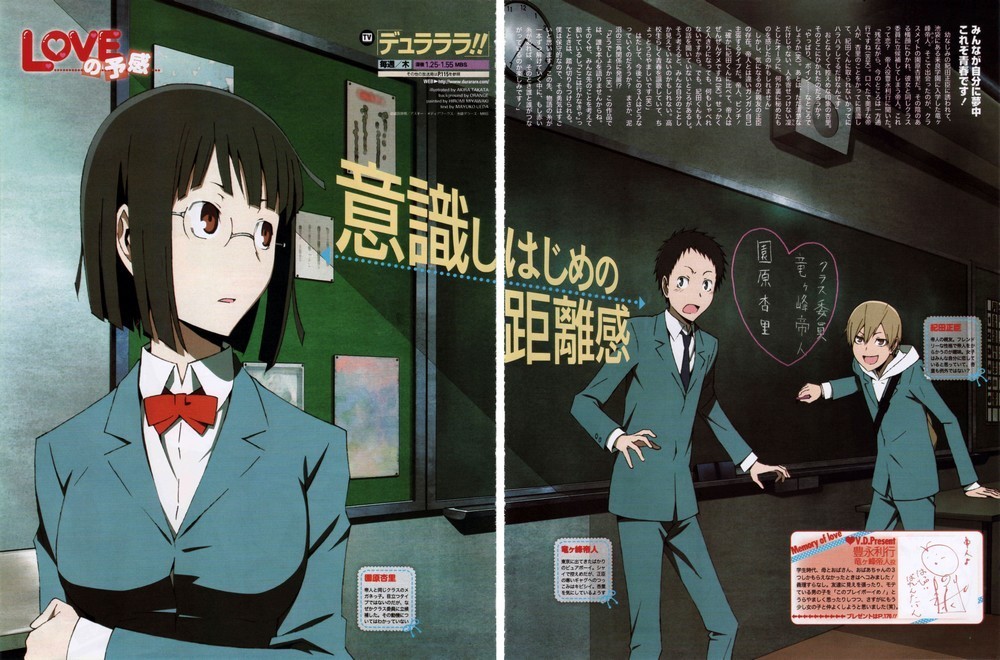
Anime time: DURARARA! debuts -- the hit TV series gets a DVD release from Aniplex

I don't watch Japanese anime all that often (which is probably just as well). When I do, however, I am charmed all over again with its odd combination of relatively simple figures and faces -- looking much alike, with just a few facial strokes, together with hair color and costume, to differentiate the leading characters -- and stories that are rich in childlike fantasy but also replete with darker themes and concerns that you'd rarely find in a show kids were watching on this side of the Pacific. So it is with DURARARA! -- but don't ask me what that title means. The press was given only five episodes (on a single disc) of Part I of this series -- which has in total three parts, each containing 8 or 9 episodes (That's the box cover art and part of the sleeve, shown above.) Perhaps the meaning of the title will come into play later on in the series.

Those first five episode were enough to have me wanting more. Had I received the remaining ones, I certainly would have continued watching. The story -- which keeps expanding ever outward, as well as circling in on itself -- has to do with a group of high school kids in an area of Tokyo who becomes fast friends through a series of very odd encounters.

These include everything from a suicide attempt (in episode two, I believe, and shown above), which proves the strongest, deepest section and includes some worthwhile philosophy and ideas about personal responsibility toward ones self, as well as how to better understand and view one's parents. This section is one that I believe most teenagers might benefit from viewing.

There's a mysterious "headless" motorcyclist -- above, left -- whom we learn a lot more about in the course of the episodes, and who has a small satellite of subsidiary figures circling round (such as the blond, above, right).

There's a sympathetic doctor, carrying a torch for his "roommate," a very odd and alternately menacing/friendly Russian immigrant (above), hawking for a nearby Sushi restaurant, who can, when necessary, fight (below).

And so much more. The plot was still expanding outwards ( and maybe inwards) when I came to the end of episode five (each one is around 21-22 minutes long). Last Saturday morning, when I stuck the disc into my machine, I was going to watch only a single episode before getting back to work. As if.  Some hundred-odd minutes later, I got up from the sofa to finally pour my second cup of coffee.
 
One of the particularly weird things about anime (for us Americans, at least) is how it combines kid's cartoon fun with barely pubescent young ladies showing off very curvy boobs and lots of leg. (The girls' uniforms are uniformly small and tight.)  Myth and legend make their appearances, too, along with lots of action -- car chases, martial arts fighting -- and loads of love, loss and betrayal. There's literally something for everyone, but I admit that it will -- for newcomers to anime -- seem more than a bit unusual to have it packaged together in this manner. 

All this makes for quite the heady (some might call it loony) mix of themes both adult and childlike, serious and comedic, fantastical and all too real.  I wouldn't want to see this sort of thing that often, but every once in awhile, there's nothing like a good anime. And Durarara! -- episodes 1-5, at least -- is very good anime.

The three-part series comes to us via Aniplex of AmericaYou can order all three parts of the series now from The Store or Right Stuf. Part One will ship this week, Part Two in March, and Part Three in May. I would hope Durarara! will be available for rental, too, but as of today, I could not find it listed with either Netflix or Blockbuster