Showing posts with label Catalan films. Show all posts

Tuesday, November 20, 2018

In Ventura Pons' MISS DALÍ, we see that infamous artist from his sister's viewpoint


I have long enjoyed the oddball movies of Catalonia filmmaker Ventura Pons, who used to be something of a staple at the FSLC's Spanish Cinema Now. It has been several years since I've had the opportunity to see one, but the drought is now broken by the very limited release of his latest, ever-oddball work -- MISS DALÍ -- about narcissist nutcase and semi-talent, Salvador Dalí and his family and "friends." I use that last word loosely, as I am not at all sure if the artist's treatment of those people closest to him could qualify as anything approaching real friendship. I once knew briefly one of the handsome young men the artist used and abused (both emotionally and physically, I suspect), and the result was not a happy camper.

Though the "Miss" in the title refers to Dalí's younger sister Anna Maria, it could as easily apply to the artist himself, as campy and gay -- but closeted -- as they probably ever came. (Think John Waters -- but without the closet, or a lick of the honesty and moral clarity Mr. Waters possesses.) Writer/director Pons, shown at right, has based his film, I am guessing, upon the written works of Anna Maria about her brother, her family and their life. His framework consists of a daylong-into-evening conversation between the aged Anna Maria (played with vigor and great feeling by Siân Phillips, on poster, above, and below, left) and her long-time friend Maggie (played by Claire Bloom, below, right). This conversation covers much of a lifetime, allowing incident after incident to be recounted, as we move back and forth in time from present talk to past happenings.

The conversation comes at quite an artistic cost, however, as the exposition here is so bald-faced as to be near shocking. And while Ms Phillips is quite marvelous, having been given the better selection of dialog, Ms Bloom is utterly wasted, having to sit quietly by murmuring little more than the likes of "Ah, yes, I remember" throughout.

The movie is saved in part by the energetic and very well-acted flashbacks, often shot in black-and-white (sometimes sepia-esque), with but a single color very subtly on display: the blue of the sea, a bit of green in the shrubbery, or maybe the rust shade of a dress. In these past-time scenes, Anna Maria is played by another wonderful actress, who seems to be making her full-length film debut here, Eulàlia Ballart, above and below, center.

Ms Ballart beautifully communicates the longing of unrequited love (for playwright/poet Federico García Lorca), as well as the gnawing, if quiet pain that builds when one is considered the lesser light in the family (first, a female; second, a non-artist). Lorca, who, as shown here, was in love with the unable-to-respond Salvador, is played by the lovely and graceful young actor José Carmona (above, right, and below, left), who captures Lorca's yearning and passion, as well as, in his recitations, a fine understanding of the poet's work.

The film's liveliest performance is given by Joan Carreras, as Salvador (above, right, and below). Carreras captures Dalí's zeal for notoriety and fame above all else (with money not far behind), and the actor's energy, wit and, yes, charm, go a long way in reminding us how much fun the artist could be. In small doses and for while.

The other actor who shines brightest here is Senor Pons' long-time performance collaborator, Josef Maria Pou (below, right), who plays Dali's stern-but-way-too-forgiving-and-enabling father. Pou proves alternately angry, funny, caring and shocked, and he is, as always, marvelously entertaining.

Most of the drama here comes via the flashbacks. The exposition, which makes those flashbacks possible, is also somewhat draining (Miss Dalí lasts over two-and-three-quarter hours). TrustMovies was never bored, however. The lives and situations, as depicted here, are just too interesting, provocative and annoyingly enjoyable to look away from. And the locations, with their visual splendor, provide a most enjoyable, affordable vacation.

We also get glimpses of Salvador's wife, Gala (played by Rachel Lascar, above, left, and below, right) -- a woman who, according to what we see here, almost no one liked -- except, of course, Salvador and Gala herself.

I wish we'd seen some of the artist's work. We don't, so I suspect that the permissions and copyrights must be locked up tighter than a drum. Or they're way too expensive for a Ventura Pons budget. While I often found the artist's work a lot of fun, certainly original, full of symbols and Freudian-as-hell, I also feel they are about as deep/profound as that puddle left by yesterday's brief rain shower. If only for his wretched treatment of Lorca (an artist whose work was deep and profound), both before and after the poet was murdered by Franco's minions, Salvador deserves this film as his memorial.

From ELS Films de la Rambla and running 168 minutes, Miss Dalí opened this past weekend in New York City (at the Cinema Village) and will open in Los Angeles at Laemmle's Monica Film Center this Friday, November 23.

Saturday, December 17, 2011

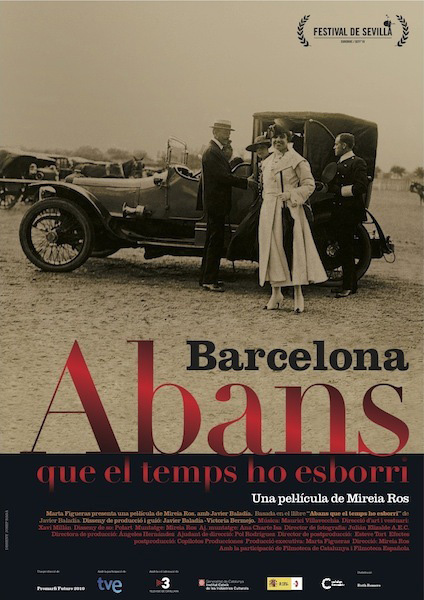
SCN: Mireia Ros' BARCELONA BEFORE--another knock-out documentary hybrid


One of the jewels of this year's Spanish Cinema Now unfortunately received only a single showing last week, so TrustMovies is awfully happy he managed to get to it. Based upon the book by F. Javier Baladía, and, in a sense, starring the handsome writer (shown below), BARCELONA BEFORE is one of those fascinating hybrid documen-taries we're seeing ever more frequen-tly, each one as different as the one that came just before.

In this film, Señor Baladía introduces us to his extended family of ancestors and in doing so takes us into the environs of the Spanish city of Barcelona at the turn of the 20th Century. What a bunch they were -- and what a movie has now been made about them! The film's director is a young woman named Mireia Ros (shown below), a Catalan actress who has expanded her reach into direc-ting and editing.

Ms Ros edited this film, in fact, and a splendid job of it she has done, melding past with present, sometimes in the most delicious manner. Speaking of delicious, her movie begins with a wartime potato recipe that slowly blossoms into something colorful, stylish and joyous, setting the program and the pace for what we're about to see. For his book and now for the movie, Baladía appears to have unearthed a trove of wondrous archival photos that help bring to life the age and the personages of time past, and how Ros handles all of this is, I think, rather exceptional.

The filmmaker manages to make the rooms of the house almost live and breathe: Some of the photography -- and what she does with it or maybe to it -- seems extraordinary. And when we begin to hear about Baladía's progenitors, oh, boy! These are people who lived. Granted, they were wealthy (how some of them came by their money -- spring water and farting goats -- is more interesting that many other success stories you may have heard), and living, of course, is a lot easier with some wealth behind it. At times, so rich and energized is the combination of ravishing visuals and smart, "felt" narration, that you may feel a sudden and enormous desire to pick yourself up and do some living of your own.

The movie is full of anecdotes, many of them quite amusing and occasionally moving enough to bring a tear to your eye. What we do not get is any sense of the underclass of the time, except when one of the family members (in the white coat, above) goes out "slumming." This lady had an eye -- and perhaps other body parts -- for the local sailors. There is plenty of irony here, too, especially in terms of the family's legacy.

It is difficult to imagine that a film this unusual and worthwhile will not have an afterlife theatrically, or via DVD and VOD.  You needn't be Spanish to be able to appreciate this story or the gilded epoch in which it takes place. So be on the lookout for Barcelona Before (its original Catalan title is Barcelona, abans que el temps ho esborri). Should you see it in available in any manner whatsoever, pounce!

Monday, December 21, 2009

SCN: Isona Passola's CATALONIA VS SPAIN -- plus a quick post-series round-up

TrustMovies would not have imagined that a documentary about the conflict between Spain and one of her "nation-states," Catalonia, would make such a fitting end for this year's FSLC series Spanish Cinema Now. But there it is. This short film (75 minutes, including credits) should pretty consistently hold you rapt, even if, as was my case, you know little to nothing about the conflict between the mother country and one of her pieces. (And here I thought that most of the Spain's problems had to do with the ETA, Cantabria and Basque Country separatists.)

In CATALONIA VS SPAIN (Cataluña Espanya), writer (with Joan Dolç) and director
Isona Passola (shown above) interviews a large and diverse bunch of talking heads to get at the problems of why, in the words of several of the interviewees, Catalonia keeps complaining so much and so often. Seems to this viewer, at least, that it have a lot to complain about -- including, as early members of a certain other nation once noted, "taxation without representation." Though in Catalunya, it seems to be more a matter of not enough representation.

There's also a language problem: Catalan or Spanish, how these are taught and accepted has long been a thorn in the side of most Catalans. (There's even a little goofing on the language "barrier" in the deliberately misspelled title of the movie.) Land -- who owns it and why (the Duchess of Alba, and not the Goya version, comes up during this section!) -- also figures in the equation, as do things like the country's current Constitution (it's a bad one, some say); the lack of proper transportation in and out of a hugely important and major city like Barcelona (no major airport, a fast train (shown below) that took ages to get into operation); even culture itself is slammed around. Posited here: Catalonia has its own special cul-
ture, while Madrid does not. On that last point, I would have to agree: one of the few films in the current series to deal with Cata-
lunya (Little Indi) is set in the region and indeed seems to sport a culture so different it could be taking place in another country.

In its short running time, Catalonia vs Spain crams in, by my count, some 27 different speakers (one is shown two photos above, another just below), many of whom appear again and again. Yet what they all have to say seems interesting and germane, so listening to them and trying to sort out their meanings proves salutary. Unfortunately, for non-Spanish- (let alone non-Catalan-) speaking folk like me, the movie's subtitles-upon-subtitles (one set to identify the current speaker, another to translate what that speaker is saying) is often daunting. I'm sure I missed a number of points along the way. Yet I did retain enough to realize the prob-
lems here and to have some hope that over time they'll be righted.

Ms Pasolla, a Catalan filmmaker, uses brisk pacing and a sense of humor; her take on all this seems one of amused, ironic anger, as seen in the charming-and-a-little-nasty, semi-animated credit sequence that opens and closes her film. For an American, this smart little movie offers a respite from watching and listening to our own crass and catbird-seated politicians dither and destroy-by-bits a possible health care initiative (Spain, of course, offers it populace health care), after following our former, unlamented administration into two stupid and mishandled trillion-dollar wars. (Spain, then under its right-leaning leader, followed us the the middle east, suffered its own terrorist attack, and quickly ditched that regime for one that's more Socialist-- several years and another election before we managed the same smart trick.)

*********

Another SCN series has drawn to a close, and after viewing 17 new films and one program of shorts, I'm sorry to see it go. If the ETA, which last year themed two of the series' better films, was present only as hostage bargaining chips in the terrific prison movie Cell 211, there was still plenty of ideas about Spain today to capture our attention. More than 30 years have passed since the death of fascist dictator Francisco Franco, and the country he ruled via torture and an iron fist is now yet another of the world's troubled democracies. Watching, via the SCN films, this country come to terms with continuing growth and change is, as usual, enlightening and disturbing, humorous and sad.

In terms of quality, this year proved one of, maybe the best I can recall: only two losers in the pack (The Dancer and the Thief and A Good Man, with the latter, according to another attendee I spoke with, "the best film in the festival." Go figure.) The remainder ranged from Don't-Miss status (Bloody May, Camino, Cell 211, Woman Without Piano) to plain excellent (The Good News, Gordos, Mediterranean Food, Paper Castles, The Shame, Stigmata) to very much worth seeing (Catalonia vs Spain, The Condemned, Hierro, Little Indi, V.O.S. and the shorts program).

Why, you may have asked, does TrustMovies spend so much time on a festival that can only be seen by New Yorkers (or those film buffs located in the tri-state are), the movies of which will likely not be shown again? It's partly because most of these movies, as good as they are, may not appear on these shores again. Yet they deserve to be seen, talked about and written about -- even if only as a record that, hey, they were here! Maybe, with any luck they will find their way to DVD or cable, and seeing their titles, you'll remember that you read about them, wanted to see them, and so will take a look.... Let's hope.