Showing posts with label China today. Show all posts

Tuesday, March 27, 2018

What, already? The documentary of the year? Jed Rothstein's THE CHINA HUSTLE hits theaters and digital


Yes, TrustMovies realizes that the 2019 Oscar ceremony is eleven months away but he dearly hopes that over the coming year a small but massively important documentary entitled THE CHINA HUSTLE will not get lost nor be forgotten in the ensuing awards season chaos. Not unlike The Big Short in its righteous condemnation of Wall Street, the banking industry and the SEC, the documentary demonstrates (for anyone who still remains unconvinced) not only how little-to-nothing has been done to regulate our wretched finance industry in the years since the housing bubble burst but how newer and ever-more-sleazy scams have come down the pike to relieve investors, together with pension and retirement funds, of their resources.

Very well written and directed by Jed Rothstein (shown at right) in a manner that allows us to understand the ins and out of a rather complicated scheme/scam, the doc begins with a few voices, including that of Donald Trump, extolling the virtues of China, followed by a most interesting definition of Capitalism. We're then introduced to a fellow named Dan David (below), who immediately tells us, "There are no good guys in this story -- including me." Amen to that because we're back in the territory of short-selling stock, à la The Big Short, and just as with that situation and in that movie, the film here involves people who short sell at a great profit to them, while everyone else in the picture loses.

And yet in The China Hustle this short selling appears to be the only way in which these sleazy scams by China, together with the help of our own financial industry, can be stopped -- since neither the SEC nor our government will do anything to prevent this outright fraud, in which Chinese companies claim huge profitability and/or growth for investors but in reality offer nothing of the kind.

How is this possible -- particularly after all the horrible effects of our earlier financial meltdown? Rothstein's documentary explains this quite thoroughly, cleverly and interestingly: It involves something called Reverse Mergers, in which a company (in this case one based in mainland China) gains a listing on U.S. Stock Exchange by way of buying the corporate shell of a defunct U.S. company that is still trading on that stock exchange. It then promotes the newly merged company’s supposed potential for "enormous" growth -- all of which is utterly fake.

The tale of how this happened (it's still happening) and why, and how these frauds came to light, becomes a truly enthralling kind of mystery during which, along the way, quite a set of fraudsters are exposed from under their rocks. Some of these -- that supposed icon of virtue, Wesley Clark (above) is one such -- may surprise you with their embarrassing behavior. Others will seem pretty much like the usual suspects, finance-industry version. And while Mr. David reminds us that nobody's a hero here, a few of the folk we meet would certainly seem to qualify in my book, particularly the young Chinese man who did research in China for one of the fellows who helped expose all this and for his time and trouble went to prison.

Still, heroes or not, some of the (mostly) men we meet here are pretty damned fascinating, as are the various jobs they do -- from Matt Weichert (shown below) and his friend Soren to Jon Carnes (aka "Alfred Little") and Carson Block, the CEO of Muddy Waters (because, as the Chinese proverb goes: You can't catch fish in clear water). Director Rothstein, in addition to making the scams come to such immediate life, also involves us a bit in the life and family of Dan David, as well as in a particular culture of China known as Gwang Hi (trading favors) that makes these dreadful deals all the easier to perform.

Wall Street, it appears, has developed a whole new way to scam -- with the "illegality" arising in and from China, making it difficult if not impossible to prosecute here. We hear about Roth Capital, a company involved in so many of these sleaze deals, during which between 2006 and 2012 over 400 Chinese companies managed to list themselves, via the American shell companies, on the NYSE. An estimated $14,000,000,000 in public pension and retirement funds have now been lost to these Chinese reverse merger frauds. And, as usual -- concerning Wall Street, the Banks and "investment" -- the supposed "gatekeepers" remain either outright sleazy or just intentionally ignorant.

Like The Big Short, this film will make you angry enough to see red. And I do not mean just red China. Yes, the Chinese have proven themselves worthless scammers (it is not at all illegal in China to defraud foreign investors), but more of the responsibility lies with the American creeps who have negotiated and profited from all this. Not that most of us any longer have money left to invest, but on the chance that you do, if China is at all involved -- stay the fuck away.

No film I've seen in a long while has made me as angry as this one. Our sleazy finance industry needs an adversary as strong and organized as the student anti-gun movement has so far proven against the NRA. Perhaps, when they've won this battle, the kids can turn their attention to Wall Street. From Magnolia Pictures and running 82 minutes, The China Hustle opens this Friday, March 30, in New York City at the IFC Center and the Landmark 57 West and in Los Angeles at the Landmark NuArt, as well as in cities all around the country. To find a theater near you, click here. Simultaneously with its theatrical release, the film will appear on digital and VOD platforms.

Tuesday, November 29, 2016

China laid bare (once again) in Johnny Ma's stinging do-the-right-thing movie, OLD STONE


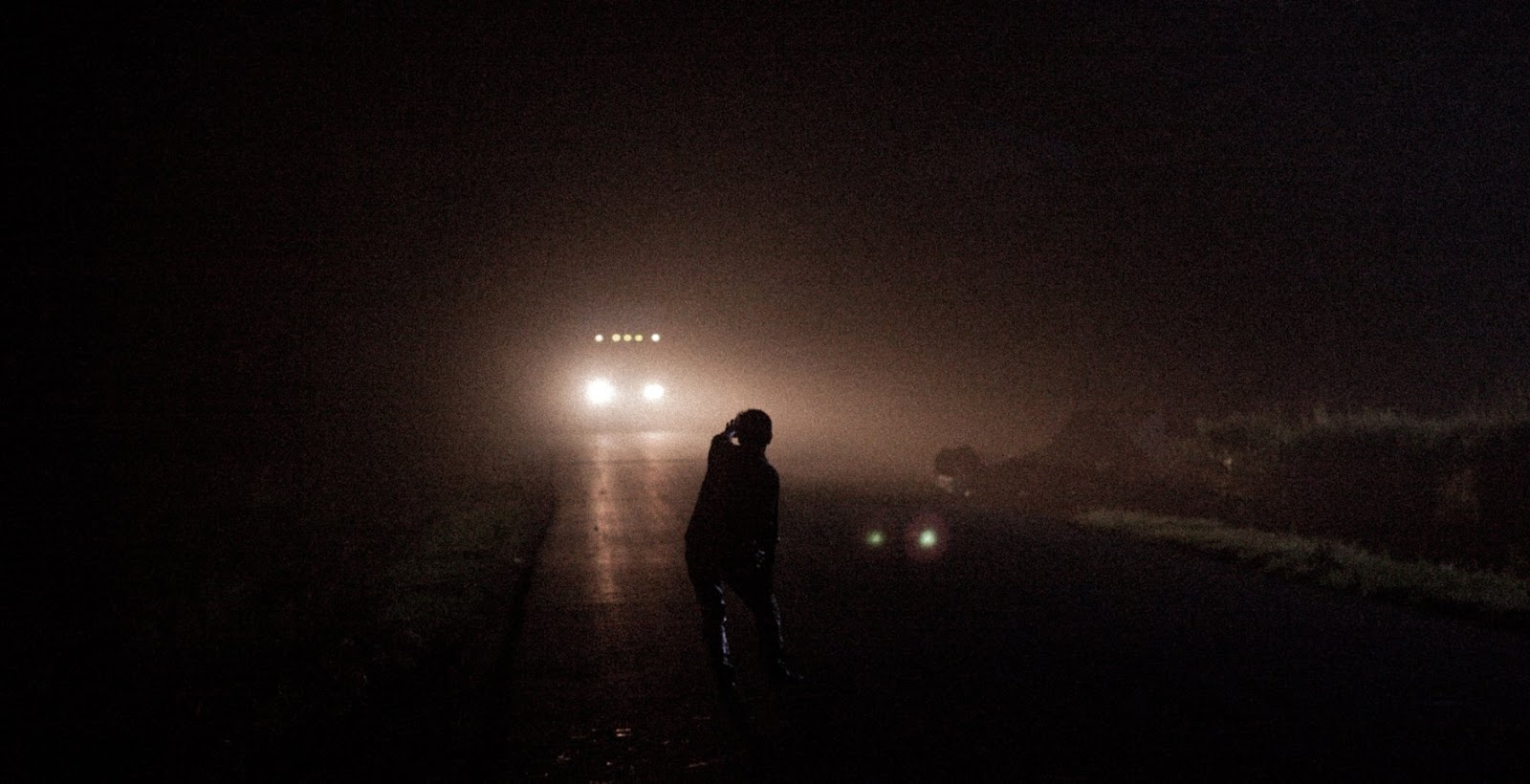
Making the correct choice -- as best you can determine, at least -- is given quite the workout in a new Chinese-Canadian movie that starts off like a heavy-duty social-justice melodrama before turning into a very weird kind of revenge (against society) quasi-thriller. That OLD STONE, written and directed by first-timer Johnny Ma (shown below), works as well as it does is due in large part to the quietly riveting performance from its lead actor, Chen Gang (shown on poster, left, and further below), who brings such self-effacing honesty and troubling kindness to his role of protagonist, that he will keep you hooked through some very odd twists and turns, a little sentimentality and a full-out character descent into... well, you'll see.

Mr. Ma, born in China but raised from age ten in Canada, offers up past, present, and even a little future in his film, which tells its story of enormous social injustice via his leading character: a not especially smart but essentially decent and honorable taxi driver involved in a traffic accident that sends a young motorcyclist to the hospital and our protagonist into the hell-on-earth that is apparently Chinese society today. Those, like myself, unfamiliar with the ins and out of China's health care, policing and insurance systems, will have to take what Ma dishes out as gospel. Given what we, along with our hero, experience here, this is not difficult to do.

Initially, you may imagine that the movie is something akin to the recent Mexican melodrama that indicted that country's horrid health-care/insurance system, A Monster With A Thousand Heads. But, no: it lacks that film's momentum, swift pacing and single-mindedness. Instead Ma goes a bit too heavily for "art," opening with and returning time and again to a view of a forest and its rolling trees.

We learn of the accident (above), along with what led up to this, in small doses, spending time with our taxi driver, his family, his boss, the police, and the hospital, not to mention the comatose victim and his family (the latter via cell phone), and the drunk skunk who actually caused the accident. All of this is woven pretty well into the unfurling scenario, with most of the puzzle pieces fitting together by the time we reach the finale.

Most effective as an indictment of a society that seems every bit as venal, uncaring and incompetent as our hero is caring and kind, the movie actually misses its mark as strong drama mostly by trying a little too hard for the artsy and/or noirish.

But Old Stone is worth seeing as a first step in what might be a productive career for the filmmaker, and especially for the award-calibre performance from the terrific Mr. Chen.

From Zeitgeist Films, in Mandarin with English subtitles, and running a short 81 minutes, the movie opens in New York (at the IFC Center) tomorrow, Wednesday, November 30; in Seattle (at the Grand Illusion Cinema) on December 2; and Los Angeles (at Laemmle's Ahrya Fine Arts) on December 9. For a look at all the dozen currently-scheduled playdates -- with theaters and cities included -- simply click  here  and then scroll down.

Monday, July 23, 2012

AI WEIWEI: NEVER SORRY/Alison Klayman offers art as protest, provocation -- and art

You can't really miss Ai Weiwei: The artist, along with his work, his blog (access to which China seems to be currently blocking) and his insistent "dissidency," so far as his homeland of China is concerned, is at this point something like legendary. And yet how much do we really know about the guy? TrustMovies certainly didn't know a lot, outside of a few obvious facts, and so Alison Klayman's new documentary, AI WEIWEI: NEVER SORRY, was eye-opening, mind-expanding and especially anger-producing. (So much about modern China is, no? For that matter, so is much about the USA. For real anger-production, however, don't miss the upcoming doc You've Been Trumped. More about that one next month....)

To get some kind of grip on her subject. Ms Klayman, shown at right, goes all over the place (as does Mr. Ai, who is quite the world traveler). While she runs the risk of flailing a bit, she mostly avoids this by concentrating on, via verbiage and camerawork, what is most important to the artist: the use of his art for social good and the freedom of the people. Nearly all (perhaps every one) of the artwork exists -- in addition to the beauty of its conception and execution -- to send a message. This does not, of course, preclude the filmmaker's showing us an awful lot of shots of the artist's cat, below, who can actually open doors (but never closes them afterward). I suspect Ms Klayman is a cat person.

As we listen to Ai Weiwei during the course of this film, it becomes clear that he is both an artist and a critic rolled into one who possesses a keen sense of humor. As do his workmen, one of whom tells us, regarding those employed to put together the artist's work: "We're just hired assassins."

For a first-time filmmaker, Ms Klayman managed to gain surprising access to the artist (above and below) and his family. (How this family plays out is among the surprises of the movie.) Prior to making the film, she worked as a journalist in Beijing, and it is clear from the film itself that her journalism still serves her well. While providing the facts, such as they are, she allows us to spend time with the artist, see his art in various stages (design, construction and completion) and hear his musings, often inspired and always intelligent, on art and life.

From his Names Project for the victims of the Chinese earthquake -- especially the schoolchildren who lost their lives in the shoddy, sub-standard construction provided by the Chinese government --  to the Sunflower Seeds installation (above) that opened (and then just as quickly closed) at London's Tate Modern to the razing of his studio by the Chinese government; from his beating at the hands of police officers to his imprisonment and eventual release, Klayman packs in a lot of events and information. (The Iran-Contra hearings even figure into all this!)

We meet everyone from the artist's mom and younger brother to his wife and the mother of his only child (and no, these last two are not the same person), and various Chinese filmmakers and performance artists. Together, these people offer a wider perspective on our guy, a fellow who has taken the term artist/activist to new heights. "If you don't act," he tells us at one point, "the danger only becomes stronger."

From Sundance Selects, the 91-minute documentary -- after making numerous international festival appearances -- opens this Friday, July 27, in New York City, Los Angeles, San Francisco, Washington DC and Bethesda, MD. A further nationwide limited release will begin in August.

Wednesday, July 4, 2012

CHINA HEAVYWEIGHT: Yung Chang takes another look at youth and careers in China

Among the facts that yours truly did not know: In 1959 Chairman Mao banned western-style boxing in China because it was too American and too violent. In 1989, that ban was finally lifted. Yung Chang, the Canadian filmmaker of Chinese descent who, a few years ago, brought us Up the Yangtze, is back again with a new film -- CHINA HEAVYWEIGHT -- that begins with a statement of the above facts and then, along with a most interesting backdrop (in the former it was the havoc wrought by the Three Gorges Damn, in this one it's boxing in China), manages to look somewhat closely at China's young people and the career choices they face and make. These are not much -- and probably much worse now than five years ago when Yangtze was made.

Mr. Chang, shown at left, manages in both films to look at two generations, parent and child; in addition, in this new one, he observes a boxing teacher, Qi Moxiang, who, if he had children, would fit easily into the parental mode. As a filmmaker, Chang keeps himself well out of the picture but his camera smack in the faces and bodies of his protagonists. He is not given to a lot of identification, so that sometimes, we're not always sure who's who and what's what. But eventually we figure most of it out. He and his camera wander and we follow along dutifully, observing some of the children who have "volunteered" and then been "selected" to participate in a program that just might offer up some new Olympic-style heroes, both boys and girls, chosen from the ever more impoverished farm communities found -- in this case, in the Sichuan province.

One young man in particular, Miao Yunfei (above, working on the family's tobacco farm, and below, wondering if he has made the right choices) has some talent -- and is clearly dying to get ahead fast -- but may not have the patience for long-term practice and devotion to the boxing life in China (Mike Tyson's his hero: yikes!). He is counseled by his coach to refrain from going "pro" until he really has the skills mastered. His mom wants him to stay on the farm, of course, but he clearly imagines that he's made for more glamorous stuff.

Coach Qi also longs for some of that old glamour; before we know it, he's in training for a "comeback" fight (he's shown below, left) in which he is outclassed, outmatched and outfought rather alarmingly. Throughout all this we get bits and pieces of the lives of these people, but nothing registers as strongly as it did in the filmmaker's Yangtze movie. I am not certain that my own lack of interest in boxing prevents me from fully appreciating Chang's film. Thught it's a sport I have long hated, I have still taken well to certain boxing movies now and again: The Set Up, Rocco and His Brothers, The Fighter. But by the end of this documentary, while I was somewhat moved by these people and their predicaments, I felt I could have been given a lot more information, considering the film's 94 minutes of running time.

Another student, He Zongli, below, appears more of a team player and a good Communist. What does that mean? While Chang would seem to leave "politics" outside the frame of his film, his inclusion of a short scene at a sporting event counters this quite tellingly. Here, the speaker announces the following: "There is no China without the Communist Party. Only Socialism can help develop China. This is an unchangeable truth..." Given what we see and hear in China Heavyweight, this seems but the reverse of the pro-Capitalism/
Hooray-for-Wall-Street agitprop meal we're constantly fed by The New York Post and Fox News.

The choices offered the young people we see here, as in Up the Yangtze, seem paltry at best, designed to help the state above all, while sucking the people dry. Little wonder that Miao hightails it to the big city and a dead-end construction job. The choice between growing tobacco and boxing (imagine two more smart, healthy, environmentally-friendly endeavors! -- unless you are Olympic-caliber, of course) is a lose-lose situation. And the economy -- here, there, everywhere -- just grows worse.

China Heavyweight -- from Zeitgeist Films -- opens Friday, July 6, in New York City at the IFC Center and will open in another ten cities around the country in the weeks to come. Click here to see all currently scheduled playdates, with cities and theaters listed.