Showing posts with label Chinese history. Show all posts

Saturday, March 1, 2014

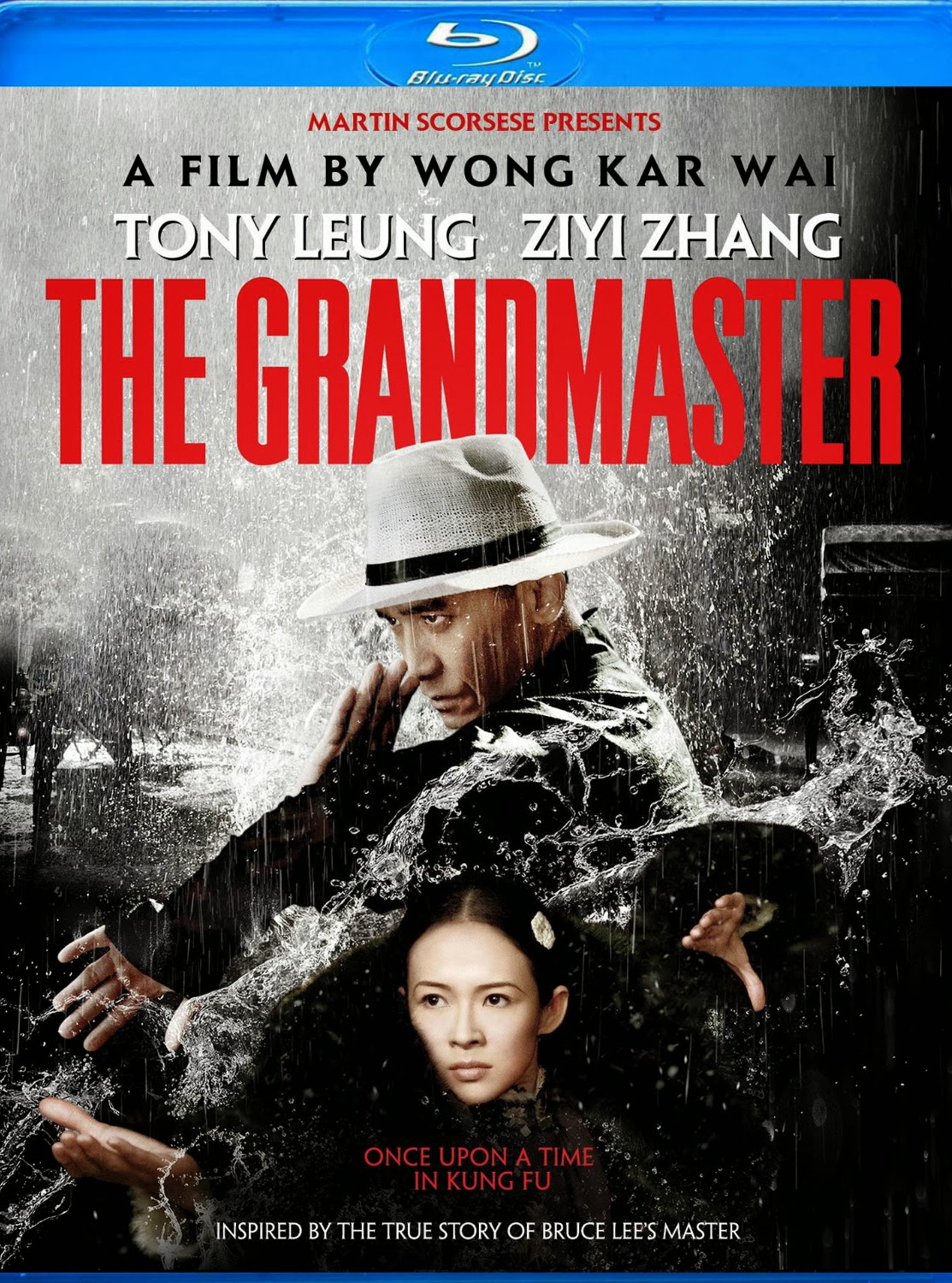
THE GRANDMASTER's Blu-ray/DVDebut: Wong Kar Wai's gorgeous & moving ode to martial arts


The name Wong Kar Wai sure does set a lot us critics' hearts aflutter. We adore his ultra-romantic, color-saturated films full of love, longing and renunciation, among other things. "Other things" this time would include, surprisingly, the martial arts and the history of that famous Grand-master (and teacher of Bruce Lee), known as Ip Man. Mr. Wong may have a special place in the hearts of American film critics, but that place does not yet include most American audiences. On Rotten Tomatoes, for instance, THE GRANDMASTER garners an 75% approval rating from critics, but only 61% from audiences. Well, maybe they'll come around in time....

Meanwhile, those of us who love Wong's work -- the filmmaker is shown at left -- can exult in his latest, just now arriving on DVD and Blu-ray. This is a decidedly different kind of film from anything I've seen by this director, while maintaining Wong's signature style. The film is almost ceremonial in its quietude and pacing, and because it is dealing with historic characters of great note and importance to Chinese history and culture, the filmmaker has chosen two of the most iconic performers working in Chinese film to play the leads, Tony Leung and Zhang Ziyi. Both actors do what is possibly the most subtle and brilliant work of their careers in this film.

Watching Leung (above) and Zhang (at right) offer the smallest of facial expressions -- a half smile, eyes lowering quietly -- to the largest effect is alternately powerful and enchanting, a veritable primer in film acting. When Wong trains his camera on these two faces, you simply can't look away. The moments toward movie's end set in a heroin den make up one of the great, heart-breaking romantic scenes in motion picture history, with Ms Zhang's stunning work topping everything she's so far accomplished. The actress never pushes the heroin daze; it's barely there. But it is there, and it colors, ever so slightly, all else.

What Wong has managed here is to fuse his usual filmic beauty with Chinese philosophy and now martial arts to what seems a near unbeatable combination. The stunning fight scenes are performed more slowly than we are used to so that many more steps can be observed and thus appreciated. The filmmaker's ability to offer graceful, precise and masterful mise en scène is something to marvel at, it seems to me.

What may prevent complete acceptance of The Grandmaster is Wong's use of narration, both verbal and written via title cards, to help tell the story. The movie runs 108 minutes but would probably have lasted more like three or four hours, had the filmmaker decided to give us his tale in a more typical show-not-tell fashion. This use of narration did not bother me, for I found it added to the ceremonial/historical aspect, but others of you may object. (My spouse certainly did. "This is the last martial arts movie I ever want to see!" was his annoyed, post-film judgment. But then, he's never enjoyed martial arts movies all that much.)

What you won't object to, I think, is the movie's sublime beauty and near-hypnotic use of camera movement. There are a number of great visual filmmakers working today, but no one does it quite like Wong Kar Wai.


The Grandmaster -- from Anchor Bay Entertainment and The Weinstein Company -- arrives on DVD and Blu-ray this coming Tuesday, March 4, for sale and rental.

Thursday, February 21, 2013

Wang Xiaoshuai's 11 FLOWERS offers a narrative of China in a time of change....

...and, for a change, that time is not present-day. Instead, with 11 FLOWERS -- the new film from Wang Xiaoshuai who has earlier given us both Bejing Bicycle and In Love We Trust -- we're whisked back to 1975 (just one year, the title cards tell us, before the end of the Cultural Revolution) to a small town in southwest China. Those of us old enough will recall this awful time of the Red Guards and the Chairman Mao personality cult, when it seemed to us westerners that China was under the influence of a bunch of brainwashed nuts.

Perhaps because it takes place so near the end of this trying time and is seen mostly from the viewpoint of its eleven-year-old, sort-of hero (and his schoolmates), the film (directed and co-written by Wang, shown at right) appears to be much quieter and more benign than we might imagine. Just beneath that placid surface, however, is roiling all kinds of trauma. 11 Flowers does a bang-up job of bringing us that undercurrent in a way that an eleven-year-old would experience it: off-center, via snippets of conversation by adults who want to keep anything untoward from the eyes and minds of the children.

On the cusp of adolescence -- toward the end of the film, our hero has his first wet dream, the remains of which are found by his parents, which occasions one of the film's most charming scenes -- Han, who looks to become a gifted gymnast, is put in charge of his school's training (above), which means the need of a new shirt. This proves a brilliant move, for the shirt (hanging out to dry, on the riverbank below) then acts as a conduit to reveal everything from character (particularly that of Han's mother) to the film's major event, and onwards, snaking its way around both symbol and something very real and moving.

The filmmaker makes us keenly aware of how children perceive things -- from hearing those conversational snippets, to suddenly seeing adults running through the streets or events taking place at a distance, from which they can parse only a bit of what is happening. Mr Wang is also is also terrific at showing us how children, as smart as they may be for their age, simply cannot be expected to act like adults until they are that. Till then, they are at the mercy of their elders. At times, you'll so want young Han to rise to the occasions presented him. It is greatly to the credit of the filmmaker that the boy cannot.

Mr. Wang sees children as neither heroic nor cowardly but simply as kids negotiating that windy path to adulthood. The road here involves parents, friends, politics, employment, sexuality, even murder and retribution -- all observed and understood believably by eleven-year-olds, with us adult viewers able to fill in the blanks, thanks to the filmmaker's double-duty skills. This is one of the best -- because it's unsentimental -- films about childhood, and about China and its history, that I have seen in some time. Well cast and beautifully acted, it's yet another feather in the cap of this lesser-known but quite humane and talented filmmaker. Let's hope it does not get lost in the ever-greater shuffle of small movie gems that appear, and then quickly disappear.

11Flowers, a Chinese-French co-production with English subtitles and one of those rare narrative films we sometimes get from First Run Features, runs just under two hours and opens in New York City tomorrow -- Friday, February 22 -- at the Elinor Bunin Munro Film Center and the Quad Cinema. Over the next month or so it will open in a few more cities across the country. Click here to see all currently scheduled playdates, cities and theaters. As this one is from FRF, you'll be able to see it eventually on DVD (and maybe VOD and streaming), as well.

Friday, December 16, 2011

DVDebut -- DETECTIVE DEE AND THE MYSTERY OF THE PHANTOM FLAME: Its Blu-ray visuals are beyond gorgeous!

If ever a movie cried out to be viewed on Blu-ray, it's Tsui Hark's DETECTIVE DEE AND THE MYSTERY OF THE PHANTOM FLAME. Roundly praised by most critics (we love a good time, especially if it's unusual or exotic) when it appeared in U.S. theaters earlier this year, the movie is out this week on DVD and Blu-ray, and TM must tell you that this is one of the most beautiful Blu-ray films he's yet seen.  If you already have a Blu-ray player, add the movie to your Netflix or Blockbuster queue. If you don't, the film proves a good enough reason to finally purchase one. It's that spectacular. And beautiful.

Sure, it's full of CGI effects (done damn well, too), but more than that, it's exceedingly colorful and detailed. Full of history, mystery, intelligent scripting and interesting characters brought to life by a starry Chinese cast, it is also one of the most oddball mixtures you could imagine. And that's what makes it so much fun. Director Hark more than lives up to his reputation as one of the most creative and talented of action directors (born in Vietnam, according to the IMDB, he was educated in film at the University of Texas, Austin!).

Don't let this amazing movie, out now for purchase or rental, get by you unseen.

Monday, May 9, 2011

Lu Chuan's CITY OF LIFE AND DEATH: returning again to the Nanking massacre


"The Japanese are such a cruel race," mutters Gemma Jones, in one oddly funny observation during the filmed version of Bridget Jones's Diary.  This line, echoing the sentiments of many Britishers who lived through World War II,  is brought to new and appalling heights via the 2009 film CITY OF LIFE AND DEATH, just now opening its U.S. theatrical run. If you've seen, as has TrustMovies, several films already that dealt with the Japanese massacre of Chinese civilians (and army) in the former Chinese capital of Nanking -- including the documentary named for that city, as well as last year's worthwhile German film John Rabe -- you can be forgiven for not rushing headlong to yet another wallow in real-life horror.

Written and directed by Lu Chuan, (shown at left), who earlier gave us the much-admired Mountain Patrol (Kekexili) and The Missing Gun, his new narrative movie, coming after what has already surfaced, may seem like too much, too late. With crack visuals ever at the ready, this is, in some ways, the best of the lot; in other ways, it's the worst. Filmed in wide-screen, using black-and-white cinematography -- the latter certainly takes us back to how movies looked at the time (December 1937) that the event occurred -- Lu's film places us quite thoroughly in the shoes of the massacred Chinese -- some of which are shown, pre-mass, just below.

The movie makes stabs, as well, at placing us in the boots of the marauding Japanese, and very soon we hate these despicable creatures with all our might. Mr. Lu has made his enemy unfeeling monsters where anything Chinese is concerned. Though they joke and talk amongst themselves now and then, given what they're doing the previous and next moment, this chatter fails to humanize them in any important way.

All except for one of these Japanese, that is: a certain soldier named Kadokawa (Hideo Nakizumi, above). Lu has made the incredibly obtuse mistake of tossing every last positive trait onto this young man -- a terrible burden for any real, full-bodied character to have to bear. The actor manages it as best he can, but intelligent viewers are going to suppress a guffaw at the guy. (Even Eastwood handled this sort of thing better in his dank, interminable Letters from Iwo Jima.)

By any standard, the movie is an endurance test, but it may seem especially so for those who've seen earlier films on the subject. The wholesale violence, the executions, the use of women as sex machines for the Japanese soldiers, the casual slaughter of children and the hospitalized -- it's all here, including a mass Sophie's Choice moment toward the finale that just adds to the pain of the poor Chinese.

The very good cast, which includes the likes of Fan Wei (above), Ye Liu and Gao Yuanyuan (two photos above) are all used more as icons than as full-bodied characters. But then, under these grueling circumstances -- everything is always awful -- there is little room for expressions of more than pain and sorrow. Mr. Ye (shown below, right, and bottom, center) fares best, perhaps because he's given more to do early on and is dispensed with before the worst of it.

The most shocking lapse of taste, given all that's come before, occurs just after the two hour mark, when we are treated to the kind of sentimentality that would have seemed au courant back in the 1930s, as someone blows -- I kid you not -- a bouquet of wispy dandelion seeds into the air, as a feel-good ending for a couple of characters materializes.

If you are going to put yourself through this movie, I would advise leaving just after the big Japanese victory ceremony about two hours and five minutes into things (set your watch) to avoid the sentimental embarrassment about to happen. Perhaps the Chinese powers-that-be determined that audiences would need something feel-good after all the carnage. But this? (Now, of course, you'll have to stay around, if only to watch those dandelions twirl....)

City of Life and Death, via Kino International, opens this Wednesday, May 11, at New York's Film Forum for a two-week run. It will probably be appearing elsewhere around the country, and then on DVD, but as of now, I don't know specifics.