It begins this Friday, September 27, and runs through Sunday, October 13. In addition to all the films from top-flight fests around the world, here making their U.S. premiere, there will also be several
world premieres. As usual there will also be the interesting, experimental
Views from the Avant Garde (with some of the screenings
free this year!); the
Gala Tributes (to
Blanchett &
Fiennes); the NYFF
Convergence initiative; films by two
Emerging Artists (
Joanna Hogg and
Fernando Eimbcke); the
Retrospective (Does the name Godard ring a bell? And do you, as I, wish that, in this case, it belonged to
Agnès or
Thierry?); a series of
Revivals and another that encompasses new
Shorts; and all this only covers about half of it.
Yes, friends:
The New York Film Festival is about to be in full swing, with so much going on, that the only possible way you could see it all would be to clone yourself at least thrice. Events will be happening often simultaneously at seven different
venues (click and scroll down to see 'em all.) TrustMovies has managed to attend only two of the press screenings, and both films were more than worthwhile. Since both are receiving a theatrical release in the months to come, I'll cover them but briefly now, with more later if and when when they finally reach the Netflix streaming facility -- concerning the content of which this blog is now dedicated to giving you a heads-up.
(Le Dernier des injustes)
In French and German with English subtitles,
218 minutes (yes, that's 3 hours and 38 minutes)
M. Lanzmann will appear in person for Q&A on Sunday, September 29!
Long, but less than half the length of his monumental (and finally monumentally boring: the trains, the trains!) Holocaust documentary,
Shoah, this "new" film from Claude Lanzmann (shown at right, and below and above) was actually shot almost 40 years ago, and an additional 30 years
after the events recalled by its subject, Benjamin Murmelstein (shown at right in the photo, top), the last Jewish Elder of the Theresienstadt concentration camp. Lanzmann, above by the railroad track, is still into trains, but nothing as all-consuming as in the earlier doc. Here he interviews Murmelstein, who was brought to trial post-WWII for his supposed crimes and collaboration with the Nazis, but he was let go unscathed. The man explains some things, while completely leaving out any mention of others. He's full of spunk, clearly loves to talk and had what appears to be a remarkable memory, though whether he was a completely "reliable witness," I rather doubt.
I’m not sure that I trust Murmelstein's remembrances, even though, in this film, he’s all we have.
Lanzman offers a few pertinent questions and occasionally tries to draw the man further out, but to not much avail.
Mumelstein has such energy and drive, however, that for quite awhile he pulled me in.
But as the movie wore on, by the end I was tired of his nattering voice and found myself questioning much that he said. (His comments on how laughable is Arendt's "banality-of-evil" theory regarding Adolf Eichman completely bypasses, of course, her more important comments about how the Jews might better have survived had they not been so organizedly in thrall to leaders like Murmelstein.)

Further, I would have liked to have known what went on at his trial, what happened to his family, and other things we don’t learn.
But the film certainly deserves a place of important in permanent Holocaust history by virtue of its subject, and the fact that this is the only such interview that exists. Even considering all the Holocaust movies I’ve already seen, I still learned a lot from this one.
And I only nodded off a couple of times during the nearly 4-hour film -- both of them when that cantor was singing (and singing and singing!). M. Lanzmann seems intent on memorializing the victims via religion. And my regular readers will know by now that I have little taste for organized religion of any kind.
For those who cannot attend the film's single festival screening at 1pm on Sunday, September 29, in Alice Tully Hall, not to worry:
The Last of the Unjust is being distributed here in the USA by
Cohen Media Group.
(L’Inconnu du lac)
In French with English subtitles, 97 minutes
M. Guiraudie will appear in person for a Q&A on Monday, September 30!
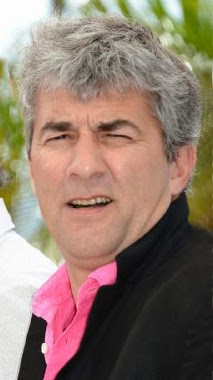
This remarkable follow-up by Alain Guiraudie (shown at left) to his also remarkable
The King of Escape (click and scroll down) -- is one hot movie. It's also very cool. Might as well tell you upfront that this habits-of-homosexuals film offers a few short hardcore moments. So if you object to gay-themed movies or full-frontal passion on either moral grounds or (for you fellows) any unseemly comparison with your own limited cock size, by all means avoid this film. (According to one of the
Findings pages in
Harper's magazine, the French are said to possess Europe's largest penises.)
In any case, the movie takes place in and around a gay cruising area by a lake (below) in a relatively remote section of French countryside where men meet for some sunbathing, sex and conversation. Then, on an early evening in which light is still visible -- suddenly, surreptitiously -- one man kills another.
Why? What does this mean, other than murder? And why does not the fellow who has seen all this from afar, hidden from both victim and killer, alert the inspector who's investigating the crime? Well, he's got a lech for the perp and perhaps something more. A death wish? Hard to say, exactly. But something's going on.... That perp (the mysterious and handsome
Christophe Paou,
at left,
below) is a hunk of major proportions and, as it turns out, a very versatile, talented and willing sexual partner, too.
As hot as the sex is here, the friendship that grows between our "hero" (acted with an almost perfect blend of decency, horniness and self-effacement by
Pierre Deladonchamps, shown at right, above and below, and four photos up, in the water),
and a heavy-set fellow (beautifully played by
Patrick d'Assumçao, below, left) with whom he has increasingly interesting conversations, is every bit as riveting as that sex and twice as endearing.
Slow-moving yet without a wasted frame,
Stranger by the Lake accrues near-monumental suspense and discomfort as it plays out. The final moments at nightfall -- as the barely visible skin over the beautiful collarbones of one of our characters fades into black -- are among film history's most memorably fraught and ambivalent.
This exquisite movie (a major winner at Cannes) is made all the more so by its transgressive visuals and theme. It should at the very least see success on the art film circuit, and gain interest and a possible release for Guiraudie's earlier odd charmer, that
King of Escape.
If you don't catch either of the festival's two screenings (Monday, September 30, at 9:15pm in Alice Tully Hall or Wednesday, October 2, at 1pm in the Francesca Beale Theater), the film has been picked up for U.S. theatrical distribution by
Strand Releasing.

 Long, but less than half the length of his monumental (and finally monumentally boring: the trains, the trains!) Holocaust documentary, Shoah, this "new" film from M. Lanzmann (the filmmaker is shown above by, yes, another railroad track) was actually shot almost 40 years ago (at left, below, is the director when his hair was still black rather than grey), and an additional 30 years after the events recalled by its subject, Benjamin Murmelstein (shown at right, below), the last Jewish Elder of the Theresienstadt concentration camp. While all the Jewish Elders (there were several) at this camp were caught in the middle of the ultimate "rock and a hard place" -- serving as they did as middle men between the Nazi atrocities and the Jewish victims -- only Murmelstein managed to survive.
 Instead he probes this man whom history hangs over like a shroud. Yet Murmelstein is remarkably jovial, with a memory, it would appear, like a steel trap. Here, above, Lanzmann interviews Murmelstein, who was brought to trial post-WWII for his supposed crimes and collaboration with the Nazis, but he was let go unscathed. The man explains some things, while completely leaving out any mention of others. He's full of spunk, clearly loves to talk and had what appears to be remarkable recall, though whether he was a completely "reliable witness," I rather doubt. (Still, what human being is?)
 I’m not sure that I trust Murmelstein's remembrances, even though, in this film, he’s all we have.
Lanzman offers a few pertinent questions and occasionally tries to draw the man further out, but to not much avail.
Mumelstein has such energy and drive, however, that for quite awhile he pulled me in and kept me going.
But as the movie wore on, by the end I was tired of his nattering voice and found myself questioning much that he said. His comments on how laughable is Arendt's "banality-of-evil" theory regarding Adolf Eichman completely bypasses, of course, her more important comments about how the Jews might better have survived had they not been so organizedly in thrall to leaders like Murmelstein. Tradition has its drawbacks.
I’m not sure that I trust Murmelstein's remembrances, even though, in this film, he’s all we have.
Lanzman offers a few pertinent questions and occasionally tries to draw the man further out, but to not much avail.
Mumelstein has such energy and drive, however, that for quite awhile he pulled me in and kept me going.
But as the movie wore on, by the end I was tired of his nattering voice and found myself questioning much that he said. His comments on how laughable is Arendt's "banality-of-evil" theory regarding Adolf Eichman completely bypasses, of course, her more important comments about how the Jews might better have survived had they not been so organizedly in thrall to leaders like Murmelstein. Tradition has its drawbacks.