Showing posts with label Clio Barnard. Show all posts

Wednesday, May 7, 2014

Stream Clio Barnard's THE SELFISH GIANT -- which is even better than you've heard


A movie, the power of which acumulates into something approaching tragedy -- not in the classic rendition of hubris and great men brought low, but in the even deeper experience of characters like us, who possess possibilities, being robbed of them and finally of an entire society sinking unnecessarily into the chasm -- THE SELFISH GIANT is British filmmaker Clio Barnard's follow-up to her unusual The Arbor. It is, first to last, a marvelous, engrossing, enlightening piece of work. Said to be inspired by Oscar Wilde's children's tale of the same name, though I defy you to connect all the dots that led from the story to the movie (doesn't matter, for I believe the spirit of the story is captured by the film), Barnard tells the tale of two young chums, both with problems, physical and/or behavioral, trying to make a go of it in a highly depressed area of Britain.

The writer/director's work here (Ms Barnard is shown at left) is quite unlike that of  The Arbor,  with its layers of irony and distancing. Instead, she has chosen to tell the tale from the viewpoint of the two boys, and from her screen newcomers, she has drawn the kind of near-perfect performances you don't often see, even from adult Oscar winners, let alone kids like these. There is not a false moment in either of their work, and if you might have a question about a bit else that goes on here (the confession/ apology from the film's "giant," a scrap metal dealer played very well by Sean Gilder, you won't be able to find fault with the two boys, played magnificently by Connor Chapman (below, left) and Shaun Thomas (below, right).

Mr. Chapman, in particular, is amazing as Arbor (odd name for a boy, but it does call to mind Ms Barnard's last film): tow-headed, small, scrappy, smart and asthmatic, his energy level is as enormous as it is put generally to ill use. He's always finding ways to scam. But, then, what else is available to poor kids in this depressed economic environment?

As his pal Swifty, young Mr. Thomas is equally fine. Slower than Arbor in nearly all ways, his innate kindness always shines forth. His love for and understanding of horses proves a saving grace, as that scrap metal dealer also deals in trotting races and ends up using Swifty as his jockey.

The Gilder character's preference for Swifty over Arbor also leads to understandable jealousy which finally takes form in action, leading to a truly awful consequence. The compact film, just 90 minutes in length, is psychologically, sociologically and economically sound, and it is formed so cunningly that we follow it as we would a suspense drama.

The Selfish Giant is also a beautiful film in its way. The countryside is hardly lush, yet we experience, as do the boys, the joy of being outside in it and away from the family problems -- drugs, alcohol, abuse -- that both kids endure.

Normally I worry about over-praising certain films, but I don't think this could even be a problem here -- so right in all regards is Ms Barnard's approach and execution. This is a small film that never tries to be any more than it is. But what it is turns out to be extraordinary.

At the end we're left with the question: How do we make this sort of thing not happen? There are ways. Time to get started. (If only the world had much time left before climate change begins eradicating us all.)

The Selfish Giant -- from Sundance Selects and Protagonist Pictures -- out now on DVD, is also streamable via Netflix streaming.  (If you get the DVD, as I did -- before I knew the film was streamable -- watch the Bonus features. These will add even more to your understanding and enjoyment.)

Sunday, May 1, 2011

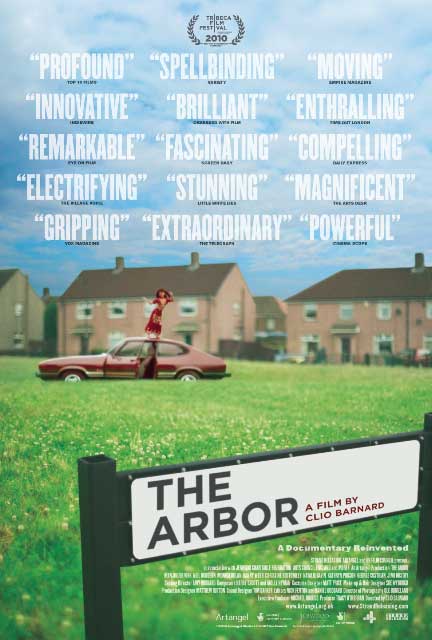
Clio Barnard's multi-dimensional portrait of a very odd artist & her family: THE ARBOR

So much has already been written, here and abroad, about THE ARBOR -- its dialog taken from transcribed inter-views and then lip-synced by some very good actors -- telling of the later life of "projects" play-wright Andrea Dunbar. It's odd to use the term later, as Dunbar lived only to 29, felled simultane-ously by her alcohol-ism and a brain hemorrhage. The film, directed by Clio Barnard (shown below), has a documentary look and feel, though when the actress playing Dunbar sets about rehearsing various scenes from her original play, al fresco, for any audience imagining a documentary, the jig is up.

Yet so real are the words spoken here (and why not, since they were indeed voiced by all the "real" people interviewed?) and so very good are all the actors who must lip-sync these words that, did we not know how the movie was made, I swear we would be completely unaware of the lip-syncing. Perhaps Britishers were more aware of this because they did not have to take their eyes away from the faces on view in order to read the English subtitles (provided for the film's U.S. release to help us Americans with the heavy and various British accents). Whatever: So gripping are these actors and what they have to say, that we watch (and listen to) performances that seem utterly full and real.

The Arbor is is finally as much about Andrea's mixed-race daughter Lorraine -- above, played by Manjinder Virk, who was sired by the playwright's Pakistani lover Yousaf, played in interesting, subdued fashion by Jimi Mistry (below, left), the only  "famous" actor in the lot -- as it is about Andrea herself (she's played by Natalie Gavin, below, right). While we see and hear the young playwright, we don't get much inside her the way we do Lorraine, whose story provides the most compelling parts of the film, allowing us to see the cyclical nature of poverty, racism and class in a manner stronger than most movies usually present.

The layers of artifice and reality on view soon begin to combine into their own distinctive mix. This is yet another film that merges documentary and narrative to arrive at something as real, in its way, as anything in either of the two standard formats. When Andrea dies fairly early on, Lorraine tells us, with barely a trace of emotion in her voice or bearing: "That's it. It's over. Things can only get better." As if. We haven't begun to see the extent of how bad things can get.

The film may finally have you wondering if "artists" should be allowed to have children. Or in this case, alcoholic artists. The results move from Lorraine and her half-sister (played by Christine Bottomley, above)   to the next  generation and a young boy whose story gives the film its most uplifting (and despairing) moments. Thanks to the ever-present subtitles, The Arbor is not a difficult film to get one's mind around. For an intelligent audience, it does not that much "work." It raises a raft of question about how to handle race, class and poverty but offers no easy answer, other than personal responsibility. And that, given these particular circumstances, brings us full circle, only to begin again.

The film, from Strand Releasing, plays currently in New York City at Film Forum through Tuesday, May 10. Click here for dates and times, listed at top. Also screening during this period is the 1986 film Rita Sue and Bob, Too!  (photo at right) made from Dunbar's play of the same name. Click here and scroll down to the bottom of the screen to see play dates for this earlier movie. I should think this film will find its way into other art houses across the country, but as of now, I can find no word of where.

IN PERSON! Filmmaker Clio Barnard and Actress Manjinder Virk will appear at Film Forum on Friday, May 6, at the 8pm show.