Showing posts with label Facebook. Show all posts

Sunday, November 1, 2015

Brant Pinvidic's WHY I'M NOT ON FACEBOOK is a smart -- and very necessary -- documentary


Confession: TrustMovies is not on Facebook, either. He was, for a short while some years back -- until he realized that he was wasting incredible amounts of time being in touch with people he didn't care that much about and for whom he did not have the time or energy. So he severed all Facebook connection (he was never impressed with the site's so-called security measures, anyway) and will never return there. He does have a Twitter account and is easily reached by email or phone. (He also admits that the image he has retained of Facebook founder Mark Zuckerberg from that fine film, The Social Network, had a certain influence here, too.) Which is all by way of saying that when he saw the title of the new documentary WHY I'M NOT ON FACEBOOK, he knew he had to view it.

You should, too. This is one of the best documentaries I've seen this year, and it is certainly one of the most necessary, as it holds up a mirror to both Facebook itself and to the American (and probably international) public and its current and ever-more life-deadening "quirks." The film's creator and director, Brant Pinvidic, shown at left, seems like a cute, smart, energetic family man whose suspicions about Facebook are more than justified by the evidence he has amassed and then, along with his excellent lead editor and producer, Dean Shull, put together in such an intelligent, entertaining manner. The result is a film that will surprise you, even as it pulls you up short and makes you think, then think again.

Along the way we meet the real Winklevoss twins, along with some of the folk Facebook has helped make "famous" (like the Pink Lady, below). We also learn how Facebook has become the leading Job-Finder of modern times (as well as one of the main job losers, too: a product of how stupidly its users use it). Mr. Pinvidic is careful not to demonize Facebook -- as his evidence piles up, at times his movie threatens to become instead a commercial for the site -- and he even creates his own Facebook identity (who is Steve Steel?!).

The movie shows us how Facebook has helped catch criminals (often because they actually post on the site about their crimes: Ah, that ever-growing need for fame!).  We meet one young high school girl who appears to be addicted to the site; her behavior here is so sad and awful that it practically demands an "intervention." And that matter of privacy? Well, as Pinvidic points out, even without Facebook, privacy these days is just about over.

The film is full of humor and fun, too. At one point, our narrator wonders, Would Jesus have been on Facebook? Oh, wait: He already is. As the director reaches the home stretch, his movie really takes off. He addresses the psychology of Facebook lovers, and by extension, the rest of us, too. His conclusion as to why Facebook has become so important so fast is extraordinarily on the mark, I think. I'll let you discover the explanation for yourself. (Hint: its simultaneous appeal to two of our most powerful emotions/needs.) That way you'll have to see the movie -- which is worth your time in every respect.

Pinvidic's real reason for making Why I'm Not on Facebook, it turns out, is less about himself than about his family's desire to join the site, particularly that of his son, who is about to enter the teenage years. How the filmmaker resolves these issues turns his movie into something smart, suspenseful, ironic and, hell -- even feel-good, as he captures humanity and Facebook in a multitude of differing faces. It also explains why, as climate change engulfs us, the general populace will continue to follow their leaders' complete inaction and will instead post Facebook 'selfies' as the end approaches. "Shirley, look -- the water's up to my waist!"  "You think that's something, Fred? The water's already around my neck!" "Well, I've got you both beat, 'cause it's just now touching my blub blub blub..." (I do hope Apple is adding that underwater option to its iPhones.)

The documentary, just 77 minutes long and worth every one of them, will open via VOD this Tuesday, November 3. And maybe in select theaters, too? (That's what it says on the poster, top.). Any way you can see it, this one's a don't-miss experience.

Wednesday, September 29, 2010

Fincher/Sorkin's THE SOCIAL NETWORK: everything you expected -- and more


How "current" is THE SOCIAL NETWORK? You won't under-stand until you sit there in the theater, hanging on for dear life, struggling to keep up with dialog that's both cracker-jack and fire-cracker, coming as it does from some mostly very smart people who know a lot more than you and are happy to make you aware of this fact. I can't remember any movie as dialog-prone as this one -- written by Aaron Sorkin (The West Wing) and directed by David Fincher (Zodiac) -- that barrels along at 90 miles-a-minute for two full hours, after which you'd be exhausted,
if your weren't so exhilarated.

 
As director, Mr. Fincher (above left) has wisely given over to that dialog of Mr. Sorkin (above right), letting his movie run, race, rise, crest then smash down on your ears with shock and delight, sometimes easing smoothly into those orifices, the better to allow that tiny, nasty jolt to come later. "You would do that for me?" asks Rooney Mara (below, as the about-to-be-ex girlfriend of our anti-hero, the as-usual-fabulous Jesse Eisenberg), with such delicate, stiletto-sharp shadings, that we cringe in delight. Humor consistently bubbles up through the nastiness and strivings of  the youth on display, and this helps keep our enjoyment level extremely high.

When in fact (and I believe, for the first time in the film), the dialog suddenly stops (this is at the introduction of the Sean Parker character, played very well indeed by Justin Timberlake, below), it's a shock -- and a reprieve.  We can take a short visual break, as we watch the morning-after routine of Parker and his one-night-stand, played with just the right combination of naïveté and smarts by Dakota Johnson. Once both parties are sufficiently awake, we're off and running with some more great dialog. Sorkin's writing gift is not so much to create the differing manner and speech patterns through which many different types of people talk (there's really little variation from character to character), but rather to take a subject, just about any subject, and let his characters run with it believably and generously so that not just conversations, but whole worlds open in front of us, which we can be a part of -- if only we can keep up.

The story here, if case you have been in a media-free cave for the past six months, details the creation of the internet social phenomenon, Facebook, by Mark Zuckerberg and his best friend Eduardo Saverin (Andrew Garfield, shown at bottom) plus a few hangers-on (played by Arnie Hammerbelow, right, and in the penultimate photo, and Max Minghella, below, left) who, from what we see, probably provided a good portion of the idea behind the idea for the site. Women are definitely secondary, mostly sexual, objects in the movie, which is no doubt how it was and is in the technological realm, big business-style -- unless, of course, it's the woman who has the idea and/or the business. The major females of The Social Network include Ms Mara, as the early and never-quite-forgotten "love" object (or whatever passes for love in the Zucker-berg brain) and Brenda Song (two photos below) as a blow-job-in-a-bathroom sex object who lingers a lot longer. Working with a truly enormous cast of speaking roles, Fincher makes sure that every one of them registers strongly in his or her moment(s), and this ability adds immeasurably to the movie's "reality" credentials.

One of the special glories of the film is how Sorkin and Fincher dole out things like responsibility and truth. Nobody is blameless or heroic here, though Garfield's Saverin becomes pretty much the movie's beating heart, just as Zuckerberg is definitely its narcissistic, ego-bloated brain. Our Facebook fellow begins the movie as an asshole, and ends up as one, too. And yet, if he is never likable (Eisenberg does a wonderful job of keeping him just this side of impossible), his abilities and motives are always comprehensible. We might wish him otherwise, but we must finally accept him, warts and warts and all.

As for Facebook itself -- though the movie ends much prior to the internet behemoth's invasions of privacy or courting/caving into corporate wishes regarding which sites can be seen and which not -- it is no great leap from the characters we see on display here to the realization that we may think we're using Facebook, while Facebook is using us.  (For a possible alternative to the site, check out the article in this weeks New York magazine about a new "fab four" and their Diaspora*.)

There has been talk -- more than that, admissions -- of fully made-up scenes in this film. Well, it isn't a documentary, after all. And since Mr. Zuckerberg is now a multi-millionaire, or billionaire, or who-gives-a-sh-aire, we can't feel too sorry for the little guy.  He'll get by. And so will we. TrustMovies, with his advanced years and ever more cynical view of our world, prefers Never Let Me Go, as this year's more important and profound look at life in our world. But for intelligent mainstream audiences (do these still exist? The Social Contract's box-office grosses will tell the tale) willing to be challenged, this film will likely win the awards, as well as the coin of the realm.  It is certainly a don't-miss movie and an enormous achievement in terms of American movie-making.

Someday, I suspect -- long after we're gone and if repertory cinema still exists -- Film Forum will offer a double bill of The Social Network and Catfish, at which viewers will marvel that such old-fashioned technology ever existed -- and wonder how human beings could have actually believed in, and given such power to, a concept as paltry as this one.  "Friends" indeed.

The Social Network, from Columbia Pictures/Sony, which made its debut at the opening night of the NY Film Festival last week, opens theatrically Friday, October 1, nationwide (in the bigger cities, at least). Go to this link, scroll down a bit, type in your zip code to find a theater near you -- then hope for the best.

Tuesday, September 14, 2010

Schulman bros & Henry Joost's CATFISH: Best documentary of the year (so far)

TrustMovies is going even farther than his usual don't-spoil-the-movie commandment by saying damn little about the "plot" of CATFISH, the one-of-a-kind documentary from first-time/full-length moviemakers Ariel Schulman (below, left) and Henry Joost (below, right) and starring Shulman's immensely photogenic and charismatic photographer brother Yaniv (also known as Nev).

I knew nothing about this movie when I planted my aging bones into a seat at Manhattan's Kips Bay theater a couple of weeks ago, along with a full-house audience, to view a special screening of the film. I suspected it might be a documentary, though I also wondered it might not be faux or mock. After a few minutes of watching, it certainly seemed real enough. And yet, in our Internet age, from Blair Witch to I'm Still Here, who knows?  So I was prepared to go with it either way -- doc or narrative. But so quickly did I get wrapped up in this tale of a filmmaker and his friend who begin to follow the love life of the filmmaker's brother as it blossoms and evolves over the Internet that I soon did not care a whit whether the movie was real or fake.  Either way, it was f-ing good -- and in my book that's what matters.

After finishing the film, I do believe it is a real documentary, but as I say, if it were exposed as a fake, I would still bow down to the filmmakers for creating such an amazing tale, no more of which you will find detailed here. Read as little as possible about Catfish prior to seeing it, please, because this film, particularly, deserves your tabula rasa going in. So, instead of events, I'll talk about the filmmaking, the themes and audience reaction -- in hopes of not spoiling your pleasure of discovery.

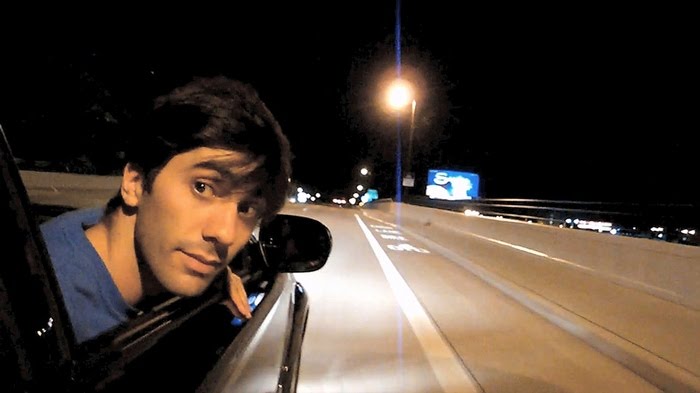
Catfish is about the way we live now -- at least, the way that more and more of us, particularly the younger crowd, are living it. As movie-makers, Schulman and Joost do the hand-held thing, of course, as this is off-the-cuff filmmaking.  But in Schulman's brother Nev, shown above and below, they have found a "leading man" of such charisma, charm and beauty (of body and face) that he easily commands the screen. And since he appears in almost every scene, this makes viewing Catfish a pleasure, even in its creepier and/or ultra-homemade moments. Nev also allows his film-making friends (and thus us) to see him at his most vulnerable, from absentmindedly scratching his nether regions to bouncing into -- and then back from -- some very disappointing events.

The scene in which Nev talks about his "phone" sex (above) is funny, sad, smart and extremely revealing.  If he'd done full-frontal with a boner, I doubt he'd have come across as any more "naked" than he does in these moments. If this film, in fact, were revealed as a hoax (web rumors have already begun, as they seem to do about literally everything these days), Nev Schulman's "performance" might seem even more impressive. (And he is performing, of course; you can't not be when you're aware that a camera -- whether narrative or documentary -- is pointed at you.)

As the film moves along on its journey, which is both literal and metaphoric, it is by turns delightful, extremely creepy, and finally moving in ways to which  few other documentaries come close, partly because this is a new world we have entered -- the virtual one of the internet -- and we're still quite "young" in our understanding, appreciation and negotiation of it. Plus, as soon as we seem to have conquered it, some new technology opens the door to another room full of possible booby traps.

It is interesting and timely that one of the most buzzed-about movies of the year, The Social Network will open on the heels of Catfish. The David Fincher-directed film (which I hope to see and report on next week, as part of the NY Film Festival press screenings) and this movie would seem to complement each other in some very interesting ways.

What the film's title signifies does not come clear until almost the finale. Even then, while it would appear to apply to one person, after a bit of mulling you'll realize that it might as easily be used to describe some other people in the movie. In either case, it offers wonderful, poignant food for thought.  Watching Catfish with a "real" audience, rather than in a screening room or at home, seems a good idea, too. The audience of which I was a part was audible in its fear, delight and surprise during the first half of the film; during the second portion it grew more and more quiet -- for reasons that will be apparent when you see the movie. Which I hope you will.

Whether you choose to view it now -- theatrically -- or wait for DVD, streaming or On-Demand -- its effect should still be thoughtful and powerful. Catfish, from Rogue Pictures, opens this Friday in New York (at AMC Loews' Lincoln Square, Regal's Union Square and City Cinema 1, 2, 3) and Los Angeles, and will expand (exponentially, I hope) in the coming weeks and months.

Look for it to pop up, deservedly, at awards time, too.