Showing posts with label Genocides. Show all posts

Friday, August 7, 2020

Tim Slade's doc THE DESTRUCTION OF MEMORY visits cultural annihilation


If what we now mostly call genocide -- the intentional action to destroy a people in whole or in part, usually defined as an ethnic, national, racial, or religious group -- is the nadir of the "civilized" world, close to this in terrible acts is something we might call cultural genocide whereby anything that reminds one of these people (their art, monuments, places of worship, even their very graves) are also destroyed. It's worth remembering, as the 2016 documentary THE DESTRUCTION OF MEMORY (now in its home video debut via DVD and VOD) makes clear, that the destruction of synagogues in Nazi Germany, as well as synagogues and mosques elewhere in the world, were happening before, as well as during and after the Jews and the Muslims in question were exterminated.

As directed and adapted (from the book by Robert Bevan) by Australian filmmaker Tim Slade (shown at left), the documentary begins by defining some of the reasons why cultural genocide is so important with the main one being that the removal of all cultural artifacts also eventually removes the memory of the people, and along with this any proof that they ever existed.

Mr. Slade and his crew move all over the world, from Sarajevo to Mosul and back again, as we hear about Raphael Lemkin and his campaign to halt cultural genocide (it was Lemkin, I believe, who first used the term genocide as a description of the act). Further, one genocide does seem to help pave the way for another, as did Turkey's of the Armenians lead to that by the Nazis of the Jews.

While some of what you see and hear in the film may be familiar, there are a number of things that arise here that were new to TrustMovies: for instance, the reason why the small amount of German Jews remaining in Dresden managed to survive the Holocaust, and the fact that Russia wanted the inclusion of cultural genocide in the post-WWII declaration, while the USA, Canada, Australia and New Zealand actively campaigned to have this cultural dimension removed -- due to their own history and treatment of aboriginal people and their culture.

While the documentary -- full of talking heads, history and ideas about the circumvention of cultural genocide --  tends at times toward the repetitive, its message is certainly vital, and its information often provocative. Regarding how these seemingly sudden genocides can happen, one speaker suggests that we try to imagine the USA had the KKK in control of its media for a full ten years, so that we had nothing to see and hear but the message of David Duke. Then we, too, might have civil war. At the rate things are progressing -- or devolving -- in America, this scenario seems less and less out of the question.

Occasionally the documentary approaches poetry, especially in its ruminations about a particular bridge in the former Yugoslavia. At other times, it forces us to consider the huge danger present in giving any political leader -- say, Milosevic (or Donald Trump) -- unlimited power. There are even a few moments of surprising good will that help counteract much of what we've seen and heard: the tale of how the small village of Baljvine (in what is now Bosnia and Herzegovina) resisted the military and managed to save its mosque -- the only one in over 600 that kept its minaret intact.

By the time we get to the worst-case-scenario of Syria, how military necessity has most always been used to camouflage intent, and of ISIS using cultural destruction as both intimidation and a wretched funding source for terrorism, we're convinced -- and then some. The Destruction of Memory might be a bit drier and more talkative than necessary, but its message remains vital and increasingly dire.

From Icarus Home Video and running 85 minutes, the documentary arrived on home video -- via DVD and VOD -- this past Tuesday, August 4, for purchase or rental via IcarusVimeo On Demand and Ovid.

Thursday, September 17, 2015

A vast-canvas road trip of genocide and longing: Fatih Akin's surprising saga, THE CUT


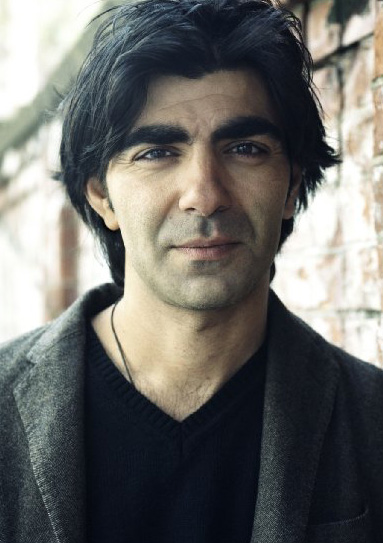
As much as I have welcomed the disparate work of German-born, Turkish-descended filmmaker Fatih Akin, whose creative, energetic and moving films have run the gamut from In July and Soul Kitchen to Head On and The Edge of Heaven, I would never have pegged him to tackle such a vast-canvas, very nearly epic family saga of genocide and search like his new film, THE CUT. Yet Herr Akin has come through with a movie that's rich, colorful and relatively "epic," yet small enough to be intimate, as needed.

The filmmaker, shown at right, who directed and co-wrote (with Mardik Martin) is here addressing the Armenian genocide which has its 100th anniversary this year and remains unacknowledged still by the Turkish nation. (Where would justice lie had the Germans refused to acknowledge their somewhat later Holocaust? I suppose if Turkey had been bent on world domination -- and stopped from that goal -- responsibility would have had to be accepted by now. I find it interesting that Akin comes from both these cultures, and that his films, among other surface things, are always about bringing together supposedly opposites, outsiders and insiders, while finding a place for "the other."

I would guess that The Cut is his biggest-budget effort thus far. An international co-production involving France, Germany, Italy, Russia, Poland, Canada and (yes), Turkey, and filmed in five countries (Jordan, Germany, Malta, Cuba and Canada), the movie looks terrific and seems utterly place-specific.

Its star is the French actor of Algerian descent, Tahar Rahim (above, of A ProphetFree Men, Day of the Falcon and The Past), whose ability to make much using little is in rare form here. The film's title refers to a particularly nasty and life-threatening wound, given early on in the movie that deprives our hero, Nazaret, of his voice. M. Rahim makes the most of his facial expressions, hand movements and body language to communicate throughout.

Initially, The Cut is about our hero's ability to simply stay alive in the face of the genocide around him. Once some kind of freedom presents itself, reuniting with his family take precedence and leads to the road-trip/search that makes up the remainder of the movie. Along the route, Nazaret encounters a wealth of varied characters, helpful or harmful, and these people help make the movie a more interesting one (they also help pass the pretty lengthy two-hour-and-nineteen-minute running time). Good and bad characteristics are doled out with enough (but not too obvious) equanimity -- amongst Muslims and Christians, men and women, along with the differing countries -- that few hackles will be raised. In a particularly sweet/sour irony, the man who gives Nazaret his wound is also the one who saves his life.

Among the most memorable, if terrible, of this movie's scenes takes place, post genocide, in a kind of camp in which women and children have been left dead or to die, in which Nazaret encounters his sister-in-law. The "look" of this scene, with its dreck-tinged colors and design, is something that may stick with me forever. I don't recall seeing anything quite like it previously. (The production design comes via Allan Starski.)

Movies like The Cut depend somewhat on an audience's good will and its need for that feeling of satisfaction and closure that "search" films demand. Akin delivers this at the same time as he offers up its cost, with a finale is moving but reticent. Overall, this is a fine addition to the filmmaker's oeuvre, as well as to the continuing history of bringing to light (and keeping it there) the Armenian genocide.

The Cut -- from Strand Releasing -- opens tomorrow, Friday, September 18, in New York City at the Lincoln Plaza Cinema and Landmark Sunshine Cinema, as well as in the Los Angeles area at Laemmle's Playhouse 7 and Royal theaters.

Thursday, October 16, 2014

Edet Belzberg's WATCHERS OF THE SKY is all about the coinage and history of genocide


Raphael Lemkin's name and life are not that well-known to many of us Americans. Prior to watching this documentary about the man and his work, I happened to read an article about all this that appeared in an issue of last year's New Republic. It whetted my appetite for more, some of which this new film by Edet Belzberg provides. WATCHERS OF THE SKY (the film's title does not come clear until almost the conclusion) is one of the most dense documentaries in terms of information, ideas, timelines, people and places that I've have seen of late. The amount of notes I scribbled as the film was unfolding are more than I have taken while watching anything else in the past year.

Beginning with some beautiful and compelling animation (which returns from time to time throughout the film), Ms Belzberg, pictured at right, weaves together the life and work of Raphael Lemkin (1900-1959, pictured below), together with the stories of several present-day people whose lives are dedicated to the work that Lemkin -- who coined the word genocide and spent much of his adult life trying to stamp it out -- began. As someone notes early on in the film, "Everyone condemns genocide but they still commit it. You can only stamp it out by moving one stone at a time." Consider this documen-tary one of those stones.

The film focuses on various genocides -- from that of the Turks against the Armenians to Sudan/Darfur, Rwanda, Bosnia and of course the Jewish Holocaust -- and we hear from folk such as Benjamin Ferencz, below, right, who prosecuted the war crimes at Nuremberg, and now works toward making war and crimes of nation-state aggression prosecutable by international law.

We also meet Samantha Power, below, whose reporting on the genocide by the Serbs in the former Yugoslavia brings back all the anger, force, grief and horror of that ghastly period. Ms Power is now the United States Ambassador to the United Nations, a place where she can use her skills toward further curbing genocide. (The movie was inspired by Power's prize-winning book, A Problem from Hell: America and the Age of Genocide.)

Luis Moreno-Ocampo (below), Prosecutor of the International Criminal Court (ICC), whom we've seen in other documentaries, here explains his work and the importance of it in helping prevent more genocide, while Emmanuel Uwurukundo, a survivor of the Rwandan genocide who lost his entire family talks about the need for hands-on work with survivors in order to change attitudes.

Among the shocking things we learn from the film is that genocide can occur within a country's own borders and still by seen as lawful (the ethnic cleansing in Darfur by the Sudanese is the ongoing and current example) and why only 22 Nazis were tried at Nuremberg (the reason is simply too simple and shocking to countenance). And we see, once again, how little force the United Nations really has.

I wish the documentary had better identification of its speakers (pace Jacqueline Susann: Once is NOT enough). And while the movie skips and jumps around like crazy, via fine use of its lovely animation (above) and some very smart editing (Jenny Golden and Karen Sim), it manages to unite all this into a cogent and compelling whole. Watchers of the Sky, via Music Box Films and running two full hours, opens tomorrow -- Friday, October 17 -- in New York City (Lincoln Plaza Cinema), Los Angeles (Laemmle's Royal and Town Center 5) and Orange Country (Edward's Westpark 8). In the weeks to come it will hit another half-dozen cities and theaters. Click here and then click on THEATERS to see all currently scheduled playdates.

Monday, May 12, 2014

Aaron Yeger's A PEOPLE UNCOUNTED: The Untold Story of the Roma opens in New York City


The Roma -- or Gypsies, as you've probably heard them referred to through most of your life -- have a long and generally unsung place in world history. If you've any interest or desire to learn what this is, and to simultaneously debunk some of the factoids and clichés you've been inundated by over the decades, the not-so-new documentary (it was made in 2011), A PEOPLE UNCOUNTED: THE UNTOLD STORY OF THE ROMA, should be a good place to begin. Early on, we're shown an old photograph of a beautiful young girl seen as the doors of a crematorium in the Holocaust were closing on her. It was long imagined, we're told, that the girl was Jewish. 
Turns out she was Roma.


The Holocaust, and the place of the Roma within it, proves an important part of this movie, in which we see various Holocaust survivors, their tattooed numbers still intact and hear their stories, every bit as horrible and specific as that of the Jews, about the depravity and abomination of it all. In fact, there is a little too much of this. Filmmaker Aaron Yeger (shown at left) might have either lessened the number of Holocaust tales or threaded them a little more cleverly throughout so that, midway, we don't start tiring and/or OD-ing on their horror.


In addition to helping us see the Roma in a new and different way, the movie also confronts racism of all kinds, and asks us pointedly, where does this come from? The answer is: humanity. And as is pointed out a couple of times during the course of the documentary, we must not allow ourselves to see the Holocaust and other genocides as something perpetrated by inhuman monsters who were the embodiment of evil. No, these were allowed and often helped along by the general populace who lived where the genocide occurred.


Late in the movie, one of the interviewees tells us, "Humanity is always looking for a scapegoat on whom it can blame its own shortcomings." Amen. Still, as the movie explains, statistics show that, in the European Union, the Roma is the group most discriminated against. So we get some of the reasons why this is so: for one thing, their constant movement from place to place (turns out, in certain countries, the Roma were never allowed to own any land, hence they had to keep moving).  


The talking heads range from those Holocaust survivors to writers, activists, attorneys, artists, musicians and men/women on the street. Their message, and the message of the movie-maker, is to be watchful. Racism is on the rise again, they tell us, and the best hope is to act locally because persecution begins on the local level. If it can succeed there, it moves onwards until it becomes something national. So it is up to the localities to defend those who are persecuted. 


Along the way, we get some odd, interesting bits. Did you know, for instance, that not one Roma was called to testify at the Nuremberg trials, even though half a million were slaughtered. (Well, they had no spokesperson, no organization.) Re Auschwitz: "The crematorium didn't look like a murder camp, rather it seemed like a large swimming pool." And we learn yet more of the infamous Dr. Mengele's experiments (shades of the current The German Doctor) -- which took place heavily on the Roma children. One of these kids -- now an old man (above) -- recalls what was done to him and describes it in the kind of compelling detail that renders it an out-and-out tale of torture porn.


There's a lot to be gotten from A People Uncounted, and perhaps the most important is that after viewing this movie, it'll be difficult to look at or think about "gypsies" in anything like the same way again.


The film -- another worthwhile documentary from First Run Features and running 99 minutes -- opens this coming Friday, May 16, in New York City at the Quad Cinema. Elsewhere? I don't know, but eventually, as with most if not all of FRF's films, it, too, will be available on DVD/streaming.

Thursday, February 20, 2014

Kurdistan comes to NYC's Quad Cinema, as two Jano Rosebiani movies open: CHAPLIN OF THE MOUNTAINS and ONE CANDLE TWO CANDLES


According to Wikipedia, contemporary use of the word "Kurdistan" (of which there is no official "country," though the term can mean a particular region of Iraq) refers to large parts of eastern Turkey (Turkish Kurdistan), northern Iraq (Iraqi Kurdistan), northwestern Iran (Iranian Kurdistan) and northeastern Syria (Western Kurdistan) all of which are inhabited mainly by Kurds. These days, some 25 years after the awful al-Anfal genocide waged by Saddam Hussein, it's easy for younger people (and older ones happy to forget history) to imagine that Kuridstan somehow is its own special country -- which it might, one can hope, someday become.

Even here in New York City, considered one of the cosmopolitan capitals of the world, we see few Kurdish films. So this double debut of movies by Kurdish filmmaker Jano Rosebiani is a welcome treat. Rosebiani is from Iraq Kurdistan, and though he seems to have spent a good deal of his life here in the USA, his movies hark back to his home country. CHAPLIN OF THE MOUNTAINS, an odd kind of sweet/sour road-trip about American documentary filmmakers showing Charlie Chaplin films in the mountain towns, as two lovely ladies tag along, even deals with the results of the al-Anfal genocide, while ONE CANDLE TWO CANDLES proves a comedy, if a somewhat dark one, about marriage and equality in present-day Kurdish culture.

The first thing you may notice about both films is how beautiful each is, scenery-wise. This mountainous area of Iraq Kurdistan, being industry-free, has no pollution and so, film-wise, the colors register strong, bright and true. On the basis of these two films, the work of Mr. Rosebiani, shown at left, seem to possess a nice combination of Hollywood storytelling ability and indigenous, low-key reality and charm.

In One Candle Two Candles he offers a kind of present-day "take" on a folk tale that includes an entire little town beginning with a goat-herd who dearly would love to own a pair of shoes and a pretty young girl (above, left) whose father is forcing her into marriage to a rich old man.

There's also a kid whose dad owns a local restaurant where very fresh fish are tastily prepared; a woman famous for castrating her husband who now seems always on the lookout for new meat; a hunky young artist just come to town (above); a sweet but feeble-minded man who longs to marry, and a dwarf who loves to expose himself and dance; and that aforementioned shoeless shepherd (below, after the "miracle").
Yes, this is quite crew.

Rosebiani sets the comic tone pretty well and keeps it going nicely throughout, though for us westerners, drawing laughs from the situation of a rich and entitled old man who'd rather burn his would-be bride to death rather than lose her to a more appropriate younger man simply underscores the horrors of Muslim culture, tradition and religion as evidently practiced here. "Would anybody blame me if I killed you?" hubby asks his bride.

Clearly, the answer, on one level, is meant to be a resounding no. Fundamentalist religion per se is mostly kept on the outskirts of both these films, yet its hammerlock on the culture is felt all the same.

On the other hand, that culture, as shown in the "Candles" movie, does seem to have some tolerance for "the Other," at least as viewed in the handling of the castrator, the feeble-minded and the exhibitionist dwarf (above). Who is kept in prison -- and for how long -- is one of the movie's funnier running jokes. Nary a homosexual shows his or her face, however; some "others" are clearly better than other "others." For the skinny on Muslim/Islamic hypocrisy on this matter, turn to George Gittoes' excellent Miscreants of Taliwood.

Chaplin of the Mountains has more of a documentary feel (Rosebiani has been involved in a few films in this genre, too) as his two young film-makers travel the mountain roads, stopping in various villages to screen Chaplin movies for the assembled crowds. There always seems to be an interruption, however: a herd of goats, or the screening at a wedding in which one of the mothers insists on more dancing rather than a movie.

Along the way, bits of several different Chaplin films are shown, the background and character of the young Parisian woman (above, second from left) who tags along is unveiled, as well as the needs and confusion of another beautiful young woman, a journalist (above, second from right), who also accompanies the two male filmmakers.

We get a philosophical discussion of love versus marriage; feminism ("In this country, you say hello, and they think you want to have their baby"); and finally we realize that, as well as road movie, we're also on a "quest" that offers some suspense and excitement. When we finally reach our title character, it turns out that the actor chosen (shown bottom, left) is way too young to be playing a great-grandpa.

As Rosebiani wrote, directed and edited both films, he's the man to praise or blame for the results. Mostly, I am happy to say, it's the former. The movies are lovely to look at, enjoyable to steep yourself in, and you'll come out the other side most likely with a better (or at least some) understanding of Kurdish culture.

From Evini Films, Chaplin of the Mountains (running 91 minutes) and One Candle Two Candles (running 105 minutes) open tomorrow, Friday, February 21, at the Quad Cinema in New York City. The filmmaker will be present for a Q&A on Friday and Saturday following the 7:10 show of "Candle"; Jano with also appear with his star Estelle Bajou (above, right) on Saturday after the 9:30 showing and on Sunday after the 5:00 showing of Chaplin of the Mountains.

Wednesday, July 17, 2013

Further 'enemies of the people' explored in Joshua Oppenheimer's The ACT of KILLING

Back in 2010, we covered a small but piercing documentary entitled Enemies of the People (that review can be found here) about Cambodia, in which its filmmakers record the words and actions of, among other "murderers," one of the top Khmer Rouge officials under Pol Pot, responsible for countless deaths of his countrymen, as he and others confess, right in front of us, on-screen. The film was grueling, informative, moving and hugely effective -- unlike anything that I had seen previously. Now, with THE ACT OF KILLING -- a new documentary that explores similar behavior in a very different country, Indonesia -- filmmakers Joshua Oppenheimer (below, left), Christine Cynn (below, right) and Anonymous (who, if s/he were identified, might risk death to him/herself and family) take this confession of genocide even further into the realm of, dare we say it, art.

Despite the similarity in subject matter, the extreme differences between these two films can be placed on the doorstep of both the countries in question and the people making the two movies. Indonesia has a squalid and disgusting history of genocidal dictatorship, death, torture and a populace most likely by now inured to this kind of slavery and lack of change. Cambodia's is otherwise. I am no expert here, but I believe that the revolutionary, horrific and relatively short
reign of the Khmer Rouge was a one-off thing for a people who had, like so many others, endured colonization and unfair rule, but whose religion of Buddhism, inflected with Hinduism, had endowed it with a certain inner peace (OK: I'm being a little simple-minded here, but culture, history and even -- gasp! -- religion do matter. Indonesia, by the way is almost entirely Muslim: over 87 percent, according to the 2010 census.) And while the filmmakers of Enemies -- Rob Lemkin and Thet Sambath (the latter's family was killed by the Khmer Rouge) -- took a simpler, more direct and personal approach that resulted in a purer look at people and events, Killing's crew have seen fit to quite heighten their film's rather surprising entertainment value.

Among other enticements, Oppenheimer et al. give us a "film" within the film (above) meant to somehow obscure the events; family celebrations; rehearsals and recreations of murder, mayhem and wives and children pleading for their loved ones' lives; tepid choreography amidst nature's grandeur (also above), accompanied by the famous pop song, "Born Free," which will never have been heard quite so full of irony; and a whole lot more.

Yes, this gussies up the film (it also lengthens it: 122 minutes against Enemies' 93), while making us better under-stand why two famous doc-makers -- Werner Herzog and Errol Morris, who also employ the art of gussying -- are credited with "presenting" this film. If The Act of Killing ends up entertaining us a tad shallowly against our better judgment, it also enriches, making us explore from different angles, while alerting us all over again to how human beings seem best built for killing, hypocrisy and denial.

The two main men we meet in the film, and who would have to be considered its stars, are one who calls himself Anwar Congo and another named Adi Zulkadry. Both -- shown in "make-up," above, with Anwar on the right -- are mass murderers. But the way they've handled this, down the decades, is quite different. Anwar is the more outgoing of the two, a real "family" man (shown below with his grandkids), but he's also the one who appears to be having trouble putting the past to rest. (Though I'm not quite sure I believed in his nightmares and "guilt." In the end scene, he seems to be wretching badly, but no vomit ever comes up. He may simply be the supreme "actor.")

Adi has a much better handle on it all. More direct and initially "honest," it turns out he believes in putting everything behind him and just leaving it there. Supposedly, because of the statute of limitations, the men can no longer be charged. But this has more to do with the current-and-as-ever political situation in Indonesia, where criminals, whether politicians or gangsters like these two guys, rule entirely. (The term "gangster," we're told again and again by the murderes on view, actually means "free man," which is yet more bullshit, just like much else spouted by Anwar and Adi.)

This movie, often disgusting and stomach-churning, will make you about as angry as any documentary you've experien-ced. (The Indonesian TV talk show, below, provides just one of these moments.) And then, as it goes along, you may find yourself beginning to identify with these two men. Just a little. But enough to possibly admit to the humanity we share. Oh, you'll still want them dead -- and maybe tortured a lot beforehand -- to somehow make up for every last one of those poor Communists, Chinese, or any other of the "other" deemed worthy of killing, whom they ushered into oblivion.

This is never broached in the film, but watching Anwar, I couldn't help but wonder if he isn't gay. I mean he looks, acts and dresses that way. But then, as we're in a Muslim country, this must of course go totally unexplored. At one point, early on, I think it was Anwar who explains, "We have to show who we are so that, in the end, people will remember." Uh... Yes, indeed, honey. And you and Adi -- along with Oppenheimer, Ms Cynn and Anonymous (the end credits here, unlike those of any motion picture I've seen, are chock full of this word) -- have done exactly that.

The Act of Killing, from Drafthouse Films, opens this Friday, July 19, exclusively in New York City at Landmark's Sunshine Cinema, where director Joshua Oppenheimer will appear in person on 7/19 at the 7:30pm showing and on 7/20 at both the 4:50 and 7:30pm showings. In the following weeks, the movie will roll out across the country in most major cities. Click here to see all currently scheduled playdates, cities and theaters.