Showing posts with label Henry James on film. Show all posts

Tuesday, June 4, 2019

Blu-ray/DVD/digital release of the 1984 Merchant/Ivory classic, THE BOSTONIANS


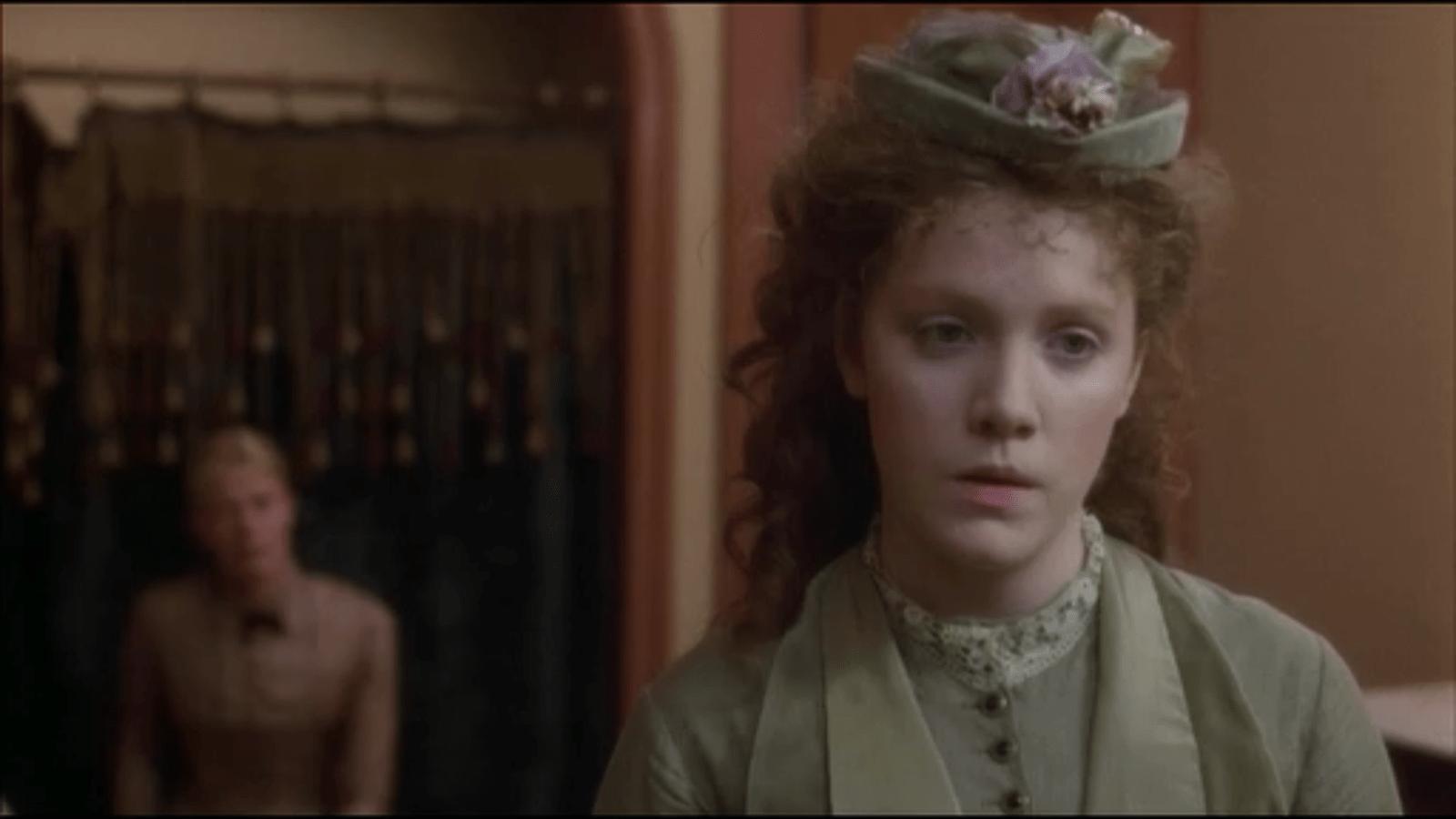
One of the more profound if unsettling experiences I've had watching a movie of late came as I viewed the new 4K restoration of the James Ivory/Ismail Merchant film, THE BOSTONIANS, adapted by Ruth Prawer Jhabvala from the Henry James novel. Both of these feelings arose while watching and hearing fledgling actress Madeleine Potter (shown below: this was but her second role, and she is extraordinary) rouse an audience to high fervor regarding the need and reason for equality for women. (The film takes place in 1875 in both Massachusetts and New York.)

The power of those words and of their delivery by Ms Potter are fierce, but TrustMovies unsettled feeling came from the unpleasant realization of how very far we are today from anything remotely approaching equality between the sexes. When this film was first released theatrically in 1984, America seemed to be able to rest easy, still basking in the triumph of Roe vs Wade and in how far it seemed that women had come over the past couple of decades. Well, never rest easy, right?

In fact, when I initially saw the film back in the mid 1980s, I found it less than compelling, perhaps for the very reason that it seemed somehow out of date. Viewing it now, in the era of Donald Trump, and the South's rise again in everything from bigotry and white supremacy to the more and more stringent anti-abortion "laws," it could not be more timely or important.

Nor, in fact, could The Bostonians' other theme of that ever-present struggle in women between the need for love and security and the competing desire for independence and power over one's body, spirit and life. That struggle is shown in fine form here via Verena Tarrant (the Potter character) and her attraction to Basil Ransome, the handsome Southern gentleman, played very well by the late Christopher Reeve (above), in one of his better non-Superman roles.

The attraction is plain and clear for both characters, but it takes most of the movie before Verena can understand her own needs well enough to act on them. And that is the great strength and finally the unfortunate weakness of the film. The second half begins to seem a bit repetitive and so loses some of its steam -- before gaining most of this back in the final few minutes.

The other main attraction of The Bostonians is the great Vanessa Redgrave, above, in one of her (god, there are so many) finest roles, as Basil's northern cousin, Olive Chancellor, the stern, middle-aged woman who saw and nurtured Verena first, and has fallen hopelessly in love with her, only to see the girl slowly being pried from her arms by her own cousin. Of course, Olive can have no recognition of this forbidden love, given the time and place, not to mention her own strictured character, so she must pretend that what is going on here is everything but what we know it is.

The settings -- indoors and out -- are by turns verdantly lovely and full of elegant, Victorian too-muchness, while the terrific supporting cast includes a bevy of lip-smackingly good performers: Jessica Tandy, Wesley Addy, Nancy Marchand, Linda Hunt (below, left, and delightful indeed), and Wallace Shawn.

There is so much to savor in this wonderful new restoration that I hope you'll see the film (or see it again, as the case may be). God knows, it holds up. And then some. From the Cohen Film Collection and running 122 minutes, The Bostonians hit the street on Blu-ray, DVD and digital last month and is available now -- for purchase or rental.

Tuesday, April 16, 2019

New Blu-rays from Cohen Media Group -- Bogdanovich's lovely Keaton paean, THE GREAT BUSTER: A CELEBRATION, and Julien Landais' gorgeous but rather silly version of THE ASPERN PAPERS


Let's get the silly out of the way first: Julien Landais' adaptation (he is director and co-writer) of THE ASPERN PAPERS, the duly famous Henry James novella, is a goregeous misfire in numerous ways. Set in Venice in the late 19th century, the film is full of delightful sets, costumes and architecture (when, after all, is a movie set in Venice not eye-poppingly beautiful?). It's a pleasure to view, even at its dumbest, which is when Landais (shown below) sees fit to offer up a bunch of soft-core sex scenes showing us the supposed affair
that took place between the younger Juliana and the late and famous, if fictional, romantic poet Jeffrey Aspern. So far as TrustMovies recalls, nothing like this took place in the original novella nor in any of the several theatrical or movie adaptations.

These flashbacks (as below) are not only not needed, they simply move this movie ever closer to downright schlock. Yes, they're somewhat sexy and might slightly induce our younger generation to pay attention awhile longer, but they add nothing at all in the way of character building.

So we're left with our trio of well-known actors to do the heavy-lifting, two out of three of which come through as expected: Vanessa Redgrave (below) as the elderly Juliana, who proves uber-protective of the old love letter exchanged between herself and Aspern,

and Redgrave's real-life daughter, Joely Richardson (below, and the best thing in the film) as Juliana's middle-aged and lonely niece, Tina, who cannot help but grow hopeful and attached to the man who has come to their palazzo in the guise of a wealthy fellow who loves their garden but who only really wants to get his hands on those letters.

As played with but a single pained, uncomfortable expression by Jonathan Rhys Meyers (below), who usually is able to help carry the movies in which he appears, here the actor becomes a real pain to have to endure after only a short while.

And so we move, over and over, between present day scenes and past would-be hot sex and melodrama, with only the beauty of Venice, the costumes and sets, and the talent of Richardson and Redgrave to keep us occupied.

This might well be enough for some, particularly lovers of Venice and the Redgrave family. In any case, this new version of The Aspern Papers, via Cohen Media Group and running 90 minutes, arrived on Blu-ray, DVD and digital streaming last week -- for purchase and/or rental.

***************************

Much better in every  respect is the new documentary THE GREAT BUSTER: A CELEBRATION, also from Cohen Media Group, written, directed and narrated by Peter Bogdanovich, about the life, times and art of that great silent film comedian, Buster Keaton. Even if, I think, you know all or much of the films of Keaton, this documentary may still enrich and surprise you -- so well-constructed, lively, and full of facts and fun it consistently is. Bogdanovich, below, weaves archival footage and film footage of Buster in all his glory, along with talking-head comedians and filmmakers (such as Richard Lewis, in the penultimate photo below) who've been inspired by Keaton.

The end product is a keeper -- a movie that informs, entertains and burnishes to glory the reputation of one of cinema's greatest.

Bogdanovich's interesting mapping of Keaton's life and career seems pretty much standard, in that he moves ahead -- until he reaches the point of the 1920s and the comedian's most productive stage. He shows us this in a small dose, with the caveat that we'll be returning to that fertile period later on.

Indeed we do, and by then we've seen Keaton's entire career laid before us. Consequently, when we come back to those glory years and see these films in greater detail, this makes for an almost perfect conclusion to all that has come before.

Though I had seen Beckett's Film (as well as Ross Lipman's Not Film), I had forgotten about the work Keaton did at American International studios during the 1960s (Beach Blanket Bingo, etc.). Ditto many of the details of the performer's life.

Bognaovich's ability to give you so much information in such fine form will have you laughing and appreciating in equal measure. I can't imagine a better tribute to a titan of American comedy than this one.

Also from Cohen Media Group, and running 103 minutes, the documentary hit the street on Blu-ray, DVD and Digital last week -- for purchase/rental. 

Saturday, August 10, 2013

On DVD/Blu-ray, one of the year's better films: McGehee/Siegel WHAT MAISIE KNEW

Covered at length this past April (that post is here), I'll just add that a second viewing of WHAT MAISIE KNEW, the very good movie from film-making team Scott McGehee (below, right) and David Siegel (below, left), holds up well (and looks even better on Blu-ray). TrustMovies still feels that one good melt-down from the little girl at the center of the film would have been a smart move on the part of the directors and adapters of the Henry James novel (on which the movie is based and has been updated to modern times). God knows this kid deserves one, and seeing her express some genuine anger would have helped balance the slightly too-sweet feeling that builds up as the movie goes along.

Balancing this are the excellent performances (every last one of them), the remarkable capture of events from the child's point of view, and the ferocious anger and narcissistic stupidity exhibited by Maisie's parents, which may set the movie record for bad parenting yet always remain within the realm of reality (no Mommie or Daddy Dearest here, thank you!).

A film to savor and maybe make you feel a little guilty about the family fights to which your own child was privy, What Maisie Knew -- from Millennium Entertainment 
and running 98 minutes -- hits the street Tuesday, August 13, on DVD and Blu-ray, for sale or rental.

Pictured at right is Alexander SkarsgÄrd holding Onata Aprile, who plays Maisie.

Tuesday, April 30, 2013

McGehee & Siegel's WHAT MAISIE KNEW: Henry James gets a (mostly) deft updating

How different are the movies of Scott McGehee and David Siegel (Suture, The Deep End, Uncertainty) when they both write and direct a film than when (Bee Season and their latest effort WHAT MAISIE KNEW) they collaborate with other screenwriters! Gone is much of the oddness and the anything-but-straight-ahead momentum that distinguishes the pair, which is not to say that Bee Season and even more so What Maisie Knew are not worth seeing. They are (with Maisie especially so) but they are surprisingly mainstream in their intention and style. Consequently, the duo's latest might very well be its biggest hit. Which would be wonderful -- if it means that we'll be seeing their work more often.

McGehee and Siegel (shown above, with the latter on the left) and the screenwriters -- Nancy Doyne and Carroll Cartwright -- have taken the famous novel of the same name by Henry James and turned it into a surprisingly relevant and timely look at parenting (and the lack of it) today. The original novel explored how two divorced spouses use their child to hurt each other at the kid's expense, and this update does the same. The specifics -- time, place, occupations, secondary characters and all the rest -- have been given almost exactly the right spin so that they move the plot along, while making everything seem absolutely au courant. James would be pleased, I suspect, and probably not at all surprised to see how very little (except the accouterments) has changed over an entire century, and beyond.

Behavior is key here, and all four filmmakers take care to put it on rich display -- with its subtext fully articulated, as well. These characters try to behave as if they understood what responsible adults act like, but their own desires continually take precedence over everything, and so they fail consistently. Maisie's mother (a brave and nasty performance played with flash and flair by Julianne Moore, shown at right) is a drug- and alcohol-addled rock star, while her father (equally nasty and played with unusual restraint by Steve Coogan, below) is sort of of art agent who lives, we soon find, too close to the edge.

These two want desperately to be thought of as model parents, but everything they do indicates (hell, screams!) that they should never have had a child. At times this movie seems like a plea to restrict irresponsible adults from ever being allowed to conceive. Their child, the titular Maisie, is brought to fine life by relative newcomer Onata Aprile. Ms Aprile (at left, above and below) is a find, and Maisie's a role that suits her almost ideally.

The film's other two important characters -- Maisie's governess/care-giver, Margo, and mom's new boy-fuck Lincoln -- initially impress us as shallow and out for their own best interests. But the screenplay and performances by the two actors who inhabit these roles (Joanna Vanderham, below and Alexander SkarsgÄrd, above, right) slowly win us over as these characters grow and change so beautifully and movingly as the movie progresses.

What Maisie Knew is a heartbreaking film in many ways. It has been some time since I've seen a movie that gave us entry (and so well) into the child’s point of view. The directors (and, I am guessing, the screenwriters) put us so firmly in the place of this girl, who only slowly (and only as much as her young age can manage) understands what is happening and that, finally, she just might have some small command of her situation.

My one quibble -- but it's a big one: Why didn’t the writers and directors know enough to give this kid at least one moment of "brattiness"? (God knows, Maisie has plenty of reason to act out!) Having raised a daughter in New York City and now seeing my two grand-kids (around the same age as Maisie) and all their friends, I have to say that I have never seen a child who is this good all the time. The only way a child could be this good would be via some major repression -- which would certainly not lead toward any happy ending. It's surprising then, that between the directors and the screenwriters, someone didn't raise the point -- Hey, we need to make her just a little more real. As it is, Maisie has our full sympathy; she doesn’t need to be perfect. But by keeping her so cute and correct at every moment, the movie ends up by default sentimentalizing both Maisie and her circumstances.

What Maisie Knew is a very good film. But it might have been a great one. It opens this Friday, May 3, in New York City at the Angelika Film Center; and on May 17 in Los Angeles at The Landmark; and throughout the country in the weeks to follow.