This Wednesday marks the opening of the third edition of the
New York Documentary Film Festival – Festival dei Popoli, running through Sunday, May 30, at
Anthology Film Archives in Manhattan. Part of an ongoing project of the
Festival dei Popoli, based in Florence, Italy, this is the oldest International Documentary Film Festival in Europe, aiming of late toward broadening the audience for its archival footage, as well as Italian documentaries in general.
This year's festival opens with a tribute to the award-winning Italian filmmaker
Gianfranco Rosi: the U.S. premiere of
Below Sea Level (2008), a nearly two-hour-long intimate portrait of a commune of outcasts living in the middle of the desert about 200 miles southeast of Los Angeles. This multi-award-winning documentary received the Venice Horizons Documentary Prize. Director Rossi will be present for the screening.
Below Sea Level is one of those documentaries that offer no explanation nor exposition but simply give you "life lived." In a revolving series of looks at the denizens of this odd "community," some themes do emerge -- among them hair (of the head, on the face, even a wig) as a kind of fortress/defense against the world. These sad people, about whom, by the end of the film, we have learned rather a lot, become unforgettable, and where and how they live seem strangely memorable, too. This is certainly up there with the best of documentaries; its Venice "win" seems no surprise.
Also among the newer offerings are two other docs that seem to express this "life lived" theme. One of these is part of the Italian Chronicles section that this year focuses on the work of
Alessandro Rossetto: Bibione Bye Bye One, an alternately lustrous and grainy black-and-white, 75-minute film from 1988 that focuses on Bibione, a town on the Adriatic Sea, located 60 miles north of Venice. The filmmaker begins by showing us an old man fishing (somewhere near Bibione, I suppose), and then shifts to the resort town for a look at the many different inhabitants and tourists who come there
.
We're at the beach; in a bizarre pet shop offering snakes and crocodiles; with an old women and her dancing, dressed-up doggie. The denizens often talk of the old days (and plenty of other things) as they amuse themselves. If the movie seems to go nowhere in particular, we've enjoy the non-ride -- and learn some interesting things along the way.
The last film I viewed is part of the
Special Event section, sponsored by
New York Women in Film & Television:
ABC Colombia, by
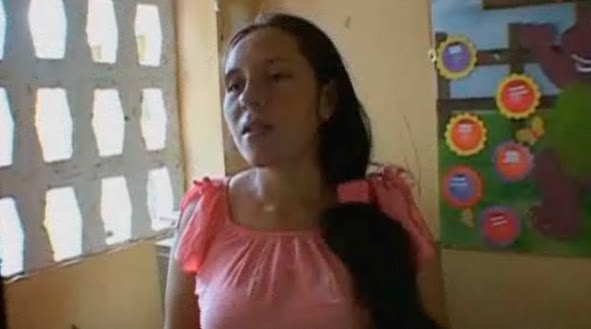
Enrica Colusso (Italy/France, 2006, 88 minutes), at the screening of which the director will appear in-person. A look at a small rural community in a part of Colombia entirely controlled by paramilitary forces, the film brings us village life via the the eyes (and mouths) of the children, their school-teacher (shown at bottom) and a parent or two. Mostly though it's the kids (like the one shown above) who speak, and what they tell us is horrible.
I don't recall many other films as upsetting as this one, in which the beauty of the countryside (below) and the village is totally offset by what we hear: Children forced first into cocoa-growing, then as they age, having the choice of joining either the military or the para-military, who, of course, end up killing one another. Listen to the children singing as they work about becoming a big Mafioso,-- "bigger than Escobar!" -- and be utterly disheartened. Along the way there are scenes of the kids crushing cocoa leaves under feet in a strange little dance, playing with toy weapons made out of carved wood (above). Soon after hearing one young man talk of gutting and carving up dead bodies so as to be able to bury then more quickly and efficiently, my screener began to pixilate and then finally refused to go any further. Though I missed the final ten minutes of this documentary, I feel as though I may have been spared the worst of it. This is one utterly gorgeous and absolutely depressing film. Yet Ms. Colusso is to be congratulated for risking her life to make it, allowing us to see and hear things as they are in this particular part of Colombia.

While the above three films are all that
TrustMovies had time to view prior to the five-day program, there will also be a multi-film retrospective under the title of
The Feeling of Being There (1958-1965): Seven Years of Documentary Cinema which will feature four programs of auteur documentaries, with a total of eighteen films depicting reality and history as filtered through the aesthetics of very different directors:
Robert Frank,
D. A. Pennebaker,
John Schlesinger,
Ivars Kraulîtis,
Joyce Chopra,
Richard Leacock,
Joris Ivens,
Agnès Varda,
Michel Brault,
Gilles Groulx,
Cecilia Mangini and
Sandro Franchina.
You can find the complete program of the entire festival
here.
GENERAL INFORMATION: Tickets for New York Documentary Film Festival - Festival dei Popoli 2010 are available at the box office only, $9; $6 for AFA members and free for NYWIFT and PGA members.
Anthology Film Archives, 32 Second Avenue, New York, NY 10003
Subway directions: F, V to 2nd Avenue / B, D to Broadway – Lafayette / 6 to Bleecker Street.
This series has been organized and produced by: The Fitzgerald Foundation of Florence and Festival dei Popoli - International Documentary Film Festival, Florence in collaboration with: Consulate General of Italy, Italian Cultural Institute, Tuscan Region, FST- Mediateca Toscana Film Commission, Veneto Region and Anthology Film Archives. It is presented by: New York Women in Film & Television (NYWIFT) and PGA - Producers Guild of America. Media Partners are i-Italy.org and Film Annex
Special thanks: are given to Stefania Ippoliti, FST- Mediateca Toscana Film Commission, Tanja Meding, Terry Lawler and Paula Heredia for NYWIFT, Riccardo Viale and Simonetta Magnani (Italian Cultural Institute), John Mhiripiri and Stephanie Gray (Anthology Film Archives), Paolo Cocchi, Fabrizio Ronchi, Lucrezia Pinzani (Regione Toscana), Monica Nonis, Carlotta Martorana (Regione del Veneto), BFI, The Museum of Fine Arts Houston, Rosanna Coscia (Jolly Hotel Madison Towers).
All photos are from Enrica Colusso's ABC Colombia.