Showing posts with label Jeremy Workman. Show all posts

Friday, November 23, 2018

Walking/discovering New York City in Jeremy Workman's THE WORLD BEFORE YOUR FEET


The very interesting documentary filmmaker, Jeremy Workman, who back in 2014 brought us that year's finest doc (of those TrustMovies managed to see, at least) -- Magical Universe -- has a new one that just opened in New York City and Los Angeles. It's titled THE WORLD BEFORE YOUR FEET and, so far as subject matter is concerned, proves highly reminiscent of Workman's contribution to another documentary, True New York, he produced two years ago. That would be the episode entitled One Track Mind, all about a fellow who has devoted his entire free time over the past 30 years to cataloging and archiving information on every last station in the New York City subway system.

Mr. Workman's new film tracks another, younger fellow, Matt Green (shown above, left, with the filmmaker), who has spent all of the past seven years walking the maybe 8,000 miles of roads and paths that make up New York City's five boroughs. Green gave up employment as a civil engineer (what most of us would call a very good job, particularly in these terrible times) to pursue his unusual dream. Why? Even he doesn't quite know. "People tell me I could be doing something more useful with my life," he explains "They ask me what is the point of it all. I'm kind of learning that as I go along."

And so do we. One of Workman's great gifts is to take us inside the folk he films, well enough and far enough so that we really do understand how they think and feel. We begin to experience life through their eyes. And Mr. Green's new lifestyle is a fascinating one: He tells us he is able to live on $15 per day. Homeless now, he depends on the kindness of former friends but mostly on that of the strangers he meets who often invite him in for a meal, a shower, even a place to sleep. He also cat-sits (and sometime dog-sits) as a means of providing himself shelter. The guy is a charmer, all right, pleasant looking, intelligent and affable. And his "trek" really does seem to interest many of the New Yorkers he meets.

Along the way, Workman lets us meet and hear from other New York "walkers": a sociology professor, a real estate agent and a writer, the latter of whom also happens to be black and explains to Green and to us some of the differences in dress, attitude and actions that he must employ, due to, yes, the race card. The filmmaker also allows us to meet two of Green's former girlfriends, one of whom he very nearly married. His obsessions (I would call them that) and lack of interest in more "normal" patterns of behavior and relaxation (he has zero interest in ever going out to a movie) seem to have rendered any long-term love relationship impossible.
For now at least.

We visit Green's home town of Ashland,Virginia (blink and you'll miss what's playing at the local movie house: a screening of Workman's Magical Universe) and meet his parents who, as you might imagine, kind of wish that their son had some real employment again (he has never asked them for money, they tell us). We see snippets of his earlier across-the-USA walk, during which he stopped at the home of his brother in Chicago, and we learn of past trauma that happened to both siblings that might help account for Matt's more-or-less uber-carpe diem philosophy.

Lasting only 95 minutes, the documentary is still surprisingly rich in the ways it brings us into Matt's world and viewpoint: the objects he sees, the people he meets, the history he discovers and especially all he notices and begins putting together and writing about via his blog -- the many "churchagogues" (ex-synagogues that have become other-denominational), all the hair-cutting establishments that have replaced the letter's "c" and "s" with those of "k" and "z" (note especially his honorable mention that caps all those kutzes), the "puddle that never goes away" (in Staten Island, I think), the ingenious vegetable gardens of Queens, real redwood trees in New York City, 9/11 memorials, cemeteries, and the oldest tree in all of NYC (along with a notebook left in its hollow by a class of kids who visited it once upon a time), and a young woman who, thanks to Matt, here tastes her first fig! This is New York City like you have never experienced it.

There is also some lovely and stirring music, thanks mostly to Carly Comando and Tom Rosenthal (among other contributors). Mostly though, this is Green's and Workman's baby (the latter produced, directed, filmed and edited it). And it is very much worth seeing. From Greenwich Entertainment, The World Before Your Feet opened in New York City at the Quad Cinema this past Wednesday, and will hit Los Angeles at the Landmark NuArt today, Friday, November 23. It will also play Washington DC at the Avalon Cinema on Thursday December 13. Elsewhere? Sure hope so. I'll add playdates, cities and theaters here, as I learn of them.

Friday, November 11, 2016

TRUE NEW YORK: a short-film anthology about the Big Apple by Jeremy Workman and others


The forever step-child of the movie world, the "short film," is so generally neglected (and, yes, he admits it, by TrustMovies, too) that the collection of shorts that makes its home video debut this coming week is at least some cause for celebration. Titled TRUE NEW YORK and featuring five documentary tales of people and life in the Big Apple, the total movie is definitely worth a watch -- if a bit uneven in terms of interest and success. The five shorts have all won awards at various fests, however, so chances are you'll find something worthwhile.

One of the five directors, Jeremy Workman (shown at right), also produced this anthology. Back in 2014, Mr. Workman made the year's best documentary, so far as I am concerned: a little amazement called Magical Universe. (The doc is now available to stream on Netflix, so if you have not seen it, consider it a "must.") Workman's contribution to this anthology -- One Track Mind, the third film of the five -- has, at its center another obsessive character similar to the one found in Magical Universe: a fellow named Philip Ashforth Coppola (below) who has dedicated most of his life to his self-financed study of the New York Subway system, with special attention to much of the architecture, art and history found in every single one of the system's many stations.

How he has managed this and what has resulted takes up the 22 minutes of the film -- the shortest but also the best of the group. Coppola is a man who clearly loves the subway, but he also possesses a nice ironic sense of humor, even about himself and his work (watch him pretend to fall asleep, as he views himself being interviewed on TV!).

Workman is, as you'll be, too, charmed by, interested in, and impressed by the man and his task. And the filmmaker brings it all to fine life with the help of his camera, Coppola, and a few talking head interviews that bolster the case.

C-ROCK, the short that opens this film, takes us to a certain spot in the Bronx (the title rock) overlooking the Harlem River, off of which (anywhere from 30 to 110 feet up) jump boys and young men as a kind of rite-of-passage. This has been going on for generations (we meet at least three of these in the film), as the youngster tell us, between their many jumps, what it all means to them, while the oldsters relive their youth.

At 29 minutes, the film seems over-extended (all that jumping proves finally a bit tiresome), but I must admit that the place is impressive, and the idea of jumping -- while maybe a tad dangerous (the movie's end credits go out of their way to mention that no encouragement was provided the jumpers by the filmmaker, Jordan Roth) -- certainly makes a spectacular visual.

The second film of the five -- Taxi Garage (originally titled Drivers Wanted) by Joshua Z. Weinstein -- is the kind of movie that might give Donald Trump heart failure (gosh, could someone show it to him soon, please?), it's such a paean to what so many of us love about the wonderful diversity of New York City and its boroughs. From the humorous old Jewish guy -- kindly but street-smart to the max -- who runs the place to his hugely diverse cab drivers (mostly recent immigrants), everyone we meet here seems like the salt-of-the-earth and then some.

In heat and snowstorm we watch them at work and learn a little of their lives and their desires. Made four years ago, before the onset and co-opting of Uber, the movie will make you wonder if the NYC Taxi company remains in business. (I just now tried the phone number we so often see throughout this little movie -- 718-786-5811 -- and sure enough, the company seems to be up and running.

New York's Muslim community is given a look in the fourth short doc, A Son's Sacrifice by Yoni Brook, that details how and why a young man named Imran (above) decides to take over his aging father's halal slaughterhouse in Queens. We meet that father, and get a short glimpse of the mother, but mostly concentrate on the son.

The movie allows us to see some interesting prejudice from Muslims themselves (when they suspect someone is not a Muslim) and also view various slaughterhouse practices. By the time we finally arrive at exactly what the sacrifice in question will be, we've learned enough about these people and their work that we can better understand and appreciate just how great this sacrifice both is and -- after all that Imran has now learned and experienced -- maybe is not.

The final film of the five -- Black Cherokee by Sam Cullman and Benjamin Rosen -- is in some ways the most bizarre, as it shows us a father (Otis Houston, Sr., who is failing via Alzheimer's) and his caretaker son (Otis Houston, Jr., an artist and performance artist), shown above and below, who sells his wares on the streets.

In its short 23 minutes, the movie tackles everything from art and freedom to caretaking and providing for family. As odd and oddly appealing is the younger Houston, there is so much more we might like to learn about this man and his beliefs that I wish the movie has spent a little less time simply watching him and more time asking him some questions. But that perhaps was not the moviemakers' intentions.

More to the point, however, is another question: In a movie entitled True New York, how "true" is it if a full 50 per cent of the population has been left out? I am talking about New York women, whom we barely see in any of these films. (Workman does interview a couple of them for his film; we catch a glimpse of one lone female taxi driver; and Imran's mom makes an appearance cooking in the kitchen, whis his dad manages to insult a woman at the family's slaughterhouse.) Granted, each film here was made in its own time and for its own purpose, but I would think that, in choosing the films to be included here, at least one of these ought to have concentrated on a female. Or is it possible that no female filmmakers or female subjects of short films actually exist? So much for diversity. (The fellow shown above, now deceased, is one of the most interesting of all Taxi Garage's drivers.)

This five-part documentary anthology, from First Run Features and running 131 minutes, hits the street on DVD this coming Tuesday, November 15, for purchase and/or rental.

Tuesday, October 28, 2014

Jeremy Workman's provocative, enriching documentary, MAGICAL UNIVERSE opens

 
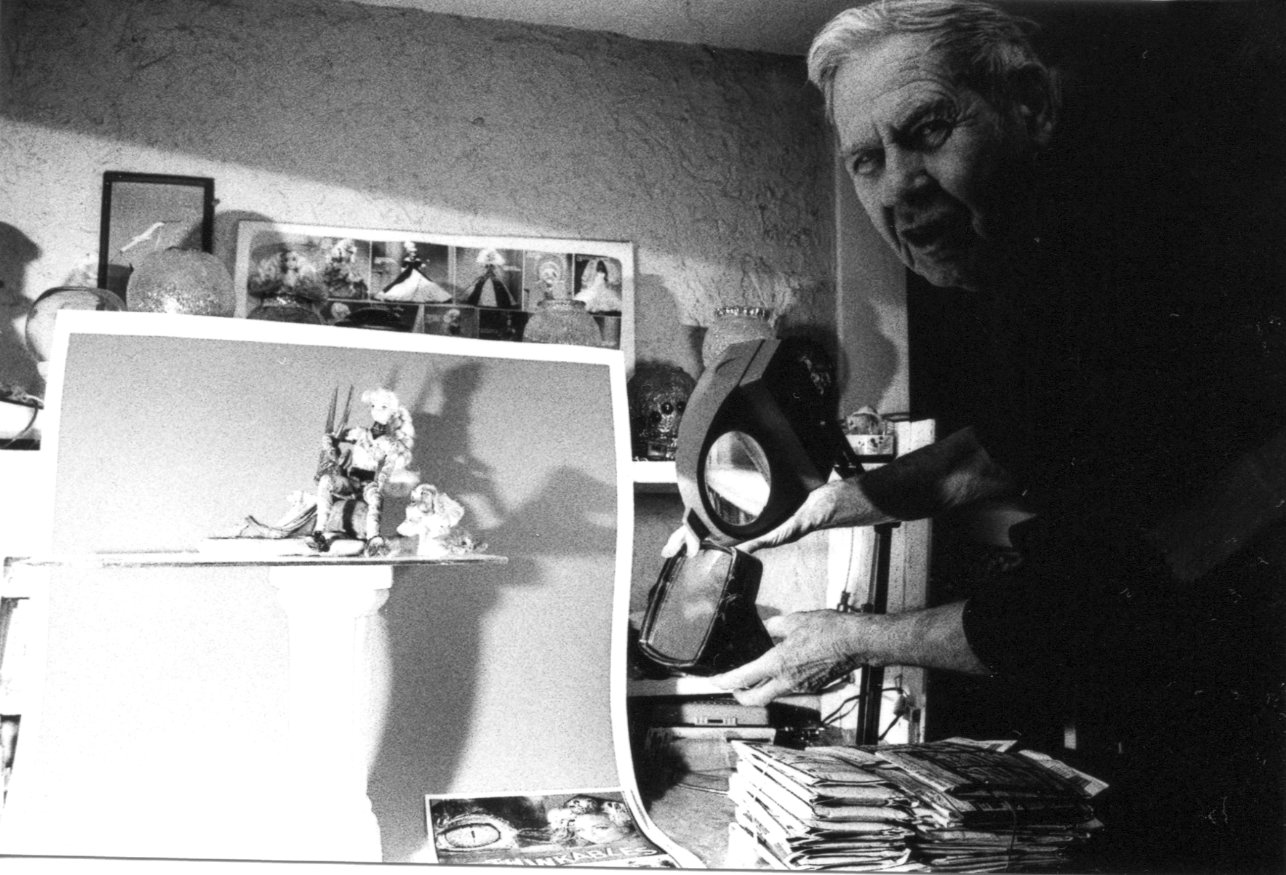
A surprise gift to the viewer, in rather the same manner as was the initial introduction, over a decade ago, a "gift" of outsider artist Al Carbee to documentarian Jeremy Workman by a journalist friend, MAGICAL UNIVERSE is proof plenty that Mr. Workman did not look the proverbial gift horse in the mouth. Instead, he and his girlfriend Astrid befriended Mr. Carbee, and out of this odd, endearing friendship has come one of the best documentaries of the year (hell, the decade, even the new century).

When I tell you that Carbee's claim to fame is creating environments using Barbie dolls which he then photographs, you may need to suppress an urge to run for the hills. Please do. For if you stick with this amazing documentary for even a few minutes, you'll be nailed. As it moves quickly along, it just gets better, deeper, more resonant and profound, more humane, moving and encompassing of so many important things that its title -- Magical Universe -- will not only refer to the world of Carbee and his Barbies but to the state you'll find yourself in by movie's end.

Back when I was a kid, big-budget films, in their advertisements, loved to brag about having been "ten years in the making!" or some such time frame. Oddly, this tiny little 80-minute documentary actually took ten years to complete. The photo of the filmmaker, at left, is perhaps how he looked before beginning work on his movie -- which he and Astrid never imagined, I suspect, would take so long nor
encompass so much. The photo at right, offers up Mr. Work-man now, speaking at one or another of the many festivals at which his film has been part. In telling the tale of Al Carbee, recently a widower when Jeremy and Astrid first met him, the filmmaker shows how a man with a lot of artistic talent (but perhaps not a lot of social skills) can turn that talent in on itself until it seems in danger of suffocating, maybe even dying out. And yet, as Carbee keeps telling himself and Workman, "Creative people just have to create!"

The filmmaker allows us to see a lot of Carbee's output -- from those Barbie creations to early work that shows the man to have been a terrific, if somewhat more conventional, artist (he loved the work of and wanted to become another Norman Rockwell).

Notes a New York gallery owner, a tad mystified, as Workman begins fishing for a possible showing of Carbee's work, "It's clear that he wants to offer pleasure to the viewer..."

"He's an eccentric," notes another person, who knows Carbee. "But he's a genuine eccentric!" I think you'll agree. Especially when the fellow get around to showing, telling, and writing copious letters and making long and bizarre videotapes sent to Jeremy and Astrid about the alternate universe he imagines. Or maybe lives in.

The odd and increasingly appealing thing about Carbee is that, although under other circumstances he might seem creepy and way too off-kilter, because the filmmaker care so much about him ("He seems like he could be my grandfather," Astrid notes), we come to feel the same thing.

Workman's film is quite homemade. That accounts for much of the feeling we get of honesty and odd beauty. If at first it seems all over the place, slowly, the more we learn, the more it all comes together. We've seen over the years a lot of docs about artists and art -- this year two particularly good ones have been Art and Craft and Fifi Howls from Happiness -- but few I think have taken us this far into the mind, the universe of the artist as well as Workman's does. His film, like its subject, is an original.

Mr. Carbee understands that he seems strange to most people. "War is stupid," he notes at one point. "Does that sound weird?" But as someone else points out, regarding this odd fellow: "Craziness is only what you expect it to be."

I don't want to go into all that happens in the course of the film, for you deserve to experience it first-hand. There is a kind of crowning achievement here, however, and when Carbee is asked if this has made him happy, he tells us: "It frees me. It makes me part of the world of reality."

You'll have to see the movie to understand the ramifications of what the man's words mean. Can art accomplish anything -- other than what it achieves for the artist -- until it is seen and appreciated? The photographs of Vivian Maier make the case for the negative answer, just as Carbee's story underscores the positive aspects of sharing.

Magical Universe, quietly stunning and endlessly thought-provoking, calls to mind the purpose(s) of art and its worth -- to the artist and the viewer -- along with what it means to be creative, and how art can both cordon off the artist and make life open up. Of course, one man's art may be another man's hogwash. The film understands this, too, and so, I think did Carbee, whose story Workman has brought to such immense life -- and in the process, produced some art of his own.

The movie -- from Sundance Selects -- opens this Friday, October 31, in New York City at the IFC Center, and will hit Los Angeles at the wonderful little Arena Cinema the following Friday, November 7. Elsewhere? Not sure, but you'll certainly be able to see it on DVD or some streaming source, and eventually, I imagine, via the Sundance Now Doc Club