Showing posts with label Los Angeles County law enforcement. Show all posts

Thursday, December 28, 2017

Streaming tip--Netflix's Ayer/Landis BRIGHT: It's more fun than most critics have suggested


Yes, you have to be willing to accept a tale of Los Angeles cops -- good ones and bad ones -- that also involves fairies, elves and orcs (the latter will be lost on older audiences unfamiliar with those Lord of the Rings movies), but once you do, BRIGHT, the latest Netflix-released movie to find its way onto the streaming miasma, is actually a lot of fast-moving-if-silly fun that simultaneously offers its own ever-timely look at and lesson on racism and prejudice. For some nonsensical reason, our critical establishment, who just loved Wonder Woman, has seen fit to pillory David Ayer, first for giving us the more-fun-than-you've-heard Suicide Squad movie and now this fantasy follow-up that traffics equally in make-believe and mayhem.

As directed by Ayer (shown at right) and written by Max Landis, Bright makes good use of both the director's past abilities regarding cop movies (Training Day and Dark Blue, which he wrote, and the fine End of Watch, which he wrote and as directed) and his newer-found ability to offer up comic book stuff in the style that it deserves: not taking it at all seriously while making it move and amuse. One can only laugh in utter derision at critics who accused Ayer of making Suicide Club unbelievable -- as though any of these goddamned super-hero/stupid-hero movie were even remotely believable? Well, "great minds" do think alike.

Meanwhile, Bright posits one of those alternate-universe L.A.s in which elves have taken over as the elite, mere humans are relegated to underling status, fairies simply fly around and occasionally get swatted, and orcs are clearly at the bottom of the food chain: think Blacks.

There is one scene in the movie in which cops descend and beat practically to death an orc that will put you immediately in mind of Rodney King. Will Smith and Joel Edgerton (above and further above, left and right, respectively) play the usual unlikely cop partners (with Edgerton as the first orc ever allowed on the L.A. police force). Smith seems more relaxed and willing to let his easy charm shine brighter than in recent films, while Edgerton (of Animal Kingdom and Loving, even under very heavy make-up and/or CGI, manages to grab us and move us, as ever.

The minimal plot has to do with a, yes, magic wand (called exactly that), the getting of which seems awfully important to various elves, cops, gang members and everyone else on view. Our two cops manage to meet and protect a lone woman elf named Tikka (Lucy Fry, above) who seems to have changed sides from bad girl to good, and now needs to keep that wand under her wing.

The leading naughty elf is played by Noomi Rapace, above, a talented actress with a great face who is wasted here. Much of her role must have ended up on what we used to call the cutting room floor, or she was simply given too little to do in the first place. In the very large supporting cast are actors like Ike Barinholtz and Margaret Cho (as dirty cops) and Edgar Ramírez (below) as a sexy federal-agent elf.

All told, this one's a time-waster, but it is a lot of fun and not at all difficult to sit through -- if you've a mind to and are in mood for fantasy and action.  From Netflix, Bright, running just under two full hours, began streaming this past Friday, December 22.

Tuesday, December 11, 2012

Gay rights, Los Angeles-style, in the 1970s: Travis Fine's dark and teary ANY DAY NOW

Let's get it over with. ANY DAY NOW -- the new film directed and co-written (with George Arthur Bloom) by Travis Fine -- is a multi-hanky tear-jerker. Let's also be straight (so to speak, as this is a gay-themed movie): It earns every fucking one of those tears. Given the situation, together with the fact that this movie is very well- written, directed and acted, how could it not?

When a Down-syndrome boy, above, a teenager with a drug-addicted mother who may love him but cannot care for him, is suddenly abandoned, his neighbor, a female impersonator/singer -- along with his sudden new lover, an assistant D.A. who is for the first time giving in to his homosexuality -- decides to take the kid in and provide him, at long last, a real home. If only the legal system will allow it.

Come on: this is heart-wrenching, finally heart-breaking, stuff. What keeps it afloat, often aloft, is the utter darkness that hangs over the movie, provided by the situation, the characters and the period and place -- Los Angeles in the 1970s. TrustMovies was himself a closeted bi-sexual man who lived in the L.A. area during this time and can attest to much of the prejudice and difficulties present back then. Writer/
director Fine, shown at left, dries out those inevitable damp hankies with a lot of smart, dark humor; performances that remain true through thick and thin (thin being some inevitable clichés); and a richness of purpose and a balanced execution that render this story worth our time and tears.

Most talked about, no doubt, will be the stops-out performance of Alan Cumming (above) as the singer/impersonator who gets the story's ball rolling. Cumming is almost frighteningly real. He gives us the kind of man -- and performance -- that constantly challenges the character, as well as the viewer, to be proud (and loud) and refuse to put up with any bullshit. This is a very fine line to walk, and if Cumming sometimes appears to nearly topple over, he (along with the script, direction and the work of his co-stars) somehow achieves the necessary but tricky balance. He's got a good singing voice, too, as several soundtrack songs will prove. (The music for the film, including the great Bob Dylan title tune is well-chosen and put together.)

In the role of the D.A. lover, Garret Dillahunt (above, left) proves every bit the sturdy, studly straight-appearing male, and then softens it enough to make us believe this hunk could go for the likes of Cumming. But haven't we all seen this in life at one time or another: the odd pairing of men and/or women who thrive on each other's seeming opposition, whether via personality, looks, or the whole shebang? Cumming has the showy role, but Dillahunt provide the necessary foundation and back-up.

The role of the boy, Marco, features Isaac Leyva (above, himself a Down-syndrome fellow) who offers everything that is required from this, his film debut. Much of the supporting cast is made up of stalwarts like Frances Fisher, Chris Mulkey, Gregg Henry and Michael Nouri -- all just fine and some near-hissable in their villainy. Yet this is not in the least unbelievable; what we see here was the standard attitude some 35 years ago, a time in which many of my readers were not yet born. Even those characters shown to be kindly and helpful were generally not ready to stand up and shout for gay rights. (Nor was I, now that I think about it...)

One thing this noble movie should make us older folk realize anew is how much circumstances have changed for the better for the GLBT set. Though, as anyone who knows history will realize, it's a fight just to remain in place.


Any Day Now, running 97 minutes and from Music Box Films (the company that has given us, with Keep the Lights On and now this one, the two best gay movies of the year), opens this Friday, December 14 in a dozen cities around the country and will expand to many more in the weeks to come. In New York, see it at the Sunshine Cinema or the Elinor Bunin Munroe Film Center; in L.A. it's at Laemmle's Monica 4, Town Center 5, Playhouse 7, and at the Sundance Cinema Sunset 5.  Click here -- and then click THEATERS on the drop-down bar -- to view all currently scheduled playdates.

Thursday, September 20, 2012

Jake Gyllenhaal and Michael Peña light up David Ayer's hero-cop film END OF WATCH

What a pleasant surprise it is to watch unfurl END OF WATCH, the new movie about a couple of naturally heroic cops who work Los Angeles' South Central area. The surprise is especially meaningful as the film's writer/director, David Ayer (shown below), has also given us some other movies about cops in Los Angeles -- Training Day (screenwriter), Street Kings (director), Dark Blue (screenwriter) -- in which many, if not most, of the police were dirty and dirtier.

TrustMovies grew up in the Los Angeles area, and his understanding of and experience with the police there tend toward the darker side of things, so while he had no trouble believing much of Ayer's sleaze-filled scenarios, he found it unexpectedly bracing, even moving to see the skill, intelligence and camaraderie that seem second-nature to the two fine actors playing the cops-at-work here: Jake Gyllenhaal, (below, right) as the rowdy, smart, white-bread Brian Taylor, and Michael Peña (below, left) as his quieter but no less savvy Mexican-Ameri-can partner, Mike Zavala.

Mr. Ayer has constructed his movie mostly as a kind of day (or several of them) in the life of these two cops, as they patrol South Central, an area that was once almost entirely black but has, over the past decades, changed its complexion to a lighter brown. Now, Black and Hispance gangs fight it out, using high-end weaponry (notes Mike, about one amazing instrument, shown above and on the poster, top, "It looks like it belonged to Liberace").

As the two take some hits (and yes, kill a few people, too), spar verbally with each other (this interplay is beautifully written and acted) and occasionally get serious (this, too, is well presented), we learn a little about each of the men but never so much as to overload the narrative with undue baggage. As a writer, Ayer seems particularly adept at this kind of balance.

As a director, he and his cinematographer, Roman Vasyanov, use hand-held to nearly the breaking point, putting us up close to the people and action about as well as I have seen done so far. We're with our guys at work, chasing criminals, rescuing a family from a fire (above: this is one of the high points of the film), and getting into some major trouble (below) -- all of which keeps, toe-wise, the cops on theirs and us on ours.

Interspersed with all this is the love-and-family life of the two. Brian has begun dating a girl he really likes (for a change), played by Anna Kendrick (below, right), with her usual charm and flash.

Mike is married, with a pregnant wife -- the lovely Natalie Martinez, shown below, post-birth. If the film were simply all these guys, all the time, it would have been one of the best cop flicks ever, I believe. But Ayer has a real problem with the construction of his movie, particularly regarding point-of-view. The POV initially is all about -- and with -- our boys. Suddenly, there's a scene in which they do not appear at all, and we're driving along with a nut-job Latino gang. This plays itself out, a little oddly, for obvious plot purposes down the line, no doubt. Sure enough, that's what happens. But it thoroughly breaks our concentration and attention -- while calling unwanted attention to itself and its rather ham-handed entrance.

But this is nothing compared to what is to come: Toward the end we get an out-of-the-blue (via some green/nighttime video footage) conversation from an upper echelon member of a drug cartel, whom we haven't seen before and will not see again, ordering a hit. This is pure, dumb exposition of a sort that belongs in some other movie -- and not one as well-made as End of Watch often is. These two instances do hurry the plot along but they are so clunky and out of place that they destroy, for a time, the film's veracity.

Surely Ayer could have found a way to work this stuff in more organically, the way he did a scene in which our guys stumble upon a storage site for human trafficking, and they (and we) learn a little about what is going on from a much higher-level member of government law enforcement. That scene works because our cops are part of it and we're experiencing it along with them.

Certain other things rankle. Are Latino gangs made up of simply the world's worst marksmen-and-women? It would seem so, on the basis of what we see here. As the movie draws to a close, the cliches begin to pile up. The finale of the film only works because of its two lead actors, who are here giving career-best performances. Because of this, we'll expect, I think, a whole lot more out of them in the years to come.

End of Watch, from Open Road Films, opens this Friday, September 21, all over the place. In Manhattan alone, the film will be playing in ten theaters. But try to find any listing of playdates and theaters on the movie's web site, or that of Open Road, and you're out of luck. But keep looking. For all its flaws, this movie is very much worth experiencing.

Wednesday, August 29, 2012

Streaming Surprise: Mike Flanagan's ABSENTIA is one truly creepy movie!

If you can stream Netflix, then you'll already know that the amount of choices you have simply boggles your mind -- and your decision-making processes. Let me help you out here. If you enjoy the occasional scary movie, do not let last year's ABSENTIA -- about a missing husband of seven years, the wife who is still putting up missing-person signage to locate him, her problematic sister, and the cop who's in love with the wife -- get by you. There's a reason it has won all those fright-festival awards (see poster above): This extraordinarily creepy movie is a real find.

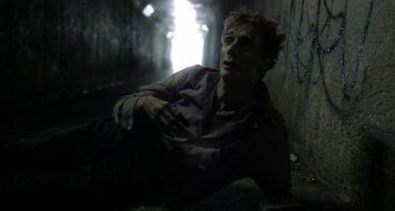
Writer/director Mike Flanagan (shown at left) understands how to put together a movie on a very low budget, with the scares coming slowly and rather quietly at first. Set in one of those nondes-cript Los Angeles neigh-borhoods -- not exactly low-end, but not quite what you'd call "nice," either -- that has a fairly long tunnel connecting two outside areas (these pedestrian tunnels used to be fairly common in parts of L.A.), the movie boasts a cast of decent actors who all look very much like real people. Katie Parker (shown on the poster, above) has a lovely face; the rest -- including Courtney Bell, below, who plays the wife, simply look like quite ordinary folk. Certain players, in fact, who appear not-quite-normal (for instance, Morgan Peter Brown, who is shown at bottom), look a little more bizarre than would your everyday Hollywood actor -- for reasons that slowly become clear as  the movie proceeds.

Until we saw Absentia, just the other evening, I would have called The Pact the creepiest movie in a long while. Not anymore, for this one outdoes even Nicholas McCarthy's scary movie. Mr. Flanagan understand how to creep us out in a number of simple but effective ways -- from how to shoot that tunnel (below), together with its occasional occupant, to making a simple shower curtain scare the bejesus out of us by having something simultaneously going on at either of its two ends.

The theme here is "missing persons" -- and how, where and why they disappear. A few decades ago, the only-middling scare movie Wolfen gave us the New York City version of this. Absentia offers the L.A. explanation, and it's the winner, hands-down. The film is handled with less gore than subtlety, and while the special effects are kept to a bare minimum, the scares are definitely not.

To say any more would simply help spoil things, so those of you who can stream Netflix, click here. The rest of you, try to find this movie elsewhere. Available now on DVD and from iTunesAbsentia, distributed by Phase 4 Films, has a running time of 87 minutes.

Thursday, June 30, 2011

Yoav Potash's CRIME AFTER CRIME: This agenda doc has us nearly rabid with anger


Of late we've seen some terrific documentaries that seem nearly-and-pleasurably agenda free (Buck, If a Tree Falls, Battle for Brooklyn: the later may have an agenda, but the filmmakers bend over backward to keep it in check). Now comes a film that absolutely has one: CRIME AFTER CRIME by Yoav Potash. This documentary, that pursues justice above all, brought my anger, beginning in the stomach and rising slowly until I could feel it in my throat, to a point at which few movies have managed. Yet the film never screams, reflecting perhaps its leading lady, Debbie Peagler, shown on the poster above and in two of the stills below.

As Potash (left) shows and tells it, Ms Peagler, some 35 years ago, was the oft-beaten girlfriend of one, Oliver Wilson, her boyfriend who decided to pimp her out to local johns on a regular basis. Six years later, after Debbie has separated from Oliver and he and his thugs threaten to kill her family, she and her mom turn to local gang members who were to beat up Oliver but instead went a little too far in their punishment, leaving the pimp dead. Deborah is eventually arrested for the murder and remains in prison for twenty years -- until her case, which clearly involves abuse-of-women, is taken up by a couple of diverse pro-bono lawyers, Orthodox Jew Joshua Safran (below, left) and marathon-runner Nadia Costa, (below, right).

For very nearly the entire first half of Crime After Crime (which sounds like a play-on-words of a certain Cyndi Lauper song but actually involves the sleazy activity of the Los Angeles County D.A.'s office), we move along a more-or-less expected route, garnering information about our protagonist and the situation, with the full expectation that wrong will be righted.  Then a roadblock occurs, and another and another, and very soon, we are feeling, tenfold, the injustice of it all.

Because Joshua, above, saw his own mother repeatedly abused, and Nadia, below, is a former Social Worker for Children's Protective Services in Los Angeles, both are primed for the task at hand. And what a task it turns out to be. Your blood pressure should rise accordingly as the D.A.'s office stonewalls and thwart's justice at every turn (one of the reasons why TrustMovies, who grew up in Los Angeles, prefers to live elsewhere).

What Ms Peagler endures (along with her family), even as her own health deteriorates, is shameful and unnecessary. And some of L.A.s public figures like D.A. Steve Cooley and a certain Lael Rubin are shown up as some of the most disgusting examples of "the law" that you will have seen. When the powers-that-be array themselves against justice, this is what results. Little wonder that Peagler, below, turns to religion -- the hope of the disenfranchised.

But what real hope is there? You will see. Crime After Crime, from the new Oprah Winfrey Network (OWN), opens this Friday, July 1, at the IFC Center in New York City, and on July 8 in the L.A. area (at Laemmle's Sunset 5 and Encino Town Center). Click here to see further playdates, cities and theaters around the country.