Showing posts with label Maurice Pialat. Show all posts

Tuesday, July 12, 2016

Maurice Pialat's masterpiece? Maybe. In any case, VAN GOGH is certainly among his best


In its new and sensationally beautiful and crisp Blu-ray transfer, Maurice Pialat's homage to the bourgeoisie's "favorite painter," Vincent van Gogh, is considered by some to be this French filmmaker's masterpiece. In the humble opinion of TrustMovies, however, Pialat never quite produced a masterpiece. His films, though some of them are very good, fall short of that exalted mark. Even so, VAN GOGH, released in 1991 and now available here in the USA on home video -- thanks to the efforts of the Cohen Film Collection -- is certainly the best of any of Pialat's work that I have so far seen.

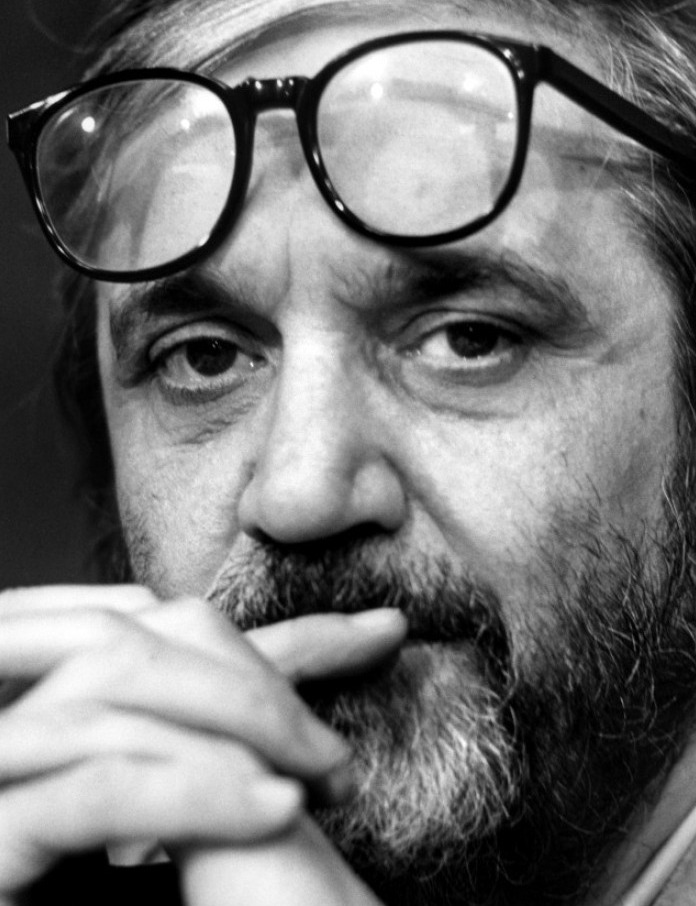
As we might expect from most other of Pialat's work, the late filmmaker (shown at left, on set) gives us the man above the artist, while still taking in that art and van Gogh's commitment to it. Behavior is paramount here, with the signature Pialat style -- near-documentary -- on display at its best, which means enormous attention to detail and character, discovered via action, dialog, and all the oddball life going on around Vincent himself. The film begins with his arrival via rail in Auvers-sur-Oise, which he calls "a charming town" and from his garret window provides him a small, choice view.

As played by that superb French actor Jacques Dutronc -- above, who has proven himself over the years to be especially fine in crime drama (Toutes peines confondues) and may here have found his finest role -- van Gogh comes alive in ways not seen previously in films about the artist: certainly not in Lust for Life, and not even, I think, in Robert Altman's very good version, Vincent & Theo, in which Tim Roth was able to go bananas (and quite impressively, of course) as the tortured artist. That latter film's release and minor success in the USA may have helped preclude the release of Pialat's version on these shores the following year.

M. Pialat disdains melodrama to concentrate on plain old behavior, including the quieter moments that build character and event from the inside out. These includes everything from interactions with landlord, doctor, family (brother Theo and wife) to of course the various love/sex interests such as that doctor's daughter (Alexandra London, above) and a local whore (given great energy and not a little depth by the wonderful Elsa Zylberstein).

Théo is played with a moving combination of love and frustration by Bernard LeCoq (above, left, in an enchanting and filthy scene in which van Gogh recites a Toulouse-Lautrec limerick, complete with dirty visuals).

There are enough moments here in which women's need to come out from under the shadow of men may have you thinking that Pialat had grown a feminist conscience. We see this in at least three of the females on view: the doctor's daughter, Marguerite; the whore, Cathy; and another of the whores who wants to be a painter, too. ("No, you're a model," van Gogh curtly explains to her.)

From the village idiot (who asks our man to capture him on canvas) to a prolonged line dance (above) in the music hall/bordello, this movie teems with life. Toward its conclusion, the story necessarily gives way to more and more bad behavior on Vincent's part and accompanying melodrama.

But even then, Pialat generally opts for the behavior over the drama and so spares us some of the usual cliché, even if he is unable to finally serve up the kind of powerful, commanding conclusion we might want. Maybe it's better we don't get this and instead are left with more of the man and less of the "tortured artist."

The film runs a very long two-hours and 39 minutes, yet not one of those minutes will bore. Each is too full of life. From the Cohen Film Collection, Van Gogh hits the street today, Tuesday, July 12, on Blu-ray and DVD. The Blu-ray contains two discs -- one of the film itself, the second featuring interviews with actors Dutronc and LeCoq, its cinematographer, and French director and fan of the film Xavier Giannoli (of Marguerite fame).

Sunday, June 12, 2016

UNDER THE SUN OF SATAN: Volume 2 of The Films of Maurice Pialat hits Blu-ray/DVD


Maurice Pialat made UNDER THE SUN OF SATAN (Sous le soleil de Satan) toward the end of his 44-year career, and the film exhibits nearly everything that fans love and detractors call out about this divisive French filmmaker. The film proves episodic and rather clunky (smoothness of any kind appears not to have been among Pialat's filmmaking characteristics), yet it deals with subjects so interesting and appealing/appalling -- god, the devil, faith, religion and miracles -- that it is difficult not to become, well, pretty quickly hooked.

Further, Pialat's knack for casting ensures that the leading roles will be played by actors who are not simply believable and talented but who possess a certain charisma that keeps one glued. Here, these includes the likes of Gérard Depardieu, Sandrine Bonnaire, and the director himself (shown at left) who plays one of the three leads with impressive seriousness and strength. The film is based on a novel by Georges Bernanos, which was adapted by for the screen by Pialat and Sylvie Pialat, his wife. Not having read the novel I have little idea how true the Pialats were to the original, but what has come out is a film about a very odd priest named Donissan (Depardieu, shown on poster, top, and below ), his vocation and career as, it turns out, some kind of miracle worker.

Initially, it seems that our priest is simply unsure of himself and maybe in over his head. But as the film progresses -- clunkily, it must be said -- pretty soon he's raising the dead. We also meet Ms Bonnaire, below, playing a young woman who clearly gets around some, having had affairs with two of her town's prominent males -- one a nobleman going bankrupt who would like her to live with him in something close to poverty, the other a married man who doubles as town bigwig.

Before you can say murder-or-maybe-accident-and-then-a-suicide, one of these guys is dead, and soon the responsible person is, too. And then the miracles -- or whatever -- begin.  The film if full of talk, much of it involving religion and faith, god and the devil. We even get a scene with Satan himself -- or maybe it's just Donissan's imagining of him -- who turns out to be gay (appropriate for a priest's fantasy, no?).

Bonnaire is, as always, riveting, while Depardieu has rarely looked sexier than here, in a cassock. And Pialat, as Donissan's mentor and friend, brings enormous caring and concern to the film, which certainly helps us some ways toward feeling that all this is somehow important.

The religious talk/philosophy is interesting but not terribly memorable. And the reactions of Donissan's parishioners to him and his healing powers seem pretty typical of any congregation exposed to "the Lazarus effect."

But is all this simply magical stuff in the guise of religion? Or maybe the reverse. Well, hey -- god works in mysterious ways, right? Because of the film's abrupt and episodic structure, we must piece together certain events and ideas, which is tolerable, I suppose. For some, this sort of filmmaking will seem "rigorous". Others will find it merely clumsy.

TrustMovies joins the latter camp, but due to the strength of the three lead performances (the rest of the cast comes off well, too), he did not find it difficult to stick with and enjoy the film on one level, at least.

From the Cohen Film Collection, Under the Sun of Satan -- running just 98 minutes and carrying the series title of The Film of Maurice Pialat, Volume 2 -- offers a Blu-ray featuring a very good transfer as a two-disc set, the first featuring the film itself, with the second disc containing a wealth of interviews. Both Blu-ray and DVD are available this coming Tuesday, June 14 -- for purchase or rental.

Thursday, May 12, 2016

Blu-ray/DVDebut: Cohen Film Collection releases The Films of Maurice Pialat: Volume 1


The late French filmmaker Maurice Pialat is probably best known to American arthouse audiences as the man who gave us À nos amours, the film that introduced Sandrine Bonnaire to the U.S. and the world (though I remember seeing his earlier Naked Childhood at one of the early New York Film Festivals). His films resolutely resist sentimentality and instead appear to offer an unvar-nished look at their characters and through them at life itself. This is most likely why Pialat (shown below) never found a wide audience here in America.

Another reason might be that those films tend to plod a bit, particularly for folk who prefer event above character. And yet, in their quiet rather careful way, they are often full of things happening. In any case, we now have with us three of this filmmaker's relatively early work (he also made a lot of docs and shorts that may never see the light of day on these shores):

THE MOUTH AGAPE (1974, 87 minutes), which deals with the death of a late-middle-aged mother and wife, and the family that gathers around her;


GRADUATE FIRST (1978, 85 minutes), which looks in on a bevy of French high-school students, along with some of their parents and teachers, as the kids topple gracelessly into young adulthood;

and the most famous of the three, LOULOU (1980, 105 minutes), which, while offering the star power of Gérard Depardieu, Isabelle Huppert and Guy Marchand, also proves in some ways, to be the least of the three. (I remember seeing this one around the time of its original release and wondering what all the fuss was about. Seeing it again, some 35 years later, I'm wondering still.

TrustMovies did a binge watch of this new release -- available on both DVD and Blu-ray -- viewing one after another of the films. This was edifying in some ways because it definitely brought out certain characteristics of this filmmaker that I might not have noticed so thoroughly, had I put more space between the viewings. In Pialat's movies, the men are mostly pigs and the women docile tag-alongs who weep a lot and do not seem to enjoy sex all that much, though they partake in it often, due to the male prerogative.

This was/is no doubt true enough in its time and may remain so in some instances today, but given the rise in feminism over the 1960s and 70s, you might have thought this had reached France. Not so much, evidently, in Pialat's world. His movies are said to be life-affirming, but one must wonder after viewing: What kind of life do they affirm?

Still, performances are adept and real, and particularly in The Mouth Agape. The moments of life are both carefully observed and seemingly off-the-cuff (this is a hallmark of Pialat, I think).  And how good it is to see French actor Philippe Léotard (above) again, alongside a Nathalie Baye (above, top) who appears here as young as I have ever seen her. Overall, the filmmaker's choice of moments and scenes come together to produce an end-of-life tale that must have seemed new and daring in its day, and remains so even now. Only Stéphane Brizé's A Few Hours of Spring has done anything like this in terms of the death of a parent on film that I have witnessed.

Ditto the life of the kids in Graduate First, which Pialat makes seem both full of energy but not much promise. In the adults he shows us, we again see lives thwarted and cut off. School, family and work life, even married life for these kids, seems of questionable value. The centerpiece of the movie is a wedding celebration during which so much bubbles to the surface. The males, whether adult or kids, all seem horny as hell, and the French penchant for philosophy -- at least in school studies -- is viewed by the filmmaker with a gimlet eye.

As for Loulou, yes, we get the young and luscious Depardieu and Huppert, as well as a surprisingly unclothed Marchand, who proves quite the "bear." Behavior is shoddy, albeit lifelike, all round, with betrayal rampant, while growing up, at least for its title character (Depardieu's Loulou), proves a very difficult thing.

Loulou is supposed to represent, I am guessing, the life force, and while the actor is as charming as he usually was in his younger days, he is just as often a rude bore. Huppert exhibits her patented here-but-not-here quality -- is there an actress better at this? I doubt it. She raises being non-committal to an art form -- and the two performers let their odd chemistry engage quite well. But for all the sturm-und-drang on view, I much prefer the two older, less showy films to this one.

From Cohen Film Collection's Classics of French Cinema series, the three-disc package in one box features Graduate First and The Mouth Agape on one disc, Loulou on another, and all the multitudinous extras on the third.  The Films of Maurice Pialat, Volume 1 (this augurs well for more to come) arrives on DVD and Blu-ray -- with the Blu-ray transfer are pretty good for each film -- this coming Tuesday, May 17, for purchase, and I hope, rental, too. The series would seem a must for Pialat fans, and a good introduction to those who've yet to discover his work. (The mother/daughter confrontation above is from Graduate First.)