Showing posts with label NYC-based movies. Show all posts

Monday, March 23, 2015

WELCOME TO NEW YORK: Abel Ferrara's puddle-deep look at the Dominique Strauss-Kahn affair


Dem mighty jus' keep on fallin'! From Gary Hart to Sheldon Silver -- and, oh, so many in between -- the supposedly powerful figures of the western world discover their own feet of clay, as the rest of us rejoice as much in their fall as we appeared to do in their rise. Certainly one of the more interesting of these figures is Frenchman Dominique Strauss-Kahn, the fellow who was appar-ently being groomed as the next leader of France, scheduled by the French "left" to take over after Sarkozy's upcoming ouster. Well, that didn't happen.

Why it didn't happen has been much conjectured upon, with very interesting and not so unlikely theories ranging from a set-up job by the opposing party (or maybe someone within Strauss-Kahn's own, or even the good 'ol USA) to the fellow's rather obvious proclivity for sodden misbehavior. In his new movie WELCOME TO NEW YORK, filmmaker Abel Ferrara (shown at right), while giving a nod here and there to economics, politics and social unrest, is really most interested in the "sex addiction" theory associated with our famous Frenchman, along with its accom-panying guilt and shame. Given Ferrara's oeuvre and obsessions, this is not surprising. What is, however, is how much of a major shrug his movie turns out to be.

Starring two well-chosen, senior-citizen movie-stars of talent and acclaim -- Gérard Depardieu (above, right, and below) as Strauss-Kahn (here called by the name of Deveraux) and Jacqueline Bisset (above, left) as his wife -- the film takes on immediate interest, if only for its smart casting. Beyond this, however, while not unwatchable, Welcome to New York grows tiresome well before it concludes.

As director, Ferrara, knows his way around camera-work and pacing, but as co-screenwriter (with Christ Zois, who often works with the director), he is never on particularly secure ground. Much of the dialog, though well delivered via its actors, sounds barely a cut above improvisation -- or the kind of expected blend of research and cliché that never probes deeper than surface level.

Further, Ferrara has decided not to stick all that closely to even what we know about the case itself. The film opens with Depardieu (as himself) explaining to the press something about how he tackles this role, and there is the usual disclaimer assuring us that, while the movie takes off from the famous case, what we're going to see is mostly made-up drama.

Consequently, the made-up maid supposedly attacked by Strauss-Kahn, looks little like the attractive and sexy real woman in the case. Nothing is made of anything politically, either (a shame, really, because there is enough juicy and oddball occurrences in this story to have made a nifty little paranoid thriller), and only a small bone is tossed to the idea of the entitled vs the underlings (above).

So what we are left with, mostly, is sex and more sex, after which, our boy having been caught out, we get the residual guilt and shame. All this has its interest for awhile until longueurs set in, and the little detail we get about the Strauss-Kahn marriage barely suffices.

Ms Bisset proves a strong presence against M. Depardieu's bulk and talent, and I must admit that it was a welcome change to see this actor having to portray, as above and below, a broken man for a change. His time under arrest, in jail, and being harassed by the press goes a distance in helping us sympathize with the guy -- which Ferrara clearly wants us to do.

Entitlement, money, power and the accompanying sex-and-more-sex to which these lead, followed of course by debasement  -- this is what interests the filmmaker most. And while all this is surely part of the Strauss-Kahn scandal, there's so much more here that his movie doesn't begin to approach.  If half a loaf is enough, by all means, crack off a chunk and chew awhile. It's initially tasty but not very nourishing.

Welcome to New York -- from Sundance Selects/IFC Films and running a too-long, two-hours-and-five-minutes -- opens this Friday, March 27, at San Francisco's Roxie Theater. Simultaneously, you'll also be able to see the film via VOD in most major markets. A further, if limited, theatrical rollout is expected over the weeks to come. Or not (See below).

*****************

Addendum: Now that is has come to the fore that filmmaker Ferrara is very displeased with re-cut version released by the distributor, perhaps the above review is not indicative of the "real" movie. Though from what I could gather from the report in The New York Times, Ferrara's reasons given do not sound, to my mind, as if they would make the movie much better. Read the Times story here, then make your own judgment. In any case, I found it very odd that IFC was suddenly not opening the film theatrically in either NYC or L.A. Now we know why.

Sunday, December 7, 2014

New on VOD--Matt Creed and Amy Grantham's LILY covers recovery from cancer treatment


Cancer at any age can be devastating, but for a young woman who looks to be in her early twenties, it's hard to imagine the shock to the system that dealing with something like this might entail. We pick up on our heroine, Lily, the main character of the eponymously titled LILY just at the close of her treatment for what looks like maybe breast cancer, when she is just finishing her radiation sessions and still has the underarm burns to show for this. The movie opens with an extraordinarily beautiful shot of our girl (Amy Grantham, below, who both co-wrote and stars in the movie) going through one of her final radiation sessions. Though you concentrate on her beautiful face, you're also aware that you can see the pulse actually beating in her delicate neck.

The film's director, Matt Creed (shown below), wisely concentrates on Lily (Ms Grantham) for just about the entire movie, since the actress has a splendid face for the camera, as beautiful in repose as in action. If only the rest of the project were up to this level.

Lily's problem -- the character's and the movie's -- is that her life is currently shit. But the more we see and learn of it, and her, it's clear that her life was exactly that before the cancer hit. Yet she doesn't seem to know or care. She just moves, often rather trance-like, from bad event to bad event, with the camera following so that we see, as in the photo at bottom, that hugely expressive feature known as "the back of the head." Yes, it's that kind of movie. It is also, I must say, quite smart about its use of exposition, of which there is little. Very quickly, we're asking, Whose kids are those? And who's this older guy (below, left) -- their daddy? Or is he her father? Or Grandpa? (He's old enough.) Omigod -- they're getting into bed....

Eventually we learn the answers. We even get a smidgen of conversation about that incredible Cuban art school we first learned of in the fine documentary Unfinished Spaces. We meet Lily's mom, and eventually her dad, and note that one's a bigger asshole than the next. As is her husband/boyfriend. Her friends (some of them, anyway) seem a little less annoying. (Though the standard scene in which they all insist to her that she looks fabulous without her wig, as below, is something we knew the second she removed it several scenes back.)

I am told that the movie is loosely based upon the real-life experiences of its star, Ms Grantham. So it is difficult not to feel something for this young woman and her truly horrible life, at least as it appears here. But this is nowhere near enough to make a worthwhile movie. (The only positive thing here seems to be that, even without a job or any prospects of one, money is not a problem for Lily.)

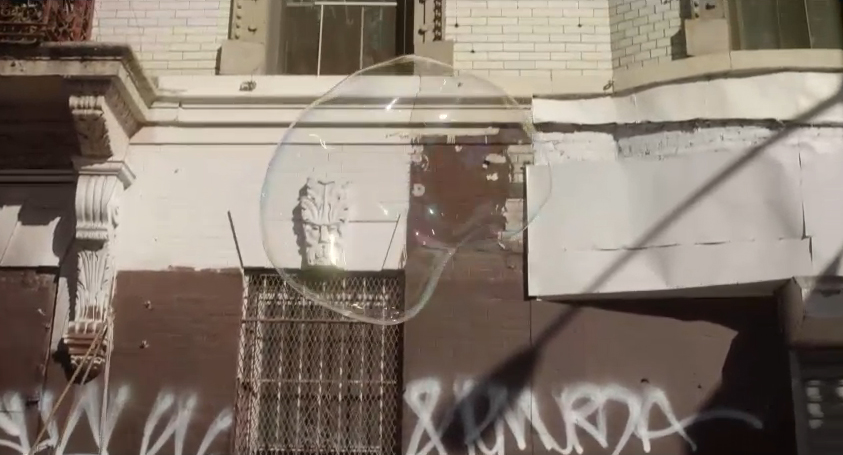
We tag along as Lily visits a thrift shop, buys a pair of tap shoes and then practices at home until her neighbor complains, after which she does this outside (below), attracting, as you might guess, some attention. And then we watch as metaphor rears its head and our girl views a street vendor creating a very large bubble (above) that finally bursts.

At film's close, Lily visits an art dealer whose help she needs. Her actions appear to be every bit as clueless and unprofessional as ever, all of which makes what I suspect was supposed to be a feel-good finale for Lily (and Lily) seem a few levels less than promising.

After several film-festival appearances, the movie will make its VOD debut this coming Tuesday, December 9.

Thursday, April 1, 2010

BREAKING UPWARDS arrives from DIY-ers Daryl Wein & Zoe Lister-Jones


TrustMovies is glad he viewed BREAKING UPWARDS -- the new do-it-yourself movie from fledgling filmmakers and on-again/off-again couple Daryl Wein & Zoe Lister-Jones -- before he read the full-page article by Larry Rohter in this past Sunday's Art & Leisure section of The New York Times. In it is detailed how the movie came to be at the relatively rock-bottom cost (for a film shot in NYC) of only $15,000. Much of the information Rohter provides is very interesting, especially for would-be filmmakers.

The film itself, however, despite some comparisons to early work of Woody Allen (his themes may be present but little of his wit or style), is finally rather dreary.  Breaking Upwards -- which details what happens when a young couple, played by the filmmakers (shown above, with Lister-Jones at left), decides to take some time off from each other -- has a relatively starry cast for DIY: Julie White (below), Andrea Martin, Peter Friedman, LaChanze, Pablo Schreiber, Olivia Thirlby and Ebon Moss-Bachrach.

Most of the cast has legit theater experience, which may account for why certain cast members (Ms White, in particular) seem to be constantly addressing the second balcony.  Only Ms Martin (below) and Mr. Friedman (two photos below) seem both at ease and on target at all times, able to spice things up (this is especially true of Martin) with a heady dose of professionalism and reality. 

The screenplay, I think, is most at fault here.  According to the Times article, it was conceived first by Wein and his friend and co-writer Peter Duchan (not the piano-player; that's Duchin). Then Ms Lister-Jones was brought in to add the proper feminine touch because of its original skew toward the male prerogative.  Oddly, it still skews heavily male, given how Ms Lister-Jones' character (whom we shall assume she both wrote and acts) has the bad habit of shooting herself in the foot with alarming regularity.  She whines continually, especially about her short stature (and then proceeds to wear only clothes -- such as very short skirts & dresses -- that call undue attention to this). She, as does Wein, plays the on-again/off-again card to distraction, and while I commend her for giving us a "warts-and-all" characterization, I just wish she were not quite so charmless.

The movie does cover all the bases: relationships, sex, friendships (male and female), parents and work issues. She's an actress, which gives us access to the audition process and some rather fun looks into off-off Broadway  theater (see photo at bottom) -- which seems not to have changed much in the 40 years since I was involved in it. Male actor egos, as well as the actors themselves (Schreiber, below, is the leading exponent here) are even bigger than I remember. And while the filmmakers hit a number of au courant buttons (polyamory, anyone?), they don't bring much of interest to their subjects, as did (even without the hardcore scenes) John Cameron Mitchell in his movie Shortbus.

Despite hitting all the right bases, Breaking Upwards often lacks the specificity in the dialog that would bring to sharp life (not to mention with more wit and humor) what is going on.  This is true in the various family scenes and the scene with Wein and his boss (played by LaChanze, at right, below, with Wein).  There is an "expectedness" to much of the dialog that runs through everything, rendering the movie flat and finally dragging it down.  While the film-making is never out-and-out bad,  it is also never very good.

However -- it did manage to get made and at that incredibly reasonable price. This may be a double-edged sword because you do, after all, get what you pay for.  By the film's finale you may feel as strongly as did I that there is but one way out for Mr Wein's character: Take that job in Canada, meet some nice girl, get married -- and be entitled to immediate health care.

Breaking Upwards, via IFC Films, opens Friday, April 2, at the IFC Center; on April 9th in Los Angeles at the Laemmle Sunset 5; and on April 16 in San Francisco at Landmark Theatres' Lumiere. It is concurrently available from IFC On-Demand via many TV-reception providers. Check here for how to determine if yours has it.