written and directed by
To even tell you the
genre of this spunky, spanking new film from the Manetti Brothers, Antonio and Marco (they've been around awhile, but this is the first of their work
TrustMovies has seen), would be to ruin their film's first big surprise, of which there are two -- plus several in the smaller vein. So let's call this one a "thriller" for now, and leave it at that until you've seen it. Which I dearly hope you will. Though it has played its two
Open Roads screenings (you can peruse the entire program of new Italian films
here), it is difficult to imagine that something this different, exciting, clever and frustratingly fun will not find a U.S. distributor fast.

First of all, let's thank the brothers for dispensing with any on-screen title card that tells us where we are (the ever-more-used "three hours earlier" or "20 minutes ago"). No, these guys simply thrust us into the mix, and we hear very frightened breathing and see a woman's eyes wide open in fear. Do we then, when we see a pretty young blond at her home/office, need to be told that this is somehow "earlier" in the timeline? No -- and the bros understand this and so refuse to treat us like some nitwits new to the movies.

All I will say about the story itself is that this attractive, bright and pleasant young woman is a translator who, at the film's "almost" beginning gets an emergency phone call requesting her help in translating Mandarin Chinese -- but under circumstances that are highly suspect, to say the least (see above and below). From there she meets and eventually wants to help the unusual Mr. Wang of the film's title, whose final words to our plucky heroine are memorable indeed.

In the cast are two terrific performers, one of whom is the actor
Ennio Fantastichini, above, left, an Italian stalwart who has made a number of appearance at
Open Roads (including
Night Bus and
Saturn in Opposition) and who makes a fine foil for our leading lady,
Francesca Cuttica (in all three photos, above). In its clever, jolting manner, the movie plays us by first seeming to be all liberal and do-good. It flirts with feminism for a time (the women against the men, as an angry nrighbor, played by
Juliet Esey Joseph, below, is added to the mix), and then proves to be utterly reactionary (
Kyle Smith will love it!). Despite, maybe because of, its necessary politics, another layer is added to the fun. Oh, baby -- this is some "arrival."

While it's hard to believe that this film has not been picked up for U.S. distribution, this may be because a remake is already in the works. (Unless the necessity for reading subtitles -- Chinese, not Italian -- would prove too daunting for most Americans.) Meanwhile, distributors: Would one of you step up, please?
Co-adapted
Without doubt the most gorgeously filmed of the
Open Roads selections (
TrustMovies says that, having now seen 11 of the 17 films in this year's program),
HORSES (
Cavalli) is a wonderfully rich, typically broad and old-fashioned -- yet also utterly specific in its details -- story of a pair of brothers born and raised in the beautiful, lush, mountain area of northern Italy at the end of the 19th Century. Co-adapted (with Francesco Ghiaccio, from a much heralded
short story by Pietro Grossi) and directed by Michele Rho, the movie is beautiful in ways that are obvious and appreciated (the poster above gives you just a taste of this beauty) but also in a subtler manner that offers the time and place -- from forests and homes to stables and brothels -- that captures reality rather than typical picture-postcard views.

In telling the story of these brothers that spans twenty years or more, we go from a childhood (above) in which the elder is spurned by his father to an adulthood (below) of separation and reconciliation. In between comes almost all the specific and highly detailed incident you could wish for to make the time, place and characters come to life. I say "almost" because in both the
Open Roads program and on the
IMDB, the running time of the movie is listed at 120 minutes. At yesterday's screening at the
Walter Reade, however, the film ran just over 90 minutes. What happened? I, for one in the audience, could easily have sat through another half hour of this story and all its beauty and sadness.

Horses, as you might guess, figure strongly in the narrative and visuals, as well as in the emotional resonance the movie gains as it goes along. If you're a horse lover, there's a lot of joy and sorrow in store here. Though the filmmaker generally takes a more tried-and-true approach to his material, which I think is quite fitting, he occasionally dots the narrative with a surprisingly stylish scene. One of the best of these concerns the change from child to adult and involves a tailor's shop, a new suit, a mirror and the word "master" -- producing a lovely and inventive few moments.

In the well-chosen and talented cast, I recognized only one face:
Asia Argento (center, three photos above), playing quite against her usual type as the children's loving but sickly mother. Themes of striking out on a new adventure versus staying at home and working the land, of class consciousness and the struggle for justice, of sexuality "learned" as opposed to "felt" all combine to make
Horses as memorable a film as it is a beautiful one. Though its two screenings are now over, I hope there will be an opportunity for interested U.S. audiences to view it eventually. (You can peruse the entire
Open Roads program by clicking
here.)

TrustMovies is beginning to suspect that he's not really much of a fan of Carlo Verdone. While he enjoyed that actor/director's earlier movie
(I'm Crazy About) Iris Blond, from 1996, the next one he viewed,
Me, Them and Lara (shown at the
2010 Open Roads: click and scroll down to find the review), featured a little too much manipulation and over-the-top nonsense to be believed (TM finally went with it, anyway, which just goes to show...) Now comes the actor/co-writer (with Pasquale Plastino) /director's latest, A FLAT FOR THREE (
Posti in piedi in paradiso), and all bets are off. Manipulative and over-the-top to ridiculous lengths -- lazy and sloppy, as well -- this is a bad, TV-level sitcom about three utter losers, jerks of a very low order, who because of their wayward womanizing, their complete incomprehension of the needs of the opposite sex, and/or their inability to fess up and be honest, have been reduced to the level of men who can't afford to live alone in present-day Italy and so must join forces to make ends meet. They do, and all heck breaks loose, some of it (about one joke in twenty) proving to be original and/or funny.

The guys are played by -- shown above, left to right, respectively -- Verdone,
Marco Giallini and
Pierfrancesco Favino, the last of whom is one of Italy's best and most versatile film actors. Watching Signore Favino in tripe like this, my heat bled. The characters learn nothing -- not over time, not in degrees, not at all -- until, of course, we need that sentimental, feel-good ending. Then, suddenly, everybody is just fine, thank you. Verdone pretends to take into account the terrible economic/political/employment situation in Italy then uses it, even more than he did in
Me, Them and Laura, for his own silly ends. If only they were funnier.

Involved in this mess is another talented actor,
Micaela Ramazzotti, (above), who was so wonderful in last year's
The First Beautiful Thing. She's good here, too -- even if her role of a crazy cardiologist is about as crudely manufactured as possible. Still, Ramazzotti gives it some life. Thanks to the actress' sense of energy, style and quirkiness, hers is the only character in the film who even remotely surprises us while maintaining some credibility. With a running time of two hours, the movie is
way too long. I wanted to walk out several times along the way, joining others in the audience who'd evidently had enough. I didn't but next time, if Verdone doesn't start giving us something better than schlock like
this, I will -- reviewing be damned. (Both screenings of the film are now over, and so far as I know no U.S. distribution is in the offing.)
It's almost unbelieveable that ESCORT IN LOVE (
Nessuno mi può giudicare) is but the first feature from actor/writer Masimilliano Bruno. As lumbering and lengthy as was veteran filmmaker Carlo Verdone's
A Flat for Three (see above), this little gem is a fleet-footed 95 minutes and so full of delight and surprise that you don't want to see it end. The humor is broad, all right, but it's done with such all-out force by the writer/director and such ease and skill from its talented cast, that the film hits its target early on and dead center and -- unusual for most comedies -- rarely ever misses from then on out. Among expert first-films, this one, though in quite a different genre, is up there with
The Usual Suspects. Think of it as
Pretty Woman updated for the millennium -- and a whole lot better because it's as much social/political/economic satire as love story.

The film begins with an hilariously over-the-top scene in which a pampered, clueless Italian wife of the upper class scolds her servant. We wince, but we laugh. Soon this wife, played in an award-level performance by
Paola Cortellesi (above)
-- last seen at
Opens Roads in
Piano, Solo (click and scroll down) and
The Soul's Place -- is reduced to poverty-level-and-then-some and must find a way to earn a lot of money fast or face prison and the loss of her son. How she does this involves just about all of Italian life today -- high-end, low-end, family, friends, the internet, S&M, and well, you get the point. Ms Cortellesi takes us on quite the journey, and she is simply terrific as she learns, grows and changes before our eyes. She gains our sympathy but slowly, yet so strong is her clutch, no matter what, she never loses us.

In between bouts of the some of the most explosive laughter I've heard in a theater (since maybe
Torrente 4 -- and this film is
so much better overall), we get a love story that's actually sweet and rather believable, as these things go. (Note the moment when the heroine takes the hero's face in her hands. It's a gem.) That hero, by the way, is played by
Raoul Bova, above, who is maturing into one of the hunkiest and most sensitive (nice combo!) leading men currently onscreen. Cortellesi and Bova and the rest of the film's crack cast keep every performance spot-on, and filmmaker Bruno sees to it that the pace never slackens until we're at the cracker-jack end credits that's a song-and-dance delight. The film's single
Open Roads screening has taken place, but if this movie doesn't get picked up for U.S. distribution -- it's a natural fit for the arthouse/
mainstream crowd -- there ain't no justice. Paging
Music Box Films! (You can check out the entire
Open Roads program
here.)
directed and co-written (with
At the first and only performance of Marina Spada's MY TOMORROW (
Il mio domani), our host for the screening and program director of the
FSLC,
Richard Peña, noted that a film such as this one could only exist in this new century. I think he's right because only in this past decade or so have women, Italian women in particular, achieved a status in the workplace as high as the one at which sits our heroine Monica (another fine performance from Italian stalwart
Claudia Gerini). She's about to be upgraded to even
higher status at work, and she's fucking her boss while fooling around with another, younger student in her extra-curricular photography class. In whatever situation she places herself, this lady is always the one calling the shots. Ah, but is she
happy?

Of course not. Fortunately the filmmaker doesn't dwell unduly on this unhappiness; it seems to go with the territory. Monica has a job similar to the one done by the character played by
George Clooney in
Up in the Air: She prepares people, indeed entire companies, for "growth, change and new opportunities." Also known as downsizing. She's quite good at this, too (see above), as well as at cushioning herself from knowing or feeling the pain of others (and of herself, as well). But then life begins to intrude and pretty soon we, as well as Monica, are feeling some of
her pain. Her father's dying, and her half-sister's son suffers from... something: He doesn't seem to fit in socially, mentally, physically. Monica's inability to connect is keeping her at a distance from everyone and everything.

Ms Spada shows us all of this is brief scenes done with remarkable visual flair. Not super-stylish, mind you, but with excellent cinematography (by
Sabina Bologna and
Giorgio Carella) and composition that places Monica somehow "outside" of it all, outside of the heart of things in every case. Even at the start of the film, it takes several scenes and minutes before we even see Monica's full face. In relation to the environment around Monica, the filmmaker places her heroine in somewhat the same position that Antonioni placed his. I suspect this Italian master would have appreciated
My Tomorrow.

If Spada's style were not so quiet, and her approach to the material not as low-keyed as it is, this would quickly turn into soap opera. But it does not. Instead it builds slowly and beautifully to a surprising but quite believable conclusion, helped along by the lovely jazz-inflected score courtesy of
Bebo Ferra and
Paolo Fresu. I am sorry that this film was shown only once at
Open Roads. At this point no U.S. distribution seems in the offing. (See the series' remaining programs
here.)
written and directed by
For the first maybe fifteen minutes of the De Serio brothers' (Gianluca and Massimiliano) first narrative film -- SEVEN ACTS OF MERCY (Sette opere di misericordia), there is almost no dialog. Just two tiny exchanges occur, one of which takes place behind the glass window of a train so we can't hear what is being said, in any case. Our interest must then come from the people we see, especially their faces. That this interest does come and is held firmly throughout the film's 103 minutes is due to the brothers' gift for matching subject matter to visual composition and for casting their film with some unforgettable faces/actors that possess enough strength and versatility to create reality -- and make it hurt.

Based very loosely on the famous painting by
Caravaggio entitled
Seven Works of Mercy (you can find out more about this work by clicking on the link; I had never seen the painting until just prior to writing up this post), the De Serios' film probe these seven acts -- visiting the sick, feeding the hungry, sheltering the homeless, giving drink to the thirsty, visiting the captive, clothing the naked and burying the dead -- as they might happen in today's Italy, by and to what only can be described as the dregs of society: its outcasts. Our heroine seems like part gypsy, herself either an immigrant or living with those from eastern Europe. She's a petty thief named Luminita (the name is freighted with meaning), strongly played by
Olimpia Melinte, who must bring in daily money, food, anything of value to the men who control the small trailer park/shackville in which she lives.

She has one friend, a young boy, who tries to help her, though she rejects all his attempts. One day, while visiting a hospital, she steals -- yes -- food from the room of a patient, and afterward, comes back again for more. Thus begins a very odd -- hurtful, helpful, competitive -- relationship with the old man who occupies the room (another terrific performance here from elderly actor
Roberto Herlitzka). I won't even
suggest where this movie goes, but if you have not previously had the experience of ministering unto -- feeding, bathing, helping in every way -- the fragile elderly, this movie will give it to you.

There are times, early on, when you may think you have stumbled into a black comedy version of
The Death of Mr. Lazarescu. But, no: It's a good deal different. The film's final scene is fraught: with love and acceptance and then, maybe, even an ascension. Yes, it's religious -- in its way -- which is nothing like your standard version of god and man and The Catholic Church.
Seven Acts of Mercy screens at the
Walter Reade on Sunday, June 10, at 2:30 pm and again Tuesday, June 12, at 4pm. Click
here to view the entire
Open Roads program.
and directed by
Emanuele Crialese

Immigrants again, this time on a small island off the coast of Sicily, where our hero, Filippo -- one of the members of a very divided family -- is out on the family's fishing boat with his grand-father when the pair encounters... oh, my. Yes indeed. Now: what to do? In Emanuele Crialese's wonderful new film TERRAFERMA, the decision that the young man and his grand-pa make sets in motion all kinds of further happenings that show us the immigration problem from various angles and via a number of different viewpoints. No mere intellectual study, however, Crialese's movie tosses us smack into the action and forces us up against conflicting feelings that are as apt to be visceral or shocking as sometimes beautifully moving.

There's a scene here as memorable as any I've seen all year, in which our hero is out on the moonlit sea with a girl he hopes might become someone special. Suddenly in the near distance they see something approaching. Is it a school of dolphin? Shark!? No. What happens next is now ingrained on my memory forever. The boy reacts as the sensible seaman he is; the girl, a tourist on the island, represents our typical kindly, liberal but untutored mentality. And the outcome disrupts everything.
The islanders, as well as the family members take sides on the questions of "illegals" and "rescue-at-sea" in ways sometimes surprising that also remain open to change. Filippo's mom (ace actress
Donatella Finocchiaro, shown two photos up) is probably the most conflicted, wanting to follow both the business-like imperative of her brother, who'll do anything to keep tourists coming to the island, and her father, who hews to the old ways. Filippo (a lovely, very real performance from Crialesi regular
Filippo Pucillo, above), is conflicted, too, in his own confused and adolescent manner. Only Gramps (a noble, angy performance by
Mimmo Cuticchio, shown below, in the midst of a message made of fish) has any certainty. This makes the resolution of the film -- which, like so much of this year's
Open Roads, brings the theme of justice to the fore -- all the more difficult and dearly earned.
Terraferma is another must-see, but one you needn't rush to immediately, as it has been picked up for theatrical release by the
Cohen Media Group. It will play at the Walter Reade this coming Wednesday, June 13, at
2:15 and 6:15 pm. (You can see the entire
Open Roads schedule here.)
Did
TrustMovies mention that immigrants were front-and-center in so many of this year's
Open Roads films? Here's another -- the lovely, poetic (both visually and verbally) and sweetly circumspect
SHUN LI AND THE POET (
Io sono Li in the original langu-age) -- in which the Chinese are the immigrants at hand. This is something we've not seen in that many Italian films (except for
Gomorrah, of course), and the result, thanks to the work of co-writer and director Andrea Segre and his collaborating writer
Marco Pettenello, who was also co-writer on
The Right Distance (click and scroll down), a film I still consider one of the finest to show at
Open Roads in several years.

In most (maybe all) films about the immigrant experience, we view and ache for the injustices that the immigrants must endure. It's the rarer movie that also lets us see things such as how the newcomers form bonds with each other and even, sometimes, with their hosts. In this movie, bonds are formed between two workers -- the fact that both are women may help in this regard -- and between our heroine and an older man, himself an immigrant to Italy from Eastern Europe from an earlier generation. The latter two are played by
Zhao Tao (above, right, of
Platform,
Still Life and
The World), who brings a quiet strength and resilience that becomes almost wrenching as the film moves along, and
Rade Serbedzija (above, left), an actor born in the former Yugoslavia who consistently registers as highly intelligent, not to mention as one of the sexiest older men working in film today.

Segre tracks the pair's slowly growing involvement and the unpleasant prejudice this creates in some of the locals (crack Italian character actor
Giuseppe Battiston portrays the sleaziest of these). This description may give the film the sound of cliche but in its execution, it manages to avoid the sense of this via exceptionally well-calibrated dialog, direction and acting. And, as I say, poetry abounds here, as gracefully and beautifully as can be. And there's even a moment of take-your-breath away surprise and joy for the main character, as well as for the audience.
Shun Li and the Poet screens once only at the
Walter Reade, Saturday, June 9, at 12:30pm -- at which the director will appear in person. (View the entire
Open Roads program
here.)
Dante Ferretti:
Italian Production Designer
directed and written by Gianfranco Giagni
For those of us who saw and loved
Hugo, the
Oscar for Best Art Direction & Set Decoration to creative partners
Dante Ferretti (shown above and below, right) and
Francesca Lo Schiavo (shown below, left) proved a joy to watch and revel in. Production design is such a major force in so many movies that our enjoyment of these would be halved, were it not for the good work of those who toil to create the visual "world" that often becomes the most "real" part of the film -- and sometimes proves the single thing that binds us firmly to the movie we're watching.
edited.jpg)
This short documentary (just 52 minutes and made for Italian television) about the life and times of Signore Ferretti, covers his childhood, how he came to the movies -- first as audience member and finally as artisan -- how he creates his impressive set designs and more. "His "composites," rather than being the usual small sketches, are more like one meter by two meters large (see the photo at top). The movie begins with a great question, posed to director
Martin Scoresese, which he does not answer, and then we hear from the likes of
Harvey Weinstein,
Julie Taymor,
Terry Gilliam,
Giuseppe Tornatore, Jean-Jacques Annaud, Liliana Cavani and others in the film world about the importance of this fellow. We don't hear from
Fellini, of course, for whom Ferretti sometimes worked, but we do see the director on film.

"A small budget forces you to come up with your best ideas," the production designer tells us, while talking about his work on
Bye Bye Monkey, though most of his films these days have rather large ones. One might wish for a bit more specific details and less general lavish praise for the Italian maestro from these talking heads, but what we get is enough to carry us along and make us appreciate anew much of the man's fine work. (My favorites of his films include
The Black Dahlia,
The Adventures of Baron Munchausen and Hugo.) Narrated by the fine Italian actor
Pierfrancesco Favino,
Dante Ferretti: Italian Production Designer will screen at the
Walter Reade once only, Saturday, June 9, at 5:30pm. (View the entire
Open Roads program
here.)

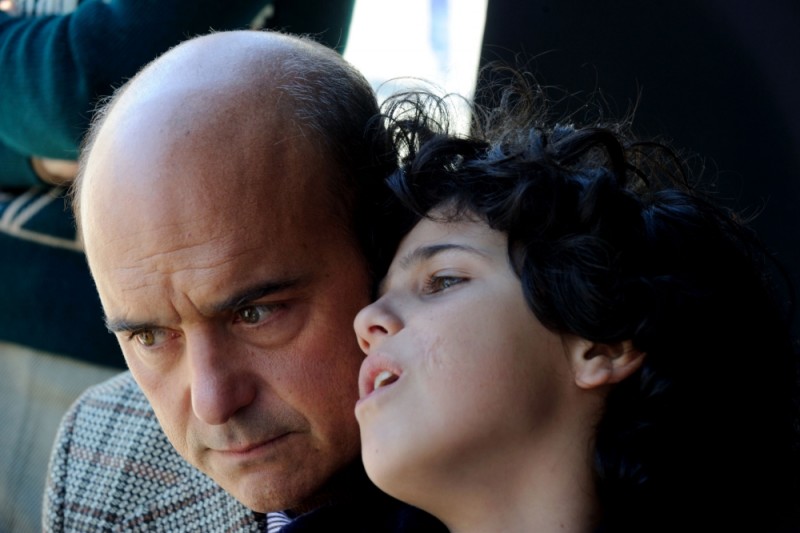
When TrustMovies departs this world, one of his regrets will be his inability to see any more of the films of Ferzan Ozpetek -- which are gorgeous to view, deeply felt, and usually deal in some way with the gay experience. What he loves most about Ozpetek is that this filmmaker always places his (often gay) protagonist as simply one element among many within the vast canvas of the world as it is. Granted, it's an important element, but it never -- as happens in so many "gay" movies -- treats the rest of the world as less important, less special or less good (or, for that matter, bad). Usually Ozpetek gives us ensemble dramas/comedies. In his newest work,
Magnificent Presence, the filmmaker stars
Elio Germano -- extending his past work as a prime Italian everyman to now include a glorious Italian every-gay-man -- as a fellow soon surrounded by that ensemble. And they're all ghosts. However, these are a very classy, retro and delightful bunch of spirits, being part of a left-wing theatrical troupe in the Italy of the 1930s and 40s.

Our hero, Pietro (played by Germano, below, who has already given us a gallery of remarkable performances, from
Do You Like Hitchcock? to
My Brother Is an Only Child and
The Past Is a Foreign Land to name a few), has come to Rome to be an actor, as well as to seek out a filmmaker fellow he's in love with -- though he tells his rather too-amorous female cousin that he is not even sure what sexual preference he possesses. As feel-good a film as Ozpetek has concocted -- and it is: I don't remember feeling
this good, this moved, at a movie's end in a long while -- the writer/director also provides us with a couple of surprising scenes in which he unveils character flaws so great that they change not only the individual but make waves that can topple others and maybe even society itself. One of these involves Petro's would-be boyfriend, the other a member of that theater troupe who is now an elderly lady (played by
Anna Proclemer, above).

Ozpetek also gives us some glorious, richly funny and appealing moments (the ghost group's introduction to modern technology and the internet is one such). But this tale of Pietro and his unusual houseguests builds into something more than a mere ghost story. If we accept the homosexual -- as I think we must at this point in our society and for all the supposed strides we GLBT's have made -- as yet remaining an outsider, an "other," then Pietro's inability to fit into society takes on great meaning. Our young man has finally found the place where he belongs, and the film's finale -- a wonderfully sustained piece of movie art -- offers such beauty, sadness and joy that it defines the word poignant.
Magnificent Presence, which made its Italian debut only last month and scored big at the box-office by being both accessible and special, plays twice at
Opens Roads: as the opening night presentation, Friday, June 8 at 6:15, and again Monday, June 11, at 4pm. Both screenings are at the
Walter Reade theater. Note: The director and his star will both appear at the Friday evening performance. (You can view the entire
Open Roads series
here.)

Since watching this film a full week ago, I've been trying to determine just why it is so powerful. Its documentary-like approach? Partly. That it's based on a terrible incident perpetrated by the police of Genoa during the G8 Summit in 2001? Undoubtedly. Mostly I think, our shock and horror are due to the realization that the event we're watching is not taking place in, well, let's say any of the states that make up the former Yugoslavia, or Hitler's Germany, or the many African dictatorships that have dotted history over the past half century. No: This is Italy at the beginning of the past decade. Filmmaker Vicari (his co-writers are
Laura Paolucci,
Alessandro Bandinelli and
Emanuele Scaringi) very smartly starts out his film by showing us a pair of provocateurs, guys with whom we don't necessarily identify and thus we're not immediately thrust into the lap of some good, liberal, progressive heroes. An incident happens -- a single bottle is tossed into the air -- and the filmmaker goes back to that moment again and again during the movie, each time moving us forward and more deeply into the fray.

That the police acted as vicious animals with barely a trace of humanity (there's one semi-decent cop in the group) will bring back the memory of Mussolini's worst atrocities. And you wonder, why? Are most police departments pent-up terror bins, ready to explode? This film will give you pause -- and then some. And the performances are so real you'll imagine you're watching a documentary. Even the addition of well-known actors such as Elio Germano
(from
Magnificent Presence, above), doesn't distract from the horror at hand.
Diaz: Don't Clean Up This Blood (the title comes from a scrawled note left anonymously at the scene) is one of the most harrowing movies I have ever experienced (though it is nowhere near the goriest), but it is also, and in so many ways, exemplary that I advise you to gird up your loins and go see it. The film plays only once during
Open Roads -- on opening night, Friday, June 8, at 9pm, at the
Walter Reade -- but I cannot imagine that it won't turn up again soon, hopefully via a theatrical release. Because this incident has been described as the greatest human-rights tragedy to befall Europe since World War II, I am surprised it was not included in the upcoming
Human Rights Watch festival. (You can view the entire
Open Roads series
here.)
We expect philosophy, thoughtfulness and weighty themes from the work of Ermanno Olmi, a filmmaker now in his 80s, and his latest, The Cardboard Village (
Il villagio di cartone) does not disappoint. Religion (guess which), faith, immigration and the taking of action all come into play in this very quiet tale of an old priest (
Michael Lonsdale, below, from
Of Gods and Men, and back again as a Catholic after his toying with Islam in
Free Men), in a church that has just been closed down and is about to be demolished, into which comes a herd of illegal immigrants looking for shelter and safety. Things don't get much more immediate, relevant nor timely than this.

And yet, Olmi's manner of handling it all is to never raise his voice and to move things ahead very slowly, with each activity taking its own good time and information doled out bit by bit. Despite this, I did not find the movie itself slow, thanks in good part to Lonsdale's detailed work and the very welcome arguments that crop up along the way between doctor and priest, lawyer and terrorist. "That's not god's law; it's yours," someone insists. "When charity is a risk," notes another, "that's the time for charity." And my favorite -- as I suspect this is for many atheists -- "To do good, there's no needs for faith. Doing good is stronger than faith."

Visually, the film is full of strikingly beautiful images -- of faces as well as religious icons -- and the little cardboard village that crops up inside the church is somehow lovely and correct. Justice -- what is it and how it might be achieved -- is of course the main theme here, and Olmi, not surprisingly, does that "justice" justice.
The Cardboard Village screens opening day, Friday, June 8, at 4pm, and again Tuesday, June 12, at 8:50pm at the
Walter Reade. (You can view the entire
Open Roads series
here.)
*************
Note: This complete the entire rundown of this year's
Open Roads festival of new Italian films.
See you next year, I hope, for the 2013 edition....




edited.jpg)


