Quentin Tarantino's provocative World War lI revenge fantasy now on Netflix is off-putting -- also comic and worth pondering. At film's end,
Brad Pitt's red neck German scalp hunter, Aldo Raine, carves a swastika deep into the forehead of Nazi Hans Landa (
Christoph Waltz, who won an Academy Award for the role). Aldo says: 'This may be my masterpiece'. The remark is Tarantino's editorial comment on his film.
Even if some think
Basterds (2009) is a mess, you can still identify with Tarantino's glee at his revision of history. Here in 1944 is the destruction of the entire Nazi high command, Hitler included, as they sit, dressed to the nines, viewing a film premier in a darkened cinema that is suddenly engulfed in a fiery conflagration fueled by nitrite-laden unspooled celluloid. The work calls to mind the difference between insisting your fantasies are real [your m.o., Mister President] and an artist crafting make-believe into a message. Here, as Tarantino has said, is his story of how cinema can save the world.
It is also wicked satire, filled with references to American war movies, Westerns, and Italian-made 'spaghetti' Westerns (see note at end) that emerged in the 60's and 70's to exploit/satirize American 'shoot-em-up's'.
The prolific Italian composer
Ennio Morricone, now about 90, scored many spaghetti Westerns and his sweeping compositions dominate
Basterds. (Morricone fully scored Tarantino's 'Django Unchained' in 2015).
The 'spaghetti' is dominated by excess -- a satirized vision of our mythical West. Villains are crazed, violence explodes hysterically, and the music swoons. Tarantino pauses his action to add 'spaghetti' touches -- the score changes, the characters freeze into iconic poses, and the action speeds or slows in homage to his objects of satire.
One insider bit is Pitt's Aldo Reine likely named for
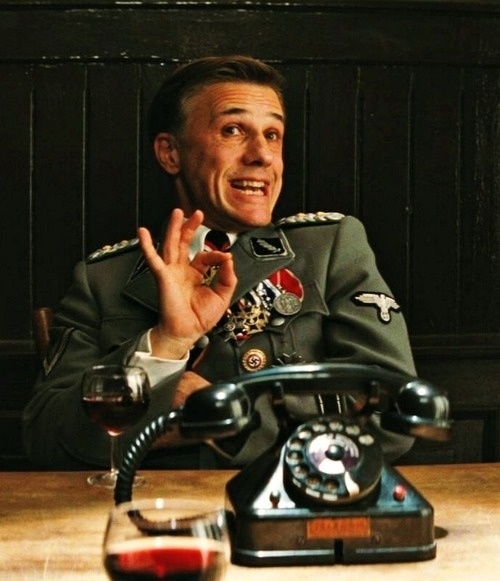
Aldo Ray, an actor famous for his roles in Westerns and war films. But while the other players exaggerate their characters with some nuance, Pitt plays Aldo as a one-note comic-book villain. His dumb, Southern red-neck schtick is almost dismissible except that it stands out so unfavorably from the rest of the ensemble. In particular, Waltz as Jew-hunting Col. Landa (below) steals the lead from right under Pitt's nose. Waltz is so droll, so full of smarm and deceptive insinuation, you can't resist loving this one you are supposed to hate. (Tarantino has inverted our natural sentiments toward these two.)
Tarantino exploits the film-insider and spaghetti-Western thing to the hilt --
Basterds is his own 'spaghetti'; its inside jokes compete for attention with the WWII story to the film's detriment. It unfolds in five busy acts that do not build to its fantastical climax. Chapter One, 'Once upon a time in Nazi-occupied France', is the bucolic opener that introduces the sly Landa in the act of uncovering a family of Jews hidden in a farmhouse in rural France. One escapes, Shoshanna, (the lovely
Mélanie Laurent, below, four photos down, and on poster, top, in middle row, left), who goes on to become the proprietor of a small Paris cinema which she uses to stage violent revenge against the Nazis.
Chapter Two, 'Inglourious Basterds' (below) depicts the group of Jewish-American terrorists led by Aldo, whose mission is to kill Nazis and scalp them. (Aldo is part Apache; each Basterd owes him 100 scalps.)
Chapter Three, 'A German night in Paris', takes place in a basement bar at which Basterds and other cohorts are shaping their own plot to assassinate the German high command in Shoshanna's theater. Among the co-conspirators are suave British spy and snooty film critic Archie Cox (is he named for
Cary Grant whose given name was Archie?) played by
Michael Fassbender, and a glamorous German film star turned Allied spy, Bridget von Hammersmark, the delightful
Diane Kruger (both, below). Their German night in Paris climaxes as some old memory of yours of a crazed shoot-out at the OK corral.
'Kino', the word for cine or cinema in a number of languages, is half the title of Chapter Four: 'Operation Kino'. 'Kino' refers to the erudite in film, the visionary themes and messages that elude mass film goers but show up in art houses dubbed 'cinema's'. In this chapter the two murder plots advance as the pure opposite of erudite cine, rather as gruesome comedies of error -- anything that could go wrong goes wrong. The 'kino' in-joke is too "in", but the underplayed slapstick is a delight.
Chapter Five, 'Revenge of the Giant Face', opens on the premier of 'Nation's Pride' which documents the 'true' story of German Private Frederick Zoller's miraculous war exploits (Zoller below, playing himself on screen). The versatile
Daniel Brühl is Zoller, who follows the beautiful Shosanna around like a hopeful puppy. Their acquaintance doesn't end well.
Meanwhile Hitler is machined-gunned over and over (see last picture) by Aldo's Basterds (attired in various disguises), as Shoshanna's giant face, spliced into Zoller's film, announces Jewish revenge on the Nazi audience as the theater explodes into the street.
In rewatching
Basterds, I found its bits witty and laugh-out-loud funny. Yet it was too long, too talky, too violent. The chapters are so busy and discreet from each other that the momentum of the narrative is thwarted. This armchair critic thinks the plot might be as smooth as ice cream if staged as a musical or operetta -- better vehicles to absorb the non-through story line, the humor, the violence -- like
Little Shop of Horrors or
Sweeney Todd. In film,
Joe Wright found an inventive frame for his
Anna Karenina: he turned his cameras on a fully constructed theater to tell the story, interspersing set theater pieces with a few scenes filmed in natural locales. In short, some kind of distancing mechanism is needed to stage Tarantino's bloody satire more explicitly as fantasy. Still, I liked it -- Basterds' characters are wonderful and the collective revenge on the Nazis for their despicable horrors is immensely satisfying.
Note: For more on Spaghetti Westerns, click
here