Showing posts with label Sebastián Silva. Show all posts

Tuesday, August 20, 2013

Sebastián Silva/Pedro Peirano's OLD CATS opens in NYC--3 years late but still welcome --plus a Q&A with the filmmakers

Good movies will out. Some of 'em, at least. OLD CATS, the follow-up film by Sebastián Silva (co-written and co-directed by Pedro Peirano) to his wonderful The Maid, was first seen here in New York City at the 48th New York Film Festival in 2010, with a supposed U.S. theatrical release to follow that winter. We're still waiting. Or we were -- until today, when the film finally opened for a week-long run as part of MoMA's film program.

In assessing these two films, as well as his follow-up to Old Cats -- Crystal Fairy, which already opened here last month to good reviews and pretty good box-office -- it is now clear to those of us who appreciate this filmmaker's work that he has maybe never created a movie character he didn't like (at least to some extent). Look for a villain in his films and you'll come a cropper. These are all folk on the road to learning, and if that sounds preachy or tiresome, it's not. The films of Silva (above, right) and Peirano (above, left) offer too much fun and are far too interesting to be mistaken for sermons.

In Old Cats, which really is a lovely movie, the filmmakers shows us yet another dysfunctional family: an older couple, Isadora and Enrique (Bélgica Castro and Alejandro Sieveking, with those titular cats), well into their 80s, when their building's elevator breaks down, leaving Isadora, who is now coping with the onset of dementia, a kind of prisoner, ten flights up.

This is also the day that Isadora's daughter Rosario (Claudia Celedón, above, right) and her butch lover who likes to be called Hugo (the wonderful Catalina Saavedro, above, left, who starred in The Maid) arrive on the scene with a plan (yet another cockamamie scheme, it would seem) that will supposedly make everyone rich.

What happens is both expected and then not. The filmmakers observe their characters well and discover flawed folk who keep trying to make things work but fail as often as they win. Silva and Peirano do not judge, but they do see clearly and allow us to do the same. We come out of their film happy, sad and chastened. Things are never easy, particularly as age and its ravages overcome us.

Much of the film takes place, by necessity, in the older couple's apartment. But smartly -- both plot-wise and visually, for a wonderfully enjoy-able and sometimes frightening outing -- the characters and we take to the streets. There, Silva and Peirano prove just as knowing and sly, with the same fine understanding of human nature, as they are when boxed into the apartment. There's an epiphany of sorts, but nothing major. Silva's too subtle for that.

As I mentioned earlier, the movie opens today, Tuesday, August 20, for a week's run at MoMA. So for all you Silva completists out there, don't let this one go by unseen. I would hope there will be a DVD release eventually. More on that when I get some answers from the distributor...

****************

At the Q&A back in October of 2010, following the NYFF screening of Old Cats, both Sebastián Silva (below, right) and Pedro Peirano (below, left) were present and happy to answer a number of questions from various viewers. Below is what I have now, three years later, been able to retain from my scribbled notes taken during the pair's Q&A....

Your film deals with the claustrophobia of family. What draws you to this subject? 

SS: I have a huge family (Editor's note: See The Maid for verification of this.) Relationships are strong and sometimes terrifying. And there are no boundaries. For me family relationships are so universal, and they mirror that of the whole society.

PP: I come from a small family. All women. It's a horrible situation! (Everyone laughs.) Part of my idea here was to use a kind of "thriller" format for this movie.

Can you talk a bit about your collaboration?

SS: Pedro is very experienced in collaborating. He does amazing writing, and he always knows every detail. I'm dyslexic, and so maybe more daring and not afraid to make mistakes. But he always knows what's right and wrong!

PP: The main things is always how to get the characters into trouble. In terms of writing, Sebastián always creates the problems for the characters that I must then come and save.

I have two questions: You have three strong and famous women playing these characters. How was that to deal with?  And also, since the one couple is lesbian, how it is for homosexuals in your country?

PP: The three are actually very good and very old friends, so that made it easier. What was really interesting here is that we had three generations and thus three different styles of acting.

SS: For instance, Bélgica Castro who plays Isadora is 92 years old and has never improvised on film, so this was very difficult for her. She'd suddenly stop and say, "Just give me the line!"

PP: Regarding the question of homosexuality, things are changing. Discussions are taking place, on top of the remains of older discussions.

SS: In any case, our film is not categorized on the web as a gay film. No! That's only a part of it.

You do old age so well. Was this due to the script or to the actress?

SS: When you're 92, like Bélgica, you know old age. We were actually worried about this, so we researched, too, about the portrayal of mental illness.

PP: I also am upset by the theme of age and I liked the opportunity to work on this. Our older actors who play the couple are actually married -- they're 92 and 87 -- and the film was shot in their apart-ment in which they've lived for 30 years, so in a sense we got a lot of research from that alone. A lot of real data: all the pills and the dynamics of how they lived. How they wake up in the morning and what they do each day. We invaded their house and learned a lot!

What about the animals?

SS: Oh, boy. We had no experience directing animals. When we wanted the cats to move, we had to use these cans of air, which we had to squirt at them. Then they moved.

PP: And when the elevator broke, we had to carry everything downstairs.

SS: The Maid was shot in my father's house, and now this film was shot in the actors' apartment. From now on, I want to find locations that are lived in!

PP: The hardest part, in a way, was that the apartment was real and so were the actors who lived in it. But the characters were not. They were so different from the actors, and that made it very odd.

Is this part of a new wave of Chilean cinema?

SS: I don't believe in this. Now it is all more individual, random. In Mexico, yes; Uruguay, yes. But in Chile there us no new wave yet. Small films are being made, with not much support from audiences. But fortunately, because of video, movies are cheaper to make!

Monday, July 8, 2013

Silva's CRYSTAL FAIRY: Ugly Americans in Chile take a road trip and too many drugs


The most recent Ugly American traveling through Chile -- Eli Roth in the godawful Aftershock -- proved to be less than a waste of time, so TrustMovies is happy to report that the latest set of UAs to "grace" the screen are something else entirely. In Sebastián Silva's new film, CRYSTAL FAIRY, the lately versatile actor Michael Cera, along with Gaby Hoffmann, an actress too seldom seen, bring the term ugly American to the kind of life it has rarely been given onscreen.

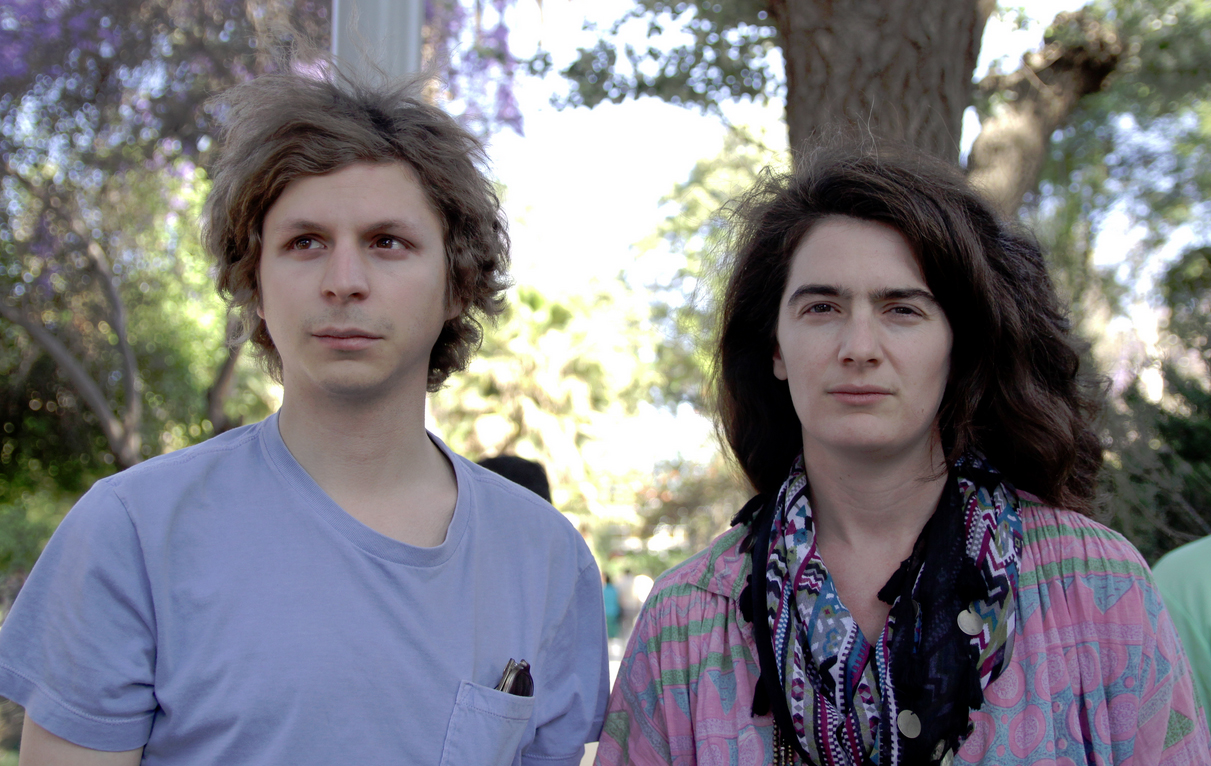
As Señor Silva, shown at left, proved with The Maid and then Old Cats, he's not one to shy away from problematic people. Here he lets loose with two of them, and Cera and Hoffmann grab their role and run with it, turning what at first might seem like cliche into something much weirder, stronger and -- heightened moment to entire over-the-top scene -- absolutely real. The two play very different kinds of "ugly," with Cera's the most unattractive. So much so, that for a time we worry that the performance is going to lose our sympathy completely. The actor (shown at left, below) plays Jamie, a full-of-himself, always-right, little twat who's determined to get hold of a special cactus said to provide a "high" like nothing else.

While himself higher-than-a-kite on coke at a party, Jamie encounters an odd woman who calls herself Crystal Fairy (Ms Hoffmann, above, right), and he invites her to join him and his three Chilean friends, the Silva brothers (shown below, with Cera), on their search for this famed cactus.

Madness (ranging from nutty to simple anger) ensues, as Jamie and Crystal, the proverbial oil and water, go at each other consistently. This might grow boring, were it not for all the little oddities -- events and people -- that Silva has his group encounter along the way. The Silva bros are smart enough to simply get out of the way when the flare-ups begins, so the movie belongs to Cera and Hoffman, as each creates an indelible character that viewers lucky enough to see this film will not soon forget.

I find it interesting that Silva would choose these two types to represent Americans, for they could be seen as the extremes of both the right-wing (entitled and pampered) and the left (frightened, loosy-goosey and abdicating responsibility). With or without this grid through which to view them, the characters are brought to rich, real and entertaining life.

While it would appear that a certain amount of improvisation is at work, there are still some very funny lines scattered along the way ("It's camomile. It'll relax you" is one of my favorites). There's a lollapolooza of a nude scene, too -- which should separate the men from the boys -- and some lovely coastal scenery.

Best of all, there's a view of life, consistent with Silva's other films, that finds more good in us human beings than bad and demonstrates this in a way that allows us to embrace it without either cynicism or unearned feel-good moments. Silva is special -- and so are his movies.

From IFC Films and running 100 minutes, Crystal Fairy (and the Magical Cactus) -- a few extra words appear to have been added to the title to draw in some dopers -- opens this Friday, July 12, in New York City (at the IFC Center) and Los Angeles (at the Landmark NuArt).

Simultaneously, the movie will open via VOD, so there's little excuse for missing this one, film fans....

Saturday, October 9, 2010

The 48th New York Film Festival closes with OLD CATS, REVOLUCIÓN and HEREAFTER

Another year, another fest, another prime line-up of films from around the world -- only eight of which TrustMovies managed to see (though he did a lot better this year than last).  The festival closes tomorrow with Clint Eastwood's HEREAFTER -- which is perhaps the only Eastwood movie I have liked without caveat (well, maybe a few small ones).  I'll have much more to say about this film when it opens next week.  Meanwhile you can catch the 10pm showing tomorrow, to which there are still some tickets remaining.

OLD CATS is the new film co-written and -directed by Sebastián Silva, director of last year's success The Maid, and Pedro Peirano. This is an equally fine film -- funny, pointed and moving about old age, family and unhealed wounds -- which plays at 2:45 this afternoon, but will, I am told, be released theatrically early next year. At that time I'll have a lengthy review, coupled with an excellent Q&A that the two filmmakers offered, post-press screening. You can check out the ticket situation here.

More important, by far -- because there may not be other opportunities to see it -- is the new film from and about Mexico, REVOLUCIÓN, which, for me, proved the highlight of this year's festival. A ten-part/ten-director omnibus commissioned to commemorate the centenary of the Mexican Revolution, it's about exactly what its title proclaims: revolution (in its many meanings) and what this has meant and continues to signify for the country of origin. The film -- the sections of which have been ordered in a perfect fashion so that our understanding of and appreciation for the concept burgeons as the movie progresses -- is thought-provoking and greatly moving, particularly for those who have acquaintance with Mexico's history.

Each episode works surprisingly well, though some are stronger than others.  But because each makes it point with feeling and economy, and sometimes wit, as well, the film grows into a wonderful comment on Mexico and its history -- as well as, in a couple of episodes, on the USA's relationship with its southern sister.  The film opens with a sweet but dark piece, The Welcome Ceremony (above), by Fernando Eimbcke (of Lake Tahoe), in which a local band from a hinterland village rehearses a song in honor of an upcoming arrival. While we get a slice-of-life of the band's tuba player (shown at center) and his family, this opening piece shows us just what revolution has resulted in, historically, for Mexico.

Patricia Riggen (La Misma Luna) provides via Beautiful and Beloved (above), a pointed story of a Mexican-American woman, her father, relatives, a lawyer and a funeral director -- and their relationship to both the US and Mexico. Funny, smart, sentimental and moving, Riggens' film speaks volumes in few minutes. With Lucio, Gael Garcia Bernal tackles the relationship of religion and revolution, as well as how revolutionaries are made. Tightly focused and beauti-fully filmed, this is a strong little movie and, along with his earlier Déficit, indicates that Bernal may yet become a director of note.

The Hanging Priest (above), from Amat Escalante and filmed in black-and-white, takes us to what appears to be a historical time, as two children on a donkey come upon a very odd sight in the desert. Well-played, the little film works as symbolism -- about the church and Mexico's next generation -- even as it suddenly brings us face to face with now, and what is next.

The most brilliant piece in the bunch comes from a filmmaker about whose work I've been rather "iffy" till now: Carlos Reygadas (Silent Light). His This Is My Kingdom section of Revolución, however, is so stunning that I'm in awe. The filmmaker simply shoots, documentary-style, the gathering of a horde of people from what looks like upper-middle class to lower, on some sort of holiday (Day of the Dead, maybe?) and catches snippets of their conversation. As day goes to night, activities grow crazier and the talk turns ugly. By the end, you may have quite a different notion of what revolution could bring.

In The Estate Store by Mariana Chenillo, whose award-winning Nora's Will open theatrically in NYC this coming week), we get (along with Ms Riggens' film) the most plot-heavy tale, and it's a good one. A love story blossoms in what looks like a fairly typical supermarket (think Gigante), but which, if the title is any indication, is actually owned in such a manner that its workers exert less control over their lives than the owners. Initially full of promise, joy and budding love, by the end, the tale has tuned into something darkly socio-economic in which the personal is political in a pointed, nasty way. Revolución, indeed.

R-100, which I guess is a particular Mexican highway (which probably will have its own immediate ramifications for Mexican viewers, but which escape this gringo), by Gerardo Naranjo (I'm Gonna Explode), is a short tale in which one member/level of society uses another, uses another, uses another. It's ugly, and the fact that we know almost nothing about any of the characters shown may be the point.  Faceless, useless, and users all, they prey -- out of necessity. The graffiti on the wall of the bridge maybe be a bit unsubtle but it makes its point.

The title of 30-30 evidently comes from a revolutionary song which has found its way onto beer and other commercialized uses, and this is the point of the film by Rodrigo Plá (La Zona), one of the richest and perhaps the longest of these short films. Here, the now-aged grandson of a revolutionary (I think it was Pancho Villa -- or maybe Emiliano Zapata) has been asked by the government to take part in ceremonies all around the nation. He does, and what he observes is a not-unexpected media circus. But given the history and continuing downward trend of this country, it's particularly depressing. Real estate, con artists, emigration and family unite in Pacifico, the fine contribution of Diego Luna (actor, producer, director and now writer) to this collection, in which a man trying to find a paradise for his family, comes to a sad but important realization. 

In 7th and Alvarado, directed by Rodrigo Garcia (Mother and Child), we are back in Los Angeles again, in the film that closes Revolución on a note of exquisite beauty and sadness. With no dialog, and using some stunning visuals, Garcia joins the Mexican-born population of this particular area of L.A. to its own past in a manner that, as this very short and elegiac movie draws on, is heartbreaking in its refusal to say more than simply this:
Watch, remember, and understand.

I hope that Revolución will find distribution in the USA, at the very least on DVD.  It plays at the NY Film Fest one time only, this evening, October 9, at 5:30 in Alice Tully Hall.  Check for tickets here.