Showing posts with label Shakespeare on film. Show all posts

Friday, September 4, 2020

Paul Ireland/Damian Hill's very loose adaptation of Shakespeare's MEASURE FOR MEASURE, against all odds, succeeds!

Can a modern adaptation of one of William Shakespeare's more problematic "problem plays" possibly work while leaving out the Bard's own never-been-bettered writing, sticking only to the basic plot (and then changing even a good deal of that) while adhering to the play's major themes? 

On the basis of the latest attempt, the new Australian movie MEASURE FOR MEASURE, directed by Paul Ireland with a screenplay adapted by Mr. Ireland and the late Damian Hill, indeed it can. OK: This is definitely not Shakespeare. But somehow, and against great odds, it is Measure for Measure because it gets to the heart of that supremely difficult play -- of which TrustMovies has never yet seen a thoroughly successful theatrical production.


This Ireland/Hill adaptation (the director's shown above, at right, co-writer Hill at left) is set in present-day Melbourne in a society ravaged by white/colored divisions, as well as anti-Muslim sentiment and is peopled here by a mostly criminal element, with its crime lords -- one white (played by Hugo Weaving as Duke, below), the other Muslim (Fayssal Bazzi, of the Stateless series, as Farouk, shown at bottom, left) having agreed to somehow share the turf.


In this version the Claudio and Isabella characters (here Isabella is Farouk's sister, Jaiwara) are not siblings but lovers, which fits into her pleading for his life just fine, and also underscores the theme of fractured community inherent in the original play. As portrayed by Harrison Gilbertson and Megan Hajjar (or Megan Smart, according to the IMDB), these performances help anchor the movie, as well.


The movie's (as well as the play's) villain is again Angelo, (the) Duke's chief henchman, and as good as is Hugo Weaving, the film's best performance comes from Mark Leonard Winter (above) in this role. Angelo, as are almost all the other characters, is highly conflicted, and his terrific, deeply felt performance captures this in spades. 


The gangland milieu serves the story well, and Ireland's and Hill's ability to capture so many of the play's important themes -- morality, hypocrisy, justice and forgiveness among them -- while giving each of these full emotional and dramatic weight helps turns this Measure for Measure  (even without the Shakespeare poetry) into something major, surprising and often quite splendid. And if the plot itself is pure melodrama, well, so's the original.


From Samuel Goldwyn Films and running 107 minutes, the movie is available now via VOD and digital streaming -- for purchase and/or rental.

Sunday, May 21, 2017

Shakespeare, love, and a lot more mix in Matías Piñeiro's latest, HERMIA & HELENA


When I first saw Matías Piñeiro's charming, unusual and short (just 61 minutes) film, Viola, back in 2013, I was very taken with the work of this Argentine filmmaker. Since then Señor Piñeiro has made The Princess of France (all of 67 minutes) and now his latest film, HERMIA & HELENA, which lasts a nearly-normal 88 minutes. Unfortu-nately, he is not quite ready for full-length.

While his themes and concerns -- everything from Shakespeare to theater productions to love relationships of all sorts -- are on display, as usual, the movie runs downhill as it expands to include other Shakespearean devices such as the discovery of parentage.

As usual, the writer/director (shown at left) has again cast as his leading character, Camila, with the alluring and talented Augustina Muñoz (shown below), who provides beauty, appeal and some surprise as the young woman -- a theater grad student (or maybe already professional) working in New York City on a new Spanish translation of A Midsummer Night's Dream -- at the center of a whole bunch of ongoing and/or would-be relationships. Ms Muñoz, is always a pleasure to watch, but the actress cannot easily carry as much baggage as Piñeiro has given her here. All the relationships and characters we meet end up with so little weight or importance that they seem to disappear into thin air even as we're watching them. (Shakespeare could get away with this because he had such gorgeous, literate, amazing verbiage to offer. Piñeiro's dialog, while sometime clever, hardly comes close.)

Still, this worked well enough in Viola, where the themes were simply love and theater, and where the movie ended before it had time to curdle or bore. Here -- even with the added use of a little "magic" (à la that Midsummer Night's Dream) -- it all adds up to less than the sum of its many parts.

The scene involving the connection of Camila with the father she's never met proves so slight and bizarrely ungrounded by anything other than mere plot contrivance that what might be pivotal in most movies proves no more important nor deeply felt than anything else in the film.

The cast includes some of Piñeiro' usual Argentine actors, along with some new American and international actors (and filmmakers) from the indie scene such as Keith PoulsonDan SallittDustin Guy Defa and Mati Diop. Everyone comes through nicely. But the movie -- for all its charm, smart performances and lovely visuals -- simply floats away.

From Kino Lorber, in English and Spanish (with English subtitles), Hermia & Helena opens this coming Friday, May 26, at the Film Society of Lincoln Center and the Metrograph. Elsewhere? We'll have to wait and see. You can update the currently scheduled playdates by clicking here and then scrolling down.

Saturday, June 8, 2013

MUCH ADO ABOUT NOTHING: Joss Whedon does Shakespeare--American and very well

What a treat it is to see Shakespeare done well by Americans, and on film (well, video), at that -- to hear the language spoken by people who understand the meaning of what they are saying, and so are able to communicate that meaning to those of us listening and grappling once again with Elizabethan language. It's not easy, as most productions of Shakespeare, pro and non-pro here in the USA, quickly prove. In my experience in New York City for over fifty years, only The Pearl Theater is able to do this on stage time and time again, helping audiences finally understand why Shakespeare's plays (and the rest of the classics that it mounts) are indeed the classics we've been told since childhood that they were. (I've even seen British productions in which, yes, the actors got the words right, but much of the feeling and most of the intention have gone missing.)

How lovely that Joss Whedon, shown at left and evidently a big Shakespeare fan, was able to round up actors he knew and prized and let them go to town on one of the Bard's better comedies, MUCH ADO ABOUT NOTHING. The result is fine American Shakespeare in which dialog is spoken easily, fluently and naturally and will probably surprise some of you who feel that these words are somehow beyond your understanding. You won't maybe get them all, but you'll come, as they say, close enough for jazz. Mr. Whedon has also managed to set the play in our very modern times and make it work without a hitch. The mansion and estate in and on which his version takes place proves a perfect manifestation of our current "court" life amongst the "entitled."

The filmmaker has also pared down the Bard to quite good effect (for movie audiences, at least). I didn't find myself missing much of anything. His choice of music is often sublime, as well, and his staging of a party scene, complete with masks, music and acrobats seems both Elizabethan and contemporary.

Whedon also cleverly, amusingly uses today's kitchen (above) as a fine place to overhear conversations, and his scene in the swimming pool (below) is remarkable: quietly hilarious and kind of creepy, too. But it is probably the wedding scene (and a couple of those following) that will clinch it for you. Turning the themes of Othello on their head and using them for feel-good comedy, Shakespeare is able to show us man's (and woman's) jealousy, hypocrisy and stupidity so well, and Whedon and his fine cast give us joy, sorrow, rage and surprise in equal measure. Beatrice's "Kill Claudio" carries more shock and weight here than I have ever heard before.

The downside? Just the usual: Dogberry is perhaps the Bard's least funny comic character and, in my experience, unsalvageable by any actor, so while Nathan Fillion (below, right) -- a performer I much admire -- plays him way down and so is much less annoying the was Michael Keaton in Kenneth Branagh's film of 20 years ago, there is still little else to do but sit there and wait for this tiresome, one-note character and his entourage to exit.

As our feisty-but-enchanting B&B, Amy Acker (below, right, and three photos above) and Alexis Denisof (below, left) are both exactly that; they make the dialog fun and new all over again. Jillian Morgese (at left in photo at bottom) makes a lovely and virginal Hero, with Fran Kranz's Claudio (center, two photos below) her dim and easily-suggestible beau.

Clark Gregg (below, right, is a terrific Leonato), Reed Diamond (a studly Don Pedro) and Sean Maher (a fine and despicable Don John) round out the major ensemble. The lush and graceful black-and-white cinematography by Jay Hunter is everything you could want, as is the movie's just-right, 107-minute running time.

Much Ado About Nothing -- from Lionsgate and Roadside Attractions -- opened yesterday, June 7, in Manhattan (Landmark's Sunshine and the FSLC's Walter Reade Theater and the EBMFC), Los Angeles (The Landmark, and the Arclight Hollywood) and San Francisco (the Cinemark Century Centre 9), with other cities chiming in soon, as the rollout continues.

Monday, February 4, 2013

Shared humanity trumps politics & passion: the Taviani brothers' CAESAR MUST DIE

What is it about movies that offer up the subject of theater programs in prison that makes these films such slam dunks? I don't think I've seen a single one -- from the riveting American documentary Shakespeare Behind Bars to the wonderfully moving and funny Spanish narrative film, My Prison Yard -- that didn't ring my bell loud and long. Now comes another, this one boasting some very classy bona fides: CAESAR MUST DIE Written and directed by the estimable Taviani Brothers, Paolo and Vittorio (with quite a bit of help from a certain Willie the Shake and his play about power, politics, trust and loyalty, Julius Caesar), this newest theater-in-prison movie rings that bell once again.

Yet why this should be so -- hugely so, at that -- is more difficult to pin down. But let me try. First off, the Tavianis combine so effort-lessly and well the documentary style with narrative technique while incorporating Shakespeare's great play (without giving us nearly all of it) that their film becomes a very odd, off-kilter work all its own. We're kept alert and suspended by the back-and-forth use of story-telling, cinematography that goes from color to black-and-white and back again, characters that are both their prisoner selves and people we know from history (and Shakespeare's work). Finally all these meld into one very real, if quite short (the film lasts but 76 minutes) movie that is part documentary (these are real prisoners, really acting Shakespeare), part narrative, and all Taviani.
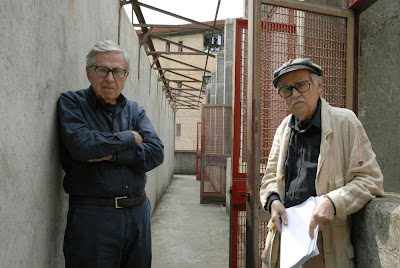
The Tavianis (above, in color and black-and-white -- with Paolo on the left and Vittorio at right) begin with the performance of the play's finale and then the curtain call and applause from an understandably excited audience. Then we go back in time to meet the inmates and watch as they audition and are cast in various roles. Most of these guys seem like natural performers, but some, in particular, stand out and are promptly cast in the leading roles. Of special note are the prisoners who end up playing Caesar, Brutus, Cassius, Marc Anthony and the soothsayer.

Caesar, in particular (Giovanni Arcuri, above, center), possesses enormous bearing and strength, while Brutus (Salvatore Striano, seated below) has a marvelous face that seems to mirror his every small change of feeling.

As Cassius, Cosimo Rega (below, right) offers quite the right lean and hungry look, even if he does seem also to be eating quite well. Antonio Frasca (center, left) makes a stentorian and rather endearing Mark Anthony, while Francesco Carusone's quirky body movements (two photos below) and sense of derangement, put to odd use in his audition, prove perfectly suited to the role of the soothsayer.

In the end credits, we are told that certain of these actors have gone on to performing careers -- quite understandable -- once their prison time was completed. Others, serving life sentences, are not so lucky. One especially sad moment occurs when a prisoner notes that, once you have discovered art, your prison cell becomes unbearable.

The use of the prison facilities -- where the rehearsals and indeed some of the actual performance takes place (the Tavianis make no real differentiation here, which is all to the good for it makes every moment count in terms of immediacy and meaning -- works spectacularly well, for the prison, with its walls and guards, not only mirrors our increasingly closed society but also makes the play appear to fit well into any period, past, present or future.

Though the whole of Shakespeare's play is not here, there is enough if it to please fans of the Bard and may send some of the them immediately back to read the work once again. So what is it, then, that makes this movie so powerful? In part, it's due to the combination of these actual prisoners performing a play that reflects well their own society and ours, creating a kind of life-mirrors-art-mirrors-life situation, the ramifications of which keeps bubbling up in the play, the actors, and the culture of prison life.

And then it happens. A singular moment that I have never seen before in this play. (In fact, it is one of the things that makes this a movie.) It takes place during the curtain call, when one character helps lift another to his feet and their faces meet. In that single moment -- which we get to see twice, though it is fleeting and not commented upon at all -- everything becomes clear. Forgiveness, redemption and understanding are present and accounted for, as the simple gesture cuts to the heart of the matter, derailing the corruption, pettiness, politics and ambitions that have preceded it.

The gesture goes beyond everything we have so far seen and tells us, yes, we're all in this together. Suddenly the scurvy politics of the play, as well as the ugly deeds -- petty drug deals or Mafia-sponsored murders -- done by these men and which landed them in prison don't begin to compare to the brotherhood we've just witnessed. As usual, with the Tavianis, humanity trumps all. This, as much as anything, is what makes this odd hybrid of a movie so stirring and memorable. And humane.

Caesar Must Die, from Adopt Films, opens Wednesday in New York City at Film Forum and Lincoln Plaza Cinema, and then moves to various playdates elsewhere around the country. Click here, then click on Caesar Must Die, then scroll down to see all currently scheduled playdates, which are listed, top to bottom, in order of their opening.

Sunday, July 3, 2011

The Bard goes bananas in Eve Annenberg's mash-up, ROMEO & JULIET (IN YIDDISH)


Taking one of the great melodramas of all time, Romeo and Juliet -- the poetry of which lifts it into tragedy -- setting it in modern-day Williamsburg, Brooklyn, and then peopling it with a very odd assortment of characters and stories-within-stories might sound like a dicey proposition. Doing the tale in Yiddish adds yet another weird layer. The icing on the kugel is provided by having the writer/director/co-producer Eve Annenberg play lead actress in the film (no, not Juliet -- but Ms Annenberg still gets the major role here). The result is one of the strangest concoctions TrustMovies has seen in some time. And as you surely know by now, he has given himself over to some pretty strange concoctions in his day.

Ms Annenberg, shown at left. makes a funny, spicy, energetic and on-target actress (in her role of an ER nurse named Ava, who, for some not-very-believable reason, decides to create ROMEO AND JULIET (IN YIDDISH) -- with lots of help from friends and the nearby Hasidic community. While I found it a pleasure to watch Annenberg's  acting work, as for her writing and directing, I'm flummoxed. What the hell did this woman think she was doing and why would she even want to do it if she couldn't manage it any better than this? A hodge-podge of ideas and moments, characters and languages, with headache-producing, hand-held camerawork and sets, cast and costumes that are occasionally charming but more often risible, the movie barely comes together. When it does, this is thanks of course to the Bard, who in every way managed things more rigorously, beautifully, and entertainingly.

Well, modern artists are forever updating and redoing Shakespeare, so consider this just another attempt. And one that does occasionally work. Romeo in peyes is no sillier than Romeo in tights, and having Mercutio doing his Queen Mab speech as rap is one nice touch.  But stealing the fairy dust bit from A Midsummer Night's Dream isn't really germane to Romeo & Juliet -- not to mention that it's handled in a manner more reminiscent of Tinker Bell than of Queen Mab.

The Friar Laurence (in this case, Rabbi Laurence) scene works nicely, too, as do the occasional flashes of the play's original dialog. You can't beat William S. for gorgeous images (even when these are translated into Yiddish and then subtitled back into English), but after awhile, the film seems like too many layers of whimsy atop one thin layer of Shakespeare.

The various characters, who double as themselves and as those in the Shakespeare play, are so cursorily presented that we care little about them in either of their roles. And anything the film manages to bring up about culture, family or love, seems so paltry as to be unnecessary. At best you might call this movie cute, short and completely forgettable. At worst it'll have you rolling your eyes and murmuring "Get on with it!"

Romeo & Juliet (in Yiddish) opens this coming Friday, July 8, in New York at the new Elinor Bunin Munroe Film Center at Lincoln Center.

Wednesday, December 8, 2010

Taymor's THE TEMPEST opens theatrically in Los Angeles, New York and San Francisco


What a beautiful piece of filmmaking -- and how true in spirit to Shakespeare's great play -- is Julie Taymor's renditon of THE TEMPEST. When TrustMovies first viewed the film (during the FSLC's New York Film Festival last September), he noted that you may want to see it prior to reading much about it. Not that there is much to spoil for buffs of The Bard, but Ms Taymor (shown below) has indeed made a few interesting changes in her paired-down, theme-heightened version -- chief among these is the casting of Helen Mirren as Prospera (yes, that's an "a" at the end). And why not?


If The Great Shake were around today, he'd embrace the rise of women. He was too smart not to, but being of his time and knowing quite well on which side his bread was buttered (and by whom), he played along regarding his view of the "fair sex," just as he did about most else -- but always with his keen intelligence, gift for language and understanding of the vagaries of human nature fully intact.

Taymor's casting of Mirren (center left, above, and below, left) is no stunt, either; she's equal parts moving and commanding in the role. And hearing much of the play's words out of her mouth (as well as that of others in this fine cast) is a pleasure. Other than Prospero, The Tempest tends to live or die by its Caliban and Ariel.  Yes, certain other characters in certain productions stand out now and again, but as this is a play about justice and the uses of authority (via magic), audiences tend to look first to its most magical and/or strange characters -- Prospero, Ariel and Caliban -- for their thrills, joy and understanding.

Ms Mirren makes the most of her "wizardess," imbuing Prospera with strength and kindness, the latter shown mainly to her daughter, Miranda (played nicely by Felicity Jones, above, right). There is also a strong sense of vengeance present (understandably so, given the character's history), which Mirren smartly lets us see as occasionally getting the upper hand. But it is her understanding and communicating of Shakespeare's words that prove most important, and here she blesses us.

Djimon Hounsou makes a spectacular Caliban. He is such a handsome, full-bodied actor, and his rich voice has seldom been put to better use. With make-up and costume that manage to accentuate his blackness and whiteness (you'll see), not to mention his sexuality (in a smartly-directed comedic scene with Alfred Molina -- shown below, right -- and Russell Brand, below, left), he becomes a slave whose enormous possibilities lie just beyond our ken -- and beyond his own ability to tap into them. Caliban is one of Shakespeare's strangest creations, and Taymor and Hounsou make the most of this. They don't (and we can't) explain Caliban -- this marvelous "other" -- but we also can't take our eyes off him. We are fully engaged, as we should be, by who he is and, at the film's moving conclusion, what might become of him.  The last shot of him, and his reaction, speaks volumes -- though it says not a word.

As Ariel, Ben Whishaw adds another feather to his growing cap. Androgynous and beautiful, fairy-like and asexual, alternately powerful (frightening when need be) and pliant, the actor is a great choice for this role.  Granted the role is half special effects, but Whishaw's skills are such that his performance and the effects seem joined at the hip, the brain -- and everywhere else.

Also in the well-chosen cast are Tom Conti (we haven't seen much of him lately), Chris Cooper (above, left -- a fellow we don't often get to hear reciting the Bard) and Alan Cumming (above, right).

The movie's special effects (and there are lots of them -- as you'd expect from Taymor) are first-rate, and the location shots -- the movie was filmed in Hawaii -- range from occasionally gorgeous and verdant to surprisingly stark.  Either way, they're a treat to view. The Tempest begins its run this Friday, December 10  in San Francisco, Los Angeles and New York City.  Click here and then click on GET TICKETS (to the right of the screen), scroll up to see theaters, and then click on your choice to view screening times and purchase opportunities.