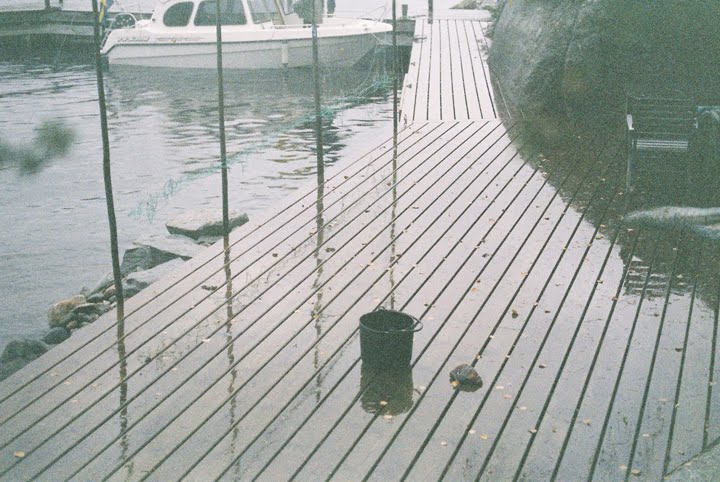
Filmed in Sweden's
Stockholm Archipelago,
THE ANCHORAGE begins with a bit of cinema verité: a pitch-black screen from which, very eventually, sounds begins to emerge: insects, birds, wind and more. Light slowly dawns, and why not? If it's dark out, then it's dark on-screen: No day-for-night stuff here! Soon we have a scene of nude bathing in the Baltic Sea by a woman somewhere between middle and old age, who, my companion noted, looks better with cloths than without. No turn-ons, either.

This woman, above, is named Ulla and it is she whom we follow for some 87 minutes, including credits, as she bathes, breakfasts, fishes, mends nets, bids goodbye to a daughter and daughter's friend, walks (a lot), watches and listen to TV/radio, checks the weather (on-line, I think), travels to what passes for a town on the island on which she lives, and only very occasionally offers a kind of diary entry featuring a thought and desire or two. Ooops. I've broken my cardinal rule and given away the plot. Except it isn't really a plot at all -- just life being lived, and then edited briskly down so that we don't go bonkers from boredom. And the film is not boring, exactly, nor will it be terribly involving -- unless you're willing to let go of many of the expectations that accompany normal movie-watching.
Letting go may be a struggle, but if you succeed,
The Anchorage, a first-film from American
C.W Winter (above, left) and Swede
Anders Edström (above, right) may please and sustain you. (
TrustMovies succeeded maybe halfway.)
In the directors' statement (part of the press material for the film), we are told,
"Life has nothing to do with dramatic progression but is instead a long and continuous movement made up of an infinity of micro-movements." In 1921, a young Jean Epstein issued a call-to-arms for a narrative cinema in which image would at last overturn its submission to text. (Ed's note: I presume the quote above is from Epstein.)
The Anchorage
is a film made in this spirit. It's a film that values continuous movement over predestination. It's a consideration of the wide-open potential of a narrative cinema that is freed from the constraints of denouement. It's a film about the passage of time, both in life and in movies themselves.
OK. But why
this woman? Well, one life as good as another, right? Maybe. However, one performer is not always as good as another, and Ulla
is a performer, whether she likes it or not. Compare her "performance" with that of
Nev Schulman's in
Catfish, and you'll get my point. The movie's location is perhaps the key. It's special -- and worth spending time in. And since Ulla lives in this location, it is she with whom we spend
our time.
When the filmmakers' camera is at work, it's generally stationary, quietly observing everything from the sea to the wind in the trees, a crossword puzzle and a needy dog. Choice, of course, is all, and I think I might have made some different choices were I directing. Though, since I can't know all the many moment there were to choose from, who knows?
In any case, we watch daily life being lived on this sparsely inhabited island where one's existence is exceptionally "cut-off." (When Ulla listens to the news, it's all about the U.N.'s sanctions against North Korea and bull-sperm farming -- hardly things that impact on her own life. Little wonder it appears to be the weather report that interests her most.)
In one scene, as Ulla sits inside her house, we see someone approach on the outside and we think, Ah -- a visitor! Some
interaction! Don't bet on it. Instead we're alone with Ulla, just as she is (mostly) alone on the island. There's a nod to global warming, fish being de-boned and beheaded, thoughts of a husband left or dead, and mostly that ever-present wind. For a movie in which nothing much happens, this one is not nearly as dull or boring as you might think. It's beautiful, in its way, and may make you wonder about, and maybe wish for, a more solitary life.
The Anchorage opens today, September 17, at
Anthology Film Archives in Manhattan. Click
here for the schedule of performances, and then click the arrow next to "Filter by Program" (in the upper right quadrant) and then click on Premiere/Revivals. Following its AFA playdate, the film is expected to move to other locations, including Cambridge's
Harvard Film Archive, Seattle's
Northwest Film Forum,
Pointlignelan/Le Fémis in Paris and Los Angeles'
California Institute of the Arts.