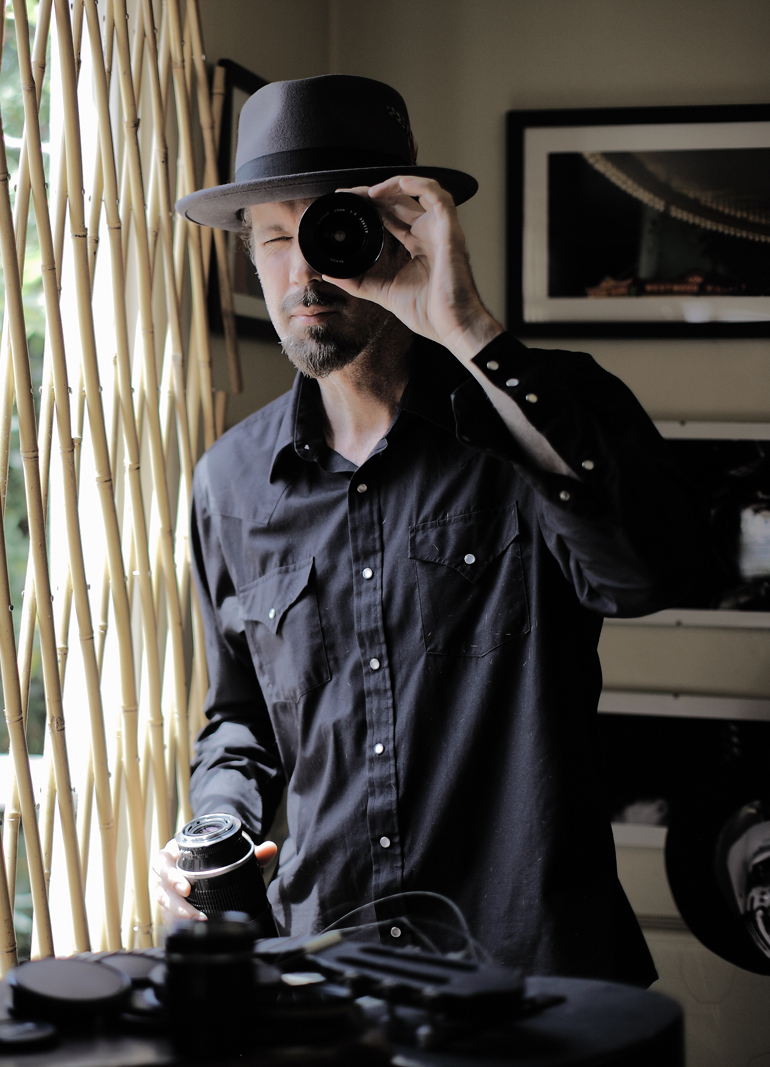
Isn't the purpose of film-making -- like every art form -- to help us figure out life? Sure, it's meant to entertain us, too, but isn't it wonderful when there's something more. These thoughts rolled around
TrustMovies' brain maybe halfway through the new "art" film by a fellow named
Jim Akin, who is the producer, director, writer, cinematographer, editor
and person in charge of sound editing and mixing of
AFTER THE TRIUMPH OF YOUR BIRTH. (According to the press material on the film, its creator, a Los Angeles native, made his movie "with a crew of zero, for a total of $550.00 -- running 3 cameras and capturing sound before doing all editing and post in his home studio." Whew.)
Mr. Akin, a photo of whom appears at right, has bitten off quite a chunk of responsibility as a first-time filmmaker, and while to my mind I can't say that he has been
entirely successful, I also must admit that his movie gets better, stronger and more interesting as it moves along. You need to get used to, and not dismiss out of hand, his rather artsy/poetic verbiage, which either gets better as it proceeds, or perhaps we simply get more accustomed to its language and style, and so can better appreciate it.
"I'm a simple man, and I expected more," our hero Eli (played by a musician new to acting,
Tom Dunne, above) tells us, in one of the movie's simpler sentences, in voice-over at the beginning. Eli's a sad, lonely man who sounds as if he might be contemplating suicide but instead decides to make a week-long walking trip from the desert to the seashore.
We also meet Eva (
Tessa Ferrer, above), another sad, lonely soul, grieving over a lost love. The first half hour of this 99-minute movie is full of exposition, mostly in monologue format (there's very little dialog) in which everyone speaks rather artily, often in metaphor ("Love is like an amputee's arm," we are told at one point), as the
days left of this trip are counted down visually -- five, four, three -- as the journey continues.
Throughout the movie and never disappearing for long is a oddly-dressed and made-up fellow whom the credits call the Answer Man (played by
Rob Zabrecky, above, another musician-turned-actor), who, with his pair of look-alike ladies, indulges in musical numbers, with some rather good dancing and vamping, and more or less acts in the
Cabaret-like style of that famous Broadway and Hollywood
musical. Performance-wise, Mr. Zabrecky is the most professional thing in the movie, with a face -- snide, sexy and dirtily appealing -- that the camera loves. If I am not mistaken (unless he is using his own voice here), he's been dubbed with the speaking voice (but not the singing voice) of a woman, making his character even more bizarre.
There are also a young boy named Jack (sweet newcomer
Dean Ogle, above); his tired, single mom; and the boy's attentive music teacher. Music (often with song) is just about everywhere in the movie, and much of it works in a low-key, appealing way. (There is already a soundtrack CD featuring
Maria McKee, below, who is said to have been the front woman for
Lone Justice, a group with whom I am not familiar.) So what we have here is some music, a little sex to keeps thing percolating, and a lot of philosophical discussion (well, mostly monologues again) involving life, love, religion, faith and parenting.
The most intriguing of these takes place among three desperate characters -- a lemur, a ferret and (I believe) a chipmunk -- which may be a kind of "first" for art films. Another good one involves two women friends discussing love, one of whom who has quite an interesting approach to selfishness and using. ("Doesn't every act of philanthropy have a payoff?") Yet another precedes sex and occurs as Eli meets an unusual handicapped woman (above) on his journey.
I noted earlier than the movie grows on you as it goes along. Verbiage that initially sounded a tad too "arty" begins to take on more meaning and assurance. "All I ever wanted is to understand. But I'm just left wondering," Eli tell us. And when the hooker he meets and beds explains to him, post-sex, "This is just a pawn shop for my pussy. I'll get it back", you want to applaud her -- and her writer/director.
Eventually, you'll understand, too, just who this Cabaret guy is -- and what he symbolizes. By the time little Jack, his mom and music teacher, Eli and his maybe "girl" come together, it's all rather endearing and lovely. I found myself more moved at the finale that I expected to be -- especially by the dedication that appears at the movie's end.
As entertainment, because of how long it takes the film to get going and come together, I would rate it between five and six on a ten-point scale. For depth, however, its reach rates a full 10, even if its grasp is only six-seven. Still, for a first-time filmmaker, I'd call this pretty damn good.
After the Triumph of Your Birth, a nicely ironic title that I believe is taken from some literary source (but, sorry, I can't place it), is being released by
Shootist Films and distributed by
FilmBaby, and will have its world premiere this Thursday, September 13, at 7:30 p.m., at the
Aero Theater in Santa Monica, California, as part of the
American Cinematheque’s ongoing film series.
The film will then be available worldwide for download on Friday, September 14th via the online distribution company,
Distrify, streaming on demand from
Shootistfilms and at the Maria McKee
website. The DVD, released by Shootist Films and distributed through
CD Baby, will become available on Tuesday, September 18th via the Shootist Films and Maria McKee websites.
The film’s soundtrack is available on Tuesday, August 7, 2012 via
iTunes, CD Baby and its affiliate distributors.
The photos above are either taken from the film's
website or cribbed from its trailer.