TrustMovies has not yet seen Sergei Loznitsa's much-heralded My Joy, the 2010 feature that seemed to put this relatively young Russian director on the international movie map. I see that it is available via Netflix streaming, so maybe one of these days, I'll grit my teeth, gird up my loins and try it. Meanwhile, we've got Loznitsa's newest opening up today, which I have seen and lived to tell about. IN THE FOG is a very long and very bleak tale of wartime Russia in 1942 on the western frontier, where partisan activity against the Germans, who have overrun and conquered the area, is high, and any incursion is greeted with nasty retaliation from the Nazis.
The film begins, in fact, with a trio of... well, they're not even really partisans in the strict sense. As we later learn, they're just railway workers mad at their unpleasant boss ("He was a son-of-a-bitch when he served the Soviets, too." one of them declares). The three are marched along through the Russian citizenry, as examples and warnings, and then hung. (This hanging is not seen but it is heard.) Filmmaker Loznitsa (shown at right), who directed and adapted the screenplay from the novel by Vasili Bykov, tosses us into the midst of it all and then allows us to find our way via some fractured storytelling that -- once we figure out where and with whom we are and at what point in the story this particular event is happening -- finally fills in the blanks.
The meat of the movie involves Sushenya (Vladimir Svirskiy, above, center) the fourth member of that railway team who tried his best to get the guys not to pull their dirty trick on the Germans. When they went ahead, they were all arrested but instead of being hung, Sushenya was let go. "Collaborator!" is what the entire town, including maybe his own wife (played by Yulia Peresild, below), now believes. The truth, when we learn it, is otherwise.
Meanwhile, head partisan Burov (Vladislav Abashin, below, left) and his underling, Voitik (Sergei Kolesov, below, right) show up at Sushenya's home to kill him for his "betrayal." But first they take him away, so that his wife and child will not witness the event. And this is pretty much where the real story begins. As it meanders onward (and although the pacing here is extremely slow, it possesses, I think, its own justification and integrity), via flashback, exposition/explanation and occasional action, we learn not just what has happened but how these events have rather forced the three men to think and act the way that they do.
Still, certain of our characters (Sushenya) seem one hell of a lot more decent than others (Voitik). And the movie makes us consider, as it drifts by, the meaning of morality in wartime and if, in fact, those two words/things don't cancel each other out. Other questions pop up, too: Can people change? Is our hero morally incorruptible -- or simply slow? And just how sleazy is this guy, Voitik? Oh, lordy: You'll find out.
If we used to imagine that the phrase "war is hell" referred mostly to combat, this movie will cure us of that idea. There is no combat here; still, everything about this situation proves godawful -- and only gets worse. I would guess that Loznitsa's view of humanity is pretty bleak. Even so, his view, as seen here also proves pretty predictable, too. (From about the mid-point onwards, I began to guess correctly every event prior to its happening.)
The slow pacing also gives us plenty of time to question certain things. This movie contains enough coincidences to choke a rom-com, albeit these coincidence are always bleak, rather than feel-good. Eventually, you may come to the conclusion that you've been playing with a stacked deck. (On the other hand, doesn't war always offer a stacked deck?)
At over two hours running time, In the Fog's one long, long journey. And its ending, which takes us literally into that title place, borders on the comical, so drearily and absolutely negative is it. You sit there, thinking, "Wait for it. OK, wait for it. Now, wait some more. And here it comes.... Ah, yes: right again." From Strand Releasing and running 137 minutes, the movie opens today, Friday, June 14, in New York City at the Village East Cinema and in Los Angeles on July 12 at the Sundance Sunset Cinema.
Showing posts with label WWII movies. Show all posts
Friday, June 14, 2013
Tuesday, April 17, 2012
MY WAY: Kang Je-kyu's remarkable canvas of pre-/during/post-World War II -- plus a short Q&A with this impressive filmmaker
Looking for a big, bold, movie-movie that you can sink your teeth 'n heart 'n mind into, one at which you can laugh and cry and care about -- and not feel gypped by the next morning? Then stick the South Korean blockbuster MY WAY on your must-see list. This one-of-a-kind historical melodrama, said to be based on true events, begins in post-World War II London, as an Asian runner wins the marathon, then flashes back to the 1930s when its two protagonists -- one Korean, the other Japanese -- were kids and sprinting competitors (below) and Korea was under the thumb of Japan.
The film, directed and co-written (with Kim Byung-in) by one one Korea's major film-makers Kang Je-kyu, shown below, follows these two boys into manhood, taking them through so many surprising & dramatic events that, were it not for the filmmaker's ability to make each event (and the people involved) real and vital, we might grow tired, bored or incred-ulous. We never do. So skillful and forward-thrusting is the arc that Kang follows, instead, we hang on for dear life.
From the kids who race in the neighbor-hood to the young men who compete for the chance to repre-sent their respective countries in the Olympics, Japan's nasty hold over Korea is reflected in both the events of the film, as Japan holds sway over Korea through-out the first half, at least, and in the character of Tatsuo (played as an adult by an intense and blin-kered Jô Odagiri). Korea is left to the noble rendering of Jang Dong-gun (below, center), as good-guy Jun-shik.
Mr. Kang captures not just the confusion of wartime and of the battleground, but also the craziness and horror of battle, not to mention to haphazardness of it all. Viewers, just as do the participants, will hardly know where to turn for relief. But the filmmaker is every bit as good in the quiet personal moments that dot the film -- most of all those that involve a Chinese POW, played with deep ferocity by Chinese actress Fan Bingbing (below).
The movie is full of action, yet all of it is to the point (no car chases/crashes here). Explosions, fire, and death by all sorts of means is ever-present and yet the movie never takes on any sense of exploitation because the human element -- as well as the director's feeling for humanity in whatever uniform -- is so insistent. Along the way our Korean hero fights for Japan and then for Russia, and probably the most wonderful of all the movie's many successes is that we root for him, and finally for the Japanese solider, too, despite all we know from our own history. This is quite an accomplishment.
The old question, Which side are you on? crops up anew with My Way, and the answer, of course, is the side that we know best, the people we care for, whoever they are. I call the film a melodrama, and it is, but it is a very good example of the genre. Most war films are melodramas, including Saving Private Ryan, but not The Thin Red Line.
Fortunately the movie is also full of ironies, most of which are not hammered home too strongly. The biggest of these is what happens, finally, to our two boys/men. When you think about, post-viewing, just who it is running in that London marathon, and what he represents, it's rather staggering.
My Way, 137 minutes, from CJ Entertainment, opens this Friday, April 20, in New York City at the AMC Empire 25, and at City Cinemas' Beekman and Village East Cinema -- as well as in New Jersey at the AMC Loews Ridgefield Park 12.
Mr. Kang captures not just the confusion of wartime and of the battleground, but also the craziness and horror of battle, not to mention to haphazardness of it all. Viewers, just as do the participants, will hardly know where to turn for relief. But the filmmaker is every bit as good in the quiet personal moments that dot the film -- most of all those that involve a Chinese POW, played with deep ferocity by Chinese actress Fan Bingbing (below).
The movie is full of action, yet all of it is to the point (no car chases/crashes here). Explosions, fire, and death by all sorts of means is ever-present and yet the movie never takes on any sense of exploitation because the human element -- as well as the director's feeling for humanity in whatever uniform -- is so insistent. Along the way our Korean hero fights for Japan and then for Russia, and probably the most wonderful of all the movie's many successes is that we root for him, and finally for the Japanese solider, too, despite all we know from our own history. This is quite an accomplishment.
The old question, Which side are you on? crops up anew with My Way, and the answer, of course, is the side that we know best, the people we care for, whoever they are. I call the film a melodrama, and it is, but it is a very good example of the genre. Most war films are melodramas, including Saving Private Ryan, but not The Thin Red Line.
Fortunately the movie is also full of ironies, most of which are not hammered home too strongly. The biggest of these is what happens, finally, to our two boys/men. When you think about, post-viewing, just who it is running in that London marathon, and what he represents, it's rather staggering.
My Way, 137 minutes, from CJ Entertainment, opens this Friday, April 20, in New York City at the AMC Empire 25, and at City Cinemas' Beekman and Village East Cinema -- as well as in New Jersey at the AMC Loews Ridgefield Park 12.
**************
Meeting with the director/co-writer of My Way -- shown again, below -- was a real treat. A quiet, seemingly self-effacing fellow, Kang Je-kyu proved a most interesting interview, aided well by a smart and energetic translator, an attractive young Korean-American woman named Angela Killoren, who works for CJ Entertainment and proved a delightful help. In the following exchange, TrustMovies' questions/comments appear in boldface, while Kang's and his translator's appear in standard or italic type.
Right! Right! (says the translator, who then chuckles).
And then to see MY WAY, which goes back ever farther to another war, WWII, and to see it also from a completely different angle. How wonderful! As we get older -- I would like to think so, anyway -- we can begin to identify with groups and peoples that we wouldn’t have identified with when we were younger. Does that make sense to you? Both your movies very strongly made that happen for me. And I think that’s wonderful. I want to talk more about Tae Guk Gi, but let’s concentrate on My Way for now. What really impressed me was the scope of the film. Much larger, say, than Saving Private Ryan. Just huge. The other odd thing, specifically, was that it made wartime seem so confusing. It captures the confusion of combat as well as any movie I’ve seen.
Is there a question in there?
Sorry: Let’s see if I can phrase things like a question. (I think for a moment) Well, my big question -- and because I am over 70 and you might be 15 or 20 years younger, this may be unfair – but going back to Tae Guk Gi: What would have happened if Korea had not been separated. It seems like such a waste, such a stupid -- sorry, I’m not even Korean so I have no right to judge. But it still seems like a stupid waste to me. And what has come out of it, even worse.
The translator asks: You mean perhaps an alternate reality?
Maybe. But what might have happened had Korea stayed united. (So she translates my words for the director)
Overall, Korea as a country, has a very long history and identity. We consider our country’s history to be 4,000 or 5,000 years long. So over that extremely long period of time, I consider the 36 years spent under Japanese colonialization, and the following 60 years during which the country has been separated, as possibly the greatest tragedy in Korea’s 4- to 5,000 year history.
You can talk about the great economic success story of South Korea. But when you contrast this with the extreme hardship and the dictatorship in North Korea, it is actually even more of a tragedy: that the same people are divided and have such different destinies.
We might also talk about a dictatorship in South Korea, too. Back awhile, maybe. As I grow older I am beginning to understand that dictatorships come in lots of different guises.
(The translator laughs again) Right, right! (She continues) Well, the South Korean government has made a lot of… has changed a lot over the years into something more Democratic. In fact we’re having a big election, the National Assembly Election, today!
Really?! Did Mr. Kang get an absentee ballot?
(She asks him, and they chat together for a moment. And then they laugh.) He was not able to vote because South Korea does not have an absentee ballot. But he will be there for the Presidential election.
Well, good! You said that Korea had only been separated for some 60 years. But most people alive in the world today have only been alive for 60 years, if that. So this division is the only way they know Korea – as North and South. That’s all they know about it and that’s all they think about it. This is one reason why I believe movies are so important. They can open up whole worlds to people that they didn’t know about. (Sure, they could go to a history book, but most people tend not to do this.) So movies can reach them. And show them that it was not always like this. But let me ask another question: It says somewhere in your biography that before you made Shiri, you almost gave up on moviemaking entirely. Why?
Actually this is related to what you were saying about dictatorships. Before I started directing and shot the movie Shiri, I had been only a screen-writer. From the mid to the late 1980 -- which was the period of the military dictatorship in Korea -- every single script I submitted was rejected by the government censors. So I thought, why am I doing this, and why would I want to be doing this in a country like this?! I felt this way because of the censorship only, not because I fell out of love with film-making. Eventually, however, society changed.
And things loosened up a bit?
In fact, the society, the social issues, the political environment, all of this of that time is very much like what China is going through right now. My friends who are Chinese filmmakers, I can relate to them, because they are in this very same fight: trying to get things made, while the government is still holding control.
Was the censorship coming at you for political reasons, for sexual reason, or what? What were you putting into the films that they didn’t like?
Obviously there was censorship around the violence and the sexuality and all that. But on a larger scale, the major thing was: Any film that inflamed a sense of identity, or the consciousness about class, about the haves vs. the have-nots, anything that seemed to be stirring up the established social order would be censored.
Woo! It’s good that The Housemaid waited a few years before the remake.
Anything like that would be censored because it might make the people feel something like rebellion in their hearts.
Just like over here, when anything like that is brought up, the Republicans all scream – (The translator chimes in with me) Class warfare! You can't say that!
Your movie really reminded me in some ways of Peter Weir’s film…. Damn -- now I can't remember its title, but it's about the men who escape from a Russain prison camp and walk all the way home...
Yes, I saw that movie. But I cannot remember its name, either.
That probably means that it should have had a better title…
(The translator looks it upon the IMDB: The Way Back, she tells us.)
Yes! Thank you. Your scenes in the Russian prison camp in My Way called Weir’s film to mind. (He nods, yes.) Your film Shiri came out around the same time as JSA, right?
No, before.
Oh -- well, when I saw JSA and then Tae Guk Gi, I began to grow very interested in Korean history. So maybe I should see Shiri.
It’s available on Netflix (the translator tells me).
I might watch Tae Guk Gi again, too.
That’s also available on Netflix (translator again).
Right! That’s how I first saw it. One more question (the PR person has alerted us that time is running out): Do you think the two Koreas will unite again, in our lifetime?
I do believe that they will be reunited. You know how good friends -- who have had a falling-out or have grown apart -- can reunite, once they overcome that. It’s been long enough. We’re the same people still, so I believe reunification will come about.
Thank you so much Director Kang, for this movie and for your other movies – and for your time today.
All photos are from the film itself --
except those of its director Kang Je-kyu.
Monday, January 17, 2011
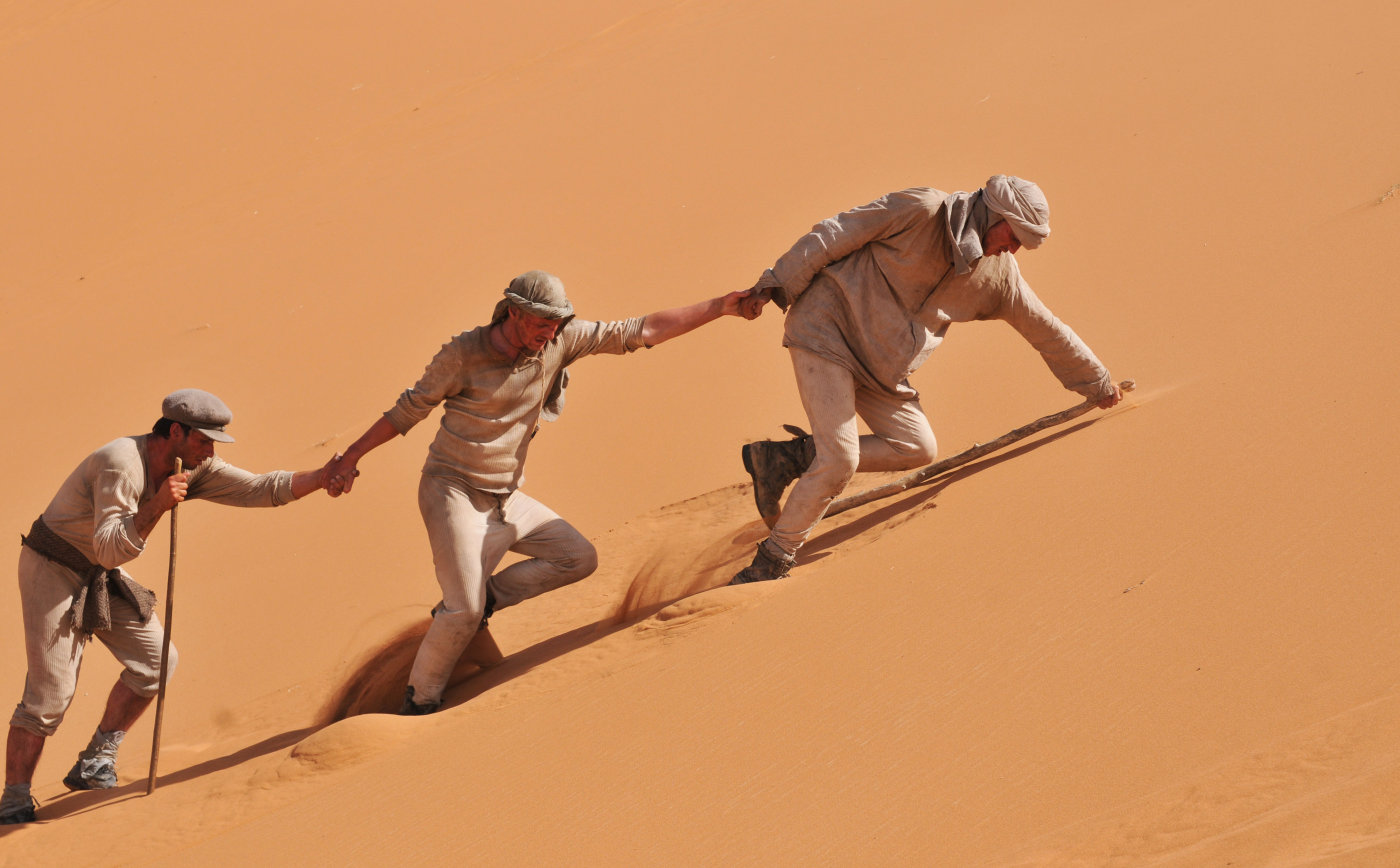
THE WAY BACK opens: Peter Weir's best in a long while is awards-caliber film-making
You couldn't ask for a simpler premise. A small group of men plan and execute an escape from a Russian gulag in Siberia during World War II. Because they cannot safely end up in either Hitler's German-occupied nor Stalin's soon-to-be USSR-occupied territories, they must walk until they reach a place under the control of Allied forces. This means from Siberia to India. Along the way, a very young woman joins them. That's it. Yet in Peter Weir's lengthy (it's two-and-one-quarter hours) new film, THE WAY BACK, there's not a moment that's slow or boring. That in itself is a major accomplishment, yet Weir, shown below, goes much farther.
To begin with, this is indeed a great story: surprising, exciting, moving, even profound. Mr. Weir gives it its due via a wondrous accretion of on-the-mark detail, terrific performances from his first-rate cast, and some of the most stunning location photography seen in years (using locations chosen, I would guess, for their oddness, as well as for their sometimes great beauty and immense contrasts: snowy forests with deserts, caves with river landscapes). This notable Australian director (and here co-writer with Keith R. Clarke, from a novel based on real events by Slavomir Rawicz) -- after giving us films of varied importance and success (Picnic at Hanging Rock and The Last Wave on his home turf, through Witness and Dead Poet's Society, to The Truman Show and Master and Commander) -- has created an old-fashioned movie done spectacularly well that is up there with -- and maybe is -- the best film of the year. (It opened at the end of 2010 in Los Angeles for award consideration.)
Weir understands the importance of pacing, too. In a film that is basically an early-on escape followed by one long jaunt, he sees to it that we're kept alert by events, small and large, and by his wonderful eye for detail. The opening scene in an interrogator's office quickly sets up the entire movie, and the following scenes in the gulag (one of which is shown above) are full of precise detail done so subtly and quickly that it all becomes a mass of complete reality. Once we're on the trek, the detailing is handled just as well A word should be said for the make-up, too (the IMDB lists ten people as part of this crew), which may be the best I've ever seen: the dirt, cuts, bruises, swellings and face and body distortions brought on by the elements, hunger and constant walking add immeasurably to the truth of each moment.
The cast of basically eight principals (plus Mark Strong in yet another fine supporting role) could not be better. Jim Sturgess, below, center, and above, second from left) earns one more feather in his cap, proving himself capable of a very good eastern-European accent throughout, as the default leader of the little group. And as usual, Sturgess offers that unique quality of his -- kindness and strength coupled to hesitation -- that draws you to him, even in a role as odd as that of Heartless, his most recent film. Ed Harris, left), as the oldest member of the group, brings his usual authority and strength, along with his sublime taciturnity.
Colin Farrell (above, right) begins as a creep, through whom a bit of humanity -- we see this as the film progresses -- still flows. Weir has long been one of our most humane filmmakers. Given the opportunity, he'll help us understand how situations and events create -- or close off -- the opportunity for a humane response. Saoirse Ronan (Atonement, The Lovely Bones) has the most difficult role -- a girl/woman in the midst of all this? Please! -- and she makes the most of it, while also making it completely believable: no small feat.
As to those locations (seen above and below), they add immeasurably to the film's richness and to our enjoyment. As our group trudges onward, with some attrition along the way, one and then another departs. The sense of loss we feel strikes surprisingly deep, so indelible have these characters become.
The supporting cast includes Dragos Bucur (Police, Adjective), Alexandru Potocean (4 Months, 3 Weeks and 2 Days), Sebastian Urzendowsky (A Woman in Berlin) and Gustaf Skarsgård (yes, Stellan's son, most recently seen here in Patrik, Age 1.5). All give equally fine performances -- a testament to their skill, along with the abilities of Weir and his casting director, Lina Todd.
The Way Back, which should elect a few happy sighs of "I didn't think they made 'em like that anymore!", begins its nationwide opening this Friday, January 21 and will expand further in the weeks to come. Click here to find a city and theater near you.
Subscribe to:
Posts (Atom)