Showing posts with label Wim Wenders. Show all posts

Friday, June 10, 2016

Blu-ray/DVDebut: Wim Wenders' angst- and surprise-laden EVERY THING WILL BE FINE


I can't remember the last time I found a movie so trying to sit through for its first half, and then slowly became so involved in the second half that, by the finale, it had me in tears. Such a film, for better or worse, is EVERY THING WILL BE FINE, the new one from the popular German arthouse director, Wim Wenders. What Wenders does here is about as risky as it gets these days, in terms of audience approval. He delays and delays and delays our gratification and involvement with his main character to the point -- if you look at the critical reviews and audience response to the film -- of near obliteration. Even TrustMovies must admit that, had he not received a complementary disc (along with an obligation to cover this film), he might have stopped watching midway and moved on to something else. He is very glad he didn't do this.

Actors are often attracted to roles that occasion angst, guilt, and depressive behavior (and why not, as these so often win awards). Part of the problem very soon into the film is that James Franco (below) is not an actor who fares well with this sort of role. He can seem all-too-shallow for one thing, and he needs real specifics from which to build a character. Initially, at least, Wenders (shown at right) and his screenwriter, Bjørn Olaf Johannessen, don't provide these. Franco plays Tomas, a novelist who is evidently somewhat blocked and whose main characteristic seems to be that, despite the sub-zero temperatures, he forgets to close doors to the outside.

Fifteen minutes into the film, after a sudden shock of an incident, we are handed an ever greater shock, and the movie, for a time, clicks in. This is due partially to the actress Charlotte Gainsbourg (below), who does "depressed" with the best of them.

Tomas, in fact, treats her character better than he treats his longtime girlfriend -- another somewhat wasted role for the often excellent Rachel McAdams (below, left) -- and later in the film will treat his next girlfriend, played by Marie-Josée Croze (at left, two photos down), with equal unconcern bordering on disdain.

But Wenders has something more on his mind. During his film a number of years pass -- nearly a decade or more, I believe -- and in that time, things and people begin to change to the point where we finally become much more involved with them and their issues. Time is said to be the great healer, but it can act as something more. It bridges huge gaps, and when telescoped as interestingly as it is here, it shows us things and makes us understand them in ways we might not have otherwise done.

The Gainsbourg character has a son whom we meet early on (below) then later see as he grows up (as a teenager, he is quite beautifully played by young actor Robert Naylor). Tomas' odd bond with both the Gainsbourg character and her son is key to the movie, and as this bond grows and changes, the film takes on enormous resonance, with its ultimate scene a pure and emotional amazement.

Every Thing Will Be Fine is also quite a beautiful film to view. I believe it was originally shot in 3D, and even on the rather spectacular Blu-ray transfer the film has been given, there are a number of moments in which you can almost see that 3D come to life. (This is one of the better Blu-ray transfers I've yet viewed.)

All of which is by way of saying, stick with Wenders' movie and you may be very surprised how moved and connected you will eventually feel. Even Franco -- about whose work I run hot and cold -- finally acquits himself surprisingly well. And McAdams gets one scene toward the end in which she absolutely shines.

From IFC Films and running 119 minutes, the movie hit the street on Blu-ray and DVD this past Tuesday, June 7 -- for purchase or rental. On the Blu-ray extras, there are interviews with Wenders and most of his cast (Franco is the exception). These are quite interesting and offer additional worth to the overall experience.

Wednesday, December 21, 2011

Wim Wenders' PINA proves (1) a must for dance lovers and (2) that 3D is here to stay

If you love dance -- particularly modern dance, and even more so the work of the dancer/
choreographer Pina Bausch -- I don't see how you can miss Wim Wendersnew film PINA. If you know her work, I suspect you won't mind seeing it fragmented (in the way that Wenders necessarily must in order to make a film like this) because you'll get the bonus of experiencing her troupe, their thoughts and the extreme love they clearly feel for their late leader. If, like me, you are not that familiar with Bausch's oeuvre (that's she in red, below) and have only seen it in snippets (in films such as Talk to Her), this movie will be an eye/mind/heart-opening experience.

As a very young man TrustMovies came to New York City to go to drama school. There, part of the curriculum was dance training under the tutelage of the Martha Graham dancers (Ms Graham herself made an appearance or two at the school during those years). While TM was not much of a dancer, he did love seeing those people do their thing. And that training -- those moves! -- has evidently stuck with him, for seeing Pina and its many excellent dancers brought his long buried love of modern dance to the fore once again.

What Herr Wenders, pictured at right, has accomplished with this film is at least twofold. In addtiion to allowing us to see, in parts, the work of this marvelous choreographer and her troupe, the director has given us a 3D movie in which the depth is so integral to the whole that after viewing this film, you really can't imagine not having that extra depth as part of your experience. (Do try to see this one in the 3D, rather than in the 2D format.) Space -- whether occupied or empty and by whom and how -- is a vital part of dance. The three dimension process allows you to experience space in a way that no other dance film before has managed. Very soon, as you watch this movie, any sense of trick effect falls away and you simply become part of the space itself, and more fully than you could, even at a live dance concert, because the camera, after all, can and does go places that the audience would never be allowed.

The Bausch troupe, too -- full of talent and beauty -- is something to behold. The various dances, the moves, the individual members of such varying age and type bring each dance to life in memorable ways.

The film is by turns emotional and primal (the opening dance, shown in the photo below the poster at top), aggressive, funny (below), thoughtful, surprising, and always beautiful, due to the movement, faces and bodies on display.

The use of the natural elements, particularly earth and water, are dynamic, too, and Wenders' decision to offer site-specific performances, wonderfully varied and on-target, makes the movie all the more visually interesting. (Some of his dissolves are wonders in their own right.)

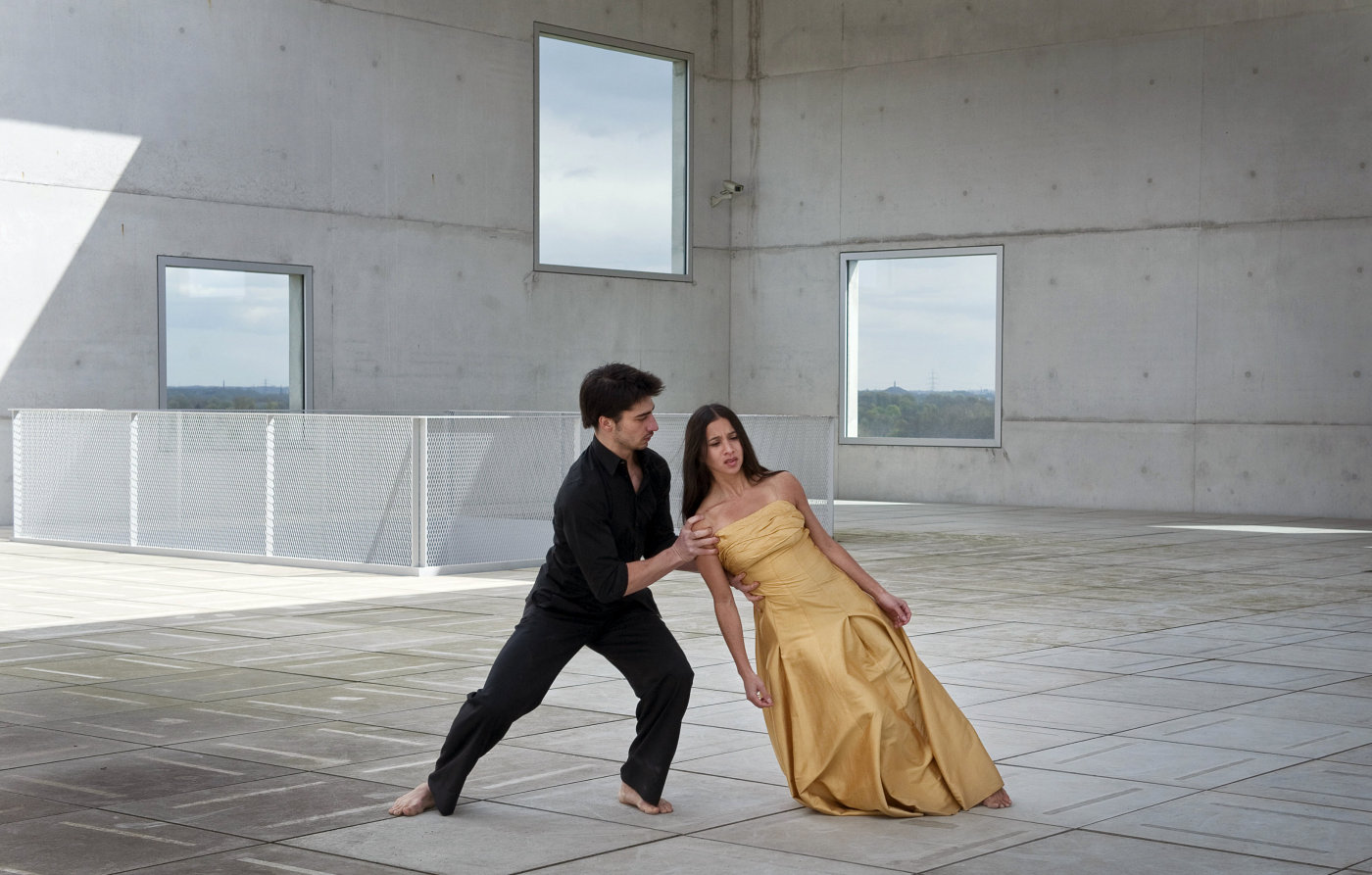
What are these dances saying? Each viewer is likely to take away his/her own message, but certain of the scenes may make make you a tad uncomfortable.  One of these, in which a group of men literally paw at one fragile woman, is utterly squirm-inducing.

The beauty of the film lies in how it shows us what dance can finally be: giving us ourselves and the world in ways we've never seen. That's what all good art does, and Pina Bausch's dance would appear to be among the best of it.

Pina (from Sundance Selects, 103 minutes) -- which is Germany's submission for this year's Best Foreign Language Film (even though most of its "language" is dance, it is certainly one of the best films of the year) opens Friday, December 23, in New York City at the IFC Center, the Elinor Bunin Munroe Film Center and in Brooklyn at the BAM Rose Cinema. A nationwide, limited roll-out is planned, beginning in January.