Showing posts with label award-winning films. Show all posts

Sunday, June 2, 2019

With GUY, French actor/writer/director Alex Lutz has created a marvel of a mockumentary


Before viewing GUY (or Guy Jamet, the full name of the character shown on the poster above), TrustMovies had never heard of Alex Lutz, an award-winning French actor, comedian, writer and director. Post-viewing, however, he will remember this man and his one-of-a-kind work for, well, in perpetuity, he hopes.

Guy Jamet, I must tell you right off the bat, does not exist. Nor does the music he sings, the people he interacts with, nor really anything we see and learn about this aging pop idol. Yet Guy and the entire world around him has been imagined and researched so beautifully and then brought to life so remarkably well in this supposed-to-be-a-documentary movie about him that, even though you know -- from the press materials and too-much-information coverage of the film -- that what you're seeing is "fake," so real, so complete does it seem that you're likely to be amused, delighted and greatly moved by it nonetheless. (That's Mr. Lutz, above, shown pretty much as he is now, and on the poster, top, and below, playing the role of the 72-year-old aging pop star. The performer, by the way, won this year's coveted César Award for Best Actor in this role.)

So, yes, Guy is what is most often called a mockumentary. Yet mockumentaries are supposed to mock. But this one, while almost always witty and sometimes satiric, is so rich, warm, and human, full of emotion and sadness at the passing of time, missing of opportunities and the knowledge of our own inability to head off our worst impulses that it leaves you with more of a sense of reality and worth than do many of the actual documentaries and narrative bio-pics I've seen over the years.

Further, I haven't even gotten into the amazing skills with which, Mr. Lutz manages to create and inhabit the elder self (he also plays the younger version, though it is mostly that 72-year-old with whom we're spending our time). Everything -- from his movements to the superlative aging make-up and/or prosthetics applied -- seems nothing short of perfection. Mr. Lutz is quite something.

And when, along the way, we see, intercut with each other, the younger and older versions of Guy and one of his "loves," (above, with Élodie Bouchez, and below, with French icon Dani), the effect is mesmerising and moving in equal measure. Here, an entire cultural history opens up before us, and while the events and characters, the times and the songs may seem initially rather ordinary, something happens as they wash over you. Eventually it all gather the importance and feel of real life.

About the music: While it seemed to me captured to near perfection, "Isn't this sort of mediocre?" my spouse asked, mid-way along. And, yes, the songs here are absolutely of their time and place. Yet by the point at which the end credits rolled, "Boy, this song has really grown on me," spouse noted. I felt quite the same.

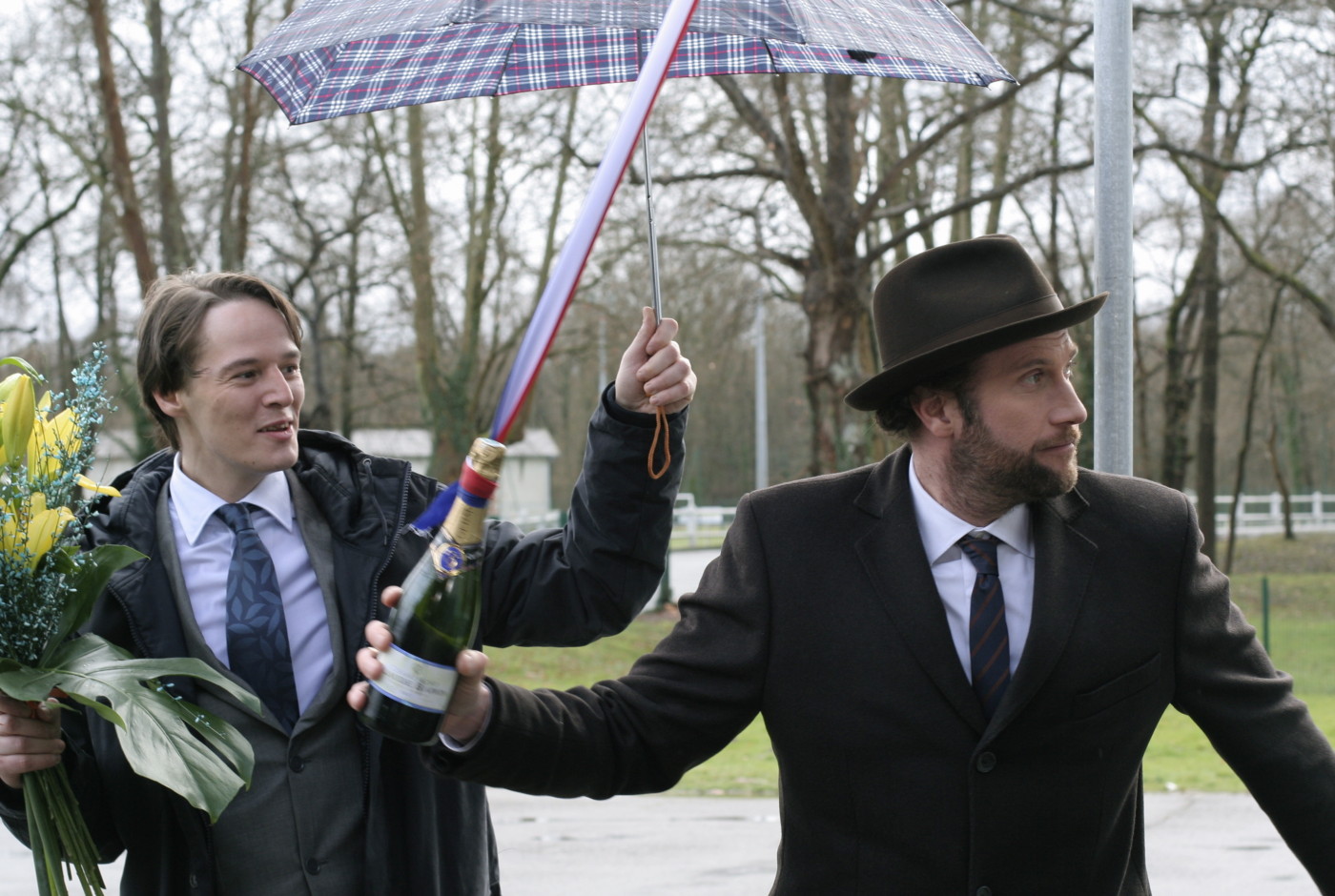
The movie is organized around the idea of a young filmmaker named Gauthier -- Tom Dingler, above -- getting Guy to agree to making this film about him by, among other things, telling him what a huge fan of his was Gauthier's mom. In reality, his late mother has informed Gauthier via letter than Guy is actually the young man's birth father. So the film is fraught with unspoken father/son issues throughout, some of them funny, others more telling. Probably the most emotional-yet-reticent scene of all involves Guy's lunch with the son he knows of and has recognized, shot by Gauthier at a discrete distance so that neither we nor he can hear what is being said by the father and his recognized son, even as the unrecognized one films it all.

While I am certain that many of the movie's more subtle and satiric barbs were lost on this American viewer, what remains was still so special, unconventional, surprising and alternately amusing and moving that Guy takes it place for me as one of this year's best films. It's an original -- and then some. (Above, right, is Nicole Calfan, very good as our hero's publicist; below, right, is Pascale Arbillot, playing his current squeeze.)

Without a theatrical release, all the more thanks is due Icarus Home Video and Distrib Films USA for making this gem available to us. Guy hits the street on DVD (digital will eventually arrive) this Tuesday, June 4 -- for purchase and (I hope) rental. Do find a way to see this one.

Thursday, June 12, 2014

Jan Ole Gerster's A COFFEE IN BERLIN proves a small, unassuming (& award-winning) knock-out


What a pleasure to discover a small, black-and-white movie that pays such high dividends on the 83 minutes you'll spend viewing it. A COFFEE IN BERLIN (originally known as Oh Boy in its native Germany) is getting a very limited release over here (for which we owe Music Box Films a debt of gratitude) and will probably not make many waves on this side of the Atlantic, even though it has already won 24 awards at festivals, in its home country, and via the European Film Awards -- from which its writer/director Jan Ole Gerster (shown below) took home the European Discovery of the Year prize).

Everything about the film is small scale (yet near perfect), from its terrific lead performance from Tom Schilling (shown below, left, of the recent Generation War), to the low-key "events" that occur along the way, to the sumptuous, absolutely scrumptious black-and-white photography that is, for my money, better even than that of the over-rated Ida, whose cinematography so screams "composed and artful" that you finally want to muddy it up a bit just to breath some life into things. The cinematography in "Coffee" (by Phillipp Kirsamer) perfectly fits around and into the world it encompasses. And then, there's the theme.

On one level A Coffee in Berlin deals with its "hero," the young man Niko Fischer, a Euro-style slacker who, according to the words of his dad (Ulrich Noethen, above, right, and recently of Hannah Arendt) has never finished anything he has started. Yet Niko is clearly a decent sort of guy who's just looking for his place in our modern world. At the same time, this movie is also dealing as much with the modern European/Western world, seen through the lens of Germany today, in which everything from wealth and class divisions to art and commerce, fear of immigration, Nazi history, and the sexuality of the "other" still prove divisive and frightening.

None of the above is baldly stated, but as you watch Niko move from incident to event to quiet thought, you cannot help but think of your own place in whatever country it is that you occupy. Herr Gerster clearly has an aware mind coupled to interests that are wide-ranging.

His little movie asks many more questions than it answers, but it asks these artfully and in a lively, non-hectoring manner. And the many subsidiary characters who help bring the film to life are quite marvelous -- beginning with the neighbor of Niko (above) who brings him a housewarming gift of his wife's meatballs to a former schoolmate of Niko's who was -- and clearly always will be, on some level -- fat but now is an attractive stage actress of sorts.

This young woman, played will great strength masking even greater fear by the talented Friederike Kempter (above) proves one of the highlights of a film that is virtually full of them. As our hero spends a day and night moving around Berlin from place to place, person to person, we see a society in which few seem to fit the way they might like and only the wealthy feel secure.

Take Niko's friend Matze -- another smart, sharp performance from Marc Hosemann (above, right, of Soul Kitchen) -- of whom we learn some surprising stuff. Or the old man in the cafe (below) who helps close out Niko's night with a brief history of his childhood under the Führer.

Our hero has spent most of the movie trying simply to get a cup of coffee, which proves more difficult than you'd think. By the finale, he is at last satisfied, on that score at least, even if his place in all this is still question-able. We're satisfied, too. You'll come away from this film thinking about it -- and your own place in things -- long after its quiet credits have rolled.

A Coffee in Berlin opens this Friday, June 13, in New York City at the Landmark Sunshine Cinema, and will hit another 18 cities in  the weeks to come. You can view all currently scheduled playdates, with cities and theaters, by clicking here, then clicking on the word THEATERS, which you'll find midway down the page.

Monday, October 8, 2012

Ohlin, Blok and Fredriksson's Swedish award-winner, SIMON & THE OAKS, opens

An ultra-classy melodrama with such a riveting story line that you'll likely be hooked from scene one, SIMON AND THE OAKS is as impressive an adaptation of novel to film as I have seen in some time, beating out even the recent and quite good Eye of the Storm. It is not surprising that the film garnered 13 Guldbagge Award nominations (the Swedish "Oscars"), of which it won two -- for best supporting actor and actress.

As directed and co-adapted -- with Marnie Blok and Linda Aronson, from the international best-seller by the late Marianne Fredricksson -- by Lisa Ohlin (shown at left), the film is a visual feast from its opening through its finale. Taking place in the Swedish countryside and along its gorgeous coastline, the movie posits a pantheistic connection between its hero, Simon, and the natural world that exists all around him, particularly those oaks which he frequents (he has a tree-house in one of them), speaks to and which seem to be speaking to him in return.

Fortunately (for my taste, at least) this pantheistic strain does not command the movie. Instead, what fuels it is a simple and compelling plot that involves Simon and his family and another boy named Isak and his family, taking them from the beginning of World War II -- during which Sweden maintained its long-held neutral political stance, while most of Scandinavia fell under the control of Nazi Germany -- through the first post-war decade. (Sweden did not exactly escape Nazi domination, I suspect, but was much more loosely controlled than were Denmark and Norway. Finland, meanwhile, was fighting wars with both Germany and Russia.)

This plot is fueled by the dual themes of parenting and parentage, nature and nurture; by music and art; and by Anti-Semitism and the Holocaust. Because the film is set in Scandinavia, an interesting "distance" from those horrible events is maintained. Scandinavian Jews were indeed rounded up and sent to concentration camps, and we see the devastating results via the character of one young woman, Iza, from Isak's extended family, even as Simon and his family are kept from harm -- often by the very ministrations and help of Isak's father (Jan Josef Liefers, above), a wealthy Jew who somehow manages to keep life, limb and fortune all intact.

The movie moves from Simon's and Isak's boyhood (above) through their years as young men (below), and although a couple of decades are covered, the filmmaker maintains a measured pace, and so the film's near two-hour length allows it to create characters that -- while they may not be as strong and detail-filled as the novel's -- are plenty rich enough to thoroughly involve us and carry us along.

Performances are strong throughout, and while it was Mr. Liefers and Cecilia Nilsson (as Simon's "aunt") who walked away with the awards, it seems strange to me that Helen Sjöholm (below, right) and Stefan Gödicke (below, left) as Simon's "nurture" parents didn't win, as well. The whole cast deserves a lot of praise for bringing to life characters that make up a tale that I shall remember for a very long time.

I suspect that word-of-mouth is going to be quite strong on this movie. So if you appreciate terrific storytelling and don't mind reading English subtitles, consider yourself advised. Alert your like-minded friends -- and enjoy!

Simon and the Oaks, from The Film Arcade (a new distributor worth watching, I think), opens this Friday, October 12, in New York City exclusively at The Paris, and the Friday following in five more cities, with a dozen more to come in the next few weeks. Click here to see a listing of all currently scheduled playdates, with cities and theaters shown.

Saturday, July 17, 2010

Attn: San Franciscans, your annual Jewish Film Fest is nearly here. What a line-up!


One of the glories of the internet is that TrustMovies can sit here in Queens, NY, posting about an upcoming event -- the San Francisco Jewish Film Festival -- July 24 through August 9, in California, having received a bundle of screeners to watch and so get some sense of what this year's event looks, sounds and feels like. We're all connected, as they say, and even more so, since TM has already seen several of the films on the San Fran program via this past year's NY Jewish Film Fest and Rendez-vous with French Cinema, both sponsored by the Film Society of Lincoln Center.

Film Still Image
from the SFJFF's centerpiece film, Anita.

Some of you may already be asking why someone as anti-religious as I (click here for one of my jeremiads regarding religion that even my lifetime companion refused to continue reading, so angry did it make him) would want to cover yet another film fest that arrives freighted with the taint of "the deity."  (Would I cover a Christian Film festival?  A Muslim?  Not likely.  A pagan one, maybe.) Part of the reason, at least, has to do with the word Jewish, which for me, anyway, suggests cultural/historic significance than religious.

One of the splendid films on view at the SFJFF, in fact -- The Family Wolberg (photo, above) -- made its NYC debut as part of the FSLC's French Cinema series this year and will always seem to me much more French than Jewish. Another, the opening night attraction (as it was here in NY) Saviors in the Night, shown just below, details a Westphalian family's experience during WWII and so becomes, for my money (if not that of the nitwit Holocaust deniers) about history rather than religion. (You can find my earlier coverage of "Saviors" here.) When a film does deal specifically with religion, chances are it may very well offer a much more negative than positive view of same (as did the terrific Eyes Wide Open, which debuted at the NY Jewish fest and went on to garner a nationwide limited release).

The films at literally all the Jewish fests I've covered offer culture, history, competing viewpoints and much more, so that each fest become a kind of education in itself -- one I would rather partake in than miss. This year's SFJFF is no exception.  Movie after movie sounds intriguing.  The Army of Crime (below), another fine film shown at the FSLC French fest, details the stirrings of the French Resistance movement against the Nazi's during WWII, while A Room and a Half (shown at bottom), which opened in NYC a few months ago, provides a fantastical, dreamlike pseudo-return of poet Joseph Brodsky to his native Russia and combines memory, fact, animation, live action and more. By the time I've finished watching the five screeners (in addition to the films already seen), I'll have sampled but a small portion of the treats on hand.

There is literally so much of which to partake -- oodles of movies, special programs and events, panel discussions, in-person guests -- that the SFJFF is like some amazing, 17-day, potluck supper in which nearly everything is likely to prove delicious.  You can find the entire film & event program here, the special progams here, the panels/discussion programs here and find a roster of the in-person directors and other special guests hereIn fact, surf the whole SFJFF web site.

Plan to spend awhile, though: There's so much to see....