Showing posts with label boxing. Show all posts

Friday, July 6, 2018

Luchino Visconti's ROCCO AND HIS BROTHERS: A classic masterpiece of neo-realism and family melodrama arrives on Blu-ray/DVD


TrustMovies first encountered ROCCO AND HIS BROTHERS, the landmark movie from Italian master Luchino Visconti, in 1960 when he was in the midst of his college years. That year he also saw René Clément's Purple Noon for the first time and of course -- as did simultaneously half of the world's moviegoers, women and men -- fell in love with the star of both films, Alain Delon. These two movies, together with Ingmar Bergman's The Magician, which he had seen the year previously, changed his movie-going habits forever by demonstrating how much more powerful, involving, thought-provoking and entertaining international films could be when compared with so much of the drivel he had experienced via the output of the Hollywood studios.

From then and onwards, TM suspects that he has seen at least as many foreign films as domestic product. Rocco and His Brothers, making its DVD and Blu-ray debut next week in a glorious new 4K restoration via Milestone Films, also put him in touch with the work of the late Signore Visconti (shown at left), for which he is doubly grateful.

And while he must have seen this film at least ten or more times when he was much younger (and then again on videotape maybe two decades ago), he doesn't recall its ever looking any better than it does now, as Giuseppe Rotunno's magnificent black-and-white cinematography shimmers and glows, then dapples and darkens its way toward making this movie one of, if not the most beautifully filmed accomplishments of all time.

Given that the movie deals with a poor family from Italy's south that travels by train to the "big city" of Milan only to find itself living in continued near-poverty, with little of what might be called traditional beauty of sets, costumes or locations to be seen, makes Rotunno's accomplishment all that more special.

Some aficionados might bridle at my calling Rocco a melodrama. But it is. Melodrama was Visconti's forte, and this film is his best among many excellent ones, from Ossessione through Senso, Sandra and The Damned. What makes Rocco so great is that the melodrama is anchored to a tale that incorporates Visconti's major concerns: family, class and the impact of change upon tradition.

Working with a vast array of characters, in which each -- from smallest to most important -- is brought to impressive life, the protagonists, a mother (Katina Paxinou, above, left) and her five sons, come north and quickly fall into the somewhat decadent life of the city. From boxing gyms and hookers to a dry cleaning establishment, the military and a thoroughly bourgeois family into which one son will marry, family members brush up against (and sometimes embrace) everything from power and money to theft and murder.

The emotional stakes here are ultra-high, and Visconti, his writers and cast plunge in with utter abandon. (This is probably what made the movie so powerful for me as a very young man: I'd never experienced anything like it on screen.)

And while M. Delon (above), an actor of limited range and depth, will always remain for me the most beautiful man to ever grace the screen, watching the film again today only makes the marvelous work of actor Renato Salvatori (below, second from right), who plays the most wayward of the five brothers so very remarkable. An actor up-until-then known for light romantic comedy, his performance here would become the highlight of his career.

So, too, would the work of Annie Girardot (below, in the role of Nadia, the prostitute who becomes involved with two of the brothers) place this actress squarely and deservedly on the map of international stardom.

The movie is just three minutes short of three hours long, but it is never in the least slow-moving, let alone boring, thanks to Visconti's ability at pacing and at making the most of the melodrama's meat. Two scenes still hold the power to shock and scald: the rape and the murder.

And how wonderful it is to see the film once again uncut and containing the various segments (along with title cards) for each of the five brothers.

Revisiting a love from one's youth can sometimes be disappointing. I'm delighted to say that Rocco and His Brothers holds up in every way and in every detail.

From The Milestone Cinematheque, available as both DVD and Blu-ray, the film hits the street this coming Tuesday, July 10 -- for purchase and (I would hope) rental. The terrific Bonus Features include two that are definitely "don't miss": a video interview with Caterina d'Amico, daughter of one of Italy's most famous screenwriters, Suso Cecchi d'Amico, and another, earlier set of interviews by Caterina with Rocco cast and crew members, including her mother. These are so filled with fascinating, pertinent, enjoyable and funny stuff that I could watch them all over again. And probably will.

Thursday, March 1, 2018

Isabelle Huppert as you've seldom seen her -- in Bavo Defurne's luscious, near-camp melodrama, SOUVENIR


The opening credit sequence is to die for: A simply gorgeous, hand-drawn typeface, telling us the who and what, is surrounded by white bubbles that move sensuously in, out and over a golden background. It's lovely and hypnotic, until it suddenly ends -- with a delightfully witty touch. I was hooked from that sequence onwards, and I hadn't yet even seen the movie's star, Isabelle Huppert. We do soon enough, and -- oh, dear -- one of the world's great cinema actresses is... almost mousy and plain, taking us back perhaps to the time of The Lacemaker. (The actress doesn't look all that much older, either, which is a little frightening at times.)

Directed and co-written (with Jacques Boon and Yves Verbraeken) by Bavo Defurne, who gave us the lovely little North Sea Texas a few years back, SOUVENIR is a kind of almost-fantasy-rom-com-drama about a May-September relationship involving a young, would-be boxer and an ex- (and once somewhat famous) singer who has dropped completely off the celebrity map and disappeared into a oddball, 9-to-5 job (or however long daily employment now lasts in Belgium) in a factory that manufacturers very large portions of -- yes -- paté!

If this sounds just a bit like unintentional camp, and at times it plays as such, the movie is generally much better than that -- thanks to its two stars -- Ms Huppert (above, right, and below) and Kévin Azaïs (above left) -- and to director Defurne's absolute commitment to his tale and the telling of it. (Douglas Sirk and Ross Hunter, I suspect, would have applauded.)

The filmmaker gives us plenty of detail regarding his protagonists lives -- in the workplace, at home with family, and past history, too. It turns out that the Azaïs character's father (Jan Hammenecker, below, right) as a young man, was as smitten with Huppert's Liliane as his son turns out to be now (much to his wife's displeasure, then and currently).

Souvenir covers a lot of ground -- past and present -- as it tells its surprising tale, which gives Ms Huppert the chance to become a full-fledged chanteuse, which she does every bit as well as she has done everything else in her screen career. Initially, her character seems oddly out of time and sync (well, she was a near star decades ago), but Huppert draws you in, as she always does, and the movie-maker has given her a couple of swell songs to sing, which she handles with rather startling style and aplomb.

The latter of these is just about good enough to have you believing that it might become a hit (which it very well may have been in Europe). It's both catchy and quirky and by the second time you hear it, it's already bonding to your brain. And the section devoted to one of those typical and ridiculous television "talent" shows is both as believable and stupid as these shows always seem to be.

Defurne is a romantic, for sure, yet how he handles the love story, along with the age difference between the protagonists, is sure-footed and believable. Motives are neither simplified nor characterizations single note. Ego, desire, vanity and the need for success -- along with the "love stuff" -- are all part of picture here.

Finally, though, it is that love stuff that resonates most strongly. The ending, in particular, is handled with simplicity and subtlety. We don't get the chance to see Ms Huppert do this kind of thing or appear in this kind of movie very often. If you're a fan, you won't want to miss Souvenir. And if you're not, or if you don't yet know this actress' work, this is an atypical but probably rather fun place to begin (or rethink) your education.

From Strand Releasing and running just 90 minutes, the film opens this Friday, March 2, in New York City at the Quad Cinema, and on Friday, March 16, in Los Angeles at Laemmle's Monica Film Center. Souvenir is scheduled to play a few more cities around the country, too. Here in South Florida it opens at the Bill Cosford Cinema on March 23. Click here and then click on Screenings to see all currently scheduled playdates, cities and theaters.

Wednesday, June 7, 2017

Does the real Puerto Rico appear in Angel Manuel Soto's LA GRANJA? Well, sort of...


Purporting to give us "the real thing" -- Puerto Rico as it was and still is post-economic collapse -- the 2015 film from Angel Manuel Soto entitled LA GRANJA (The Farm) turns out to be way too interested in the sex and drug life of its protagonists than it is of much else (except for the film's exceedingly ugly violence). While the filmmaker may be telling us that, sure, sex and violence are what are left behind after most else is taken away from a destitute population, he demonstrates this a little too often and with a little too much sheer enjoyment not to make us feel creeped out in the process of viewing his often horrifying work.

Señor Soto, shown at left, offers up a handful of characters and events that are co-joined by blood -- meaning both family and that red. oozing stuff -- in a time frame that circles back on itself so that what we might imagine is taking place afterward is actually occurring beforehand (or simultaneously). None of this will seem new to die-hard moviegoers (especially those who've viewed Amores Perros), but Soto serves it up well enough and draws persuasive performances from most of his cast.

His characters includes a tubby adolescent, a midwife who works in the local hospital and desperately wants to conceive a child (below), a teenage boxer with some talent who doubles as a murderer (further below), his father (three photos down) and the gangster/drug lord who controls them all (shown at bottom).

While things have certainly grown much worse since the economic meltdown, nothing in the film -- not the characters nor the events -- would seem to indicate that any of these are newly minted. They clearly predated the collapse but certainly have grown worse since then.

In the lengthy pre-credit sequence alone, we begin with that sex and drug use, combined with voyeurism and a rather philosophic narrative that turns out to be something less that we first imagine. We then move on to what is, I think, one of the most disturbing scenes I've ever witnessed on film in which a young boy is taken from his father's car at gunpoint and literally beaten to death in front of his father, even as he keeps calling out for his daddy to help him.

The reason for all this is presumably the usual -- money and power, drugs and sex -- but the how and why appears so arbitrary and almost simple (hasn't anyone thought of "offing" the lead gangster, who seems relatively henchmen-free?) that one can't help wondering about what kind of power structure is in place here.

There is clearly a political crackdown-on-drugs afoot, and at the finale this plays into events. Along the way we get another murder or two (one of a hospitalized, drug-addicted new mother by our infertile nurse), the possible conscription into whoring of a group of schoolgirls (below), our tubby teen's use as a drug mule, homemade sex videos via camera, and, gosh, I've lost count.

The sad little "unincorporated territory" of The Commonwealth of Puerto Rico has seldom looked less attractive or more disgusting, with the huge gap between the wealthy and the rest of the country about as pronounced as anywhere in the western world. La Granja is said to have taken a full four years to complete because it was condemned by the Puerto Rican government film establishment, and while one can understand why (a tourism generator, the film is not) and condemn this condemnation, one can also wish that this were a better film than it is.

Released here in the USA via Breaking Glass Pictures and running 100 minutes, La Granja opens this Friday, June 9, in Los Angeles at Laemmle's Monica Film Center and in San Diego at the Digital Gym/Media Arts Center.

Wednesday, May 17, 2017

Philippe Falardeau's CHUCK: an under-the-radar movie that will knock your socks off


French-Canadian filmmaker Philippe Falardeau ought to be a lot better known that he is. With seven full-length films behind him -- four of which TrustMovies has seen and found exceptional, each in its own way -- this fellow has the knack of directing a movie (and sometimes writing it, too) with exactly the tone, style, pacing and all the rest that the subject requires. That the four films I've seen are wildly divergent in subject, tone and style, makes Falardeau's work all the more impressive.

There's no way you could watch one of these films and pronounce, "Ah, yes: a typical Philippe Falardeau movie!" (The filmmaker is pictured at right.) They're simply too different, one from another. Congorama (2006) is like little seen before or since: a search-for-family movie that goes from real to surreal and beyond without missing a beat. It's Not Me, I Swear! (2008) is all about a oddball ten-year-old with growing pains, and it's as good a film, in its own way, as is The 400 Blows. His next movie, Monsieur Lazhar (2011) was nominated for Best Foreign Language Film and might easily have won. It's that good, as it takes in everything from education to immigration, suicide to sacrifice. Based on a one-man theater piece, the manner in which Falardeau opens it up to include a whole world is in itself stunning. (You can read my earlier interview with M. Falardeau here.)

Now comes CHUCK, another "little" movie that turns out to be big in every important way. Here, the filmmaker is working with his starriest cast yet -- the likes of Liev Schreiber (above and below), Elizabeth Moss, Naomi Watts and Ron Perlman -- as he tells (with the help of a four-man writing team, including Mr. Schreiber) the tale of the boxer, Chuck Wepner, whose life story appears to have inspired a certain Oscar-winning movie named Rocky.

So, this time Falardeau is dealing with a bio-pic coupled to a period piece (most of the film is set in the 1970s), and -- surprise! not. -- the filmmaker gets everything right.  Performances are stunning without ever once calling attention to themselves by offering us "great acting" in quotes. Every actor simply lives his/her role and is utterly convincing at every moment. And the sets, hairstyles, cars, clothes and all the other "period" details? Perfect, again without calling undue attention to this fact. In addition to being period, everything looks quite "lived in."

Mr. Wepner's tale is also a warts-and-all kind of story, in which Chuck hardly comes off as any great guy. But this, too, makes the movie seems all the more real. This fellow cheats on his wife (Ms Moss, above right, makes her so much deeper and more "felt" than the usual wronged woman), takes dive after dive into booze and dope, and -- when he finally get the chance at a small role in Rocky 2 -- he can't even manage to arrive on time or sober for the audition.

Yet so real and so deeply does Mr. Schreiber probe into character and need that his performance -- were Chuck the kind of movie that Academy members made sure they saw -- would be a shoo-in for a nomination. This actor is as good here as he has ever been. And that is saying a lot.

Perlman (above, right) is just fine as Chuck's trainer/manager, and Ms Watts (at left below and further below) excels, as usual, at disappearing into a role so thoroughly that you may not even recognize her at first. She is as good here as she was in Mulholland Drive, though the role itself is not nearly as major.

As appears to be the constant case, M. Falardeau has again given us one terrific movie that seems to be disappearing without a trace -- despite mostly excellent reviews and a "look" and a cast to die for. This is the kind of film that will find its audience over time, probably on cable to streaming, and will have people saying/asking, "This was a great little film. Why haven't we heard more about it?" Indeed.

From IFC Films and running a solid, entrancing 98 minutes, Chuck hit the cultural centers a couple of weeks back (in Los Angeles, look for it at Laemmle theaters; in New York City, you can view it at the AMC Lincoln Square 13), and it will open here in South Florida this Friday, May 19, in the Miami area at the AMC Aventura 24, Regal South Beach 18, and AMC Sunset Place 24. On May 26 it will open in Boca Raton at the Regal Shadowood 16 and in West Palm Beach at the AMC CityPlace 20.

Sunday, April 16, 2017

Juho Kuosmanen's charming partial-biopic, THE HAPPIEST DAY IN THE LIFE OF OLLI MÄKI


Based on a short period in the career of a real-life boxer from Finland, THE HAPPIEST DAY IN THE LIFE OF OLLI MÄKI, directed and co-written (with Mikko Myllylahti) by Juho Kuosmanen, proves one of those sweet and very low-key Finnish films (think Aki Kaurismäki but not as stylized) that are charming, very easy to view and never push too hard in any direction. The movie may not lodge itself in your permanent memory, but I very much doubt you'll be sorry you saw it.

Kuosmanen's film (the director is shown at left) tracks the training period leading up to and including the world championship fight for featherweight title in 1962 fought by the titular Olli Mäki against an American fighter named Davey Moore. Happiest Day is sweet movie and actually quite romantic (especially for a boxing story) as Olli (below) and his girlfriend Raija (Oona Airola, further below) bond, break apart a bit, and then join again, as the championship match approaches. Not much happens beyond the budding love story, but we do get to view the boxing training, the PR machine, the news media and other typical artifacts circa the 1960s, brought to life in some nice period detail (though I must question the stadium shown us that has that huge video screen that certainly could not have been present in 1962).

Otherwise, the movie stays nicely on track as we get to know Olli and his attitudes to everything from sports and family to love and relationships. (His non-boxing profession was that of baker, and I'm sorry that the film does not give us a bit more of that.)

Instead we get a good dose of he effect that Olli's friend and trainer, Elis (Eero Milonoff, at right, below) has on the boxer, and for the most part it's not such a good one. Here, Elis' ambition and desire for success seem to trump all else, and Olli must fight doubly hard (even though he barely seems to understand this or how to do it) in order to hold on to his humanity and his woman.

But, as I say, the movie is Finnish and so it seldom pushes for effect but instead lets character win out over event. Performances are as genuine as can be, and because the film is based on real-life people and, we must assume, a lot of facts, what we see, hear and feel goes down all the more easily.

The last scene, in particular, is a charmer. Note the old couple our hero and heroine pass by and comment on as they walk along, and then be sure to read the cast list during the end credits. You'll be delighted with what you discover.

A rare theatrical release via MUBI, which we know best for its streaming service, The Happiest Day in the Life of Olli Mäki, running 92 minutes, opens this coming Friday, August 21, in New York at the Angelika Film Center and the Lincoln Plaza Cinemas and in Los Angeles at the Laemmle Royal, to be followed by an exclusive digital release on MUBI. 

Sunday, August 2, 2015

DVDebut: writer/director Rustam Branaman's AA- and Jesus-loving melodrama, ANY DAY


ANY DAY could as easily have been called Any Movie, for all the meaning encased in its pointless title. It is, in a word, mediocre in almost every way. The story -- of a drunken boxer who kills a man in the first scene, goes to prison, and then spends the rest of the movie trying to rise above his reputation -- is mostly by the numbers. As written by Rustam Branaman (he also directed), characterization is minimal: Everything occurs for plot effectiveness rather than deepening our sense of who these people are. The dialog ranges from wooden to adequate, and by the time of the finale, you'll swear the movie is really a commercial for either Christianity or Alcoholics Anonymous (maybe both). Only the acting by a game and well-chosen cast saves the film from a humdrum snooze-fest.

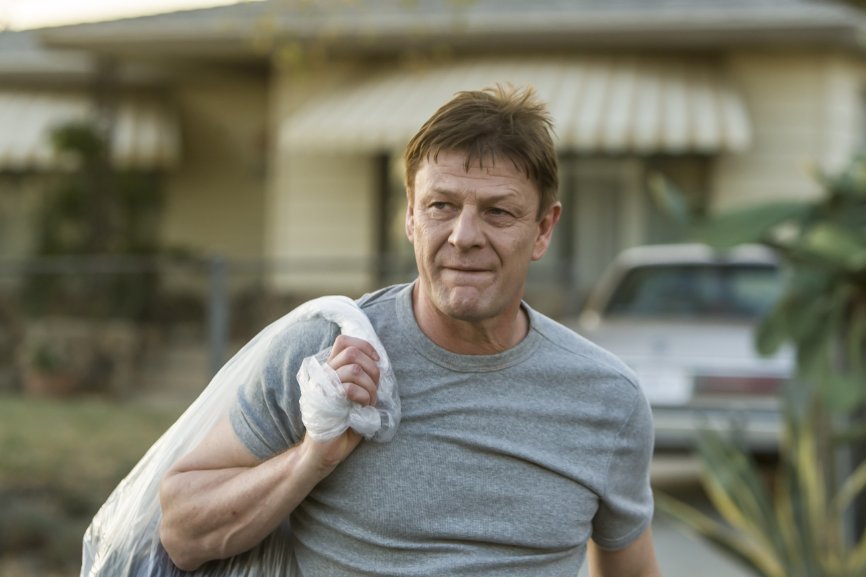
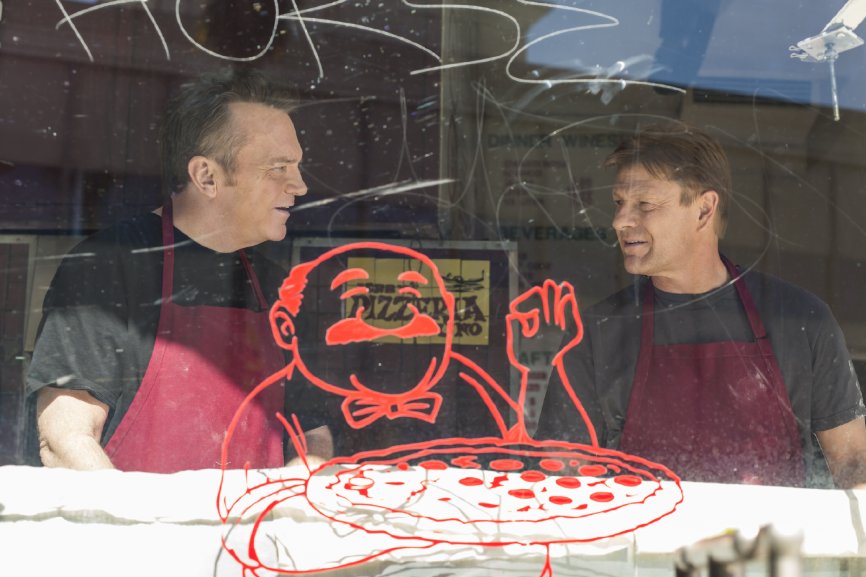
The film's star, Sean Bean (above and below), is shown in just about every one of the movie's scenes. It's his story and his picture. But as good as Bean often is, he can't save this tale because he's been given far too little to work with and so comes across as an actor waiting for his character to coalesce.  (Sometimes you could swear you see him grasping at the straws the screenplay provides, hoping for something more specific on which to hang his motivation and performance.)

As his angry but loving sister, Kate Walsh is as effective as this actress is allowed to be, but it is Nolan Gross, as her young son, who pretty much steals the movie. Gross has got the "Jesus" role (he's uber-loving, strong, centered, and sacrificial), and as written, it's pretty silly. But the young actor rises to the challenge surprisingly well. Love interest is provided by a sensible Eva Longoria (above, right), while the "best pal" role goes to the always-fine Tom Arnold (below, left), as a guy who manages the local pizza shop and gives our hero much-needed employment.

That's about it. If the cast entices, take a chance. You could do worse and undoubtedly have, many times previous. From Anchor Bay Emtertainment and running 99 minutes, Any Day hits the street this coming Tuesday, August 4, for purchase or rental.

Friday, August 12, 2011

Justin Frimmer's BORN AND BRED looks at boxing and Hispanics, sports and kids

As it is with Blacks and basketball, so it seems with Hispanics and boxing -- a combination that many feel is the road out of marginalization and the ghetto. According to the new documentary BORN AND BRED, directed and co-edited by Justin Frimmer (a hard man to find a photo of), the eastern reaches of the Los Angeles area deliver more boxers than anywhere else in the USA. I am not at all certain that this is the kind of record we want to keep repeating, however, especially after seeing this new film. What Mr. Frimmer shows us seems to me alternately appalling and sad, but I am not certain -- and this may be a good thing -- just where he stands in regards to these children who, from a very young age, make boxing their be all and end all.

The children we see here seem to have, as one person in the film notes, no real childhood. On the other hand, there's no surety that they'd have had much of a childhood without it. Get 'em while they very young, one trainer counsels. "Seven, eight and nine is better than ten or twelve." At times the movie seems like a commercial for the sport, never more so than when a glammed-up white guy who clearly has some job promoting boxing goes on at length about its glories.  Toward the finale he's back to tell us that boxing is the single "most culturally resonant sport." Huh?

Along the way we get a little sidebar on immigration, and the many demonstrations against the new laws that would make it even more difficult for the USA's illegal immigrants. Because Hispanics are at the forefront of the film, immigration is a major concern, of course, but the film's handling of this is too cursory to offer much insight -- except the usual position of "It's really good for America." Well, yes, but perhaps only up to a point.

Back to the boxing and the kids. "We fight until we die," one of them tells us along the way, and although he's quite happy about this, we may not feel as delighted. The children we see and hear most about are the now famous twins Oscar and Javier Molina, whom we watch train and then fight, lose and then win. Now, in one of the more ironic roads down which this film travels, the two are literaly fighting from different homelands. Then there is little Victor (whom, I believe, is shown at right) whose birth parents were decidedly unfit. He is adopted by a pair who seem to care immensely about him. But genes may reign: While the kid is winning his fights, it's all great. One loss, however, and -- whew!

Regarding those boxing twins (above and below), while their dad is all for the ring and the fights, mom would like her boys to perhaps have a back-up career. She thinks school and good grades are important, too. And speaking of these children not having a childhood, even in high school, the twins are not allowed girlfriends. (And if they're getting a little on the side, we're certainly not privy to it.)

Frimmer either can't or won't probe too deeply into all of this, but he has given us enough of a look to raise a lot of questions. For all the lip-service about the wonderful discipline and training that boxing provides, take a look at the body language and the expression on the face of Javier Molina after he's won his important bout toward the end of the film. These speak volumes about Hispanic macho, male entitlement and the power of force and fist.  "Culturally resonant," indeed.

Clearly, I have mixed feelings about this movie, but it is definitely worth seeing and thinking about. Born and Bred will open, for a week's run, next Wednesday, August 17, in Kansas City (at the Screenland Armour), and on Friday, August 19, in  Los Angeles (Downtown Independent) and New York (Quad Cinema).