Showing posts with label dance films. Show all posts

Wednesday, May 8, 2019

Ralph Fiennes & David Hare's excellent bio-pic of Rudolf Nureyev, THE WHITE CROW, opens


What a fine and fascinating entertainment, as well as one of the better bio-pics of recent times, is THE WHITE CROW -- the very welcome collaboration between director/co-star Ralph Fiennes, screenwriter David Hare, and the very impressive newcomer actor/dancer taking the title role, Oleg Ivenko, who plays the young adult Rudolf Nureyev.

What these three have given us is a portrait of Nureyev that seems nuanced, detailed and believable factually, psychologically and especially emotionally.

Fiennes (shown at right) and Hare go back and forth in time near constantly, and this works surprisingly well, TrustMovies thinks, because the pair concentrates less on connecting the specific what-happened-and-why dots than on the emotions these events raise in both the child and the young adult Nureyev. Thus we are consistently placed within both the heart and mind of the character, and this helps us understand the talented, gorgeous and highly self-centered man at the core of this film.

Mr. Ivenko, below, handles both the dance and the acting with aplomb. Perhaps Fiennes understood how to capture and make best use

of this young man's talents -- which in so many ways mirror those of Nureyev -- without asking him to do too much. In fact, Ivenko's is a paired-down performance -- he is most often shown simply "thinking" -- relying in good part of his handsome face, terrific body and dance skill to bring to life the international ballet idol of the 1960s and 70s. It works.

Aside from the childhood flashbacks, The White Crow concentrates on Nureyev's ballet training, particularly that under the tutelage of his chosen teacher, Pushkin (played with great restraint and a fine undercurrent by Fiennes, above, right), mixed consistently with his traveling in the Russian troupe to Paris, where he first became rightly famous.

There he meets and bonds with the young woman, Clara Saint (Adèle Exarchopoulos, above, right) and the French dancer/choreographer Pierre Lacotte (Raphaël Personnaz, below, right), both of whom prove instrumental in the Parisian life of our dancer, as well as in the choice he must finally make.

Thanks to the ever-invasive Russian officials assigned to chaperone/guard the dance troupe, our narcissistic hero champs harder at his bit until the exceedingly suspenseful climax of this first-rate film, which -- if the details of the finale are maybe not completely as-they-were -- can be forgiven because of the filmmakers' skillful handling of this scene.

Those of us old enough to remember and appreciate Nureyev's talent and beauty -- his famous bisexuality is clearly shown here, too -- will probably revel in how closely Ivenko achieves all this, while younger audiences will at least be given a good taste of what this dancer/icon was all about.

The movie's dance scenes (as above and below), though not so very many, are plenty good enough to convince us of why this then-unknown dancer rose so quickly and permanently to fame. Mr. Hare's screenplay, by the way, is so appropriate and smart that you are mostly unaware of it as the film rolls along.

From Sony Pictures Classics and running a rich and not-a-moment-too-long 127 minutes, The White Crow opened on the coasts last month and is now expanding nationwide. Here in South Florida, it begins its run this Friday, May 10, and will play the Miami area at the AMC Aventura 24, Regal's South Beach 18, and the Coral Gables Art Cinema; in Fort Lauderdale at the Classic Gateway 4; in Davie at the Cinemark Paradise 24; in Boynton Beach at the Cinemark 14; in Boca Raton at the Regal Shadowood and the Cinemark Palace; and at the Movies of Delray and the Movies of Lake Worth. Wherever you live across the country, click here and then click on GET TICKETS (badly designed but to be found hidden in Ivenko's forehead) to view the theaters nearest you.

Wednesday, May 2, 2012

FIRST POSITION: Bess Kargman's ballet doc opens, and TM experiences déjà vu


I wonder if Bess Kargman -- the director, producer and editor of FIRST POSITION, the new documentary that tracks talented ballet students vying for acclaim at a prestigious ballet competition -- saw the earlier and very fine documentary, Only When I Dance, a film by Beadie Finzi, which also tracks talented ballet students vying for acclaim at a prestigious ballet competition? (Distributed by Film Movement, Only When I Dance was also an official selection of the Tribeca Film Festival back in 2009.) I ask the question because the two documentaries have such similarities that, while watching Ms Kargman's movie one might easily confuse it with Ms Finzi's, especially where the films' leading South American male dancer is concerned (Kargman's hails from Colombia, Finzi's from Brazil -- and both are dark and gorgeous young men with incredible abilities in ballet). But while Only When I Dance* profiles two young dancers and runs 78 minutes, First Position tackles a half dozen of them and lasts a bit over 90.

Both films are worthwhile, but I give the edge to Ms Finzi -- who got there first & spends a longer, more productive time with her two students, their teachers, their families and their dancing. But since First Position opens in theaters this Friday and is well worth seeing -- if you enjoy dance, kids and the thrill of competitions -- let's address that film from here on in. Ms Kargman, shown at left and whose first film this is, has chosen her half dozen students well -- for their abilities, their singular stories and for how very photogenic they are. (Their looks, if not as important as their dancing, will serve them well in both competitions and careers.)

Among the kids we see and get to know a fair bit are Gaya (above, left) and Aran (above, right), both competing in the youngest division, who seem to appreciate each other's skills. Well-spoken and supremely talented, Aran has been dancing seriously since he was four years old.

Michaela (above) -- born, then orphaned by the rebels, in Sierra Leone, and finally adopted by a lovely older American couple -- proves an incredibly strong and able dancer, whose mottled and discolored skin condition is not, fortunately, visible from the distance of the stage. She is also black, and there appears to be an unspoken rule about black ballerinas never advancing into the best of the world's ballet companies. (This was true of Only When I Dance.) But, from what we see here, Michaela seems to be breaking that rule. Let's hope.

Rebecca (above, center, in blue), on the other hand, would seem to be your real, and rather typical, prize: Caucasian, blond, gorgeous face and body, plus terrific ability. And yet... Her story, too, should grab you.

Miko, above, is a mixed-race 12-year-old with a very good teacher and a stage-mother mom who proves quite useful. Watching this lithe and graceful girl dance as a Spanish señorita is both joyous and eye-opening.

Miko's little brother Jules, age 10 (above, being stretched by mom), is a contender, too -- though midway through the movie he makes a decision that seems awfully mature for someone his age.

Then there's Joan Sebastian, that Colombian hottie, age 16, who dances up a storm and has such flexibility that you'll gasp. They're all good, these kids, and Ms Kargman sees to it that we learn enough personal information about each that we're quickly hooked.

While the documentary has built-in suspense regarding the competitions and who will survive and prosper, the filmmaker doesn't squeeze this dry. She'll inform us of wins (or losses) when necessary, via on-screen notes. This speeds things along nicely. Watching the performers do their numbers is generally enchanting because we see enough unbroken/unedited dance to enjoy it as such, and then form our own opinions.

Crisp and fast-paced, First Position is a worthwhile addition to the dance-film canon, giving adult art-film movie-goers a good time while possibly enticing a new generation of kids to the dance.  The movie, from Sundance Selects, opens this Friday, May 4, in New York City at the IFC Center and the Elinor Bunin Munroe Film Center. In the Los Angeles area, it will open at Laemmle's Royal Theater in West L.A., Encino's Town Center 5 and Pasadena's Playhouse 7. In the weeks to come it will be arriving in theaters across the country from Atlanta to Washington DC.

*In addition to its similarities to Only When I Dance, this film also calls to mind another youths-in-competition documentary from last year, the under-seen Make Believe -- which followed six amateur magicians on the road to possible professional status.

Wednesday, December 21, 2011

Wim Wenders' PINA proves (1) a must for dance lovers and (2) that 3D is here to stay

If you love dance -- particularly modern dance, and even more so the work of the dancer/
choreographer Pina Bausch -- I don't see how you can miss Wim Wendersnew film PINA. If you know her work, I suspect you won't mind seeing it fragmented (in the way that Wenders necessarily must in order to make a film like this) because you'll get the bonus of experiencing her troupe, their thoughts and the extreme love they clearly feel for their late leader. If, like me, you are not that familiar with Bausch's oeuvre (that's she in red, below) and have only seen it in snippets (in films such as Talk to Her), this movie will be an eye/mind/heart-opening experience.

As a very young man TrustMovies came to New York City to go to drama school. There, part of the curriculum was dance training under the tutelage of the Martha Graham dancers (Ms Graham herself made an appearance or two at the school during those years). While TM was not much of a dancer, he did love seeing those people do their thing. And that training -- those moves! -- has evidently stuck with him, for seeing Pina and its many excellent dancers brought his long buried love of modern dance to the fore once again.

What Herr Wenders, pictured at right, has accomplished with this film is at least twofold. In addtiion to allowing us to see, in parts, the work of this marvelous choreographer and her troupe, the director has given us a 3D movie in which the depth is so integral to the whole that after viewing this film, you really can't imagine not having that extra depth as part of your experience. (Do try to see this one in the 3D, rather than in the 2D format.) Space -- whether occupied or empty and by whom and how -- is a vital part of dance. The three dimension process allows you to experience space in a way that no other dance film before has managed. Very soon, as you watch this movie, any sense of trick effect falls away and you simply become part of the space itself, and more fully than you could, even at a live dance concert, because the camera, after all, can and does go places that the audience would never be allowed.

The Bausch troupe, too -- full of talent and beauty -- is something to behold. The various dances, the moves, the individual members of such varying age and type bring each dance to life in memorable ways.

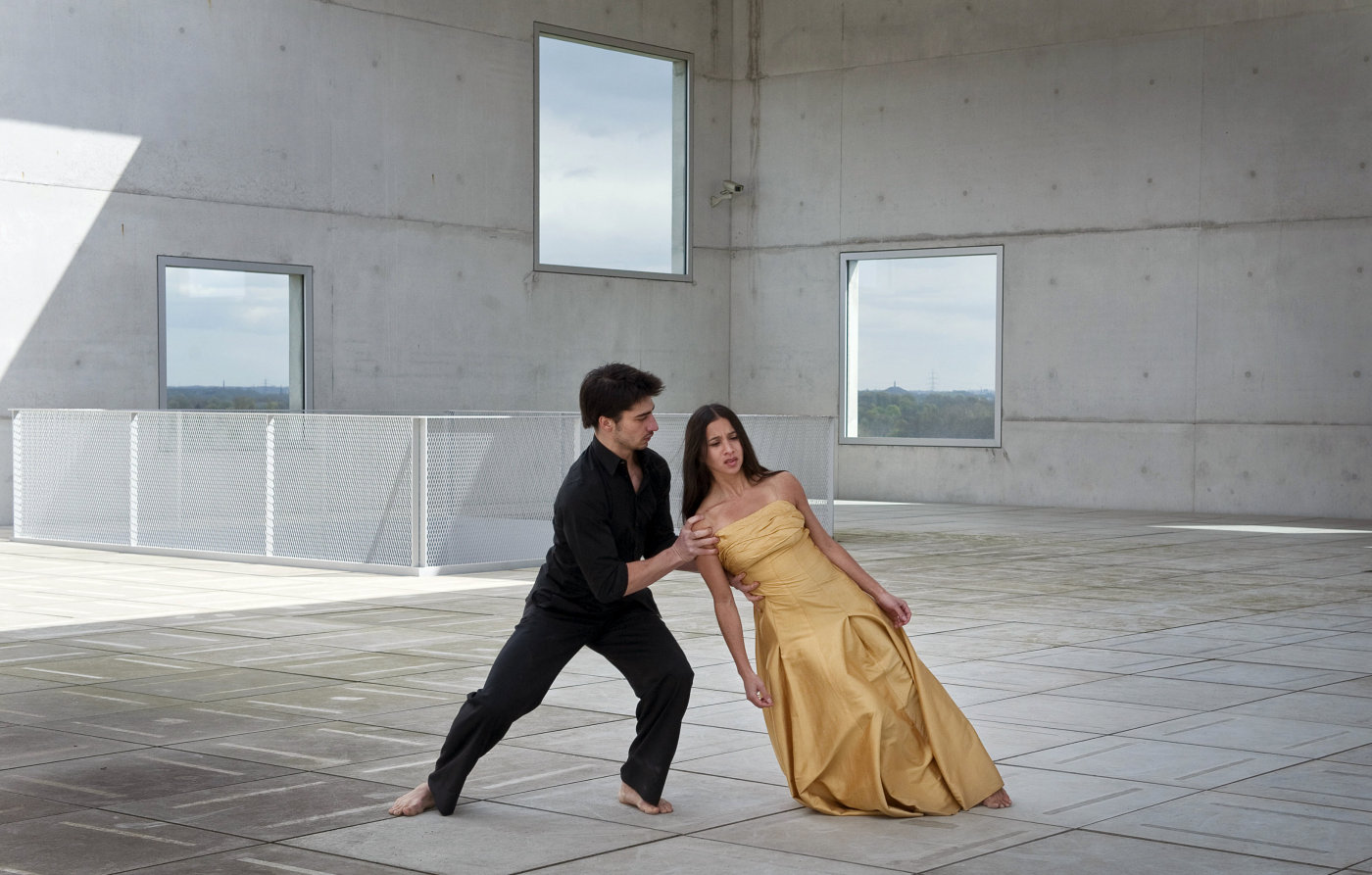
The film is by turns emotional and primal (the opening dance, shown in the photo below the poster at top), aggressive, funny (below), thoughtful, surprising, and always beautiful, due to the movement, faces and bodies on display.

The use of the natural elements, particularly earth and water, are dynamic, too, and Wenders' decision to offer site-specific performances, wonderfully varied and on-target, makes the movie all the more visually interesting. (Some of his dissolves are wonders in their own right.)

What are these dances saying? Each viewer is likely to take away his/her own message, but certain of the scenes may make make you a tad uncomfortable.  One of these, in which a group of men literally paw at one fragile woman, is utterly squirm-inducing.

The beauty of the film lies in how it shows us what dance can finally be: giving us ourselves and the world in ways we've never seen. That's what all good art does, and Pina Bausch's dance would appear to be among the best of it.

Pina (from Sundance Selects, 103 minutes) -- which is Germany's submission for this year's Best Foreign Language Film (even though most of its "language" is dance, it is certainly one of the best films of the year) opens Friday, December 23, in New York City at the IFC Center, the Elinor Bunin Munroe Film Center and in Brooklyn at the BAM Rose Cinema. A nationwide, limited roll-out is planned, beginning in January.