Showing posts with label experimental films. Show all posts

Wednesday, August 30, 2017

VOD debut for Michael J. Saul's short film collection, THE DAYDREAMER'S NOTEBOOK


The name Michael J. Saul was new to me, or so I imagined, when I sat down to view THE DAYDREAMER'S NOTEBOOK, a collection of short films that span a time frame of 36 years of movie-making. Turns out, however, that TrustMovies has indeed reviewed a film by Mr. Saul: his 2015 low-key pot-boiler, The Surface. I didn't much like that film, so I'm pleased to report that viewing a larger chunk of Mr. Saul's work proved a more interesting venture.

This filmmaker, shown at right, seems a good deal better with short films, and perhaps, the shorter the better. If that sounds like a "dig," I don't mean it to be, for what we see here in short form often proves rather lovely, suggestive and elusive. In one of his shortest, Nightcrawler, Saul recalls via narration and visuals, preparation for a fishing trip with his dad, which he evidently hated. The movie shows us why. Two others, Idol and Boat 14, return us to the image of a young man who was perhaps muse to Ms. Saul, David Allan Payne (below), seen in several of the films in this Notebook.

Saul uses slo-mo often, and often beautifully, especially in Euphoria (below and further below), an ode to longing and incipient sexuality that features three beautiful teens engaged in sexual behavior and fantasy, all in glowing black-and-white cinematography that incorporates dance, movement and even some special effects.

The filmmaker's introduction to this collections provides a bit of his history, along with school report cards that feature teachers' comments. We get but a glimpse of who he is/was, as he explains how important daydreaming became to his creative process.

Much of what we see here -- Cons, Idol, Boat 14 -- is archival, and some of the film decay we view may put you (unintentionally) in mind of the work of Bill Morrison, though the two filmmakers have not much else in common, I should think.

The Daydreamer's Notebook, though not overtly homosexual (The Surface gives you plenty of this), is certainly homoerotic. Yet perhaps the best of these shorts is something called Subterranea (above and below), in which Saul combines glorious nature images with sci-fi tropes to form something quite lovely and original. This one doubles as a memorial video to the late Steven M. Miller, who was Saul's collaborator and composer for 30 years, and whose music fills most of this Notebook.

The longest of the films included here -- The Cipher and the Boar (below and at bottom)-- proves the least interesting, though the most time is spent on it and in it (we even get look at the making of this one, together with  a visit to the "premiere" it had back in 1981). Shot on 16-mm, the would-be thriller/horror short tracks two boys (one of them the young Mr. Payne) who stumble upon the house of a very nasty taxidermist.

A kind of dark fairy tale of the Gingerbread House/Hansel & Gretel variety, the movie, told without dialog, is full of fraught, would-be terrifying images that eventually grow repetitive and tiresome. We get what's happening, but it takes too long to arrive. This is also Saul's lengthiest and most "narrative" short in the bunch, so, given my reaction to this one, as well as to his recent narrative film The Surface, I'd call the briefer, elliptical and more experimental work his stronger suit.

Already available for viewing via Amazon Instant Video, the collection arrived on VOD yesterday, August 29, on TLA Video, and will make its debut on Dekkoo, the new all-gay streaming site, sometime this fall.

Thursday, March 9, 2017

Improvisation upon improvisation, as Thomas White's lost/famous WHO'S CRAZY gets a digital restoration and a theatrical release


I'd never heard of it (prior to the press release from Kino Lorber arriving in my email box), and I suspect you will not have, either. But if senior readers would like a dead-on time trip back to the 1960s and the experimental film scene of that era (or you younger ones who might be curious about the kind of "art" that went on back then), WHO'S CRAZY? is the film to see. Directed by Thomas White (with some help from his then-partner Allan Zion), this was the first and last movie Mr. White ever made. And though the IMDB credits White and Zion with both direction and writing, while the story idea may have been theirs, the dialog would have come via the film's actors -- all members of that famous improvisational theatrical troupe The Living Theatre.

An anarchical theatrical group dedicated to busting loose from the strapped-down mores and attitudes of the 1950s, The Living Theatre's actors happened to be taking a kind of "enforced vacation" in Europe -- their directors/founders were currently in prison in the U.S. for tax problems with the IRS -- when their path crossed with that of Mr. White.

The actors were staying in a farmhouse in Belgium, which soon became the film's setting. The plot, such as it is, involves a bus carrying some inmates from a local insane asylum that breaks down, allowing the inmates to escape and take shelter in the farmhouse, where they cavort and frolic for nearly all of the film's 73 minutes.

The movie's title gives away just about all of the meaning involved, with the question being: Who are the crazies here: those inmates or their guards/authorities called in to round them up? This fits right into the "hippie" philosophy of the day -- to which TrustMovies himself thoroughly subscribed at the time. (The movie was made in 1965 and had its first public screening at the following year's Cannes Film Festival and again in 1967 at a festival in Bordeaux -- after which it promptly disappeared.)

If -- visually and plotwise -- Who's Crazy? proves an amalgam of the "experimental" tics and tropes of the day (which, it must be said, begin to wear thin pretty quickly), there is one singular thing that makes the film important, maybe even great: its also improvised musical score.  This arrived via Ornette Coleman and his musicians David Izenzon and Charles Moffett -- who evidently watched a cut of the film, improvising their score on the spot, adding immensely to both the visual and audial enjoyment of the movie. That score is terrific: jazzy, bouncy, funny, surprising and above all, fluid and utterly free. It's an amazement.

Initially Who's Crazy? has no audible dialog. (This goes on for maybe the first 25 minutes). When words are finally heard (along with French subtitles, as the movie was only screened in France!) these seem as desultorily experimental as all else. The inmates run around a lot, prepare a meal, turn the place into what looks rather like a "beatnik" club of the era past, seem to be forming some kind of "commune" and then engage in a mock trial.

There's a very nice snow scene in the Belgian landscape, and White offers up a few stop-motion visual effects. Then we get romance, complete with hot candle wax, maybe a little Satanism (or is this just bad make-up?), a tad's worth of philosophy (peace and love, doncha know?), and a wedding.

The film makes fun of so many of our cultural mores and standards -- or perhaps is simply intent on getting us to view these in a different light -- and then those nasty nut-house guards return, along with reinforcements, to round up the inmates. At this point that musical score, together with the accompanying visuals, may put you in mind of the Keystone Cops.

As I say, if this is mostly a bizarre time-trip into our "experimental" movie history, it's also one that buffs may not want to miss. And then there's that amazing score. Distributed by Kino Lorber, Who's Crazy? opens at the Film Society of Lincoln Center for a week-long run this Friday, March 10. It opens in Los Angeles for a  two-day, two-performance run at The CineFamily on April 1, and then hits Seattle at the Grand Illusion Cinema for a week on April 21 - 17.  To check for any further playdates, click here and then scroll down.

Thursday, January 19, 2012

That old panderer Jean-Luc Godard gives us something to ponder in FILM SOCIALISM

Oh, am I using that headline word incorrectly?  I don't think so. According to my dictionary, a panderer, in addition to a sexual procurer, can be someone who "caters to or exploits the lower tastes and desires of others." While one does not necessarily think of intellectual pursuits as part of the "lower" tastes and desires, it seems to me -- and has for some time now -- that Jean-Luc Godard has become, intentionally or not, a fake who appeals to our pretensions more than anything else. And to my mind our pretensions qualify as lower tastes and desires.

Once upon a time, this filmmaker (shown at right) made a ground-breaking but not-very-good movie (Breathless) and then a much better one (Le Petit Soldat -- so important that France banned it for a long while). Otherwise, he's mostly been jerking us around. Misogynistic and misanthropic (the latter can be more easily forgiven than the former because it is at least all-inclusive), like Warhol in art, Godard makes us look at things differently. But not, unfortunately, in ways particularly edifying. So, having given up on JLG some years back, I decided to take a look at his latest, FILM SOCIALISM, with as open a mind as possible (what? You say it's sieve-like?) under these already greatly prejudiced circumstances.

Surprise! I wouldn't call the film a complete waste of time. Here are so many verbal and visual tricks and tics -- subtitles that sometimes do and sometimes don't translate what's being said in the dialog, plus a soundtrack that goes in and out at odd times, and subject headings that seem deliberately unhelpful -- that for a time you can't help but marvel at the filmmaker's use of distraction. Much of the film was also shot aboard a cruise ship, on which we're sailing with a bunch of tourists. Until we're not. (That ship, a friend of mine pointed out this morning, is the lately-infamous Concordia, the captain of which was recently immortalized by the NY Post, in one of its better recent headlines, as "Chicken of the Sea.")

I think you might call this movie another provocation by a provoker of long-standing, in which -- after all the nonsense (with maybe some sense buried deep within) -- the speech and the written word begin to somewhat coincide. Along the way we get a llama (above, left) and a mama (below, right).

We're treated to some Chopin and some Patti Smith (shown below), and on Blu-ray, the movie is often drop-dead gorgeous, with its scenes of the sea and sky pretty damned ravishing. (One character's blue eyes almost look like a special effect.)

We're whisked off briefly to the Palestine of 1926 and elsewhere, and moments from famous old movies are woven in throughout. And, oh, yes, there's politics, consumerism and immi/emigration, too -- though anything Godard might be saying about them that even approaches originality is lost on me. It's all style (I use the word loosely) but little real content here.

Then, near the end, we are shown a wise, old owl (no doubt a stand-in for our filmmaker), followed soon by the words NO COMMENT. Which is why TrustMovies decided to make his own comment via the above post.

Film Socialism, at a rather long 102 minutes, is available now -- for sale or rental -- on DVD and Blu-ray from Kino Lorber. Or you can watch it via Fandor, where it has just become available.  Bonne chance, mes amis!

Tuesday, November 9, 2010

BRUCE CONNOR: THE ART OF MONTAGE opens two-week run at NYC's Film Forum

Just what is montage? Since even yours truly has been known to use the term incorrectly (at least according to the defini-tions he can now find), let's begin with the explanation found on Wikipedia:  a technique in film editing in which a series of short shots are edited into a sequence to condense space, time, and information. It is usually used to suggest the passage of time, rather than to create symbolic meaning as it does in Soviet montage theory. OK: good enough. Applying that definition, I'd say most montage used in mainstream film does indeed suggest time passing
/events happening rather than the creation of symbolic connection.

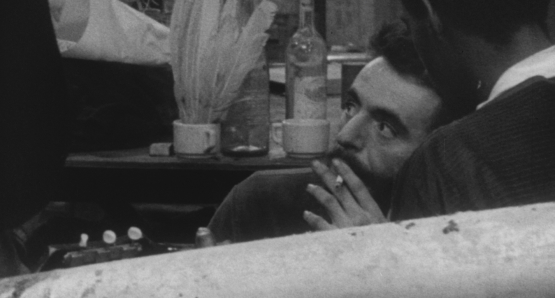
For mainstream symbolism montage, look to something like the "candidate recruiting" section of Alan Pakula's The Parallax View and especially to art/experimental film practitioners such as Jay Rosenblatt, Gustav Deutsch and Bruce Conner (shown at right), the artist who died in 2008 and whose filmed montages/collages are being given a two-week/two-program retrospective at New York City's Film Forum, starting tomorrow through November 23. The work of men like these three are said to have inspired the quick-cut, fast-paced music videos that pack as many rapid-editing "ideas" as possible into their short time frame. And so they do, but so -- one might ask -- what? Enough of these quick-connection movies, shown one after another, can leave a viewer feeling that he's stumbled into an attention-deficit-disorder film festival.

Watching the two series of Conner's work under the titile of BRUCE CONNER: THE ART OF MONTAGE has something of this effect, due to the filmmaker's love of repetition. There's a lot of it here. The artist's place in the annals of those who told us, early on, about our increasingly crazy consumer culture, is secure, I think -- even if watching the actual work can try one's patience. The still above is from Conner's Report, in which he purposely takes the hugely overused President Kennedy assassination footage and plays with it -- to sometimes interesting effect -- removing sound, using repetition, and then slicing in photos such as the above.

If I had to choose, due to time and/or money constraints, between the two programs, I'd opt for Program A (click and scroll down to see the complete programs for A and B), which contains probably Conner's most famous work (also his first), A Movie, in which the filmmaker strings together newsreels and old-movie clips with other found footage, attaching wildly appropriate music (or maybe it's appropriately inappropriate) to come up with something that veers between an idiot's delight and the shockingly thought-provoking. Among its images is the world's most popular "death" symbol, the mushroom cloud, which the artist would use again (and again) in his later Crossroads (below), which offers A-bomb detonations around the Bikini atoll in such luscious slo-mo, black-and-white photography that I suspect would give even Lucy Walker pleasurable goosebumps.  And yet 36 minutes of these explosions is simply way too many.

If you like naked ladies, you'll find plenty to ogle here -- artistically, of course!  Program A offers something I'd never seen in Marilyn Time Five: Miss Monroe, in her pre-plantinum days, clad in nothing but panties and  lolling around in very suggestive moving images -- all to the sound of her own quite lovely voice singing the Livington/Malneck/Kahn song I'm Through With Love. We literally get Marilyn doing this five times from different angles and in differing repetitions. Via this 13-1/2-minute film, you can see -- in a way that none of her Hollywood studio movies managed to capture quite as well -- why Monroe was the heterosexual male's delight. With her ample body (those breasts -- and way before augmentation came into vogue!), her softness (in appearance she seems to have almost no muscle) and her seemingly infinite pliability, she's a dream come true. In Program A, we also get 60s icon Toni Basil in Breakaway (below), a new kind of "liberated" woman, who, like Marilyn, sings her own song, but with very different results.

In The White Rose (7 minutes, from Program A), actually tells a kind of story: an artist who had been working on one enormous painting for something like 13 years and must finally have it removed from her apartment.  We watch it happen until, finally, the artist sits out on her fire escape surveying the moving company men as they cart her art away.

Most of Conner's work is in black-and-white but as he moved along, he also experimented with color and sepia. Around 50 minutes into Program A, just following the headache-inducing Mea Culpa (above), we see some of this. Take the 5:10 to Dreamland (below) is a welcome, quiet respite from all the freneticism, followed by the Valse Triste, also in sepia with a score by Sibelius, which tracks a lot of comings and goings. Conner's last film Easter Morning (in full color) offers images of leaves, flowers, color and light -- all stop-motion, fast editing, and (for me) not much meaning.

Program B begins with two short films set to modern music: Mongoloid (to DEVO's song) and America Is Waiting, to the song by Eno and Byrne.  Both are only 3-1/2 minutes long, and the latter, for me, offers some of the most interesting and thoughtful image juxtapositions of any of Conner's work (one of its images is shown below). The final fifteen-minute film in this program, Looking for Mushrooms, looks as if the filmmaker has found -- and then ingested -- some. Filled with jerky hand-held camera movements, the film follows the indigenous people of.... Mexico? For awhile, at least, and then we're clearly back in America -- with boobs, naked ladies, Tiffany lamps, light shows, dissolves, overlapping photos and some nearly subliminal images.

This is an odd ending to a mixed bag of movies. I'm glad I saw them, some of which I'll certainly remember and perhaps watch another time. Again, Bruce Conner: The Art of Montage will run through Tuesday, November 23 and perhaps eventually appear on DVD, where aficionados can play and replay until meaning becomes clear(er) and/or the repetition induces a pleasant, hypnotic and not unwelcome sleep.