Showing posts with label family sagas. Show all posts

Thursday, January 15, 2015

Jay Craven's NORTHERN BORDERS brings us a scrappy Vermont family some sixty years ago


Noticeably old-fashioned in both its style and subject matter, NORTHERN BORDERS, the new film directed and adapted (from by novel by Howard Frank Mosher) by Jay Craven, may take some getting used to in these times of fast-pacing and elliptical storytelling. But TrustMovies thinks it's worth your trouble. In addition to a high-level cast that includes the likes of Bruce Dern, Geneviève Bujold and Jessica Hecht, the movie has a quiet integrity to it that builds sturdily and steadily as it unfurls.

Mr. Craven, shown at left, appears to be a moviemaker dedicated to filming tales that involve the people and state of Vermont, and Northern Borders is yet another of these -- maybe the best of his since Where the Rivers Flow North. It's a tale of a fractured family, mid-1950s-style, in which the grandson, Austin Kittridge III -- played by Seamus Davey-Fitzpatrick (below, right), whose low-key, quiet and thankfully not-too-cute performance is another of the film's assets -- spends some months with his grandparents, played by Mr. Dern and Ms Bujold (shown below, left) on their relatively isolated farm in Vermont. There he discovers some interesting family secrets and lore -- a missing aunt who supposedly robbed a bank -- while learning about the strange characteristics of long-term love in the process.

From the start the movie is low-key funny, as our little hero wonders if the drunk in the train station could be his grandfather. Once he arrives at his new home, grandma -- born in Egypt and full of Egyptian history and lore -- begins calling him "Tut" (for the Pharaoh Tutankhamen) and fills him with new ideas which lead to questions about life and love, right and wrong.

Grandpa does pretty much the same thing, but in his own taciturn style (Dern, shown above, is, as usual, very fine). The movie is full of decade-specific references -- the early days of Off-Broadway and Adlai Stevenson -- and the look of the film seems quite on-target.

The various townspeople and neighbors of the family whom we meet are rendered in quick, often comic strokes (the visit from the Sheriff is a particularly underplayed comic scene), and as the movie meanders along, you'll find yourself adapting to its slow pace and small, charming "events."

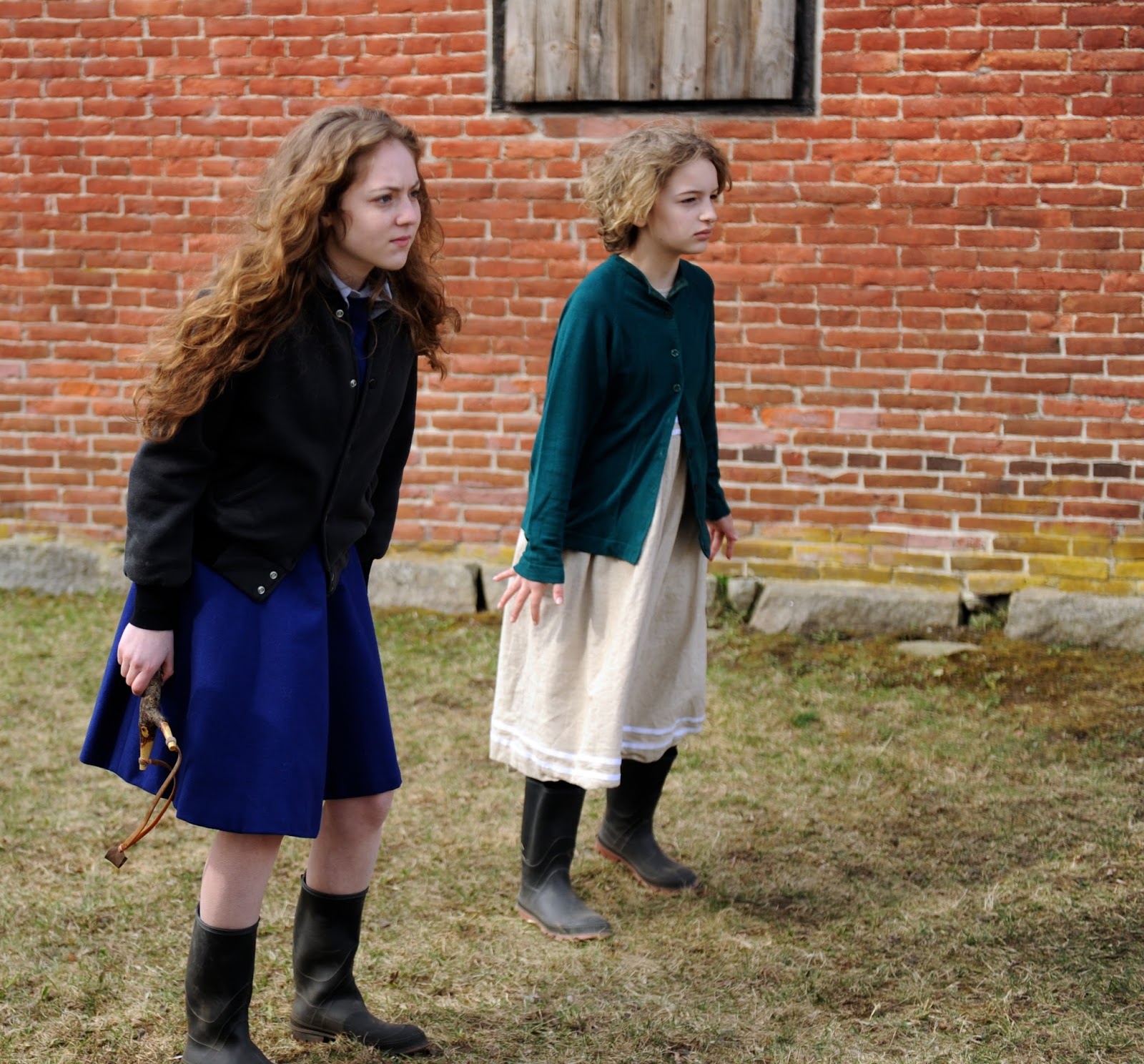
These include everything from a school bully -- above, left, and a girl, for a change! -- locking the teacher in the outhouse to a maple syrup festival, the gifting of one of the family's cows, game-playing and maybe a little "first love" with a school friend, and even the coming of electricity to Vermont's outlying areas in an interesting scene, below, in which we see some Vermont "justice" doled out in court.

Probably the oddest of all the events is the arrival of that would-be bank-robber aunt (played by Ms Hecht, below) and what this means for young Austin. At times the movie seems more tall tale than actual family history, but eventually this becomes part of its charm.

By the time of Northern Borders' finale, we, like young Austin, have lived through quite a turn of events, and may very well be all the better and wiser for it.

The movie opens here in New York City at the Cinema Village this Friday, January 16, after playing a number of regional cities. I would think or at least hope that a DVD is in the works, as well, for any old-fashioned-minded folk who don't live near enough NYC to get to the theater.

Monday, September 23, 2013

The Jean-Jacques Annaud and Menno Meyjes DAY OF THE FALCON proves flight-worthy

The original title -- Black Gold -- of the film under consideration here has been used at least eight times already, even as recently as 2011. So, given the cliché factor and the addition of over-use, the change to something else was a smart move, even if the resulting DAY OF THE FALCON doesn't exactly set one's heart to racing. "Black gold," of course, refers to oil, as is the case in a half-dozen of these films, though in one of them it means coffee, while another creatively combines oil with a horse.

First seen in 2011, the film made its VOD debut in the USA this past February and had a slight theatrical release the following month. Now, here it is on Netflix streaming and worth seeing for a number of reasons, beginning with its director, Jean-Jacques Annaud (shown at right), a man who has given us over the past 37 years not that many but mostly good movies, and who knows his way around intelligent, exotic (to those of us in the west) spectacles like the Oscar-winning Black and White in Color, Quest for Fire, The Name of the Rose and Enemy at the Gates, to name but four of his dozen films.

This new one -- set in Arabia at the beginning of the 20th Century and adapted by Annaud and his oft-time collaborator Alain Godard (from the novel Arab by Hans Ruesch) with a decent screenplay in English by Menno Meyjes -- tells the tale of two Arab tribal heads who, rather than fighting over a large plot of desert land, agree to keep it between them as a kind of unused no-man's-land, with the additional obligation that the Sultan (played by Mark Strong, above) will turn over his two sons to the Emir (Antonio Banderas, below) to be raised along with the Emir's own son and daughter.

How this is exactly "fair" (what does the Emir give in return?) escaped me, but if you can accept this beginning, the rest of the film unfurls pretty seamlessly, with -- once oil is discovered (below) in this no man's land -- plenty of spectacle, battles, thrills, suspense, surprises (my favorite is how one finds fresh drinking water in the ocean!), along with enough intelligence to make the themes and events shown from a century ago quite timely and thought-provoking for today's world.

First off, who is the villain and who the hero? Both "kings" are shown to be bright but hypocritical in a number of ways. In the movie's depiction of Islam and tradition, we see conventional wisdom and forward thinking both come a-cropper at various times.

The most important plot thread is the growth and change of the Sultan's younger son (another fine performance by A Prophet's Tahar Rahim, at left), who goes from a bookish, eye-glassed librarian to a powerful warrior chief in such a way that you thoroughly believe the entire process. Along the way, he must marry the Emir's daughter (the lovely Freida Pinto, below), whom he indeed loves, and find a way to live with and show decency and honor to those who have betray-ed him and his family. How and why this hap-pens makes for a more intelligent spectacle that you might expect.

We also get interesting views of Islam as a thing that both holds humanity back and offers it a code for living. "God hates what we do to each other in his name," a character notes along the way. And there's a particular death scene mid-movie that uses the religion's tenants in a manner that nearly brought tears to the eyes of this particular atheist.

Above all this, even, what I found most interesting in the movie is its use of oil as the agent for change, and how it affects all concerned. There's a lot of truth here, and most of it is unfortunate. Notes the Sultan, toward the close of events, "When the foreigners (yes, you can read America in this) finally leave, we will not recognize ourselves."

In the supporting cast are good turns from the talented Riz Ahmed and a gorgeous, charismatic actress named Liya Kebede. All in all, the movie proves that there is still a good deal of life, not to mention intelligence, left in some of those Arabian desert spectacles. Regarding that oil, you may leave the movie, wishing as I did, If only... 


A co-production of France, Italy, Qatar and Tunisia, Day of the Falcon is available now via Netflix streaming, on DVD, and elsewhere, as well.

Sunday, September 22, 2013

An original--and an odd one--Bob Byington's family saga SOMEBODY UP THERE LIKES ME

Bob Byington is a name (and a movie-maker) new to me, but I'm awfully glad I stumbled onto his SOMEBODY UP THERE LIKES ME, for it is as odd a film as I've watched in some time. I missed its theatrical opening earlier this year, but its sudden appearance on Netflix's streaming facility this week led me to give it an immediate shot. It took awhile to get with the program, considering that most of the characters (especially the lead, Max, played by Keith Poulson) are not very likable. Stick with it, however, because it gets a whole lot better as it goes along. Even if you can't quite put your finger on the filmmaker's point, by the end of the film, I think you'll feel that your time was well spent.

The very confusion you're likely to feel here -- Why do some characters age, while others do not? Why does everyone seem to take life so cavalierly, almost non-seriously? -- adds to the movie's bizarre-but-impactful quality. Mr. Byington, shown at left, has given us a four-generation family saga, all packed into a mere 76 minutes. Love, death, career, betrayal and more happen over five-year intervals, and things that would normally shake us to our bones, occur so fast and in such a routine manner that our reactions here would seem to call into question the reactions we experience in more "normal" movies.

It's our hero, Max, who is anything but heroic (that's Mr. Poulson, above), whose failure to age takes on immense proportions. Is this because he also does not in the least mature? Perhaps. His son, does, however, going from infant to toddler to youngster to teen to adult, even as others grow and die. (The movie spans some 35 years.) That's the son, as an adult (played quite interestingly by Jonathan Togo), below, right, shown with Max's grandson.

The film begins as Max catches his wife (Kate Lyn Sheil) in flagrante delicto. Soon he is married again to the lovely Lyla who has a penchant for breadsticks (played by Jess Weixler, below, right) yet he is not an ounce happier, more intelligent nor curious than before.

His best friend Sal (Nick Offerman, below), along with Max and Lyla, all work at the same steak house restaurant -- this place sort of holds the movie together -- which rather defines "career" so far as the film is concerned (one venue or idea is as good as another).

Stylistically, the writer/director coaxes good performances out of his cast -- all the actors manage to inhabit the same bizarre page -- and his use of simple, colorful animation (below) to thread the scenes together proves charming and full of vibrant color.

There's a magic suitcase (symbolic of...?), a nanny who doubles as sexual partner, a best friend who doubles as a sexual betrayer, and a therapist who sings (a crackerjack job from Megan Mullally, below, right). All of this goes by in the snap of the fingers, and if its meaning eludes, its strangeness more than makes up for this -- as though Mr. Byington is on to something very important, but has decided, with the kind of perversity the movie loves, to hold it just slightly out of our reach.

Somebody Up There Likes Me (not to be confused with the Paul Newman movie from the mid-1950s), the title of which has got to be viewed super-ironically -- as, I suppose, is this entire movie -- can be seen now via Netflix streaming, on DVD and elsewhere, I imagine.

Thursday, September 6, 2012

Schepisi and Morris tackle Patrick White's THE EYE OF THE STORM, doing it justice; Rampling, Rush and Davis all shine

Patrick White, who died in 1990, remains the only Australian novelist and playwright to have won the Nobel Prize, and his popular family saga THE EYE OF THE STORM was said to have helped that 1973 win, as it was published the same year. TrustMovies remembers reading it around the time of publication and enjoy-ing it (somewhat), but it has not stuck with him very strongly. Consequently, watching the new movie based on that book brought back only fleeting memories of its tale of a dying matriarch of a wealthy Aussie dynasty, and the not-much-loved son and daughter who return down under from Britain and France to see her off.

This story involves everything from generational skirmishes to family secrets, immigration and emigration, class differences, the Australian penchant for self-denigration, and more. One of the Australia's finest film directors, Fred Schepisi (shown at right), who has given us The Chant of Jimmie Blacksmith, the splendid film version of Six Degrees of Separation and the brilliant Last Orders, and the actress/screenwriter Judy Morris (below, left),

have done a yeoman job of adapting and distilling more than 600 pages down to this 131-minute movie, while retaining depth of character and enough incident to give those above themes decent play. This was perhaps an even more difficult job because none of the leading characters in the book (and film) are particularly likable. Yet they are full-bodied and very human. And while only two generations are shown here, it will be clear to any thinking person that the matriarch's parents no doubt helped instill in her the inability to love, which she passed down to her children, and they to theirs (whom we do not see: two generations of these folk are plenty).

The cast that Schepisi and the producers have assembled is sterling, beginning with Charlotte Rampling (above) as the powerful woman in charge of things. This is the largest role and most central character that Ms Rampling has taken on in some time (she is more often seen in supporting parts), and she fills it out impressively. Always a subtle but commanding actress, one who often looks as if she is withholding something, she is well cast here as an aging woman unused to giving up any portion of the power she possesses.

As her son (a little Oedipal stuff seem to be going on) and daughter (a woman never as accomplished or beautiful as mom) Geoffrey Rush (above) and Judy Davis (below) are simply as good as it gets. As an actor who's had some success in Britain ("until your Macbeth," as mom is quick to point out), he captures the actor's ego, jealousy and ability to "act" any way at any given moment. And he still manages to remain human and, god, so very needy.

Ms Davis is always revelatory, whether essaying Judy Garland or Sybylla Melvyn, playing a smart 'n sleazy Presidential aide or a delightfully overwrought tourist in Barcelona. A much more accomplished and versatile actress than Rampling, here she uses her arsenal of subtle changes and minute expressions to convey the hurt and pain her mother has always inflicted, even now, as the woman is dying. Little wonder this daughter has not -- and never will -- grow up.

Among the excellent supporting cast, three people stand out. I'm all for nepotism when it results in a performance as good and glamorous as that of Alexandra Schepisi (above, left), the director's daughter, who plays the most important of the nurses caring for the Rampling character and who sets the "class" theme in play, falling as she does for the family son, who uses her just as it appears he uses everyone and everything.

As a frightened and perhaps slightly crazy Russian emigre who has found favor with the matriarch, Helen Morse, dancing above, gives a sad, frightened performance that sticks with you.

And, as the Rampling character's solicitor and general go-to guy, an actor I don't recall previously noticing, John Gaden (above, left) delivers a performance of quiet rectitude and trust. His character, above all, is full of surprise -- and buried life.

As unlikable, but always real, as many of these character are, it's a pleasure to report that the movie itself is surprisingly enjoyable. We are kept slightly off-balance by everything, as the various pieces of the puzzle that make up these lives continue to shift until, at last, we see some kind of order slowly forming.

The finale is both sad and enriching, with the whole damned canvas -- times present and past, loves found and lost, promises made and betrayals undertaken -- finally filled to the frame with something robust and flawed. You might call it life.

A shoo-in for the suddenly-more-visible senior audience (and thankfully less feel-goody than either that Marigold Hotel or the springing hope), The Eye of the Storm, from Sycamore Entertainment Group and Paper Bark Films, opens this Friday, September 7, in New York (Lincoln Plaza Cinema and Cinema Village), in the Los Angeles area (Laemmle Playhouse 7, Music Hall 3 and Fallbrook 7) and at the Rialto Theater in The Villages, Florida. Simultaneously, it will be available for viewing nationwide via VOD. Check your TV-reception provider for details.

Friday, December 3, 2010

The Lewis/Lantos vision of BARNEY'S VERSION brings Richler's novel to life


Sometimes a labor of love proves exactly what is needed. That, at least, seems the case with BARNEY'S VERSION, the film of Mordecai Richler's final novel that producer Robert Lantos, director Richard J. Lewis, screenwriter Michael Konyves and a beautifully-chosen cast have brought to the screen in splendid form, and which Sony Pictures Classics is opening today in New York and L.A. for one week to qualify for award consideration by Academy members. Consider they will. This is good old-fashioned film-making meant for modern audiences. It reminds us what movies are still capable of doing: bringing the novelistic pleasure of a wonderful story, rich characterization and decades of time passing before us, as characters we come to love begin to grow and change.

OK: Lots of films attempt this, using pretty much the same strategy. But in the hands of this team and its crack cast, led by Paul Giamatti, shown above, left, as Barney (a shoo-in for Best Actor nomination) and Dustin Hoffman as his dad (above, right, and likewise likely for a Best Supporting Actor nod), almost everything that has made its way to the screen seems intelligent, often very funny, and absolutely on-target.

TrustMovies confesses to not having any idea of the bona fides of director Lewis (shown at left), who according to the press materials has worked mostly for television. No matter. He's made a real movie here, drawing ace performances from his entire cast and, working with Konyves' fine screenplay, choosing the right scenes -- at the right length -- to bring to marvelous life this odd, engaging story of a smart schlub in (and out of) love. In the first scene of the movie, we peg Barney as an asshole. By the end, we're likely to reach the same conclusion.

Yet between those points, we learn so much about the guy and come to care for him despite his foolish narcissism that he -- and his family and friends -- seem part of our own lives. This bunch includes his first, second and third wives, played respectively by Rachelle Lefevre (shown, pregnant, below), Minnie Driver, and the outstanding Rosamund Pike. To the filmmakers' credit, as crass as wives one and two may be, they remain human, sorrowful and worth caring about, even if they're certainly not the right match for our Barney.

That right match is provided by Pike (below, from Pride & Prejudice, Surrogates, An Education, Made in Dagenham), and this might be the movie that finally gives her the kind of audience identification she deserves. (But take note: She's a brunette here, after playing blonds through most of her movie career.) Other important roles are essayed by a hunky, smart Scott Speedman (as Barney's best friend, shown at left,  above) and Bruce Greenwood (as a suavely annoying "other man").
 
The filmmakers capture the time period beautifully via visuals, sets, clothes and music, and Richler's wonderful humor is brought to the fore with writing that's a canny combination of character, situation and ethnicity -- plus performances that make the most of some very smart dialog.

Barney's Version -- unlike last year's tiresome but supposed Oscar Bait from Sony Pictures Classics, The Last Station -- is the real thing, another fine film from Canada and one that Academy members may find it difficult to pass up. It has opened here in New York at City Cinema 1, 2, 3 and in Los Angeles at The Landmark for one week only and will not be seen again until its official theatrical opening on January 14, 2011.