Showing posts with label fashion. Show all posts

Friday, February 8, 2019

The best fashion documentary in a long, long while: James Crump's giddily entertaining, hugely informative ANTONIO LOPEZ 1970 -- SEX, FASHION & DISCO


How in hell could it be that a documentary this good -- enormously entertaining, full of new information and all about the world's favorite meaningless preoccupation (fashion) -- didn't get a decent theatrical release in the USA? TrustMovies suspects that this was due to the fact that the subject of ANTONIO LOPEZ 1970: SEX, FASHION & DISCO, Mr. Lopez himself, a great fashion illustrator in his day, is simply not that well known outside the fashion field.

Unlike figures such as Karl Lagerfeld and Andy Warhol, who are also seen in this film, Lopez was much better known to fashion insiders rather than to the general public. I myself had never heard of him when I sat down to view this grab-you-by-your-lapels-and-dance-you-off-to-discoland doc -- which held me in thrall for all of its 95 minutes.

As written and directed by James Crump (shown at left), the documentary introduces its unusual subject and then immediately pulls you in via compelling interviews with quite an array of fashion folk and celebrities. Fortunately, these are not simply the usual suspects. (Mr. Lopez's life and career was far too free and full for that.)

By the end of the film, Mr. Crump has made a very good case for Lopez (shown above and below) being one of, if not the most talented and important figure in all of the fashion/celebrity world, easily eclipsing the likes of marketing maven Warhol -- about whom we hear yet again how "not there" the man was, so far as his so-called art was concerned.

We see and hear about Lopez's personal life and rampant sexuality, his groundbreaking illustration (below and further below) and about the manner in which he worked, why the result was so different from anything seen before (or since, really), and of the many icons he discovered -- from Jessica Lange to Jerry Hall to Grace Jones, along with more famous models than I have time to list here.

We also hear plenty from Grace Coddington, whose thoughtful, intelligent commentary greatly enriches the film. Best of all, however, and the moral center of the movie, is the delightfully rambunctious and greatly missed Bill Cunningham, whose remembrances of Lopez and his lover/partner Juan Ramos, provide much of the humor and emotion, together with a sense of great caring for a time, place and people, the likes of which and whom we will not see again.

What a difference is the Bill Cunningham (at left, below) shown here from the older, much more staid fellow we saw in that very lovely (but very "correct") documentary, Bill Cunningham New York! (If you enjoy this film as much as did I, you'll also want to watch the extended interview with Cunningham that is part of the Bonus Features on the DVD.)

Mr. Crump is also to be congratulated for giving us such lovely footage of Jessica Lange (below), seemingly speaking off the cuff and from the heart. She is, as usual, a pleasure to see and hear -- even more so telling us about a time and place we had no idea she'd been such a part of.

The documentary flips back and forth in time between the 60s and 70s yet is so lively and fun, you won't mind at all. And what to make of the young Karl Lagerfeld (below) we view here? Quite a difference from the éminence grise we've seen over the past couple of decades! His treatment of Antonio at the end of the latter's career, as told us by Cunningham, makes for the emotional high point of the film.

Most important, of course, is Lopez himself, and Crump makes it clear what a wonder he was. A better artist than Warhol, he had not a whit of interest in marketing. And that seems to have made the major difference between their careers.

Antonio wanted to live and create (and have as much sex as possible) -- all of which he did. We have not, nor probably will we, encounter this combo of talent, personality and achievement in the fashion field again.

From Film Movement and arriving on DVD and digital this coming Tuesday, February 12, Antonio Lopez: Sex, Fashion & Disco will be available for purchase and/or rental. Click here to view the various ways in which you can see this documentary.

Wednesday, June 27, 2018

All about an amazing personality and career: Lisa Immordino Vreeland's LOVE, CECIL


Back in 2012, the granddaughter-in-law of the fashion maven Diana Vreeland, Lisa Immordino Vreeland, co-directed a documentary about the more famous Vreeland's life and work. It was a resounding success in many ways (even, to some extent, at the box-office), and in 2015, the younger Vreeland followed this up with another well-received documentary about Peggy Guggenheim. Now, Ms Vreeland has turned her attention to one of the fashion and photography icons of the mid-20th-Century, Cecil Beaton. The result -- LOVE, CECIL -- is yet another documentary home run.

Sure, Cecil Beaton was, as one of the interviewees admits rather far along in the film, a social-climbing snob. But he was also a supremely talented photographer, writer and designer, as so much of the work we see in this rapturously beautiful documentary thoroughly proves. And Ms Vreeland (shown at left), along with her editor, Bernadine Colish, and cinematographer, Shane Sigler, using a wealth of archival photographic treasures and a running narrative taken from Beaton's own witty and delightful diaries (read superbly by Rupert Everett), interspersed with amusing, telling and intelligent interviews with a wide range of prominent people, whips all this into an informative, entertaining and, yes, brittle (just as was Mr. Beaton) froth that allows this 98-minute movie to speed along quite nicely.

Gay and barely closeted (at a time when homosexuality was still a criminal offense in Britain), Beaton (shown above and below) managed to avoid any consequences from this (save perhaps his inability to latch on to any even vaguely permanent love relationship).

What got him most in trouble, stalling and nearly ending his career, turns out to be an anti-Semitic slur he buried, hardly able to be noticed, into some published art work for Conde Nast. Why this even happened remains a mystery (it seems to have been so to him, as well), as he was not noticeably anti-Semitic -- though god knows, plenty of his famous friends certainly were: the Duke and Duchess of Windsor, for instance, along with other Hitler worshipers in the extended "royal family."

How and why he survived this event and quite literally "worked" his way out of it provides one of the more interesting episodes in a documentary chock full of them. His initial success in the USA and New York City enabled him to return to England with enough fame to build on and garner even more. His photographic work during World War II (for which he seems less known now) helped him regain his stature, as did his photography of the Royal Family and the Coronation of Queen Elizabeth.

As we learn what happens to his brother, father and mother (his two sisters disappear from the narrative early on, never to return) weight and sadness are added to Beaton's tale and life. Yet the man himself remains witty, charming and cleverly self-deprecating throughout.

Thanks to Vreeland's smart pacing and to Beaton's rather incredible life, nearly everything we see and hear proves a kind of "highlight." What a career this man had! By the time we get to the section in which an interviewer asks him to name some of the folk he does not like -- and why -- his bitchy, funny answers scorch the screen. (His take-down of Richard Burton and Elizabeth Taylor, in particular, seems absolutely on the nose.)

Among the interviewees, artist David Hockney's reminiscences prove especially fond and thoughtful. As old age approaches we meet Beaton's much-loved white cat and see the man himself struggling against the dying of the light. Once that cat has departed, it is but a matter of a very short time until Beaton does, too.

Vreeland's documentary is like a trip back to a time long gone -- one that perhaps is not so much missed (it's the mid-20th-Century, after all). Compared to our current times, however, and what looks like a world approaching corporate/wealthy Fascism leading a citizenry made up of far too much right-wing, racist scum, those days seem a paradise lost.

From Zeitgeist Films, Love, Cecil opens this Friday, June 29, in New York City at the Film Society of Lincoln Center and in Los Angeles on July 20 at the Landmark NuArt. Overall, the film is scheduled to play some 25 cities across the country, including, here in South Florida, the Living Room Theaters in Boca Raton on July 27 and the Coral Gables Art Cinema in Miami on August 10. Click here (then scroll down) to see all currently scheduled playdates, cities and theaters

Monday, May 28, 2018

Fashion time again in Kate Novack's new doc, THE GOSPEL ACCORDING TO ANDRÉ


A big step up from last year's embarrassment about shoe designer Manolo Blahnik, this year's gift to fashionistas -- THE GOSPEL ACCORDING TO ANDRÉ directed by Kate Novack -- is a good deal more palatable and intelligent a film. Whether you will be interested in the life and work of one, André Leon Talley (shown at left: fashion writer/ historian and layout/photo-shoot artiste), will depend, I should think, mostly on your interest in the world of fashion. But if, say, your spouse or significant other is of that mind, should you tag along, you may find yourself at least somewhat interested in what you'll see, hear and learn. Mr Talley has a lot to say, clearly loves saying it, and more often than not makes pretty good sense. There are reasons that this great big bear of a man is so very famous.

Filmmaker Novack, pictured at right, has done a capable job of interviewing this semi-icon who was born and raised in our South, knew he had to get the hell out of there as a Black man who was also gay, and so left his beloved grandmother (who raised him) and lit out for places like New York and Paris, where he quickly made his mark as a disciple, first of Diana Vreeland and later of Anna Wintour, and then by garnering a name of his own, with which the fashion world would soon have to contend.

All this is shown (by Novack) and told us (mostly by Talley himself) via some good archival photos (such as the two final shots, below) and present-day interviews with Talley and a ton of celebrities who seem to swear by this man.

The celebs include everyone from Marc Jacobs and Tom Ford (above) to Isabella Rossellini and Whoopi Goldberg (below), Fran Lebowitz (who offers the film's funniest line -- about sex in the 1970s), Diana Ross, and of course Ms Wintour (who admits that André possesses a much greater sense of fashion history than she does).

If you follow the fashion world closely, much of what you see and hear may not seem so new to you. Since I don't follow this, the content here proved pretty interesting, even if the documentarian does not probe all that deeply. To her credit, Novack does ask (and Talley answers) questions about his enormous girth. "I bloated up after the age of 40," he explains. Later we see him trying to lose a little at the Duke Diet and Fitness Center in North Carolina. He never appears to have had any ongoing, heavy-duty intimate relationship with anyone, and clearly does not care to go much into the reasons why -- other than the usual excuse of career and too much work.

In fact, Talley spends more time bemoaning the nasty comments he overheard regarding the reasons for his relationship with Vreeland (was he her "big black buck"?) and the appellation affixed to him as "Queen Kong." But this is more than countered by some of his conceptions and famous photos shoots  -- Cindy Crawford as a sexy widow, veiled but in her skivvies, and that Vanity Fair fashion piece aping Gone with the Wind but with the races reversed.

After Trump's election, he blogs for The New York Times about Melania's elegance at the inauguration, and near the end of the documentary we're back in a Black church in the south-- the place from which Talley says he gained his earliest and most enduring sense of fashion. At the close of the movie, one of his acolytes claims, regarding Mr Talley, that "Under it all is a very fine cashmere heart." Huh? A heart made of cashmere? Now that's a new one!

From Magnolia Pictures and running 94 minutes, The Gospel According to André, after opening in our cultural centers last week, hits South Florida and elsewhere this Friday, June 1. In Miami, it will play the O Cinema Wynwood. Wherever you live around the country, click here to find the theater(s) nearest you.

Saturday, August 12, 2017

Léa Pool's fine nostalgic drama, THE PASSION OF AUGUSTINE, makes its U.S. VOD release


"We're going to fight -- for our convictions, for our girls, for our music, for everything we believe is right." So states the nun in charge of the Catholic Convent School that doubles as a music academy for talented girls in the hinterlands of Quebec. The time in the 1960s, when lots of change was afoot in the U.S., Canada, and pretty much all western democracies. And while the film -- THE PASSION OF AUGUSTINE -- might initially seem one of those us-against-them melodramas that pits the good guys (in this case, girls) against the bad, the subject matter here is actually much broader that merely that: the necessity for, along with the difficulties and growth that can come, via change.

Made in 2015 and winning seven Quebec Cinema Awards (formerly the Jutra Awards), the film is directed by the Swiss-born Léa Pool (shown at right, who has worked as filmmaker in French Canada for, I believe, most of her career) and written by Pool, together with Marie Vien. Ms Pool has given us a number of fine narrative and documentary films, including Lost and Delirious and Pink Ribbons, and I would count The Passion of Augustine among her best. Pool and Vien tells their story, which includes a rather large cast of characters to meet and get to know within a mere 103-minute time frame, succinctly and well, broadening the scope sufficiently so that we can understand in both the small and large picture, as well as what is really at stake here.

The lead character is the music-loving nun, Mère Augustine, in charge of the school and the girls who attend it. As played, and very well, by Céline Bonnier (shown above), this character, whom we get to view warts and all (humility, as Augustine's nemesis points out, is not her strong suit), makes a terrific heroine to take us through these changing times, as politics, religion, education, sexuality, and feminism were all jostling for position during this fraught decade.

How the filmmaker engages us with all this is quite nicely handled, never pushing too hard, while allowing us to view and understand both sides of each question that arises. We get a good sense of the school's student body (above), with special emphasis on one new student, a niece of Augustine (Lysandre Ménard, two photos below), who is also something of a piano prodigy, even as we enjoy meeting and appreciating the alternately funny and moving group of nuns, below, who work so hard to make certain this unusual school succeeds.

A higher-up member of the local archdiocese wants to close the school, so the die is soon cast in terms of antagonist/protagonist, even as that new student must face not only a major musical competition but the growing sickness and possible death of her mother. All sorts of change is on the horizon, including a "shocking" new dress code for the nuns, and Ms Pool handles all of this with humor, charm and the kind of quiet understanding that avoids melodrama.

As it reaches its most interesting, believable and in no way foregone conclusion, the movie is satisfying on a number of levels. Dialog is smart and true, the direction is appropriate but un-showy, and performances are fine, right down the line. (The musical score also includes some lovely renditions of Chopin, List and Bach.)

When, toward the film's end, someone suggests, "Have faith in the future," us older folk may quickly recall the 1960s and realize how easy it was to feel that way back then. Now? I'm not at all convinced (though I might be more so if I lived in Canada).

From Under the Milky Way and Solaris, The Passion of Augustine, in French with English subtitles, will make its VOD debut nationwide on all major platforms this coming Tuesday, August 15.

Thursday, August 4, 2016

Romance, the closet, China! Raymond Yeung's happy/sad gay love story FRONT COVER opens


What happens when an ace stylist (gay, of course:"All the good ones are," he explains early on) for a major fashion magazine in New York City gets the job of styling a shoot involving a red-hot and very popular Chinese actor who's just a little bit uncomfortable around homosexuals? Given that the movie under consideration is a gay film, you can probably choose among several typical scenarios and come pretty close to correct.

What makes FRONT COVER charming and entertaining, however, is its combination of decent dialog, good performances, deft direction and an insistence, where the home stretch is concerned, on believability over feel-good.

The writer/director here is one, Raymond Yeung, aka Ray Yeung (shown at left), a Hong Kong-based filmmaker with a few earlier films to his credit. His latest explores Asian identity and sexual identity, both East and West versions -- in China (via that popular leading-man actor) and here in the USA (from the POV of our fashion stylist). Neither one, it turns out, is all that comfortable behind the mask that he has created for himself. All of which proves nothing much new, but the way Mr. Yeung handles his tale is appropriate, often fun, and finally surprisingly moving.

In some ways the movie is quite a typical gay film. Our hero, Ryan (Jake Choi, on poster, top) is surrounded by stereotypical characters, from his diva boss at the fashion mag (Sonia Villani, above) to his BFF (played by Jennifer Neala Page, below). Both actresses do what they can with limited and rather obvious material, but fortunately the movie concentrates most of its mind and heart on its two leading men.

These are played by Mr. Choi, as the Asian-American stylist who only has sex with white guys, and James Chen (below) as Ning, the hot young Chinese actor, who is himself constricted by his "image" and constantly surrounded by female hangers-on.

After a rocky start, the two men begin to warm up to each other and an interesting bond is formed. Yeung's style -- via both dialog and visuals -- is mostly graceful and loose, which makes it easy for us to willingly tag along. And the performances of Chen and Choi are lovely, too: funny and smart, with both men uptight in different ways for different reasons.

Ryan's parents (Ming Lee and Elizabeth Sung, above) get into the picture, and while their behavior may seem typical to Asians, for us Americans, they appear just different enough to raise the interest level a notch or two. And if the ensuing relationship between the young men seems initially a little too easy, wait a bit.

Plenty of drama and good/bad possibilities are provided when a photo, above, is surreptitiously taken and released to the media. The outcome may divide audiences between those who demand their feel-good fix and those who prefer some reality with their romance. For me, the finale proved not merely bittersweet but downright sad, lifting the movie out of typical gay rom-com fluff and into something richer and deeper -- out of which a dose of genuine character might even be built.

Front Cover -- from Strand Releasing and running 87 minutes -- is worth a watch. After screening at various GLBT festivals, it opens theatrically this Friday, August 5, in New York City at City Cinema's Village East Cinema, and the following Friday, August 12, in Los Angeles at the the Sundance Sunset Cinema. To see other currently scheduled playdates, with cities and theaters listed, click here and then click on Screenings on the task bar midway down the page.

Wednesday, July 20, 2016

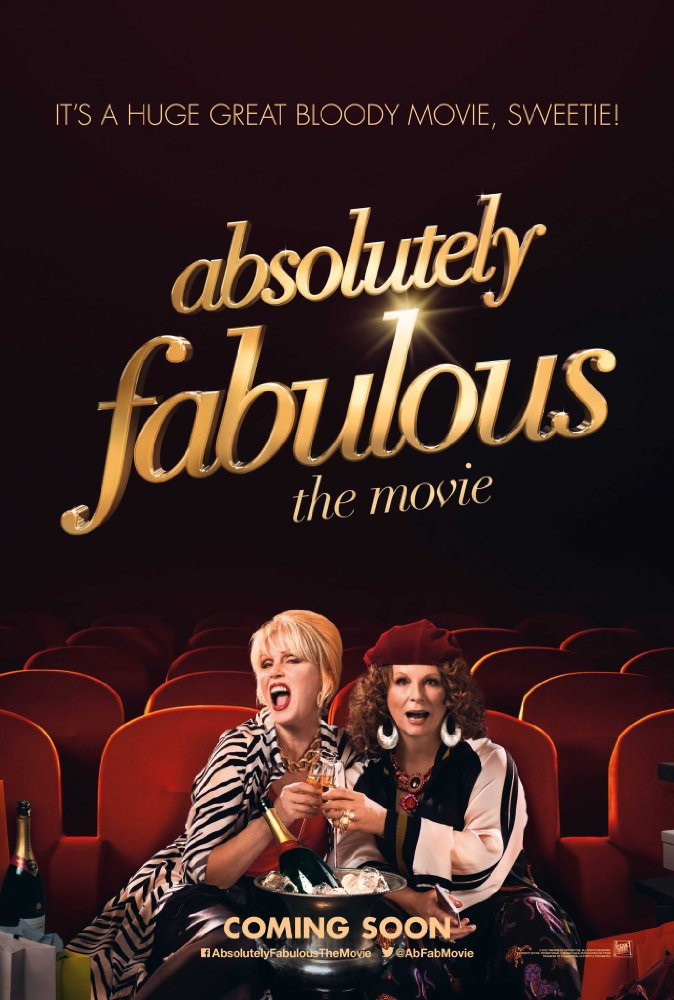
The Ab-Fabbers are back, this time in ABSOLUTELY FABULOUS: THE MOVIE


The popular British TV series Absolutely Fabulous, which had a twenty-year run (not bad!) during the era in which our last century slithered into this one, was a lot of fun and rather set the current stage for gals behaving badly. The product of writer and star Jennifer Saunders, with the help of costar Joanna Lumley, it deservedly captured the fancy of folk on both sides of the pond. Now, four years after the demise of that series (in Britain, at least; it may have ended earlier here in the USA), the movie version, long talked about and/or in gestation, arrives.

And? TrustMovies found it pretty good and often very funny, if a little too gassy and taking too much time to get airborne. I resisted for awhile, thinking, "What? All this again?" But then at some point I let out a loud laugh, began chucking at the antics of these two women -- Edina (Ms Saunders) and Patsy (Ms Lumley) -- and by movie's end was thoroughly satisfied that my humor quotient had been met for the day. The director here is a woman named Mandie Fletcher (shown at left) who helmed several of the TV episodes and so was evidently tapped by Ms Saunders and maybe the producers to direct the film -- which she has managed to do quite serviceably.

The setting this time out is the current world of fashion, which is shown us as mostly a hotbed of silliness and stupidity. Edina (below, left), who hopes to land a book deal for her memoirs (what she submits to the publisher is pretty funny) but is rejected, then moves her goal to doing PR for the fashion set.

Ms Lumley (above, right) plays her usual hanger-on, providing drugs alcohol and other fun stuff. But the ladies are down to their last pound -- even if they are living in a modern mansion well beyond their means.

Series regulars like Julia Sawalha (as Edina's straight-laced daughter) show up, along with "secretary" Bubbles (Jane Horrocks, above, left) and Edina's mother (June Whitfield, above, right) -- with the latter two barely used except as a kind of reminder of the fun we once had.

So the movie belongs, and rightly so, to Saunders and Lumley, the latter of whom seems to hang back and be used for the usual only -- until a little over halfway along, when she comes into her own with a delightfully goofy impersonation that will keep a grin plastered on your face for the remainder of the movie.

The film owes its ending to the great Some Like It Hot but the homage/steal is good enough to please fans of both films. We get currently posh-if-squalid London and the French Riviera as locations, plus Ms Sawalha doing Karaoke in a gay club (above), and a bunch of cameos from folk we love (or maybe used to) such as Joan Collins and Barry Humphries (above) -- plus a few new surprise personalities, as well.

As it is set in the fashion world, we get our fill of "fashion" faces, too. Kate Moss (above) is used for beauty and fun, good-naturedly putting herself through the wringer for our gals. And none other than Jean-Paul Gautier (below) makes an ironic appearance as a old beachcomber-type fellow searching for coins and other precious metals in the beachside sand.

A word must also be said for one of the most beautiful new faces to light up the screen in some time -- that of Indeyarna Donaldson-Holness (shown below, left), the lovely young girl with a mouthful of a name, making her screen debut as the Saunders character's granddaughter, Lola.

So, yes, you can expect to have a good time at this current rendition of Ab/Fab. It's not great art but it is (mostly, at least) good, silly fun.

From Fox Searchlight and running a thankfully lean and let's-not-outstay-our-welcome 90 minutes, the movie opens nationwide this Friday, July 22. Click here (then scroll waaaaay down to the bottom to find the theaters nearest you.