Showing posts with label film history. Show all posts

Monday, April 9, 2018

At NYC's Film Forum, Rüdiger Suchsland's treasure-trove of seldom-seen movies -- HITLER'S HOLLYWOOD: GERMAN CINEMA IN THE AGE OF PROPAGANDA: 1933 - 1945


History buffs, particularly film history aficionados, will likely revel in the new documentary opening at New York City's Film Forum this Wednesday, for it will opens the doors to what (for most of us non-Germans, at least) we have only heard of fleetingly and certainly never seen: those movies -- more than a thousand of them! -- produced by Nazi Germany during the Third Reich. Thanks also to Film Forum, we've seen a couple of documentaries over recent years that showed us some of the especially antisemitic movies the Nazis produced (two fine docs by Felix Moeller: Harlan: In the Shadow of Jew Süss and Forbidden Films: The Hidden Legacy of Nazi Film), but this new one is like a deep dive -- psychologically and historically -- into a particular German cinema that, while plenty antisemitic, is also romantic, crazy, bizarrely funny and really quite sad. And sick.

Written and directed by Rüdiger Suchsland (shown at left), HITLER'S HOLLYWOOD: GERMAN CINEMA IN THE AGE OF PROPAGANDA, 1933 - 1945 proves an unveiling of the past that few of us (even, I suspect, younger generation Germans) will not have seen. Out of the hundreds of movies made under the Third Reich (many of which probably never survived) Herr Suchsland has chosen snippets from a very interesting array to tantalize us, as well as put forth some pretty compelling theories regarding what and why.  What did Nazi Germany dream about?" the director asks early on. Death is the answer. These movies are full of self-sacrifice and an almost mythical, mystical yearning for death.

But, golly, so many of these deaths were somehow "happy" ones -- at least in Nazi cinema. The movie never states this, but I could not help but wonder if Hitler and his closest crew -- Goebbels, Himmler and even Leni Reifenstahl -- somehow knew (and on some weird level even wanted this) that their whole enterprise was doomed from the start. When you dedicate everything to death, rather than life, what the hell are you actually asking for?

One of the many little jolts of recognition that arrive regularly throughout the film comes as Suchsland explains how almost completely devoid of irony and how full of "forced cheerfulness" Nazi movies are. You may remember at that point how often German cinema of the 40s, 50s and 60s was accused of having little sense of humor. Thankfully, that's no longer true (see Look Who's Back and Not My Day, for two very funny recent examples.)

Another example: As we watch those "amazing" parades of German youth dressed in military garb, Suchsland sums it all up: "Modern Synchronized movement. And future cannon fodder." Yes, death again.  There's even more "happy death," as we examine briefly Hitler's Euthanasia movement. And did you know that the German version of Titanic, while banned in its home country, was still allowed to be seen in the "occupied" territories?

Among the enormous number of directors, actors, and actresses who parade before us, several stand out, one of whom is described by Suchsland as "a Janus-headed artist stuck between collaboration and resistance," the work of whom Goebbels despised but Himmler loved. According to the filmmaker, one late-in-the-game movie -- Großstadtmelodie -- seems to actually defend the right to privacy and even happiness in the here and now! So take that, death-lovers!

How the filmmaking changed as Germany became ever-more Nazi, went to world war and then began to lose that war is captured via the parade of films we see. And while, along the way, you may wonder about some of Suchsland's conclusions, it is clear that this filmmaker knows a hell of a lot more about German filmmaking during this period that any of us, so it will be difficult to disagree with many of his conceptions. He makes a generally fine guide to a period of filmmaking in a specific place that many of us may imagine we know but until now, at least, have mostly been flying blind.

Hannah Arendt and her ideas make a helpful, thoughtful appearance or two, helping to stress Suchsland's major point: that a country's people can indeed become -- at least in their own mind and imagination -- the movies that they see. Hitler's Hollywood proves quite the  revelation; for anyone interested in the filmmaking of this time and place, it is not to be missed.

From Kino Lorber and running 105 minutes, the documentary opens in its U.S. theatrical premiere at New York City's Film Forum this Wednesday, April 11, for but a one-week-only engagement. It is also scheduled to be seen in Baltimore at the Parkway Theater, beginning April 27, and in Chicago at the Gene Siskel Film Center on May 11. Click here and scroll down to keep abreast of any further playdates, cities and theaters.

Saturday, October 14, 2017

On DVD, a delightful, 203-minute course in American film history -- THE CHAMPION: A Story of America's First Film Town


What a little treasure trove for film lovers is the new Milestone Cinematheque release of THE CHAMPION: A STORY OF AMERICA'S FIRST FILM TOWN. I may have previously heard something about Fort Lee, New Jersey, being a place where early movies were made, but nothing had prepared me for the details that spill out -- surprising, funny, and full of so many names of our early and important filmmakers, actors and eventual and/or would-be moguls -- during this 35-minute-but-too-short-by-half documentary.

It's rare for TrustMovies to wish a film were longer, but he could have easily sat through another hour or more of this one. Still, this two-disc set is more than worth its cost, as it also offers eight silent films from the heyday of Fort Lee (the early 1900s through World War I) plus another short documentary from 1935 detailing even more about movie-making in this New Jersey precursor of Hollywood that was, by the 1930s, already a movie-making ghost town.

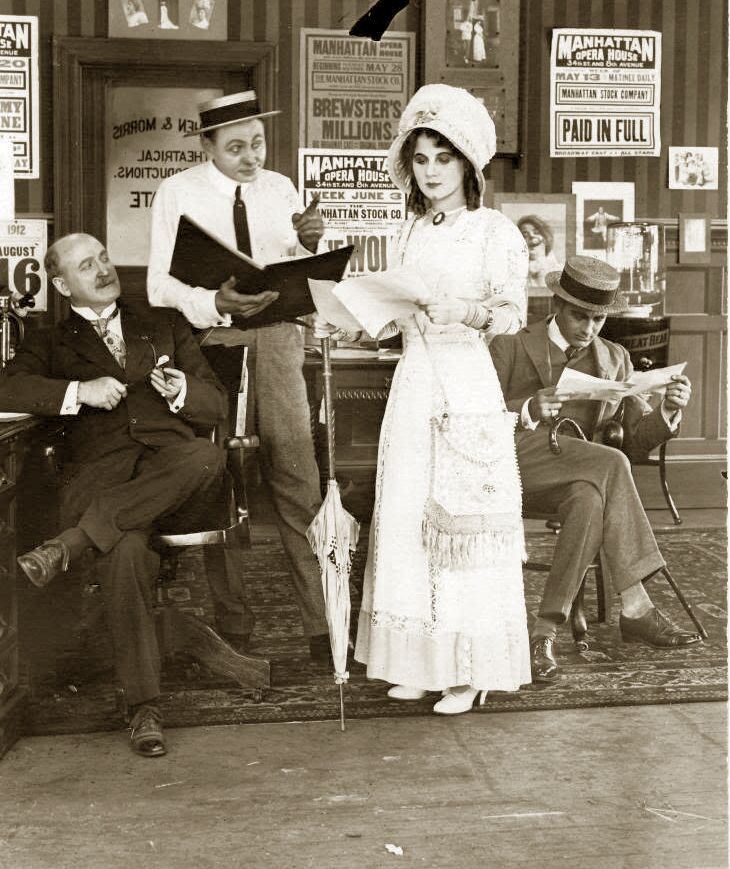
As written and directed by Marc J. Perez (based on the book Fort Lee, the Film Town by Richard Koszarski), The Champion takes us to the spot where those famous Perils of Pauline were filmed, shows us what certainly must be one of the earliest "special effects" to be seen onscreen (in a silent movie called Rescued from an Eagle's Nest), and puts us in touch with some famous (or almost) names like Florence Lawrence (shown above), said to be the first real "movie star," as well as stand-bys like Goldwyn, Laemmle and Sennett, as well as names that ought to be better known and maybe someday will be.

In that last category would fall the first black feature filmmaker, Oscar Micheaux, and the first female filmmaker, Alice Guy-Blaché, who wrote, directed and/or produced some one thousand films and actually owned her own film studio -- all before women could even vote here in America.

The Champion concentrates most on a man named Mark Dintenfass, who came to Fort Lee in 1910 and decided it would be smart move to build a studio nearby (in Englewood Cliffs). He purchased land and built what would become the hugely successful (for awhile) Champion Studios, the mark of which is shown below.

This story, along with many others, are told briefly and well in the documentary, which ends, as I say, too soon, but then allows you to take a look at some of the silent films that came out of this era and town. Chief among these is the 31-minute version of ROBIN HOOD, made in 1912 by Eclair America, which was to become the first American-produced version of the tale. The longest of the films is THE DANGER GAME (from 1918) running one full hour.

The other short silents run from nine to eleven minutes each, and though some are in better restorative shape than others, all are great fun to watch and marvel over -- both for how far film (and now video) has come, and how much fun, even enlightening, it could be back at its near-beginning. In fact, this new set makes a lovely complement (or maybe vice versa) to one of last year's most interesting movie-history documentaries, The First Film.

From The Milestone Cinematheque, and running, in all, 203 minutes, this two-disc set features a 2K restoration of that 1935 doc on Fort Lee entitled Ghost Town. For five of the films, all produced at Champion Studio, this new release marks the first time these silents will have appeared on DVD. Special thanks are due The Fort Lee Film Commission for its work in putting together this fine set. The Champion, complete with all its extras, hits the street this coming Tuesday, October 17 -- for purchase and/or (I hope) for rental, too.

Monday, June 5, 2017

Bill Morrison's most mainstream -- yes! -- endeavor yet, DAWSON CITY: FROZEN TIME


TrustMovies has loved (to some degree) every Bill Morrison movie he's seen so far, from Decasia and The Miners' Hymn to The Great Flood and Beyond Zero: 1914-1918. But in recommending any of them, as I have always done, I've also had to place a caveat along with that recommendation that the movies require some effort on the part of the viewer. They are not your standard sit-back-and-watch-that-superhero-in-action sort of thing. Now comes DAWSON CITY: FROZEN TIME, in which Morrison's love of everything from movies to decaying film, history, oddball facts, social justice and more all come to the fore and provide -- thanks to the crackerjack tale he has to tell -- that almost anybody with minor intelligence and love of movies and history can enjoy. Yes, this film is utterly accessible.

The story here -- which details the how, when, where and why of the discovery of what may very well be the largest single load of silent movies, long thought to have been destroyed, that has even been recovered -- is so terrific and well-told that it is hard to imagine Mr. Morrison (the filmmaker is shown at left) ever being able to top this film in terms of again finding a tale so filled with all the things he cares for most and is most adept at filming. His movie held me in thrall from its first frame throughout its complete two-hour running time.

Dawson City tackles everything from the Klondike Gold Rush to some great old silent movies and features everyone from Charlie Chaplin to an honest-to-god avalanche that looks more real and shocking than anything our special effects wizards have put together in recent times. We even get a sneak peek at how the Trump family's (yes, sleazy Donald's) fortune actually began -- with the combo hotel, restaurant and whorehouse shown below.

Once gold was discovered, we see how the newly minted mining town of Dawson City rose from what was formerly a perfectly lovely village of an indigenous Canadian Indian tribe that had occupied the area for ages.

Morrison dots his movie with lots of fascinating history and anecdote, along with the inter-cutting of those silent movies (as above and below) right into his film in order to demonstrate salients points along the way. This is an inspired, charming, often funny and always on-target means of reminding us of the importance of both history and film and how well they can and should complement each other.

Needless to say, almost all of these are not silent movie scenes that we've viewed previously anywhere else because, so far as any of us knew, all this had been missing or destroyed. Along the way see view footage of everything from Palestine (in 1907!) to the infamous Black Sox Baseball Scandal, as well as wonderfully detailed history of the odd up-and-down fortunes of Dawson City itself.

With the exception of the film's first few minutes, and then at around the hour-and-three-quarters point, we get something unusual from a Morrison movie: verbal narration. The remainder is, as usual, told us via visuals, music (by Alex Somers and often exceptionally beautiful) and an excellent written narration, all of which somehow seems exactly the right way to unfold this remarkable story.

Toward its end the movie even turns into to a bit of a "love story," and the finale features a montage of a host of water-damaged, decaying film that Morrison so loves and when used in this way produces its own very special "special effects." Over time, I think I am beginning to love and appreciate the strange beauty of this decay, almost as much as does Morrsion. Maybe you will, too.

Meanwhile, the movie will make you most grateful that this treasure trove of film was buried in the cold, preserving climate of the Yukon. The reason, as we learn, was that Dawson City was the last stop on the circuit of towns that played these films, and the movie companies did not want to pay the freight charges to ship their films back. Thank god that last stop was not somewhere down here in hot-weather Florida.

From Kino Lorber, Dawson City: Frozen Time opens this coming Friday, June 9, in New York City (at the IFC Center) and on June 16 in Chicago (at the Gene Siskel Film Center,) Los Angeles (at the Landmark NuArt) and San Diego (at the Digital Gym). To view all currently scheduled playdates, cities and theaters, click here and then scroll down.

Friday, September 9, 2016

Who really originated the "moving picture"? David Wilkinson's THE FIRST FILM hits VOD


Garnering in Britain an actual theatrical release and some very nice critical praise, THE FIRST FILM -- by British filmmaker David Nicholas Wilkinson, who directed, co-wrote (with Irfan Shah) and co-produced -- appears to be going straight-to-digital on this side of the pond. This is a shame, I think, because the movie, in many respects, deserves the kind of coverage that a theatrical release would entail. It posits that so much of what we think we know about who was responsible for the beginnings of cinema -- Thomas Edison, the Lumière brothers, Georges Méliès -- is nothing like the entire picture, especially as concerns a French fellow by the name of Louis Aimé Augustin Le Prince (henceforth to be known in this post as simply Louis Le Prince).

Filmmaker Wilkinson (shown at right) is convinced -- and does an awfully good job of convincing us, in turn -- that it was Louis Le Prince who actually made what can be considered the first motion picture, even though only a tiny portion of same (a shot from which can be seen on the computer below) still exists. The raison d'être of the film can be traced to a public relations flub in which a book on film that mentioned Le Prince and his contribution was rejected for review by a couple of important media outlets because of its theory about Le Prince's contribution to the history of film. So pissed-off was Wilkinson that he set about making this film as a kind of proof of his thesis. Sometimes, it seems, a little righteous anger can lead us to positive ends.

As interesting and worthwhile as is The First Film, I would not call it an unqualified success, as it is a little bit too long and a tad repetitive. But so thorough and technically proficient is Wilkinson (shown below, right, with Daniel Martin of the Leeds Industrial Museum) in his research and investigation that we come away convinced that Le Prince was at least as important, if not more so, than any of the other names generally associated with the "birth of film." For this reason his movie becomes an instant must-see for anyone genuinely interested in and/or involved with film history.

The tagline on the poster at top -- The Greatest Mystery in Cinema History -- is no marketing ploy. A deep and still unresolved mystery lies at the heart of the film and its story: the complete disappearance of Le Prince just days before he was to unveil his moving picture. So, in addition to what we learn about the man's contribution to the birth of cinema (and there's plenty), Wilkinson also investigates that disappearance, with the help of everyone from an actual relative (Laurie Snyder, shown below, Le Prince's great-great-granddaughter, located here in Memphis, Tennessee), to an ex-policeman, and various film historians and technicians.

We get a good number of the usual talking heads, but as these include the likes of actor Tom Courtenay, who will complain? At the film's beginning, Wilkinson asks several people involved in film about Le Prince, and no one, it seems, has heard of the man. At the finale, he corners a few of them again and -- in the movie's most embarrassing moment (for the filmmaker) -- rather forces them to own up as to whether or not Wilkinson has proven his theory. Any intelligent viewer will by now have formed his own opinion, and so certainly does not need to be further prodded and cajoled by the filmmaker badgering his interviewees.

To my mind Wilkinson has indeed proven his point, and done so via good research, a technical understanding of the earliest cameras, smart investigation, and the ability to put some puzzle pieces together with flair and intelligence. And then, finally, to have made a movie about all this which, if not great, is good enough to pass muster.

There are a couple of fun, ah-ha! moments along the way -- one at a grave site (above) that helps seal the deal -- along with a genuine understanding of how difficult it can be to lay precise attribution to the idea of "being first," when so many people in so many places were simultaneously striving for the same results. Still, the reputation of certain "great men" are reduced a notch or two here. (What TrustMovies learned back in grade school about Thomas Alva Edison was certainly nothing like what he found here: Mr. Edison now seems less an inventor and more of a smart marketer and "patent thief.")

Overall the filmmaker has made a fine case for his findings that place Le Prince front and center in the history of film. We learn a lot about this unusual man and by film's end quite appreciate him and his efforts. It remains to be seen how willing the "film community" -- all those critics and historians and the rest who've accepted down the decades the conventional wisdom regarding who got there first -- will be to fully accept the Le Prince possibility, too.

Meanwhile, The First Film -- from Guerilla Films and running 106 minutes -- makes its U.S. debut this coming Monday, September 12, online via all major platforms. I would hope that a DVD will also appear at some point. We shall see. 

Wednesday, March 30, 2016

Samuel Beckett in and on FILM, as Ross Lipman's grand compilation, NOT FILM opens


When I tell you that today, we're covering a two-hour-and-nine-minute documentary about the making of a 22-minute movie, eyes will probably roll. But when the filmmaker is a fellow named Ross Lipman -- noted for his terrific restorations of works by Chaplin, Welles, Altman, Cassavetes, Shirley Clarke and Kenneth Anger -- and who turns out to himself have a tremendous talent for documentary filmmaking, you had best put his movie NOTFILM on your must-see list. That is, if you have any reverence for Buster Keaton, Samuel Beckett, cinema history and the artistic and filmmaking processes.

Lipman's movie (the filmmaker is shown at right) is all about how another, earlier movie got made: a film called simply FILM, written by that uber-famous-and-reclusive writer Mr. Beckett; directed by a noted theater director but newcomer to movies, Alan Schneider; and starring the beloved silent-film star, Keaton, who died the year after Film was completed.

TrustMovies imagined that he had somehow seen Film when it first appeared. Well, he hadn't. But he is happy to have seen it now. Though not considered much of a success upon its release, the little film holds up much better than critical assessment would have it. All about "the we and the I" (eye) -- with a nod to Michel Gondry -- Film is also about seeing and being seen, and, as always with Mr. Beckett, about the state of being itself.

Film is actually fun. That's a prime moment, above, in which the only sound in this "silent" movie is heard. There is also a marvelous scene of animals doing a kind of slapstick routine, and of course there's Keaton. And though, back in the day, critics and audiences were evidently flummoxed as to what the thing meant, now, with another half century of movies and film knowledge under our belt, audiences should have no trouble deciphering "meaning," should they need it that desperately. (It seemed pretty obvious to me.)

Also, Film lasts but 22 minutes. Even if you don't appreciate it (I think you will), you'll have spent almost no time at all. (We just watched Tarantino's The Hateful Eight last night and gave up nearly three hours to that well-acted, dreadfully written, poorly conceived, sub-level, Agatha-Christie-writes-a-western piece of trash. Talk about wasted time that one can never recover.)

Now, what about NotFilm? Can you really spend over two hours delineating/discovering what went into the making of Film? You have no idea. What Mr. Lipman has given us compiles history, personality, filmmaking and marketing, along with all the "art" and "chance" involved in the moviemaking process. And he does all this with such intelligence and grace that I probably could have watched a full four hours without tiring or even complaining.

Lipman begins with an interesting cliché that he then turns upside down: "Art shouldn't be about art, it should be about life -- as though they were indistinguishable." From there we meet Mr. Beckett and learn of his relationship with Barney Rosset and what he wanted to do with his Film and how he planned to achieve it. While this will be catnip for Beckett fans, even those, like me, who don't find his work as meaningful or brilliant as do some, it will still fascinate,

Using a number of talking-head interviews, done with smart and on-point Q&As with people like Kevin Brownlow; Jean Schneider (the widow of Alan); premiere Beckett interpreter, the now late Billie Whitelaw; and many others, including James Karen an actor friend of Keaton who plays a supporting role in Film, Lipman allows us to learn so very much about how art is created and how life intrudes on that art. (Mr. Beckett's cataracts -- that's the writer, shown above and below -- have much to do with how the Keaton character perceives the world in front of him).

We also witness, thanks to reams of archival footage the filmmaker viewed and then parsed, a number of small surprises (how Rosset managed to tape-record Beckett, who was adamant about never allowing himself to be recorded), as well as how Brownlow used his (then) excellent memory to write an immediate transcript of his talk with Beckett.

Lipman spent seven years making his movie, and it shows -- in everything from how people age and change to the amount of material collected and then sifted through to find the gems. We learn that an entire scene that would have brought Film to a half-hour length had to be cut; how Beckett even had camera angles mapped out; and how film critic Leonard Maltin, who was but a youngster at the time, managed to be there on location near the Brooklyn Bridge (above) as filming took place.

Finally Lipman addresses the change from photo-chemical film to digital, and alerts us that the latter is how his film is being shown. Yes, NotFilm really is not film. As written, narrated, photographed and edited by Lipman, this wonderful work is an appreciation of everything from the creative process to Beckett, Schneider and cinematography (we also meet and hear from the late Haskell Wexler who, only by chance, was unable to shoot Film).

This milestone work is being fittingly released via Milestone Films and will open in New York City this Friday, April 1, for a one-week run at Anthology Film Archives and in Los Angeles at the American Cinematheque from April 1 - 9. At both theaters you'll have the chance to see Film along with NotFilm. (Check the schedule for each theater.) Further screenings across the country can be found by clicking here. Whether or not Film will be shown along with NotFilm at other venues is unclear as of now. If I were you, I'd call the theater you're near and make certain -- beg if you must -- that management plans to schedule both for viewing.

Saturday, December 19, 2015

That great original, Harold Lloyd, debuts on iTunes with 100 YEARS OF HAROLD LLOYD


Most film-goers know Charlie Chaplin. Maybe a few less are familiar with Buster Keaton. But I wager that even less know the work of another of comedy's "greats," Harold Lloyd (1893-1971). Now, thanks to Random Media and Harold Lloyd Entertainment, some of the comedian's best work is available via iTunes in 100 YEARS OF HAROLD LLOYD.

Here come fifteen works from the library of this legendary silent film star: seven features and eight shorts, available for rental or download-to-own on iTunes beginning December 15th in the US and around the world. Lloyd's motion picture career actually spanned 34 years and included more than 200 films and shorts.

100 Years of Harold Lloyd will be available in three packages: The Films: a package of seven features; The Shorts Vol. 1, a package of three shorts; and The Shorts Vol. 2, a package of five shorts. The films will be released in various languages in over fifteen countries, arriving in many of these for the first time.

The feature films included in the package are: Dr. Jack (1922), Why Worry? (1923), Safety Last! (1923), The Freshman (1925), For Heaven's Sake (1926), The Kid Brother (1927), Speedy (1928). The shorts included are: An Eastern Westerner (1920), High and Dizzy (1920), Never Weaken (1921) in the first, and Take a Chance (1918), Young Mr. Jazz (1919) The Marathon (1919), Bumping into Broadway (1919), His Royal Slyness (1920), in the second.

Each feature film and collections of shorts will be available to own for $14.99 HD / $11.99 SD or to rent for $3.99 HD / $2.99 SD. TrustMovies is not quite sure just how the "100 years" collection title figures into the picture, however, as neither this year nor next are the 100th anniversary of Lloyd's birth, death, or of his first or last films (his career actually began back in 1913).

For more information on 100 Years of Harold Lloyd (info which actually seems in very short supply), you can try clicking on the links following for iTunes, Random Media, Harold Lloyd Entertainment, or Alchemy (which acts as distributor for Random Media here in the USA). I tried my best but could only find mention of same on the Harold Lloyd site; on iTunes I could only come up with the first volume of short films.