Showing posts with label films about photography. Show all posts

Saturday, July 27, 2019

"Hey, look!" Stephen Wilkes' new documentary -- JAY MYSELF -- highlights the life, work and philosophy of photographer Jay Maisel


There have been a number of documentaries about famous American photographers over the past few years, and many of these have had their American theatrical debut at Film Forum. Here is yet another in the batch -- JAY MYSELF, about photography great Jay Maisel -- and it turns out to be one of the best yet: entertaining, thoughtful, wise, often pretty funny and occasionally even moving.

Ostensibly all about the major move Masiel and his family must make from the landmark bank building (on poster, left) the photographer bought for $102,000 back in 1966 (and sold for $55 million in 2014), the movie -- in just 78 minutes -- manages to capture a lot more.

As directed by Stephen Wilkes (shown at right) and written by Josh Alexander, the documentary bounces along mostly merrily, giving us somewhat of a history of Maisel, showing us quite a range of his very good photography, both commercial and artistic (Maisel himself would insist that one mode does not necessarily contradict the other), and offering up a portion of the man's philosophy of work and art.

This last can be summed up by the first two words of the headline copy, above, and Maisel makes a very good case for these words as a philosophy for any would-be photographer to live by.

Why so late in life is this major move necessary for Maisel? (The photographer, shown at left, tells us that he had planned to live in the bank building until he died.) But unless I misunderstood what I heard on the soundtrack, this very large structure costs around $300,000 per year to maintain. Enough said.

Still, a move like this, at Maisel's age, is no easy one -- not to mention all the "stuff" the photographer has collected down the decades (he has lived there for over 50 years!). And if the man is not defined as a "hoarder," this is only because there is so much room in his huge building that he can spread out his hoarding to the point at which his living quarters seem more like an oddball museum (see below and further below).

We hear from a number of photographers, mostly his friends and contemporaries, but what makes the documentary particularly special, TrustMovies thinks, is that the filmmaker has known Maisel intimately over such a long period of time. Wilkes was an intern for Maisel at the beginning of Wilkes' career, thanks to a portfolio that pleased his mentor, and the two have remained close ever since.

It's a delight to see so much of Maisel's work, while simultaneously hearing his ideas about "seeing." Art is trying to make others see what you see, he tells us, which is certainly one way to define an artist's objective. Regarding commercial art: You approach the job as an artist. And then you make as much money as you can. Interestingly, Maisel accords one of his teachers, Josef Albers, credit for helping him understand the uses and importance of color in art.

The documentary's musical score (by Jay Goodman) adds a lot of fun and bounce to the proceedings, all technical aspects of the film are first-rate, and its relatively short running time means that nothing and no one outstays their welcome.

From Oscilloscope Laboratories, Jay Myself opens this coming Wednesday, July 31, at New York City's Film Forum for a two-week run, before hitting another dozen or so cities across the country -- including Los Angeles (at Laemmle's Royal) on August 16 and here in Boca Raton at our Living Room Theaters on August 30. Click here and scroll down to see all currently scheduled playdates, cities and theaters.

Tuesday, February 12, 2019

The "old days" of Miami featured in Dennis Scholl and Kareem Tabsch's THE LAST RESORT


A fascinating journey by a pair of filmmakers that details the work of a pair of photographers who helped document a Jewish community and a piece of the history of Miami, Florida, that has now pretty much ceased to exist, THE LAST RESORT proves a small, precise and beautifully handled little documentary about some wonderful archival photography and the two very different fellows who took it. As good as is the photography itself -- and it is very good -- the tale told here of one of the photographers proves equally  compelling.

The filmmaking team -- Dennis Scholl (below) and Kareem Tabsch (at left) -- have lovingly assembled both the photos and the stories of the photographers, Andy Sweet and Gary Monroe, their friends and family, and especially the residents of the South Beach area of Miami back in the 1970s, when so many of these folk had their "pictures taken."

In just a brief 70 minutes, we are made privy to what seems like an entire community of retired Jews -- quite a few of
them Holocaust survivors -- who made their permanent, often final home here in Florida. The documentary is a combination of history, Sweet and Monroe's photos, older archival shots, and interviews with a wide range of people -- from friends and family to residents and their younger relatives. One of the latter includes noted filmmaker Kelly Reichardt (Certain Women).

Although TrustMovies cannot find any reference to the "writers" of the film, he is guessing that may have been Scholl and Tabsch, as well -- both of whom are South Florida  residents and filmmakers. Whoever wrote the narration of The Last Resort, it is very well done, providing oodles of info in an entertaining, fast-moving fashion.

But it is the photo array that certainly seals the deal. You could hardly ask for more different styles that Sweet and Monroe offered -- the former shot colorful, off-the-cuff photos (as above) that captured the moment and people with delight and glee but zero sense of anything judgmental; the latter shot only in black-and-white (below), in a much more formal, artful manner.

Both styles work beautifully and actually manage to complement each other. Though the two photographers often ribbed each other about how each chose to work, they remained close for a long while and quite committed to their project of recording this fading community.

Although Gary Monroe is the photographer who is still with us, the movie devotes much of its narration to Andy Sweet. Little wonder, as his story is by far the most -- in movie terms, at least -- melodramatic and compelling. It is also hugely sad, but difficult to write about without giving away spoilers.

We see much more of Sweet's life, from his early years onto teen youth and adulthood, with Monroe providing narration and updates, as needed. In fact, Sweet and his story begin to take over the film  from maybe the midway point onwards.

This is not a bad thing, since his story is such a mind-boggling one, and the Miami Jewish community is mostly shown us only by the photos the two men took. Both Sweet and the community are gone now, yet their histories survive, thanks to this fine little movie and the photos -- the reclamation of which the documentary's final section is devoted --  that tell the story.

Distributed by Kino Lorber, the documentary opened in New York City this past December and will hit South Florida, its natural audience, this Friday, February 15 -- at the Coral Gables Art Cinema, Miami; O Cinema Miami Beach; the Movies of Delray and Movies of Lake Worth; and the Living Room Theaters in Boca Raton. On February 22, it will play the Lake Worth Playhouse, and on March 1 the film will open at the Miami Beach Cinematheque, and in Los Angeles at Laemmle's Town Center 5. To view all current and past playdates, cities and theaters, click here. For information about personal appearances at the O Cinema, Coral Gables Art Cinema and Movies of Delray, click the link above to each of those theaters.

Saturday, November 4, 2017

DAGUERROTYPE finds chiller-master Kiyoshi Kurosawa filming (and fumbling) in French


Some of TrustMovies' favorite chiller films have come from Japanese director Kiyoshi Kurosawa, who has given us, over the years, Cure, Pulse, the recent (and perfectly titled) Creepy, as well as genre-jumping wonders such as Bright Future and Tokyo Sonata. In his latest to reach our shores -- DAGUERROTYPE (known originally as Le secret de la chambre noire) -- the filmmaker is working beyond his usual Asian locations and in the French language (the filming, I believe, was done in Belgium), and as is often case when filmmakers work in a language other than their first -- see Olivier Assayas' Clean or Personal Shopper for further proof, or especially Yorgos LanthimosThe Killing of  a Sacred Deer, which I will cover whenever its distributor sees fit to open it here in South Florida -- the results can be pretty iffy.

Kurosawa's dialog (the filmmaker is pictured at left) has never been what the viewer remembers best, in any case, as his visuals -- usually as subtle as they are chilling, with masterful camera movement -- pull us in and hold us fast.

This is true again here, too, except this time his film moves exceedingly slowly and is freighted with a plot so utterly manufactured and full of coincidence and nonsensical behavior that we hold on only for those occasional but very impressive visuals. As usual, what Kurosawa chooses not to show us is often as meaningful and impressive as what we actually see.

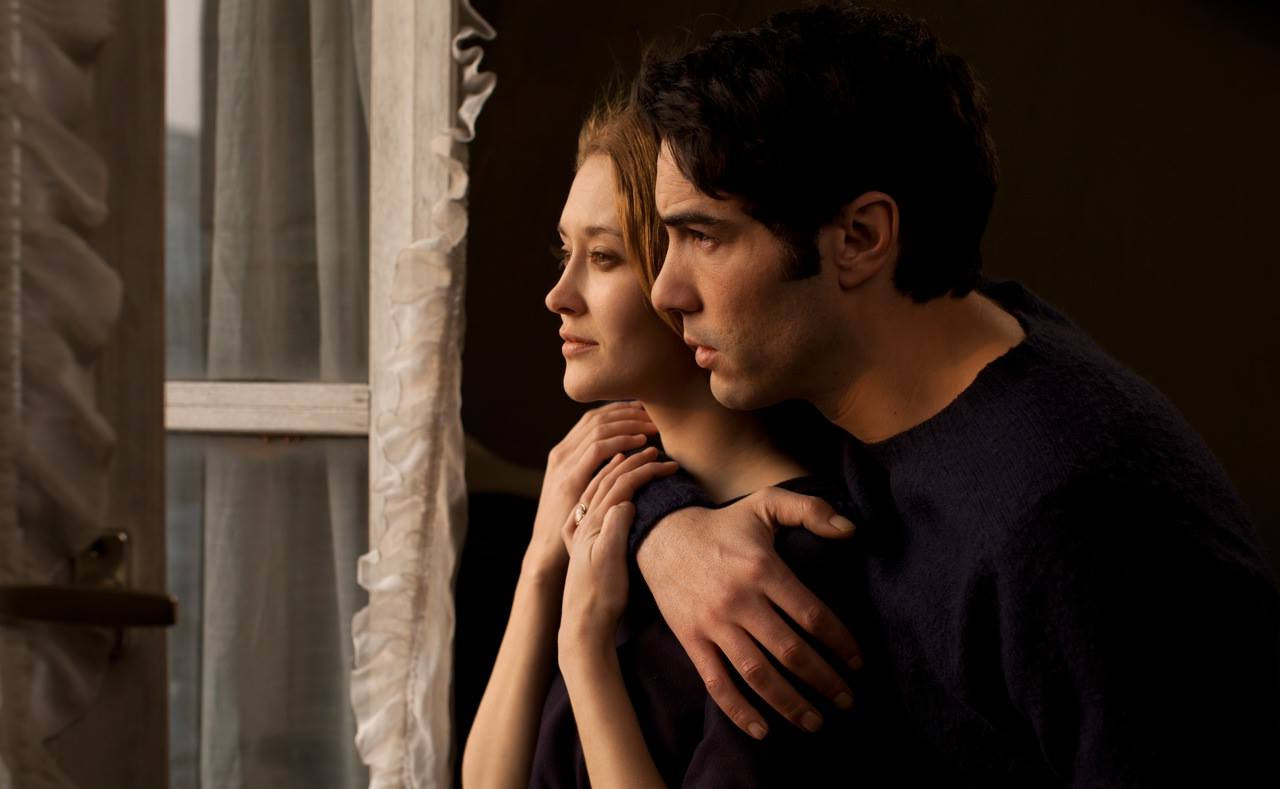
Not being nearly as familiar with as many Asian actors as I am the western variety, I must say that the filmmaker has assembled a crack cast to perform his little divertissement. His star is that remarkable French actor Tahar Rahim (shown above and below, right), who broke through to international acclaim in 2009's A Prophet, has now amassed 25 movie/TV credits, and in the ten films I've seen has never given less than a sterling performance.

Rahim possesses a remarkably beautiful, sculpted face that expresses much yet seems to do very little in the process. I don't know that he has ever had an unbelievable moment on-screen, and his innate sensuality/sexuality is such that it spills over into everything he does without being at all "pushy." If you have not seen his lovely turn in Heal the Living (now streamable on Netflix), you really must.

His co-star here is the pert and delicate Constance Rousseau, above, whom I've seen a few times previously but never in a role as large as this one. She and Rahim make a fine pair; their chemistry is good, even if their dialog is generally so-so.

The movie's third wheel is that fine Belgian actor Olivier Gourmet, shown above, right, with yes, the great Mathieu Amalric, at left, who does a mere walk-on in the film. Here, as he often does, Gourmet seems to personify a "walking, talking frown." He plays the Rousseau character's unhinged father, an old-fashioned daguerrotype photographer who used to be a hotshot fashion fellow, but upon the death of his wife, seems to have gone round-the-bend. Gourmet has a single scene in which he is allowed to behave and emote a bit, and he's terrific, as ever. Otherwise, he is condemned to that movie hell reserved for actors working with directors of a foreign tongue.

It is Gourmet's hiring of Rahim that sets the would-be plot in motion, as the younger man learns some of the trade of the older, while beginning a relationship with the daughter. Botany and French real estate (along with its burgeoning value) figure into film's later development, and more silliness ensues. Daguerrotype is never in the least frightening nor chilling, even given its many nods to death and ghosts. Further, its love story seems paltry, despite the efforts of its two stars. I admit to being happy to have seen the film, however, if only for a few precious visual moments. It's a rare Kurasawa miss, nonetheless.

The best thing about the film, in fact, would be its lovely poster image (shown at top), which turns out to be cribbed from the still above and then colorized to make a certain point. (That point actually gives away the single surprise this movie has up its sleeve, and even that surprise should be obvious early on to those viewers who have seen more than a handful of films in their life.) From Under the Milky Way, in French with English subtitles and running an unconscionably lengthy two hours and twelve minutes, the movie arrives on VOD nationwide on Tuesday, November 7, on all major platforms including iTunes, Sony, Google Play, Amazon, Microsoft, Vudu, Comcast, Charter, Cox, Vimeo, and various other cable operators. 

Monday, April 28, 2014

Dan Wechsler's MORE THAN THE RAINBOW: NYC photography and photographers come to fine life


Ostensibly all about the hugely talented New York City street photographer Matt Weber -- and indeed there is plenty of Mr. Weber and his fine work on display here -- MORE THAN A RAINBOW, the documentary made in 2012 by first-time filmmaker Dan Wechsler grows into a truly interesting discussion of photo-graphy and its discon-tents via a half dozen or more other photo-graphers, several of whom I believe make their home, too, in one or another borough of New York City.

Mr. Wechsler, shown at right, along with his cinematographer Arlene Muller and editor John Rosenberg, does a crack job of putting together a movie full of energy, pizzazz and found art (rather like the city it covers). Its photographers are not at all shy about communicating, and as they seem extremely intelligent and well-spoken, it's a pleasure to hear most of them spout, just as it is to see their quite varied work. Only one of them seems something of an asshole, a fellow named Eric Kroll who seems to actively dislike Mr Weber's work and has no qualms about telling us this. Kroll's own work, involved solely in sex and Kroll, seems not nearly as interesting (and if you're familiar with TrustMovies, you'll also know he has nothing against sex of almost any kind).

Other photographers include Dave BeckermanBoogie, Ralph Gibson, the Philadelphia-based Zoe Strauss, Jeff Mermelstein, the late Ben Lifson and more, and while the subjects discussed begin with and bounce off Matt Weber (shown above, center, and below), we're soon into subjects that range from color versus back-and-white and how steam seems endlessly attractive for New York City shutterbugs to love relationships, how day jobs impact on photography (Weber drove a cab for twelve years to earn his keep) Capitalism, and photographs of 9/11.

Regarding that last subject, one of the interviewees here maintains that a particular shot of Weber's from 9/11 is the best photo taken on that day -- and one of the most poignant  pictures in the history of photography. You'll just have to see the film to see the photo, and yes, I'd pretty much agree with that assessment.

Some of Weber's other works are shown here, and -- damn -- they're good, taking us back to the heyday of street photography and demonstrating why New York City's vitality seems a constantly burgeoning thing. We've got 3 Sailors, Times Square (above, from 1989) and Van Gogh, below, also from 1989.

There's an Ecstatic Obama Girl from election night, 2008 and one of those must-snap-it steam shots, titled Homeless Heat (1990), further below.

We watch wonder boy Todd Oldham putting together a book on Weber's photography (Did that particular book ever see publication?)

Finally, if the movie seems to run down a bit prior to its close, this may be due to filmmaker Wechsler's not quite knowing where to go or how to end his piece. Even so, there is plenty of art and life on the screen,
and plenty to think about when it's all over.

More Than the Rainbow, from First Run Features and running 82 minutes, opens this Friday, May 2, in New York City at the Quad Cinema, and in Los Angeles at the Arena Cinema from May 24 thru May 26.

Bonus: Because this film is being distributed by First Run Features, we're pretty much assured of a DVD release eventually (one photographer friend of mine wants to own it ASAP) and probably some streaming venues, as well.

Sunday, March 30, 2014

First film from a new distributor, RAM Releasing: Nate Taylor's creepy/sad FORGETTING THE GIRL


If any of you out there have wondered, sometimes, at least, why a company like Film Movement -- that possesses one of the higher art/mainstream taste levels among our current lot of distributors -- doesn't occasionally get a little more down-'n-dirty and give us a kinky or grueling genre piece, you can now say hello to RAM RELEASING, which is a subsidiary or maybe just a division of Film Movement that will be releasing some of those genre films. The first (that TrustMovies has seen, anyway), directed by Nate Taylor (shown below) from a screenplay by Peter Moore Smith, comes upon us this Tuesday, April 1, on DVD and Blu-ray, and is called FORGETTING THE GIRL.

If Music Box Films can spawn Doppelganger, Miramax birth Dimension, and IFC create a Midnight division, why not Film Movement? And if the previews for two upcoming RAM releases on this new DVD -- APP and Hide and Seek -- look more interesting than the movie at hand, so be it. Forgetting the Girl certainly starts well enough, with our "hero," photographer Kevin Wolfe (played by an alternately cute 'n creepy Christopher Denham, below) recording himself on camera and telling us that, if we're watching this, then things are not so good. Then we begin to learn about some of the girls that Kevin needs rather desperately to forget.

The first of these is a blond looker named Adrienne (nicely played by Anna Camp, below), who actually asks Kevin for a date, rather than what usually happens: He asks the girl and the girl says no.

Another very pretty, though rather quiet and shy young woman named Beth (Elizabeth Rice) enters Kevin's life, and soon one of the girls has disappeared. What has happened?

Suspicion falls on everyone from our nutty shutterbug to his landlord (Paul Sparks), a fellow who goes in for crude porn photos (which we hear about but do not see), and even on his erstwhile office manager, a young woman named Jamie (Lindsay Beamish, above) who clearly has a yen for her boss.

The boss, as we know from nearly the first scene, is greatly troubled by a childhood incident involving his younger sister. This is related verbally, as well as shown us in bits and pieces, over and over again. When at last -- in one shocking, sudden moment -- what's going on becomes clear, this is both a relief and a bit of cheat.

Most viewers, I think, will have cottoned on to what has happened in the past, and will not much care about the would-be hero of our film, which slowly goes from interesting and off-kilter to tiresome and obvious. There is a real sadness here, however, and a shockingly high level of wasted lives to account for. If only all this were not simply the fodder for some heavy-duty blood & gore. Well, movie-makers must bow to what their genre audience wants, I guess....

In any case, the movie will make young, would-be actress/models think twice before agreeing to get those head shots they've been putting off for who knows how long. Forgetting the Girl hits the street on DVD and Blu-ray this coming Tuesday, April 1. Meanwhile, I'm looking forward to the next pair of releases from RAM....

Saturday, October 27, 2012

Twilight time: In GREGORY CREWDSON Brief Encounters, Ben Shapiro shows an amazing photographer at work

How much can one photographer pack into a single photo? Whatever you might have previously imagined regarding this question, I think you'll be surprised at what the shutterbug (that's not quite the right word) profiled in the new documentary GREGORY CREWDSON: Brief Encounters can manage.

If TrustMovies has seen up to now any of Crewdson's work (shown above and further below), he was unaware of this, so he came quite fresh to the film. And he wonders: Had he seen this man's photos before watching this movie, would he have been remotely aware of how much work -- time, money, energy, and above all detailed planning -- goes into each shot? He'd like to think so, but maybe not. How could any mere observer imagine what taking each of these photographs entails? Still, the end product in every case -- rich, resonant and haunting -- is certainly impressive.

In this film, directed by Ben Shapiro and starring Mr. Crewdson (seen at left), the photographer shows us (as well as explaining) why he prefers shooting at twilight time, when day is no longer but night has yet to arrive. Others have found a sense of menace and nightmare in the man's work; I find mostly melancholy and sadness, as well as a rich vein of beleaguered humanity and maybe just a tad's worth of hope. The photographer takes us to his small town in Massachusetts, where the photos from Beneath the Roses -- the series from which the work shown here comes -- and then involves us in everything from his earliest thought processes and connections to the idea for the photo through its planning and set-up and completion.

For audiences members interested in art and where it comes from, not to mention specifically photography and photographers, this is fascinating stuff. And filmmaker Shapiro is careful to temper the technical talk with interesting reflections on family and history, along with how Crewdson works with his "actors" (below) and his crew to achieve the particular results he demands (above).


Crewdson thinks of his work as a kind of film-making and the comparison is apt. Yet, insisting on the kind of detail he does here (see below!) in a full-length film would demand a budget that would make even James Cameron or Michael Bay blanch.

Along the way we learn about the photographer's psychologist father, his early life in Brooklyn (he played in a band while in high school, and the group even wrote one song about photography -- a snippet from which we hear), and how his early viewing of a Diane Arbus show affected him. We also hear from novelists Russell Banks and Rick Moody regarding this man's art. By the time we leave Crewdson -- wandering through the old Cinecitta studios in Italy -- we can't wait to see what this world-class photographer does with that.

From Zeitgeist Films and running just 77 minutes, the movie opens this Wednesday in its U.S. theatrical premiere at Film Forum in New York City. To view all currently scheduled playdates around the country, with cities and theaters shown, click here.

Tuesday, October 9, 2012

Documentarian Ross McElwee returns -- and he's got a PHOTOGRAPHIC MEMORY

It's been nine years since Ross McElwee's last documentary, Bright Leaves (his last that I saw, at least. Most of us, I suspect, mis-sed his In Paraguay from 2008), which explored, among other subjects, North Carolina's tobacco history. His newest off-the-cuff foray into himself and his life opens this week, and I think it might be my favorite of all of his work that I've seen (which includes Sherman's March and Time Indefinite). It is near-perfectly titled PHOTOGRAPHIC MEMORY, and it deals with his life as a photographer (not as a filmmaker), with memory, and with (as usual) himself and especially his son Adrian, who has morphed from a dear and charming child into -- oh, god, all us parents will identify with this -- a surly, angry teenager.

But wait. Adrian (below) has a point or two to make along the way, and McElwee (shown at right) allows him this, especially in one wonderful semi-rant about why his dad has taken it upon himself to search Adrian's room. The son's thought processes and questions to his dad are exemplary, I think. (All teens should see this movie and have Adrian's words at the ready -- as long as they're also making some attempt to understand their responsibility to themselves and to their parents.) In a movie crammed to the brim with three generations of father-son tsuris, the filmmaker never loses his easy-going charm and his singular ability to serve up major life themes as though they were simply part of today's menu, thank you very much.

In the midst of all this, Mr. McElwee decides to hit the road (or cross the ocean) back to France, where he spent his, we might call them, formative years, learning the photography trade and getting involved with a beautiful young French woman, Maud (below -- shades of Rohmer!), and being hired to help shoot weddings and communions by an interesting fellow named Maurice.

In this process, the filmmaker begins to question most everything: his behavior vis-à-vis Maud and Maurice, their behavior (and intentions) toward him, photography, memory, even our current move from film to digital technology -- and of course his relationship with his son, who has lately taken to engaging in extreme (and maybe dangerous) sports.

McElwee make his movie into a kind of mystery, which lends the experience some welcome suspense and tension. Will he rediscover these people who were so important to him for a time? Will he learn what really happened and why? To give away more would be to spoil your fun and the filmmaker's journey, but I will say that to hear this American southerner speaking French is one of the unexpected amusements of the movie (well, for us; maybe not so much for the French).

And his relationship with his son? Well, those of you who live in the New York City area can actually meet that little boy (shown at the beach, two photos up) and brushing his teeth as dad shoots him, just above, when the grown-up Adrian and his father make a personal appearance at the IFC Center in New York, where this lovely, quiet and resonant movie makes its theatrical debut this coming Friday, October 12. On that date, the film -- from First Run Features and running 87 minutes -- will also debut in Hartford, Connecticut, at Real Art Ways and in Chicago at the Gene Siskel Film Center. You can see all currently scheduled playdates, with cities and theaters, by clicking here.