Showing posts with label freedom fighters. Show all posts

Friday, August 30, 2019

Is Pierre Schoeller's ONE NATION, ONE KING the best French Revolution movie ever?


If not, it's pretty damned close. This 2018 film, just now being released in the USA to DVD and VOD, is so stunning and vital in just about every way -- visually, intellectually, emotionally -- that for the first time, TrustMovies found himself understanding so much more about what was going on during this incredible time of change for France and its populace than he had ever been able to do before, while viewing a movie on the subject.

ONE NATION, ONE KING (Un peuple et son roi, which translates into the far more meaningful title of "A people and their king') was written and directed by Pierre Schoeller (shown at left), who has done a couple of other interesting films (Versailles and The Minister), but nothing I'd seen prepared me for the breadth, depth and scale experienced here.

Schoeller has managed to combine beauty and spectacle with personal stories that grab us; political notions of many sorts (along with the particular folk who harbor them) that highlight the thinking of the time; and a look at the various classes -- from the French royal family on down to lesser royalty, the intellectual set, and the illiterate peasants and workers who strive for bread, shelter and some semblance of freedom.

Best of all, he gives all these characters their due, so that we come to understand, even if we cannot always sympathize with, their particular plight. And actually, he comes surprising close to gaining our sympathy, even for the French King, played extremely well by Laurent Lafitte (shown center, above and below). We first see Louis XVI performing a traditional religious ceremony in which he washes the feet of "poor children," and it is immediately clear, when one of the children actually speaks to him, that this King has no understanding or any genuine empathy for his people. And yet, over the course of the film, the more we see of him and his family, the more we come to understand the way in which extreme privilege both frees and imprisons its bearers.

The intelligentsia gets equal time, and we hear from a rather large number of them -- most impressively from the standout Denis Lavant (below, center) as Marat

and Louis Garrel (below) as Robespierre. Garrel gives us just barely a hint of the foul craziness that absolute power, even for a short time period, can bring with it.

The movie is awash with some of France's better thespians (that's Niels Schneider, below, second from right, as Saint-Just), but what these characters say proves every bit as interesting as who they are. I suppose it helps if you have some sense of France's history. Mine is certainly not that good, but I still found the film as intelligent as it is rousing.

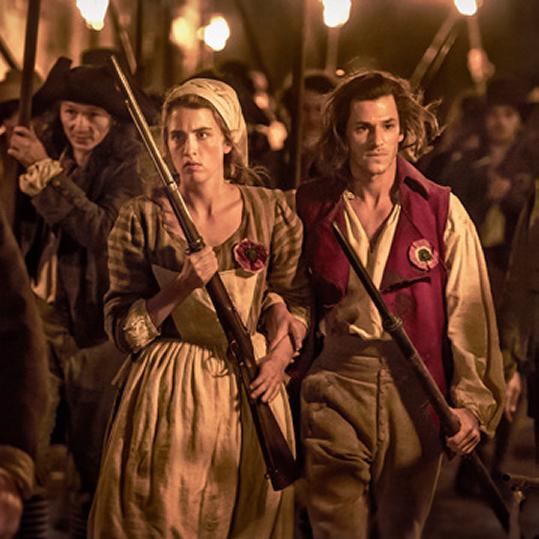
In the roles of the working folk, constantly prodding for their betterment and freedom, Adèle Haenel and Gaspard Ulliel (below, left and right respectively) are front and center as the romantic leads. They are just fine (as always), but it is Olivier Gourmet in the role of the town's glassblower who proves (along with Lavant's role in the intellectual set), the film's standout.

How M. Schoeller weaves together all these characters and classes, their philosophies and intents, is exemplary. His pacing; use of sharp, short dialog; and especially his occasional action scenes -- the massacre of unarmed protestors ordered by the Marquise de Lafayette is the film's emotional high point, as well as its turning point regarding the strength of the Republican protests -- all combine to make One Nation, One King a resounding success.

From Distrib Films US and Icarus Home Video, the movie hits the street on DVD and VOD this coming Tuesday, September 3 -- for purchase/rental.

Wednesday, August 21, 2013

THÉRÈSE: Claude Miller's final film is one of his best, with a splendid Tautou & Lellouche

The late Claude Miller (1942-2012) was not a "dark" filmmaker, though he never made life look simple nor easy. Don't try to find villains in Miller's movies: The vicissitudes of life, along with nature and nurture, make for perfectly fine stand-ins. In one (among many) of his "bests," Class Trip, a young boy discovers that his father is a serial killer; in a more recent one, the excellent Holocaust film A Secret, jealousy, disappoint-ment and depression allow a mother to sacrifice her son and herself to the Nazis. The problems and results of parenting, birth and adopted, take their toll in the remarkable I'm Glad My Mother Is Alive. Now we have THÉRÈSE, Miller's final film (the writer/director is shown below), adapted from the novel by François Mauriac, and from the resulting adaptation, it appears that this Miller/Mauriac match was made in movie heaven.

If there is a villain here, it is the society of 1920s rural France itself, with its strictures regarding sex and class, in which a smart woman must either sacrifice herself for and to her husband or, as in the case of our young Thérèse -- played by Audrey Tautou, below, in very fine form, if already (so soon!?) a bit too old for this role -- go a little crazy in her quest for autonomy. Don't let the age thing bother you much, however; in all other regards, Ms Tautou nails the role. By the end of this memorable film, you understand Thérèse as you would your own daughter (if you've been paying attention to your daughter, that is) and despite everything you've seen here, you'll root for her something fierce.

In the role of Thérèse's husband, Bernard, is a fine French actor who continues to show off his rather remarkable range: Gilles Lellouche. From thriller heroes (Point Blank) to comedic characters (My Piece of the Pie to rom-coms (Little White Lies), this guy has grown from small-role character actor to versatile leading man.

As M. Desqueyroux, Lellouche expertly captures everything from the particular country-style haute bourgeoise class to the post-WWI time period. His final scene in the film is both heartbreaking and ironic: If only Bernard had been able to learn and grow a bit sooner, how different things might have been.

Miller captures the period, as well as the particularly stifling rural life especially well, and his supporting cast shines, too: Anais Demoustier (above, left), as Bernard's half-sister; Catherine Arditi (above, right), as her mother; and Francis Perrin as Thérèse's father.

So far as I know, M. Miller, who is perhaps best noted re his career as the filmmaker mentored by Francois Truffaut, has never been given a retrospective here in New York by the FSLC, where many of his films made their New York debut. A retrospective is long overdue, as writer/director/adapter Miller, in my estimation, had surpassed his mentor in many ways. Perhaps now that he has left us, we'll see one at last.

Meanwhile, Thérèse, via MPI Pictures and running 110 minutes, opens this Friday, August 23, in New York City at the Angelika Film Center and  the Elinor Bunin Munroe Film Center, and in the Los Angeles area at Laemmle's Royal, Town Center 5 and Playhouse 7. Other playdates around the country are in the offing, as well.

Thursday, April 4, 2013

Terrorists/freedom fighters in their twilight years: Redford's THE COMPANY YOU KEEP


The evergreen saw that tells us a terrorist is simply a freedom fighter from another viewpoint takes on meaning yet again in THE COMPANY YOU KEEP, the new film starring, directed and co-produced by Robert Redford, with a screenplay via Lem Dobbs from the novel by Neil Gordon. Interestingly close in theme to another movie -- Bob's New Suit -- that just made its straight-to-DVD debut (about which I'll have more to say here soon), Company tells the tale of the appearance, after several decades, of former Weather Underground members who've been hiding from the law under assumed identities but are now making themselves known, arrested and/or on-the-run.

Mr. Redford has assembled about as starry a cast (for adult audiences, that is) as any we're likely to see again soon, and he and Mr. Dobbs have given that audience a tale that, initially at least, is likely to depress them in a  thoughtful, darkly nostalgic manner that will take those who currently reside in Redford's and my own generation back to the days of our protesting the Vietnam War. What the movie then brings to the fore, inadvertently or not (I think not), is how little has changed regarding the way our government lies, cheats and steals, engaging our country in unauthorized, unnecessary conflicts that cost our "higher powers" little and in fact enrich them no end, while sacrificing the lives of our young. For those of us approaching (or already in) our 70s, there is no way the film will not initially make us angry anew and doubly so for how little those in power seem to have learned -- or even care that they have not.

All this, of course, occurs at the beginning of the film, as the situation is being set up. Once in action, the movie becomes a kind of thriller (and not a bad one) about what, exactly, is happening and why, before eventually descending into a feel-good finale that makes everything all right. I am as clued-in as the next moviegoer to what audiences want (or say they want) and so can fully understand the reasoning going on here.

Yet having brought up the subject of the Weather Underground, its intentions and how these sometimes went afoul, it is a shame that Redford didn't deal with all this more effectively. He addressed important and timely questions in his more overtly political film Lions for Lambs (made in the middle of the disgusting George W. Bush regime), which you should see -- and see again if you didn't appreciate it the first time, for it was and remains a brave and intelligent movie, very well executed.

On the other hand, he and his team have given us probably his most accessible and popular entertainment in some years (perhaps since Quiz Show or that silly Horse Whisperer), and so one can't really blame him for taking the easier route. At least he's raised some worthwhile questions about some important subjects: how the past must impinge on the present and the lies we tell our children, for whatever reason, will finally haunt us and them.

About that starry cast, let's count the blessings on display: Julie Christie (four photos up) in what seems to be another yearly and welcome return to the screen, looking weathered and quite wonderful, is as good as ever in the acting department; Brit Marling (adding luster to her recent work in Arbitrage and Sound of My Voice) as another piece of the puzzle; and Brendan Gleeson (two photos above) as a slippery police chief. Anna Kendrick, Sam Elliott, Nick Nolte (three photos above), Chris Cooper and Richard Jenkins (above, right): they're all here and doing splendid work. Oh -- and look for a wonderful prison scene with Susan Sarandon (shown below).

As his co-star, Redford has tapped the now-slightly-beyond-teen-years Shia LaBeouf, below with Ms Marling, playing an enterprising young journalist whose biggest story to date this one is. LaBeouf seems less out of his element here than in films like Lawless or the Wall Street sequel, and he acquits himself well, delivering some choice lines like "I barely have furniture!" (which, in context, proves delightful).

To see this fine a cast strut its stuff is reason enough to view The Company You Keep. But should you happen to see it along with members of the younger generation, for goodness sake, open up a line of discussion and fill them in.

From Sony Pictures Classics and running a long but never boring 125 minutes, the movie opens tomorrow, Friday, April 5, in New York City (Cinemas 123, Lincoln Plaza Cinema and Regal Union Square) and Los Angeles (Hollywood Arclight and The Landmark), and the following Friday, April 12, in 32 more cities, with a continuing rollout across the country in the weeks to come. Click here to see all currently scheduled playdates, cities and theaters.