Showing posts with label grief and loss. Show all posts

Thursday, July 9, 2020

Absolutely in a class all by itself: Makoto Nagahisa's WE ARE LITTLE ZOMBIES


Mashing up so many dfferent genres while remaining utterly its own original, WE ARE LITTLE ZOMBIES gave me the most bizarre and special movie experience I've had since first encountering South Korea's lollapalooza, Save the Green Planet. First of all, this film is as witty -- verbally and visually -- as anything you have recently (or even not so recently) seen. It moves like a house afire, telling the tale of the meeting and life thereafter of four children, all orphaned on the same day, and all already fed up with adults and life as they have so far experienced it.

I think it is safe to say that writer/director -- whose first full-length film this is after a single, award-winning short -- Makoto Nagahisa (shown at right) is clearly a born filmmaker. Except that he may soon tire of the medium, since I am not certain what more he could give that he has not already provided via this film. We shall see.

Meanwhile, We Are Little Zombies addresses it all -- love (given, but mostly withheld), death, grief, contemporary life, parenting (mostly bad) -- even as it cleverly, delightfully indicts parents, adults in general, Japan in particular, and consumers and society at large (both eastern and western). Have I left anyone or anything out, Nagahisa?

Yet this indictment is so funny, fresh and endlessly entertaining that movie buffs ought not mind, even if more mainstream audiences may throw up their hands in disarray. Who cares? How the filmmaker gives us these kids and their back stories, those parents and their deaths, the real and surreal, fantasies, facts, fishbowls and so much more will make you grateful you still have eyes and ears.

While a Puccini tune runs throughout the film, its oddball musical numbers are amazing in their own right. For a while the film seems like some old-fashioned videogame come to life, and then around the midway point it takes a turn -- for the even better. Our heroes/heroine become a kid band, complete with their own sleazy/sweet manager (the red-head above),

before moving into the utterly surreal/unreal/too real. And still, the energy and wit never flag. Sweet, sad, profound, memorable and certainly one of this year's best movies,  We Are Little Zombies also proves to be the zombie movie to end them all, even without the de rigueur flesh-eating. (The scene in which we suddenly see the zombies -- and their "attachment" -- proves a perfect humdinger.)

From Oscilloscope Films and running a full two hours (from which I would not have wanted to cut one minute), the movie opens today in virtual and real cinemas all across the USA. Click here and then follow directions to learn how and where you can view it. Oh, and I want to nominate for the Movie Faces Hall of Fame little lead actor Keita Ninomiya. What a face -- and what a beautiful pair of eyes this kid has!

Thursday, April 16, 2020

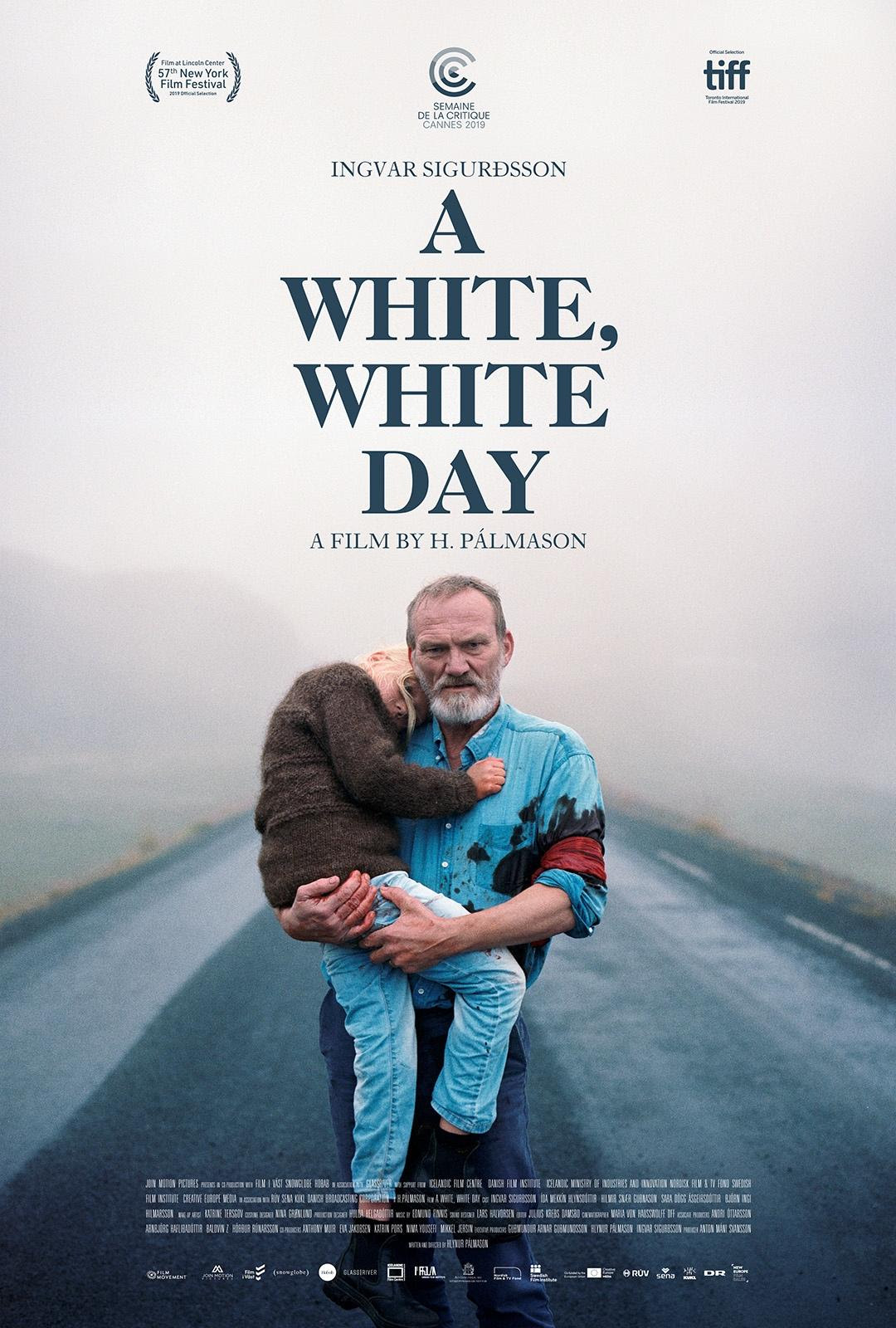
Grief and its variations in Hlynur Palmason's Icelandic genre-jumper: A WHITE, WHITE DAY


If we don't know by this time, via its movies at least, that the Nordic island country of Iceland has a culture and character pretty damned different from all others, even those of Scandinavia, to which it most probably closely compares, then the new film, A WHITE, WHITE DAY, should bring that point home all over again. It's surprisingly quiet (especially for a movie in which a kidnapping and a likely suicide occur) and somewhat repetitive, yet days after viewing it, the film keeps coming back to mind at odd times and in odd ways. It's sneakily memorable.

As written and directed by Hylnur Palmason (shown at right; this is his second full-length feature), the film begins as we follow a car traveling down a lonely, snow-surrounded highway in a lot of fog. After the first "event," we move to a shot of a field with a house under construction in the distance, as horses graze, day changes to night and then one season becomes another.

All this (below) is both repetitive and time-consuming, and yet it holds us via its very obstinacy: We haven't even seen a human face as yet.

When we finally do, the faces belong to three generations of a family who've now lost their matriarch, leaving a grieving widower, a local policeman named Ingimundur (played by a very impressive actor, Ingvar Sigurdsson, below), as well as other family members in various states of disarray.

The character who seems for awhile in the least disarray is Ingimundur's granddaughter, Salka (below), played with amazing skill and utter honesty by newcomer Ída Mekkín Hlynsdóttir. This young actress is so good in so many ways that it's no surprise she's already won an acting award.

Ingimundur and Salka make quite the team; they easily put in the shade the rest of the supporting cast, all of whom are excellent, even as the support circles around these two protagonists, as satellites who job it is to help guide the pair to some kind of fruition.

The plot, which I will not much go into, involves everything from caring and betrayal to crackerbarrel therapy, soccer games, anger and revenge. What makes the movie work so very well, aside from the excellent performances and smart, less-is-more writing and direction, is that particular, maybe even peculiar, Icelandic character.

Perhaps because of its wintry locale and sparse population, citizens seem to be allowed to make mistakes -- some of these real doozies -- without the kind of constant supervision, reprimands, penalties and whatnot that so many countries (western or eastern) seem to inflict. There's a kind of trust implicit here that a person can and will arrive at his own place at his own pace. Call it built-in forgiveness, maybe? Along with the ability of citizens to take some real responsibility for themselves.

Whatever: These cultural "traits," for lack of better word, imbue this work with the kind of substance and oddball grace that many would-be-more-important movies never get near. Another fine and interesting film from Film Movement, A White, White Day will have its "virtual cinema" premiere tomorrow, Friday, April 17, in locations across the country. Click here to view venues and learn more information.

Friday, November 1, 2019

PAPI CHULO: DVDebut for John Butler's comedy/drama of Latinos and Gringos in L.A.


A movie full of small surprises (and one major surprise), PAPI CHULO is the work of Irish filmmaker John Butler, the fellow who, back in 2016 brought us Handsome Devil and in 2013 The Bachelor Weekend (which I've not yet seen).  His latest film would seem to be his first time working in the USA, and TrustMovies must say that Butler has nicely nailed the peculiarly Los Angeles dynamic involving Latino and Gringos, class and economics, and especially those cliched attitudes that permeate so much of what goes on between the two.

Mr. Butler, shown at right, doesn't so much upend those cliches as he does simply lay them out in front of us (and the characters), simultaneously revealing their silliness. This is a smart way to handle a tricky subject, and the filmmaker manages it throughout the entire film, often leaving a smile on our faces, even as we wince in recognition.

The plot pf Papi Chulo has to do with Sean, a gay L.A. TV weather reporter suffering from a break-up with a longtime lover, from whom he is having a very difficult time separating. To complete the painting of his deck, Sean hires an older Hispanic laborer, Ernesto (Alejandro Patiño, below, right), who is waiting in one of those pools of men seen on the sidewalks of L.A., New York and now probably in most cities throughout the country, hoping to find work.  Slowly, haltingly and often humorously, a kind of bond begins to form between the two.

Sean is played by Matt Bomer (shown above, left, and below), an "out" gay actor who has often played gay roles, including an excellent representation of a trans woman in Anything. This role, however, seems to me different in some important ways because the character of Sean is so sad, silly and needy, often simultaneously, that he is as funny and charming as he is unhappy and sometimes even obnoxious.

Mr. Bomer is actually quite extraordinary in the role, so alternately loose and easy, frightened and protective is the actor that he makes Sean into one of the most vulnerable of gay characters I have seen on screen. He is also enormously funny, as he tries every which way to connect to his new friend. Mr. Butler's delicious dialog, coming from the mouth of Bomer, often sounds utterly spontaneous, and all the better for it.

How the movie, along with relationship of the two men, progresses comprises the simple plot, which takes quite a turn midway. In retrospect, this makes perfect sense but it may still throw you -- the way the certainty of an assumption proven wrong often does.

As complete and "out there" as the character of Sean is, Ernesto's appears quite the opposite. Guarded and near completely unable to demonstrate affection, he is a good example of Hispanic machismo, non-toxic variety, in which those signs of love must be shown via his wife and children. Señor Patiño imbues his character with clear-headedness and a quiet grace that is believable and touching.

As in Handsome Devil, Butler allows in sentiment without letting it gush into sentimentality. You'll be charmed, surprised, entertained and/or moved by just about everything here, without feeling ill-used the following morning. Think of it as a guilt-free pleasure.

From Breaking Glass Pictures and running 98 minutes, Papi Chulo hits the street on DVD  this coming Tuesday, November 5 -- for purchase or rental.

Wednesday, September 18, 2019

Don't listen to the usual critical establishment: John Crowley & Peter Straughan's adaptation of THE GOLDFINCH proves rich, joyous, artful and moving storytelling


"I can't believe they did it!" raved my spouse as we left the local theater where THE GOLDFINCH has recently opened. Spousie had read the novel a few years back, loved it, and had looked forward ever since to a possible movie version. TrustMovies himself had never read the book and so sat down to view the film as a clean slate. He, too, loved it -- swept away within the opening moments and held fast throughout the two-and-one-half-hours of crackerjack storytelling, wonderful performances, and the most artful melding of past and present, youth and adulthood, time periods, places and -- most important -- that very difficult transition of loss and grief into understanding. Not to mention the uses and importance of art.

Every movie that director John Crowley (shown at right) has so far made is a good one -- from Intermission and Boy A through Is Anybody There?, Closed Circuit and the especially wonderful Brooklyn. And now he has given us what is certainly his most ambitious work and one that, I believe, will hold up beautifully and should have future audiences asking, "How in hell did this one go so unappreciated?"

Interestingly, each of Crowley's six films is in a different genre. He never repeats, and yet each takes its particular genre and lifts it quite nicely. The man is not a writer, but damned if he does not recognize a first-class story -- as well as the way to best bring it to life.

What is so funny -- surprising, rather than hilarious -- is that in the case of The Goldfinch (very well adapted by Peter Straughan from the popular novel by Donna Tartt), were you asked to give a precis of this story, you would be very hard put to do so. It's about so many people and so many things and events. Ms Tartt evidently knew just how to pull the reader into her complex tale, and so, film-wise, does the Crowley/Straughan duo.

The main event in all this the filmmakers do not allow us to see, except in small pieces, throughout their movie. It's major, though, and awful, leading to the kind of loss that can never be patched. Various characters deal with this loss in differing ways, and while it is loss and grief that bind the movie, so fascinating is the story and the characters who fill it that instead of becoming a some kind of "downer," the movie end up lifting us in rather remarkable ways.

The heavy lifting may be done by the filmmakers and Ms Tartt, but the marvelous cast assembled here certainly does its part, too.  The major roles of Theo Decker and his bizarre Russian friend, Boris, are taken by (in adulthood) Ansel Elgort and Aneurin Barnard (above, right and left, respectively) and in childhood by Oakes Fegley (at right, two photos up) and Finn Wolfhard. Each actor is not only exceedingly good, but each also makes a fine older or younger version of himself.

The distaff side is equally well represented by the likes of Nicole Kidman (above), Sarah Paulson (shown at bottom, left), Willa Fitzgerald and Ashley Cummings (below), and again, each is precisely on the mark. Crowley has always been terrific with actors, especially in his understanding of just how hard or soft to go with the various important moments. Here, he hits everyone of them with grace and ease

Crowley and Straughan (along with cinematographer Roger Deakins and editor Kelley Dixon)  understand how to create important moments of transition regarding events, characters and moods without ever once hitting us over the head. Demeaning critics have referred to this movie as "flat." Which makes me wonder how any intelligent, genuinely watchful viewer could confuse flatness with artfulness and subtlety?

Well, see for yourself, my friends, as this crackerjack tale moves from New York City to Las Vegas to Amsterdam and back. Along with everything else that's so fine here, the film's last visual is spectacular: Simplicity itself, it unites present and past with a poignancy in which all seems perfection and the best is yet to come. For that moment, at least. (Below, right, is Luke Wilson, with Ms Paulson, who brings new meaning to the term bad dad.)

Distributed via Warner Brothers (with Amazon involved in its financing), The Goldfinch has opened this past week, nationwide. If you love a good story told artfully and beautifully, give it a whirl. Click here to find the theater(s) nearest you.

Wednesday, March 13, 2019

Death, decay and dysfunction in Shawn Snyder's dark buddy movie, TO DUST


Decomposition is paramount in the new and very dank/oddball growth-through-friendship movie, TO DUST, co-written (with Jason Begue) and directed by first-time full-length filmmaker Shawn Snyder (shown below).

In it, a cantor from an Orthodox Jewish community in upstate New York who has just lost his wife to cancer, finds himself coming apart at the seams, prone to nightmares involving death and decay, and unable to function as father to his two sons.

Because this religious community has, as is typical, cut itself off from as much as possible of the remaining (and what some might call "normal") world, our cantor cannot find proper help from his own highly traditional and strictured community and so must go elsewhere.

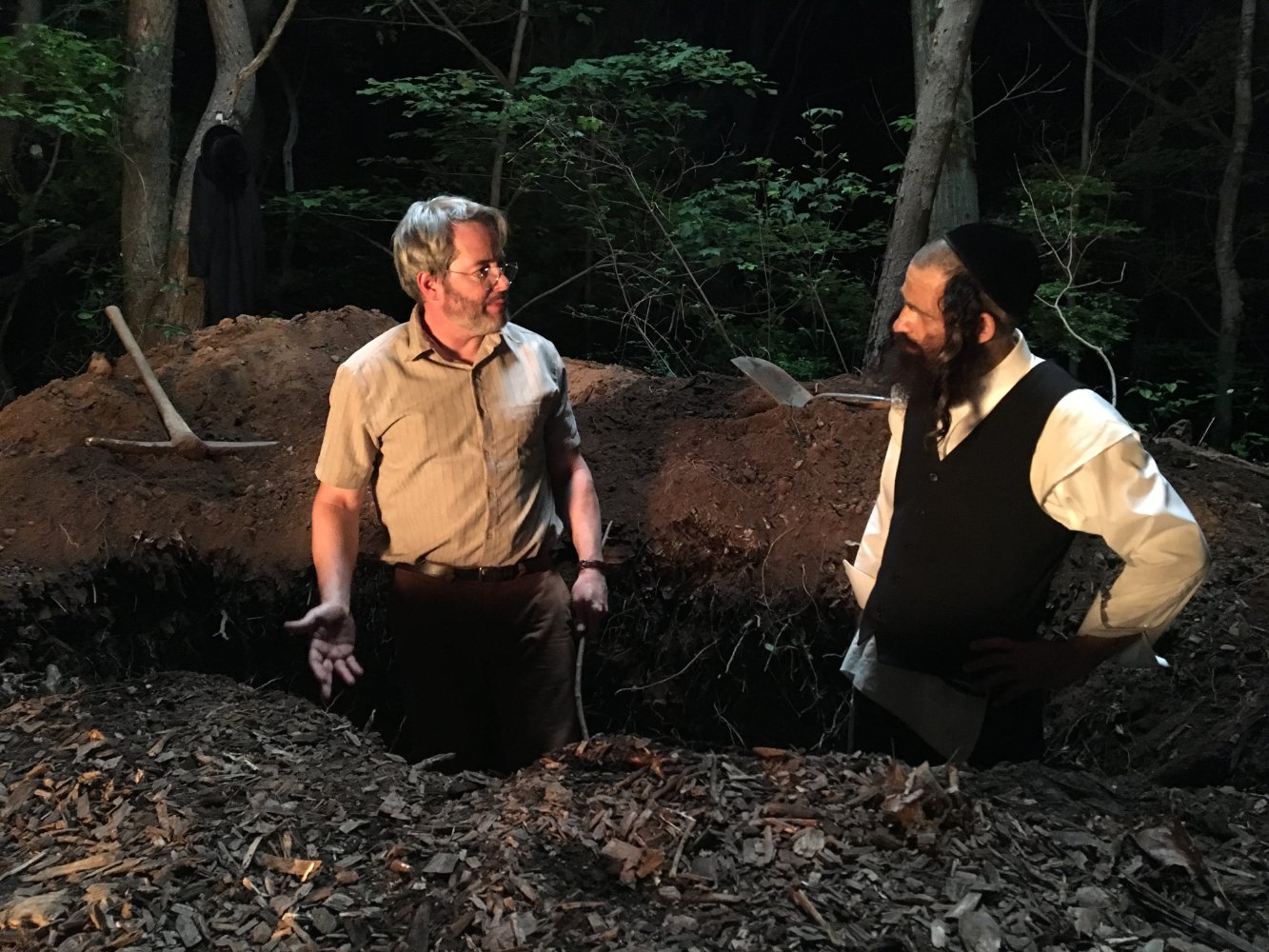
This is not so easy, thanks to the many rules and regulations involved in Orthodox living. Simply speaking to a woman in an office outside the community, for instance, in a no-no. So the cantor, Shmuel (played by Géza Röhrig, at right on poster, top, and below, whom you'll remember from his commanding performance in the Best Foreign Language Film Oscar-winner, Son of Saul), rather like a bull in a china shop, barges his way into the classroom and the life of a local community-college science teacher named Albert (Matthew Broderick, at left on poster, top, and below), whom he then forces to explain to him, in minute detail, how a corpse decays.

If this sounds like one of the least believable meet-cutes in the history of cinema, well, it is. But is is also just bizarre and bleak enough to maintain one's initial interest. And if these two characters are barely developed -- Shmuel has but a single characteristic, grief; while Albert seems a lonely outsider who, in the comfort of his home, wears a woman's housedress -- both Broderick and Röhrig are consummate professionals who bring every bit of their talent to the proceedings and manage, at least while we're watching them, to create life and truth here.

The movie's insistence on exploring decay and decomposition -- initially via pigs and finally at a human corpse farm outside Knoxville, Tennessee -- may turn off more than a few viewers. Those who stick with the film will get the expected feel-good resolution  that, even though it arrives via means as bleak as all else here, seems no more believable that the movie's meet-cute beginning. And the relationship between the two men is so unbelievable that it must be taken -- whole-hog, so to speak -- on faith. Thank god for Broderick and Hashem for Röhrig, as these two guys do all they can to make the trip witty and enjoyable.

The supporting cast has little to do but certainly does it well enough, while the technical aspects of the movie, while seldom belying the small budget, are handled professionally. And if you are one of those viewers (unlike me) who disdains profanity, here's the film for you: In the disc on which I viewed To Dust, all of the curse words on the soundtrack had been bleeped out!

From Good Deed Entertainment and running 91 minutes (in the version I saw, at least; the IMDB has the film clocking in at 105 minutes), To Dust opens here in South Florida this Friday, March 15, in the Miami area at the AMC Aventura 24 and AMC Sunset Place, in Fort Lauderdale at The Classic Gateway, in Boca Raton at the Regal Shadowood and Living Room Theaters, in Palm Beach Gardens at Cobb's Downtown 16; in Tamarac at The Last Picture Show, and at the Movies of Delray and the Movies of Lake Worth.

Thursday, August 23, 2018

Amazon streaming tip: Mark Pellington/Alex Ross Perry's poetic and moving NOSTALGIA


Yes, Mark Pellington (shown at left, director) and Alex Ross Perry (shown below, co-writer) do seem an odd combination, but in this particular case the combo works better for TrustMovies than either writer/director's work has managed to do individually.

Granted the title NOSTALGIA is a tad overused (95 exact title matches on the IMDB!), but it does indeed apply to this movie, whose themes are grief, loss, and the importance in one's life of both objects and memories. The film begins with a lovely scene in a diner between a waitress and a quiet, contemplative man (played
quite memorably by John Ortiz) who is an insurance assessor. We then move to one of his clients (Bruce Dern) and then to another (Ellen Burstyn), with various family members and friends involved, and from there to a dealer in sports memorabilia (Jon Hamm, shown in bottom photo) and then to this man's sister (Catherine Keener), her family and a sudden bereavement.

That's it, so far as plot goes. What holds the movie together and makes it often so beautiful and moving is its combination of themes, visuals and dialog, all brought to thoughtful, specific life by an array of first-rate actors, led by Mr. Ortiz who is a good here as I've yet seen him. He brings the kind of grace and understanding to the proceedings that help lead us into this unusual, artful look at the "whole" (or maybe the "hole") of our lives.

Criticism has been leveled at the film due to its supposed repetitiveness, yet each episode has its own special tale brought to life by top-notch performers. Supporting roles are cast with such a roster of talent -- Beth Grant to James Le Gros -- that each small performance rings  true and special.

The question of what the objects we collect during our lives mean -- to us, as well as to others -- is given a most interesting workout here, and the result is worth experiencing and thinking about.

Yes, the movie is slow-paced (and the final section goes on a bit too long), but it is so beautifully filmed that some of you, at least, will be pleased to have viewed it. Do give this film a try. Nostalgia is streaming now via Amazon, where Prime members can see it free of charge.

Monday, July 30, 2018

MILLA: Valérie Massadian's exploration of young womanhood opens at NYC's AFA


The movie opens on a shot of a young couple seemingly covered in something like gauze. But then, when the camera captures the two from another angle, we see that they have been asleep inside an automobile, the windows of which have fogged up by their breath. This is the first instance of how, in MILLA, the new film from Valérie Massadian (Nana), what we see and hear turn out to be something more and different from what we might expect. And yet the surprises in Milla are small and quiet, as is the movie itself. It's very slow, too. Those of you who prefer action films, take note.

Ms Massadian, shown at right, intends a study -- of a character (our young heroine, Milla) and of a class of people -- the less educated, wealthy and entitled -- that we are not used to seeing, let alone entering the lives of in any real depth, in mainstream movies. She has succeeded, too.

Though her movie begins slowly and may have you thinking, "Oh, my: another vérité look at the life of the lower class," do hold on. Milla proves something more because it does not take for granted that the life here is anything less than genuine, important and even positive -- though certainly difficult, yes.

Massadian does not cram on the crap, as do some would-be realist filmmakers. Milla's life has ups and downs, with one major loss midway, but she copes as best she can. And in the starring role, newcomer Severine Jonckeere (above and below) proves a lovely and very moving addition to the canon of near-real characters caught on film. A collection of small scenes caught at various times and in differing place, each of which makes its simple point, Milla quietly and slowly builds to something major.

Though the film is slow-paced and rigorous, once you take its characters on their own terms, just as the filmmaker has done, you watch, learn and grow along with them. The cinematography involves mostly interiors -- that car, the couple's squatter residence, a bar, hotel, vegetable stand, and eventual apartment for Milla and her son -- but the exteriors, including the sea and the fishing vessel on which Milla's boyfriend finally finds employment, are beautifully handled, as well, often in the kind of middle distance that allows us to feel for and appreciate the characters via their surroundings.

Milla is a tale of slow growth, change and acceptance: of what life throws at you, of motherhood, of responsibility. The sparse dialog seem reflective of the characters and their circumscribed lives. Once Milla's son Ethan arrives, after but a brief time with him as suckling infant, we see him as a young child. Ethan Jonckeere (below), who I presume is the actual son of the leading actress, is certainly one of the most adorable child actors you'll have seen: completely natural, never posing for the camera, and totally involved and engaged in life.

The filmmaker includes everything from a musical number to some lovely poetry, a shipwreck unseen but experienced via a dirge, loneliness and coping, and a cat ("You don't want me to pet you," Milla observes, "but you're not leaving." How cat-like). The momentary imagined return of the dead boyfriend, played with quiet grace and caring by Luc Chessel, once to comfort a grieving Milla and again to observe his sleeping son, is handled with the same finesse as the rest of this unusual movie.

Above all else, the film is cautiously hopeful. These days, that's quite a lot. From Grasshopper Film and running a lengthy 128 minutes, Milla opens this Friday, August 3, in New York City at Anthology Film Archives, and in Los Angeles on August 15 (only at 8pm) at the Acropolis Cinema. That seems to be it theatrically, but we shall hope that DVD and digital will soon be in the works.

Monday, July 23, 2018

DVDebut for Russell Harbaugh's well-acted grief 'n gloom fiesta, LOVE AFTER LOVE


Reviews were generally so positive when LOVE AFTER LOVE opened theatrically this past March that TrustMovies made certain to stick it on his must-see list and/or perhaps cover it for its DVD release. That release is now, and sure enough, the movie -- co-written (with Eric Mendelsohn) and directed by Russell Harbaugh (shown below) -- proves to be the very well-acted and relatively insightful look at a family working through its grief during (but mostly after) the death of its husband/father.

Made up of quite a few "family gathering" scenes interspersed with some twosomes, often sexual encounters, the film moves forward in time without explicitly informing you of the where or when. If you pay attention, however, you can easily follow things. Tolstoi's famous-but-specious maxim that begins Anna Karenina (regarding how happy families are all alike but unhappy ones unhappy each in its specific way) comes to mind here, as the family we meet appears to be very unhappy indeed.

Further, this unhappiness does not appear to be stemming merely from grief: These folk were clearly fucked-up long before dad took to dying. Of the two sons, one (James Adomian) is a passive-aggressive alcoholic and the other (Chris O'Dowd) a narcissistic asshole and serial womanizer, and there is no indication that this has not long been the case.

Mom (Andie MacDowell) holds things together as best she can, and it is clear that she's something of a hedonist who was in an "open marriage" before the current husband and is soon involved with someone new afterward.

Mr. Harbaugh makes no excuses for these people. He simply presents them as they are, via their dialog and actions. And yet to make the claim, as many critics have done, that the movie is all about grief and how we manage it seems an oversimplification. It is hardly just grief that these folk are having to handle: It is their life -- past, present and future -- with which they are (barely) coming to terms.

In fact, you may feel -- as did I, my spouse and the friends with whom we viewed the film -- that the extended family (husbands, wives, significant others, friends) were more appealing than the family itself. Still, this is the family we're dealt, movie-wise, and Harbaugh, Mendelsohn and the fine cast bring them to life quite solidly. Mr. O'Dowd (above) is spectacularly good. If anyone else has better portrayed an impossibly narcissistic asshole, I'm at a loss to recall it.

Mr. Adomian has not as much to do here but certainly does it well. His oh-pity-me! less successful brother is a mountain of quiet-but-overbearing excess in every way. And Ms MacDowell (above) proves more than the equal of her on-screen sons. This is one of her most unusual roles -- written with more specificity and detail than the actress is often given -- and she does it full justice, in the process showing us just how much subtlety and understated strength she is capable of.

Nice supporting turns come from Dree Hemingway (above, as O'Dowd's current) and especially from Juliet Rylance (as O'Dowd's ex) -- two of that extended family you'll find yourself wishing were part of a more kindly crew.

From IFC Films and running 93 minutes, the movie hits DVD this coming Tuesday, July 24 -- for purchase and/or rental. It is (or soon will be) available via digital streaming, as well.