Showing posts with label marriage. Show all posts

Wednesday, May 6, 2020

Mass unemployment, corporate malfeasance, and something extra join forces in Robert Jury's debut film, WORKING MAN


You could hardly ask for a more timely movie -- unless it covered the current Corona crap-fest -- than WORKING MAN, the first feature film from writer/director Robert Jury. It deals with a rust belt community in which one after another major business has shut down, leaving more and more citizens unemployed. When one of these, a past-retirement-age fellow named Allery, feels so lost without his job that he literally but secretly goes back to work in the plant which has already shuttered, he starts a chain of events that soon spirals well beyond his personal control.

Mr. Jury, pictured at left, has certainly cast his movie well. The role of Allery is taken by that fine actor, Peter Gerety, (shown below and recently seen on Netflix in the lovely movie, Change in the Air). If you're imagining that Jury's film deals with corporate mistreatment of workers, you'd be on target. But this fledgling work has a lot more on its mind -- coping with family tragedy, the distancing of husband and wife, why and on whom we place our trust -- and this proves both a strength and something of a major problem. The filmmaker bites off more than he can properly chew, and then relies too much on coincidental storytelling to bring his themes to fruition.

Recognizing medicine in a neighbor's cupboard and having it be the same as what one's troubled offspring used to take proves a little too convenient, plotwise, and even character-wise, as a reason for the too easy and complete change-of-heart on the part of Allery's wife, played well, despite less resources given her, by Talia Shire, below.

The film's most interesting character, however, is that of another laid-off worker and neighbor of Allery, Walter, played by a very impressive actor new to me who's worked mostly on TV and cable, Billy Brown. Though Walter's character is in some ways the most problematic link in Working Man, so interesting, impressive and powerful is Mr. Brown's performance that this actor pretty much carries the film.

Working Man is good enough to make you wish it were better. By its conclusion, you can be forgiven for imagining that the take-away here might be "You can't fight City Hall" (even if, these days, you might not know who the hell the City Hall you are fighting actually is), employment is not as important as healing a failing marriage, and a good peach pie can help a bad bi-polar/borderline personality disorder.

Mr. Jury's direction is just serviceable, but his dialog is generally good. Supporting performances are all excellent, too -- the various worker are both drawn and performed well -- with the standout coming from Patrese McClain as a woman with a connection to Walter.

From Brainstorm Media and running 109 minutes,  the film, which hit VOD yesterday, May 5, is one that, for all its problems, I am still pleased to have viewed. 

Wednesday, November 8, 2017

With BITCH, writer/director Marianna Palka gives Jason Ritter his most important role yet...


...and he runs with it like crazy. Mr. Ritter's is the best performance from an actor I've seen this year, and if the storied Academy members ever deigned to really look at small indie movies in the way they should, fit praise would be forthcoming around "Oscar" time. Don't get too hopeful; remember how they treated last year's best actress, Rebecca Hall in Christine. Meanwhile, take a chance on the unusual new movie entitled BITCH, written and directed by Marianna Palka, who also co-stars. Back in 2008 Ms Palka gave us the very fine Good Dick, also starring Mr. Ritter, and her new film is even better: stronger, original and hugely surprising.

Palka, above, plays a put-upon housewife named Jill Hart who is literally suicidal when we first meet her. At first we imagine this is due to her clueless and unfaithful hubby, Bill Hart (played by Ritter, below) and her four (count' em!) kids who we assume are the sort of impossible, narcissistic brats driving their mom 'round the bend. But things are not quite so simple. Note the dog outside their house who barks constantly, and with whom Jill may be identifying.

And, no, this is not a 21-Century update on that popular TV show, Hart to Hart. What happens here may be about as strange as American indie movies get, and yet on even a realistic level, Bitch never quite leaves the realm of the possible -- if the hugely unconventional and bizarrely, brazenly ugly. TrustMovies is not going to go into plot detail because viewers deserve to experience what happens here -- and then decide why it happens -- on their own. I'll just say that Ms Palka has been awfully brave and ballsy in her choices.

First off, she cedes the film's most important role to Ritter, who makes an absolute meal of it. From his early and very funny scenes as the self-involved, utterly clueless husband from hell to the movie's mid-section as his character falls screechingly apart (above) to the finale in which Bill begins to change, this is first-class movie-making in both conception and execution, as well as superior performing. Palka herself does a remarkable job as the titular bitch. This kind of performance is something you will not have previously seen, and yet it is also clearly a supporting role.

Also giving fine support are Jamie King, above, left, as Jill's sister, and Brighton Sharbino, Rio Mangini, Kingston Foster and Jayson Maybaum as her four children -- all of whom turn out to be more caring and helpful that we would have initially imagined. So what's the big problem? Sure, feminism rises to the surface here, but not at all in the manner we most often see it. The key lies in the relationship between husband and wife, and how this unfurls is near-miraculous in terms of original and surprising movie-making.

There is a speech given somewhat past the halfway mark that is so succinct and devastating in terms explaining the care and effort a woman brings to a marriage that hearing it should make many of us ex- and/or present husbands cringe in recognition and guilt.

Bitch is finally a love story, and considering what has come before, what occurs subsequently seems doubly moving, rich and profound. Yours truly was in unexpected tears toward the end. As much as anything he has seen in a long while, Palka's film raises and then gives a very possible answer to Freud's famous question, What does a woman want?

From Dark Sky Films and running 93 minutes, the movie opens this Friday, November 10, in New York City (at the Village East Cinema), in Chicago on Friday, November 17 (at the Facets Cinémathèque) and on November 24 in Los Angeles (at Laemmle's Music Hall 3), as well as in a number of other cities across the country this week and those following. Click here then scroll down to see (some of the) currently scheduled playdates, cities and theaters (perhaps Dark Sky will want to update this list soon so that the Los Angeles opening is added).

Thursday, October 12, 2017

Tao Ruspoli's MONOGAMISH continues the everlasting search for what works best re marriage, love, sex, kids and all the rest


A not-uninteresting combination of visual/verbal confessional, educational films from the 1940s and 50s, other archival snippets from film and TV, the filmmaker's family history, along with that of the idea of marriage itself, and talking-head interviews with sociologists, marriage counselors and advice columnists, MONOGAMISH, a new, four-years-in-the-making documentary from Tao Ruspoli (shown two photos below), reopens (once again) that seemingly eternal discussion of whether or not monogamy really works and is the best resolution for folk who are in love, want to marry and start a family -- or who would simply rather fuck for awhile, before moving on to greener, or at least other, pastures.

Now, if you're anything like me, you had your first discussion about all this during college (for TrustMovies, that took place back in the late 50s/early 60s), and the same subject reared its fascinating head again during the late 1960s with the hippie crowd and its anything-goes sexuality, and then the following decade with the me-generation, its swingers and the explosion of the porn industry.

Part of the charm -- and, yes, it must be also said, the naivete -- of this documentary arrives, for us old folk, at least, from the realization that, oh-oh, here it comes again: that old question, Does monogamy work? Of course not, or not very well. But, as one of the many quotes from the famous featured in the film (and paraphrased here) reminds us, monogamy may not work well, but it's the better than anything else we've got. Or is it?

By the surprising, amusing and fairly jaw-dropping finale of this film, much of what you've seen and considered will be called into question. (No answers will be provided, however, for that would require a re-visit to or by Rispoli in perhaps another ten years.). This filmmaker first arrived on my map some eight years ago, with his narrative movie (done in documentary style) called Fix, which was unusual and great fun, too. Since then he has concentrated on documentaries, none of which I've seen -- until this one. One of the reasons for his making this film was the split from his significant other, actress Olivia Wilde, and its repercussions.

The talking  heads from past and present includes everyone from the right-wing uber-idiot, George Putnam to the sensible and quite easy-to-take gay columnist Dan Savage (above), who is clearly a good friend of Ruspoli whom the director turns to for help in his time of need. As his film tackles monogamy and its discontents, it also explores history, women as property, and the rise of feminism. As one fellows asks in the course of the film, "Do you want to overturn thousands of years of civilization?" No, but maybe thousands of years of patriarchy, yes.

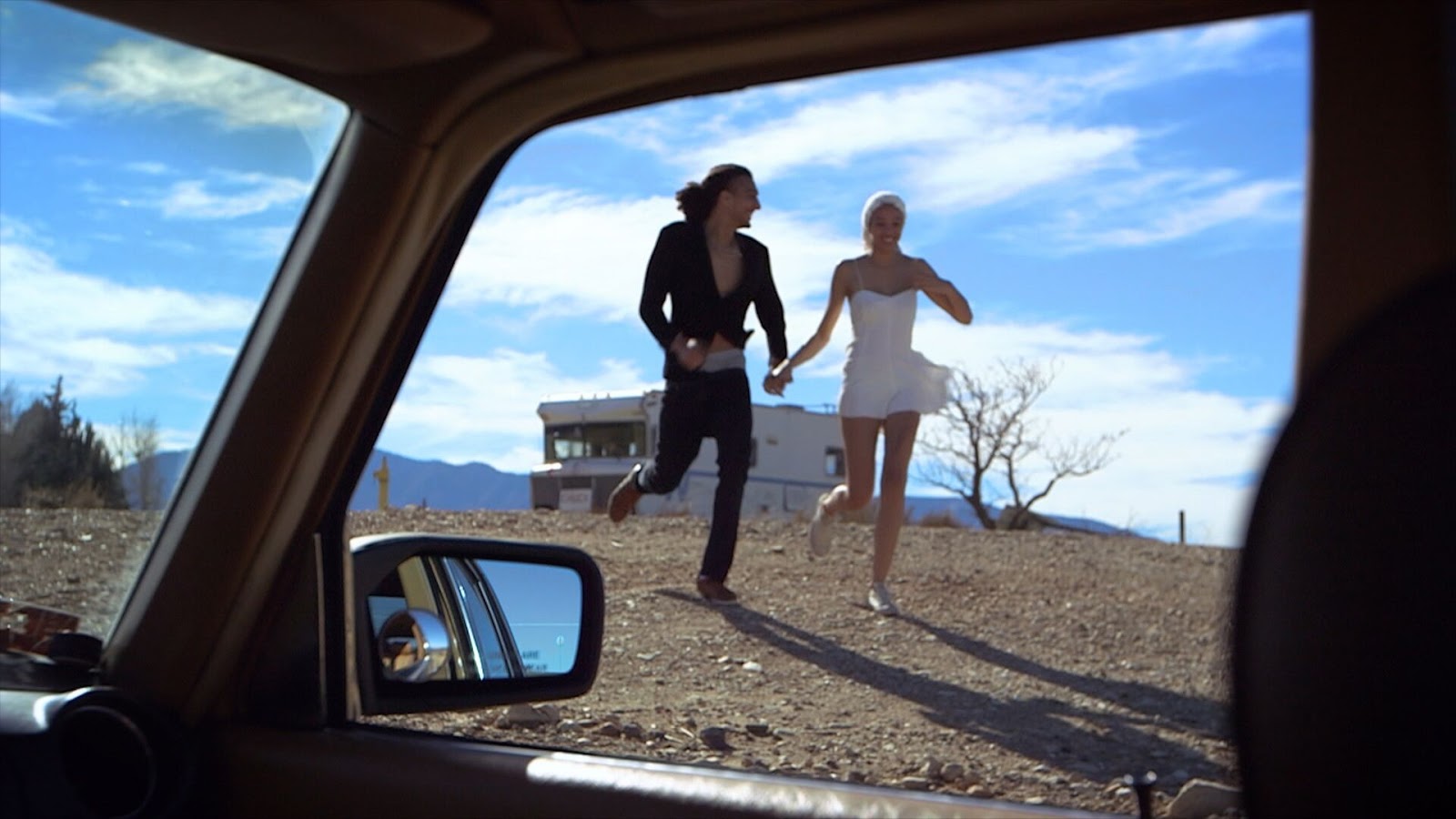
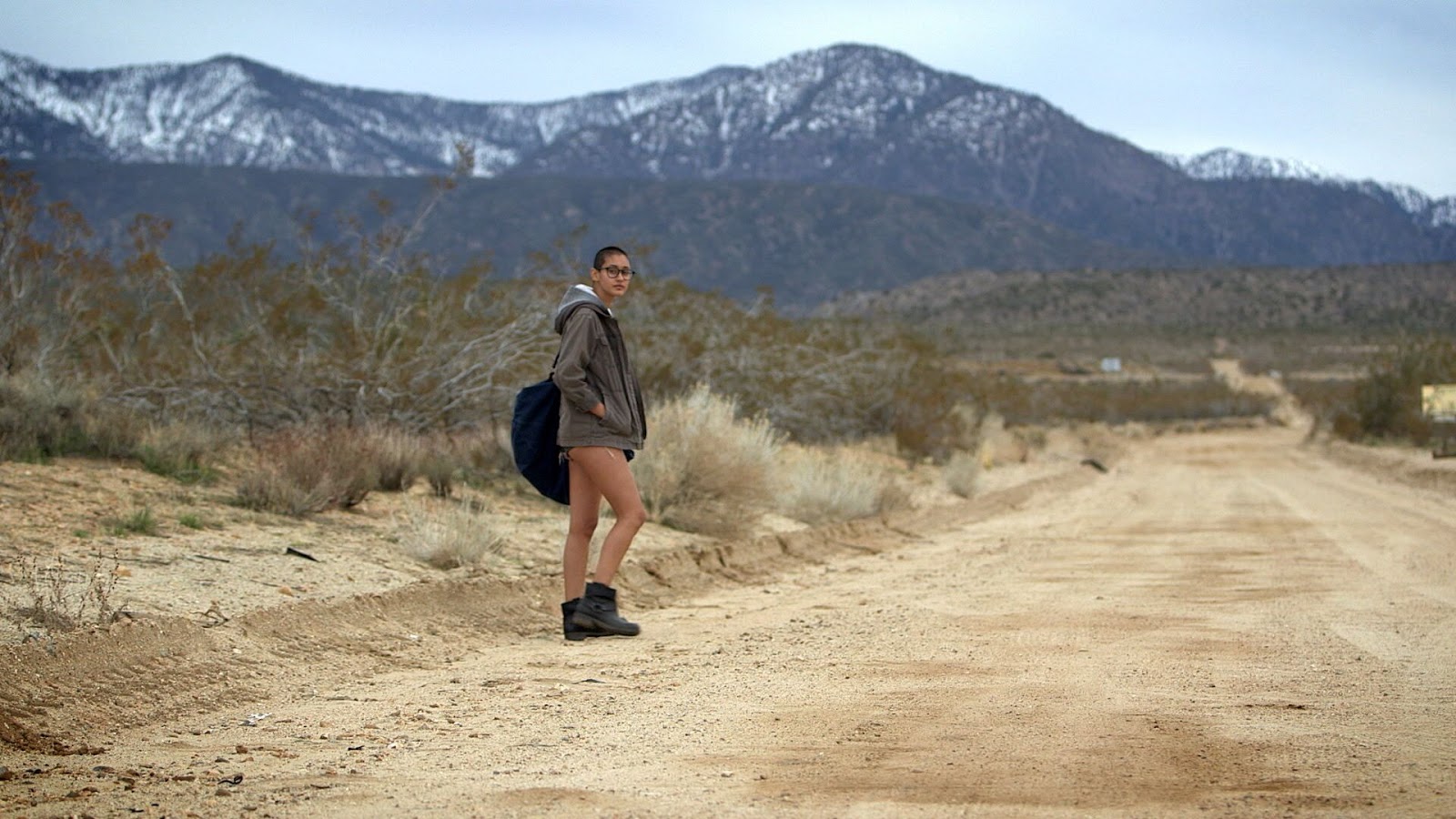
Along the way we get a great quote about marriage and second marriage from Oscar Wilde, a lovely poem by William Butler Yeats, interviews with a number of folk who are experimenting with what we used to call "alternate life styles" (above). The director even includes a little narrative interpolation featuring a hitchhiker (below) and the lucky pair who pick her up.

The movie may be all over the place, but it manages to -- yet, again -- raise enough interesting questions about an old, old subject to hold our attention. And that ending, a humdinger, does indeed make the trip both thought-provoking and worthwhile. And please, Tao, let us know what happens here. (Since the movie was finished back in 2014, I suspect that plenty has already occurred.)

From Mangu.tv/Mangusta Productions and running a lean 74 minutes, the movie opens tomorrow, Friday, October 13, and will expand to wide release in November. Theaters? Well, in New York City, it's playing at the Roxy Cinema in Tribeca. That's all I know so far....