TrustMovies is going even
farther than his usual don't-spoil-the-movie commandment by saying damn little about the "plot" of
CATFISH, the one-of-a-kind documentary from first-time/full-length moviemakers
Ariel Schulman (below, left) and
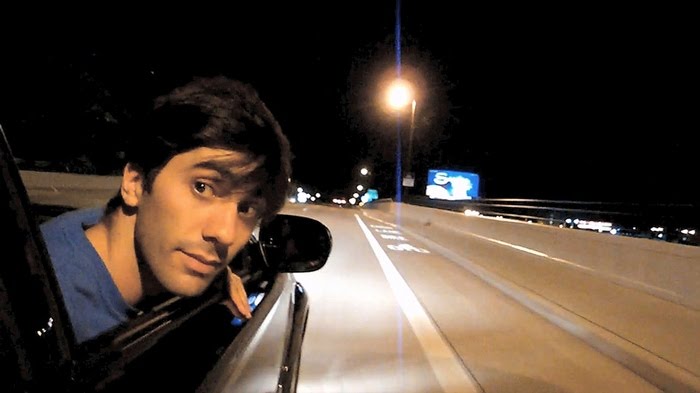
Henry Joost (below, right) and starring Shulman's immensely photogenic and charismatic photographer brother
Yaniv (also known as Nev).
I knew nothing about this movie when I planted my aging bones into a seat at Manhattan's
Kips Bay theater a couple of weeks ago, along with a full-house audience, to view a special screening of the film. I suspected it might be a documentary, though I also wondered it might not be
faux or mock. After a few minutes of watching, it certainly
seemed real enough. And yet, in our Internet age, from
Blair Witch to
I'm Still Here, who knows? So I was prepared to go with it either way -- doc or narrative. But so quickly did I get wrapped up in this tale of a filmmaker and his friend who begin to follow the love life of the filmmaker's brother as it blossoms and evolves over the Internet that I soon did not care a whit whether the movie was real or fake. Either way, it was f-ing good -- and in my book
that's what matters.
After finishing the film, I do believe it
is a real documentary, but as I say, if it were exposed as a fake, I would still bow down to the filmmakers for creating such an amazing tale, no more of which you will find detailed here. Read as little as possible about
Catfish prior to seeing it, please, because
this film, particularly, deserves your
tabula rasa going in. So, instead of events, I'll talk about the filmmaking, the themes and audience reaction -- in hopes of not spoiling your pleasure of discovery.
Catfish is about the way we live now -- at least, the way that more and more of us, particularly the younger crowd, are living it. As movie-makers, Schulman and Joost do the hand-held thing, of course, as this is off-the-cuff filmmaking. But in Schulman's brother Nev, shown above and below, they have found a "leading man" of such charisma, charm and beauty (of body and face) that he easily commands the screen. And since he appears in almost every scene, this makes viewing
Catfish a pleasure, even in its creepier and/or ultra-homemade moments. Nev also allows his film-making friends (and thus us) to see him at his most vulnerable, from absentmindedly scratching his nether regions to bouncing into -- and then back from -- some very disappointing events.
The scene in which Nev talks about his "phone" sex (above) is funny, sad, smart and extremely revealing. If he'd done full-frontal with a boner, I doubt he'd have come across as any more "naked" than he does in these moments. If this film, in fact, were revealed as a hoax (web rumors have already begun, as they seem to do about literally
everything these days), Nev Schulman's "performance" might seem even
more impressive. (And he
is performing, of course; you can't
not be when you're aware that a camera -- whether narrative or documentary -- is pointed at you.)
As the film moves along on its journey, which is both literal and metaphoric, it is by turns delightful, extremely creepy, and finally moving in ways to which few other documentaries come close, partly because this is a new world we have entered -- the virtual one of the internet -- and we're still quite "young" in our understanding, appreciation and negotiation of it. Plus, as soon as we seem to have conquered it, some new technology opens the door to another room full of possible booby traps.
It is interesting and timely that one of the most buzzed-about movies of the year,
The Social Network will open on the heels of Catfish. The
David Fincher-directed film
(which I hope to see and report on next week, as part of the NY Film Festival press screenings) and this movie would seem to complement each other in some
very interesting ways.
What the film's title signifies does not come clear until almost the finale. Even then, while it would appear to apply to one person, after a bit of mulling you'll realize that it might as easily be used to describe some other people in the movie. In either case, it offers wonderful, poignant food for thought. Watching
Catfish with a "real" audience, rather than in a screening room or at home, seems a good idea, too. The audience of which I was a part was audible in its fear, delight and surprise during the first half of the film; during the second portion it grew more and more quiet -- for reasons that will be apparent when you see the movie. Which I hope you will.
Whether you choose to view it now -- theatrically -- or wait for DVD, streaming or On-Demand -- its effect should still be thoughtful and powerful.
Catfish, from
Rogue Pictures,
opens this Friday in New York (at
AMC Loews' Lincoln Square,
Regal's Union Square and
City Cinema 1, 2, 3) and Los Angeles, and will expand (exponentially, I hope) in the coming weeks and months.
Look for it to pop up, deservedly, at awards time, too.


.JPG)
_Katie+Wall(Caitlin).JPG)
.JPG)
_Brendan+Cowell(McGahan).JPG)