Showing posts with label movies about childhood. Show all posts

Wednesday, October 18, 2017

THE FLORIDA PROJECT: another small but strong movie from indie filmmaker Sean Baker


I've been following the films of Sean Baker since his 2004 sophomore effort, Take Out (you can find my review and Q&A with the filmmaker here) and finding that work evolving, growing richer and stronger with each new film. Baker has now made six full-length features, with his latest THE FLORIDA PROJECT, the most precious jewel in the crown. Word was out early regarding how special is this movie and, for those who love narrative films with a documentary feel, as all of his films have so far seemed, this one will not disappoint.

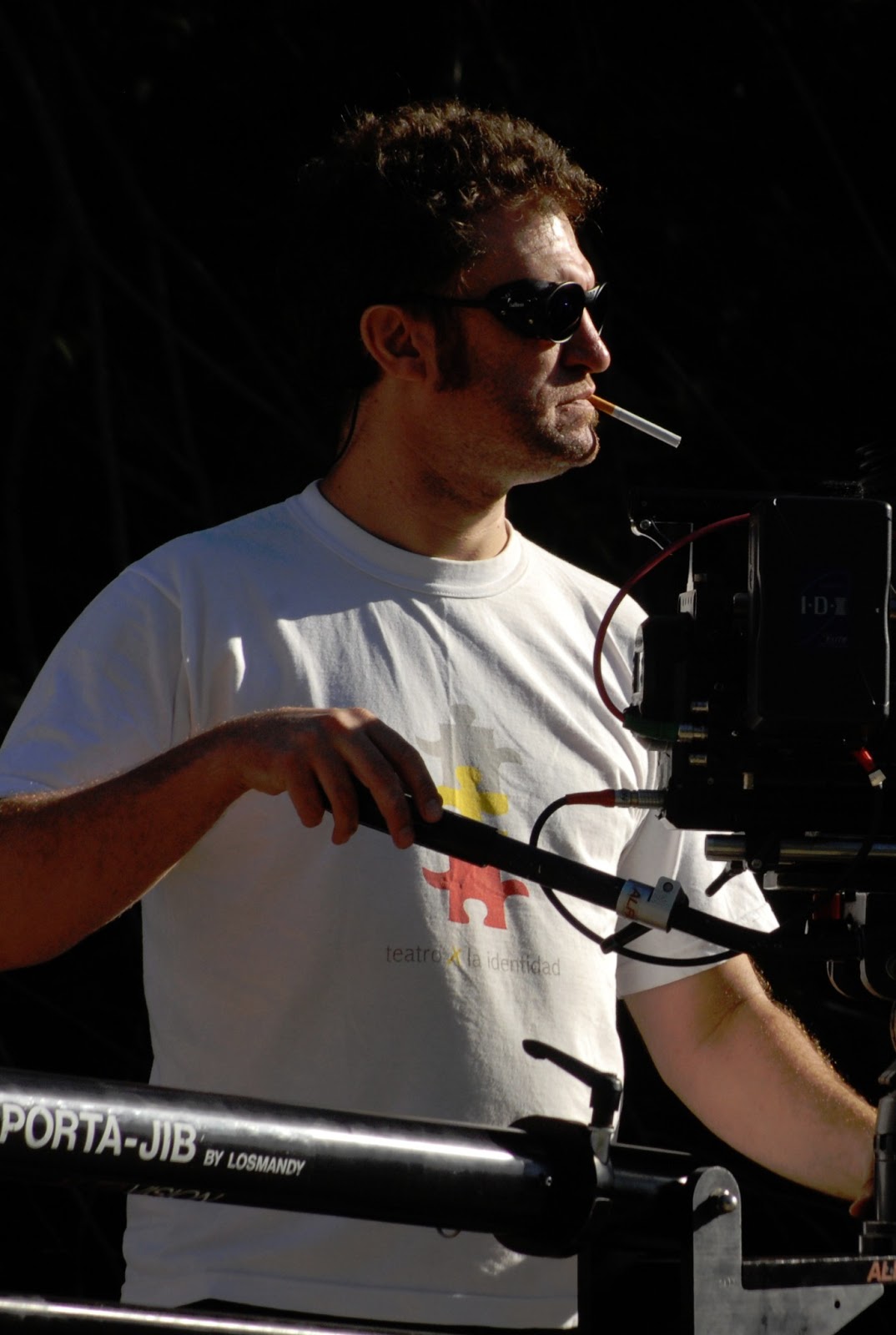
Mr. Baker, shown at right, loves children -- both of the small sort, and those who, though they may look like adults -- see Starlet and Tangerine for a couple of examples -- still mostly act like the kids they've never been able to move beyond. How they manage (or don't) to begin to make that move comprises the arc of those two films and their characters' stories. With The Florida Project, Baker gives the actual small kids their lead and lets them run with it. The result is initially bubbly, bracing and enormous fun, but as the movie moves along, its dark side surfaces almost equally. What's missing for most of these kids is not only proper parenting but the kind of safety net any decent society needs. The movie does not "tell" us this; it doesn't need to because it shows us so clearly everything we need to know.

The film takes place in the Orlando, Florida, area -- far enough away but also near enough to Disney World to make that place resonate without our ever actually having to see it (throughout most of the movie, at least). Instead we and our scrappy heroine, Moonee, played by a very young actress, Brooklynn Prince (shown above, center, and below, right), who makes an indelible impression here, hang out at the low-end motel in which the kids and their caretakers live. All the children are terrific and seem as real as kids get, but Ms Prince receives the major screen time, and she's worth every minute of it.

As her problemed mom, newcomer Bria Vinaite (above) is equally real and twice as troubling, as the character stumbles from one bad move to the next and yet keeps caring for her daughter as best she can -- which is, unfortunately, not really very well.

The filmmaker mixes professionals actors with non-pros and does this with such ease that if you did not already recognize performers such as Caleb Landry Jones, Macon Blair and especially Willem Dafoe (shown above, and who is as incredibly fine here, playing what you might call a "normal" character, as he has ever been), you would think them all just part of the real people Baker has recruited for his project.

Baker's choice of incident builds carefully and very well to what will be a turning point. We don't know quite in what direction it will turn, nor whether it will help or hinder, but by then we've spent nearly two breathless hours watching, smiling, wincing, frowning and feeling childhood, its joys and discontents, as strongly as you could want -- and all with characters from an economic/social class of which many of us don't rub up against at all often. When we do, we're likely to somehow discount them. Mr. Baker (as with all his films) makes certain that doesn't happen here.

The Florida Project, from A24 and running 115 minutes, opened on its home ground, Orlando, last weekend and will hit Miami, Fort Lauderdale, Boca Raton and West Palm Beach this Friday, October 20, along with elsewhere throughout the country now and in the weeks to come. To discover the theaters nearest you, simply click here.

Wednesday, January 9, 2013

Argentine entry for Best Foreign Language Film, Benjamín Ávila's CLANDESTINE CHILDHOOD, opens in New York

What would it be like to have been a child raised in a family of left-wing activist, guns-and-ammunition-running relatives during Argentina's 1970s right-wing military dictatorship -- which has been called the most repressive in that repression-prone country's history? Not a lot of fun, perhaps, but fascinating as hell, at least according to the very interesting, thought-provoking memoir movie based on real-life characters that opens this week. CLANDESTINE CHILDHOOD is the Argentine submission for Best Foreign-Language Film in this year's "Oscar" sweepstakes, and I would not have been surprised to see it make the shortlist.

That it didn't might just be due to the fact that the movie's politics, given the historical situation, seem pretty middle of the road. The co-writer (with Marcelo Müller) and director, Benjamín Ávila (at left) makes certain that we understand the necessity of activists rising up against a tyrannical dictatorship at the same time as he makes clear how deprived in certain ways is their child, the boy who is at the center of this relative-ly stringent movie.

The film's greatest strength -- aside from being compulsively interesting and occasionally nail-bitingly suspenseful -- is that it forces you to identify with all its major characters: those who must fight against oppression, even if it takes their own lives, leaving their children bereft (and who knows what else?); the relatives who want to help the family but are too frightened and cowed by the violence against dissidents to join in their "revolution"; and most of all, the boy himself, torn between the normal needs and desires of approaching adolescence and the need and desire to help and be part of his immediate family.

Beginning with a scene that combines live-action with a kind of classy, children's-book/comic book-style animation, the movie takes us into the mind-set and world of its hero, young Juan (played with exactly the right combination of intensity, fear and childlike understanding by first-time actor Teo Gutiérrez Romero, shown above center, with mom and dad), who will soon be living under the alias of Ernesto, with a fake passport, birth date, birth place, history -- the works.

One important question the movie asks (and without ever out-and-out mentioning it) is this: What kind of children-to-adults do active revolutionaries raise? In one pivotal scene the boy's uncle (a charismatic performance from Ernesto Alterio, above, right) and father argue over the birthday party for the boy soon to take place here at "home" with all his school mates. Does the revolution halt for this event, or is the party merely a wasteful pastime?

Another terrific scene takes place between the boy's grandmother (Cristina Banegas), and the rest of his immediate family, partic-ularly his mother (a rich, multi-layered perfor-mance from Natalia Oreiro, at left, with gun, and 3 photos above), about the child's well-being. There is no "answer" to these questions, only despair, anger and maybe, just a little, hope. The movie is based upon real-life characters; how truthful to the actual characters the film is, I have no idea. But as an entertaining, thought-provoking movie, Clandestine Childhood hits the proverbial nail dead center, with its shock waves manifesting still.

The film, released here in the USA via Film Movement and running 110 minutes, opens this Friday in New York City at the Lincoln Plaza and the Quad cinemas. Click here and scroll down to see all currently scheduled playdates around the U.S.

Friday, May 11, 2012

Kids! Koreeda Hirokazu's glowing & moving I WISH offers the best of them. And of us.

I'm ready to call Koreeda Hirokazu one of the words greatest living filmmakers, certainly among the great humanist artists of all time. Each of his movies seems better than the one before it, and since that one was already full of wonder, amazement, joy and sorrow, how much fuller, more encompassing could his latest offering be? You'll have to see I WISH to find out.

The story of two siblings, Koichi and Ryunosuke -- played repsectively by newcomer brothers Koki Maeda (above, right) and Ohshirô Maeda (left) -- experiencing an enforced division due to the separation of their parents, the movie tracks both their lives, along with the little community that surrounds each of them: relatives, friends, school, teachers and then, finally, "the world," as one of them calls it -- upon discovering that life just might be larger and more complicated than his immediate circumstance had suggested. Has this fact ever hit home in cinema with quite the quiet force and exquisite combination of sadness and delight that it takes on here?

In this film -- the sixth from this director that I have seen, beginning with Maborosi in 1995 -- Mr. Koreeda, shown at left, offers up an almost continuous array of highly specific details, often in rapidly moving, short scenes, of Japanese life today. Much of this will seem both resonant and exotic, not least the active volcano, constantly spewing ash, over the city of Kagoshima where Koichi, his mom and her parents all live. Ryunosuke lives a long way off with his father in the town of Fukuoka, where dad is still struggling to earn a living as a rock musician. Reunion is on the minds of the two boys and their mom, less perhaps to their musical artist dad.

How we come to know and care for all these people -- and we do, even the adults -- constitutes Koreeda's special magic. The Japanese title of this film is Kiseki, which I'm told means miracle. There are a number what one might calls small miracles along the way in this movie -- and one very large one at the finale. Yet thanks to Koreeda's clarity of vision and ability as a filmmaker, none of it seems in the least other-worldly.

Rather, these events have to do with people behaving decently, being kind, helping each other. And finally, in the person of Koichi, at least, taking this in and using it to help himself grow. You don't see things like this in film very often -- certainly not executed with the style and grace shown here. (After all the utterly realistic and almost improvisational scenes with the kids, Koreeda gives us a long montage of visuals that build -- for us and for the character -- into a gorgeous, moving summation of... life.)

Among the movie's many blessings is the character, Megumi (played by Kyara Uchida, in purple dress, above, right), a friend of Ryunosuke who wants to be an actress. How she gets her chance, in a manner no one could have predicted, is tender and original. As is the old couple who help these kids and in the process experience a kind of complete, yet thankfully understated, joy that comes very close to heartbreak. Come on: nobody else in movies is doing anything like this.

To be honest, TrustMovies expected something wonderful from I Wish. But he had no idea it would be this special. The film, 2 hours and eight minutes and not a moment too long, from Magnolia Pictures, opens today in New York City at the Lincoln Plaza Cinema and the Angelika Film Center; in the Los Angeles area, see it at the Landmark Regent Theatre and the Laemmles' Encino Town Center 5 and Pasadena Playhouse 7. In the weeks and month of come, you'll see the film opening across the country. Click here to see all currently scheduled playdates, with cities and theaters.