Showing posts with label movies about marriage. Show all posts

Saturday, August 19, 2017

Sacha Guitry's LA POISON gets The Criterion Collection treatment on Blu-ray & DVD


Sacha Guitry. Hmmm... Of course, you've heard the name of this Russian-born, French playwright/filmmaker/actor. But his actual work...? Not so easily or quickly identified. As much as TrustMovies prides himself on knowing and appreciating French film, he is embarrassed to say that, until viewing LA POISON -- the 1951 film to be released on Blu-ray and DVD this coming week via The Criterion Collection -- he had never actually seen a Guitry movie. All that has now changed, as I plan to lap up each and every film by this fellow that I can find.

La Poison proves an original surprise from its opening credits onward. In those credits, which suddenly move from the usual written-words-on-screen to an in-person appreciation, as M. Guitry -- shown above, center, with two of his actors from the film -- takes the time and trouble to thank each of his actors, as well as his cinematographer, editor, set designer, music composer and every last person who collaborated on the film for their efforts. (He even makes a quick phone call to thank a woman we never see but whose voice we hear in the film.) Guitry also manages to get in a delightful bit of praise for, as well as a dig at, La Comédie-Française, regarding those two actors (Jean Debucourt, left, and Jacques Varennes, who flank him, above.

Because, La Poison is the first and only piece of Guitry I've seen, I must base my ideas and opinion solely on it. From this, I'd say the man had a great gift for witty dialog, smart and subtle satire, and a marvelous appreciation of human hypocrisy combined with a gift for unveiling that hypocrisy in all its varied splendor. His theme here is marriage gone about as sour as marriage can go, which had led to its participants' plans to do away with each other. Hers (Germaine Reuver, above), the poison of the title, is the more standard approach, while his (that great and unique French actor Michel Simon, at left, below) turns out to be something quite different that blossoms and evolves in amazing ways as the plot unfurls.

Guitry's film begins slowly and sweetly, with a look a "typical" French provincial town that turns out to be both typical and not so. The town's priest (Albert Duvaleix, above, right), as in the work of Marcel Pagnol, dispenses as much logic and solid, worthwhile advice, as he does religion, while the town gossip, (Pauline Carton, below), rather than being some mean-spirited bitch, turns out to be pretty smart, as she and the town pharmacist go over the various ailments that plague the citizens, and she compares here own notes regarding a person's character with the prescription given him (or her). This is a scene -- cleverly mixing humor, intelligence and moral ambiguity -- that you will not have encountered.

Once the "murder" plot is set in motion, the pace picks up mightily, as do the film's humor, satire and surprise. How Guitry works out his particular and peculiar "morality" is as smart, shocking and delightful as anything you'll have seen. Tt will have you alternately laughing and gasping, and always alert so as not to miss a single, clever, engaging bit of word play or moral hypothesis.

Performances are all you could want (Guitry clearly knew his actors and what they could accomplish like the back of his hand), and his keen appreciation of what human beings -- including, yes, children -- so often understand and can reveal seem to me pretty extraordinary. (That's Jeanne Fusier-Gir, above center, as the town florist.)

Criterion's new Blu-ray is spectacular indeed. The transfer could hardly look better, competing I should think, with the film's quality at the time of its theatrical release. Supplements include a lovely appreciation of Guitry, his work, and particularly this film, by no less than Olivier Assayas, while the supplementary 24-page booklet includes a fascinating essay by Ginette Vincendeau that details the movies strengths, as well as its misogyny, along with details of Guitry's life and WWII activities. It's a must-read (but see the film first), as is the wonderful obituary on Guitry included here, which was written by François Truffaut.

Arriving on both Blu-ray and DVD from The Criterion Collection this coming Tuesday, August 22, La Poison, in French with English subtitles and running just 85 minutes, will be available for both purchase and rental.

Sunday, August 6, 2017

A relationship dissolves in Joachim Lafosse's astute and painful drama, AFTER LOVE


How does a 15-year relationship end between two attractive, intelligent partners who have a pair of lovely twin daughters that both of them adore? Discover the answer via a new and often searing piece of cinema entitled AFTER LOVE (the even better French title is L'économie du couple).

As directed by Joachim Lafosse (pictured below, who earlier gave us the equally searing Our Children back in 2012) and co-written by Lafosse, Fanny Burdino, Mazarine Pingeot and Thomas van Zuylen, the movie
probes the final weeks (maybe months) of that relationship by simply showing us, yes, scenes from this particular "marriage." M. Lafosse, wisely I think, gives us little exposition, except what we can pick up from the (often heated) exchanges between our two protagonists. From these we gather that she is the much more financially independent partner; he seems to be near constantly short of money, though when he does work -- as an architect/home renovator -- he does a good job. He also owes money to some rather unsavory characters. Does he perhaps have a gambling problem?

We never really learn the answer to this, or to some of our other questions, but this matters little, since we learn enough about these two that we can quickly enter into their lives and discover more as we go along.

As played by the hugely talented and fiercely committed performers Bérénice Bejo (above) and writer/actor/director Cédric Kahn (below), this pair is brought to fine and seething life. They are given plenty to say and feel via the smart and believably elliptical dialog provided by the writing team, while the choice of incidents given us by Lafosse is just varied and interesting enough to hold us fast.

The film's finest and most spectacular scene comes midway at a dinner party she has organized for the couple's friends, though he has not been invited. When he shows up, the sparks that fly seem all by themselves enough to melt this iceberg of a relationship, only the tip of which we've so far been able to fully view.

The couple's twin children (above), played with near-perfect skill and enthusiasm by newcomers Jade and Margaux Soentjens, seem to be holding up as well as could be expected under this onslaught (their parents at least have the sense to try to explain what's going on to their children as much as possible). Still, the movie should keep any of you who've experienced the anger, pain and sadness of separation where children are involved alert and very on-edge.

If After Love were all just anger and recrimination, the film would be harder to sit through than it is. But the filmmaker has provided moments of respite in which we can't help but wonder if things might finally be salvaged here.

Both parents clearly have their good and bad points, and both seem at times to want to repair some of the damage that's been done (he more than she, and perhaps for economic reasons above all). In the supporting cast, everyone is good, but the stand-out would be Marthe Keller, playing Bejo's mother, a woman who understands relationships and the work it takes to keep them going.

When, at last, agreement is reached between this pair, you're likely to feel relief -- and even greater sadness. As movies about marriage/relationships go, After Love is certainly one of the better examples.

From Distrib Films US, in French with English subtitles and running a just-about-right 100 minutes. the movie opens this Wednesday, August 9 in new York City at the Quad Cinema, and on Friday, August 25, in San Francisco (at the 4 Star Cinema) and on Friday, September 1, in Los Angeles (at Laemmle's Royal). Elsewhere? Not sure, but you might try clicking on the film's website and then scrolling down to the task bar midway and clicking on Theaters.

Wednesday, March 15, 2017

Hirokazu Kore-eda's latest, AFTER THE STORM, opens in New York via Film Movement


For those of us who love the work of Japanese filmmaker Hirokazu Kore-eda, the chance to see another of his graceful, beautiful explorations of family connection and growth will not go unattended. In the last couple of Hirokazu's films that TrustMovies has seen, however --  Our Little Sister and his latest, AFTER THE STORM -- it seems to me that the slow pace is slackening even further, while any surprise has gone almost completely missing. While these elements might be deal-breakers for some movie-makers, where Hirokazu is concerned, they don't matter so much. This is due to the rich, human detail he always provides regarding his main characters. You come away from his films steeped in the many individual idiosyncrasies of character, as well as a greater understanding and appreciation of the culture at large.

There is also a grand sense of kindness experienced here, both from the individuals shown and via directorial intent. This is not to say that the people we meet are all good and sweet all the time. Hardly. Our main character here, Dad, played Hiroshi Abe (below, of Hirokazu's I Wish and Still Walking), is a novelist with writer's block who now works as a sleazy private detective, catching husbands or wives in extra-marital affairs to pay his bills (which he rarely seems able to pay, in any case). He is also not above selling out his client, if he can make some extra money off the spouse. Yeah: nice.

This guy also loves to gamble, much to the consternation of his ex and his mother, each of whom is brought to lovely life respectively by Yôko Maki (shown below, of Like Father, Like Son) and Kirin Kiki (of Sweet Bean), shown further below. Both actresses bring such truth and concern to their characters that they help keep the movie on track, given Dad's consistently bad behavior.

In fact, the movie threatens to go off the track, due to Dad, who seems so unable to change, learn or grow in a better direction that, given what you know from Kirokakzu's other films, his "turnaround" is simply going to be unbelievable: too much too late. Stick with After the Storm, though, because the filmmaker manages, as usual, to give us growth in such tiny but smart increments that we not only buy it, we finally revel in it.

There is one scene in particular, in which the poignancy of a failed marriage that both participants -- plus offspring and older generation --want to see repaired is captured with such beauty, sadness and delicacy that, all on its own, it makes the movie worth seeing.

Hirozaku is also finely attuned to the manner in which that apple never falls far from its tree (we learn quite a lot about the recently deceased grandfather, too). Yet in this filmmaker's world, both apple and tree are decidedly mixed bags -- plenty of negatives but some redeeming positives in the mix -- from which Dad's young son (a very good performance by a young actor, above, left, whose name I am not certain of) will also grow and change.

The film is firmly anchored by the excellent performance from Mr. Hiroshi (above and below), a tall, rangy, immensely sexy actor with charisma to spare. Watching him repeatedly fuck up and then try to make up for this, will keep you alternately annoyed and hopeful, desolate and delighted. He is a pleasure to watch in action or repose -- as is, finally, the movie itself.

From Film Movement and running a lengthy but packed-with-detail 117 minutes, After the Storm opens this Friday, March 17, in New York City at the Lincoln Plaza Cinema and the IFC Center, Here in South Florida, it opens on Friday, April 7, at the Living Room Theaters, Boca Raton; the Tower Theater, Miami; and at the Miami Beach Cinematheque. To see all currently scheduled playdates, with cities and theaters listed, click here and scroll down.

Saturday, March 12, 2016

A digital debut for Joan Carr-Wiggin's HAPPILY EVER AFTER: Lightning does not strike twice


When the terrific (and still woefully underseen and under-appreciated) rom-com If I Were You burst upon us in March of 2013, TrustMovies thought that he, as well as the world at large, had found a fabulous new filmmaker: Joan Carr-Wiggin. Granted, he had also seen and not much liked her earlier film, A Previous Engagement, but because If I Were You remains among the best rom-coms he has ever seen, he was more than a little excited to view her new one: HAPPILY EVER AFTER. Unfortunately it skews to that former film's weaknesses rather than to the strengths of the latter.

Those would include the just-about-perfect performances of If I Were You's stars, Marcia Gay Harden and Leonore Watling, as well as a plot that grew ever more interesting, off-kilter and appealing as the film moved along. Carr-Wiggin (the filmmaker is pictured at left) has, in her latest work, appeared to revert to her earlier problem of putting preaching prior to plot and entertainment value. And this only grows more so as Happily Ever After runs its course. Yes, the filmmaker wants to point up western society's penchant for hypocrisy and denial, but having the characters almost constantly wag their finger at each other (and us) is perhaps not the best way to do this. (The film's title itself is problematic, as there have been by now dozens of movies and TV films to use this same moniker. By calling your film Happily Ever After, you're immediately in used-tire territory.)

In addition, there are so very many oddball couplings, "surprise" connections and reversals/revelations in the course of the film that, after awhile, we stop counting -- and caring, (My spouse stopped watching around 80-minute point; I lasted out until the end.)

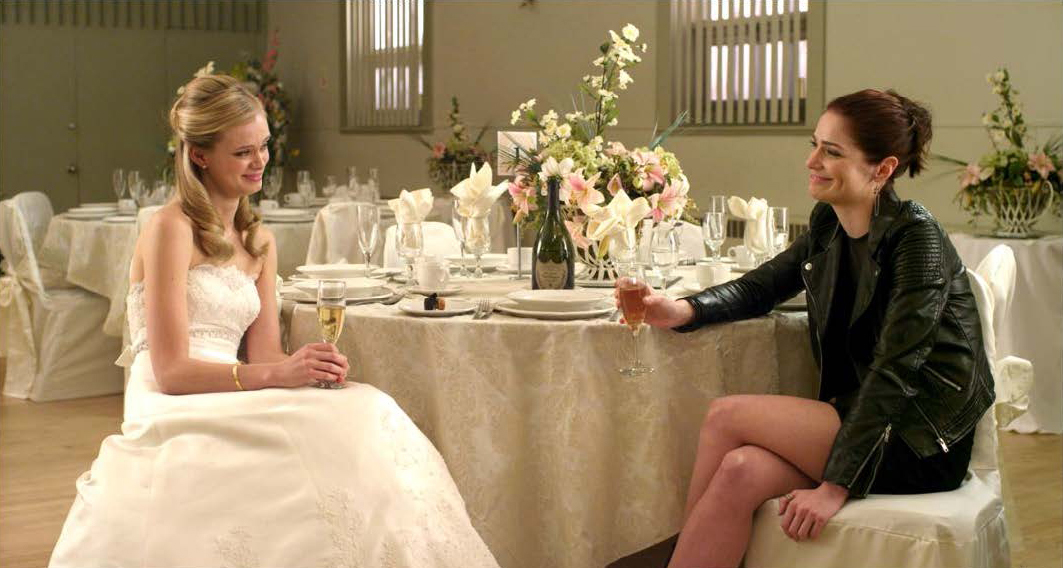
This is too bad because Carr-Wiggin has assembled a pretty good cast to people her romp and occasionally given them some smart dialog to perform. Shown at left in the two photos above is the movie's OK co-star Janet Montgomery and her even-better co-star Sarah Paxton (shown at right in both photos).

The two play high school best friends, whose friendship disappeared suddenly when the former headed out of town without notifying anyone some years previous. Also involved are the Paxton character's mother (Alex Kingston, above left) and current best friend (Claire Brosseau, above, right).

The guys -- usually a lesser breed in the Carr-Wiggin oeuvre -- are represented by our two heroines' dads (Peter Firth, left, and Al Sapienza, right) and Alex McCooeye (center) as a somewhat baffled groom-to-be. As I say, the performers are good, but the hoops they are asked to jump through would prove tricky to the most seasoned and talented performers. (Harden and Watling in If I Were You, for all the bizarre situations in which Carr-Wiggin placed them, had much stronger characters to play. And the actresses are damned strong, too.)

So, on balance, Happily Ever After proves more trying than entertaining. But the filmmaker is said to have yet another film coming out later this year featuring a very good British cast. We live in hope. Meanwhile, this one -- running a too-long 112 minutes and distributed by Alchemy -- makes its digital debut this coming Tuesday, March 15, on major platforms from Amazon to Xbox and most everything in between. 

Thursday, February 27, 2014

Streaming tip: Stacie Passon's CONCUSSION shows us what a bump on the head can do


Never for one moment uninteresting, yet forever making us want to get deeper into things as it glides along the surface of its main character's life, CONCUSSION, the writing/directing debut of actress Stacie Passon (shown below), is one of the better movies I've seen in some time about the lives of present-day lesbians and how they manage work, love, family (including children). The movie begin with the delivery of a bad bump on the head, as a ball thrown by one of those children bloodies the side of the face of our heroine, Abby (Robin Weigart). Whether this event itself causes a kind of disconnect in Abby's life or that disconnect was fully there, waiting to be exposed, is up for grabs. But what happens from here onwards makes for quite the change in our working housewife's life.

Abby already has a career as a successful woman who locates real estate that "needs work," does that work, and then sells at a tidy profit. She is also married to a woman with her own successful career, and the pair have two children: a boy and a girl who are, one assumes, pretty normal and relatively happy. But all this -- which would be plenty on the plate of most people I know -- is somehow not enough. Via some happenstance involving friends, clients, co-workers and their "connections," Abby comes upon the opportunity to act as an escort -- which, after a bit of coaxing and working out her own "rules of the game," she does. How she manages all this is the meat of the movie. Why she does it, why she needs to, we never really learn.

Consequently the movie skates along, quite nicely for the most part on the surface of things. We see these "connections" made, and they are certainly believable enough; we watch as client after client is serviced by Abby -- often psychologically, as much as sexually; and then, at last, we watch things (sort of) fall apart.

Some movie-makers would use this kind of story as an excuse for heavy melodrama, or maybe something in the thriller genre, not to mention the possibility of high (or low) comedy. Ms Passon opts for none of the above. Instead she goes for almost mundane reality, and the result, as I note above, is never uninteresting. But so much remains out of sight and mind.

Does this woman love her children? Is she even capable of this? It certainly doesn't show in what we see. Which makes us worry for those kids' future. The relationship between spouses is also fraught and barely probed. Both women have their problems and issues, it is clear. By the end they may have begun to work on this. Or maybe not. They might simply go back to that all-surface life.

Performances are fine right down the line. Everyone is so good in fact, that we want to know more about them all -- from the elusive, shy client played by Laila Robins to the the pert little girlfriend (played by, I believe, Emily Kinney) of Abby's contractor, who has set up this entire escort service. But the movie, such as it is, belongs to Ms Weigert, who is as usual, quite good, so far as she is allowed to go. Which is, again, all glistening surface.

The core, which is missing from Abby's character (we never see her prior to getting that titular concussion), is also missing from the movie itself. This makes it unusual, certainly -- as if this is the life we'll have once those pod people from Invasion of the Body Snatchers have taken over completely. I don't know that this is anything like what Ms Passon wanted to achieve. But it is something of an achievement, granted an odd one, nonetheless. You can watch the movie now on Netflix streaming, Amazon Instant Video, and probably elsewhere, too.

Wednesday, August 28, 2013

Jill Soloway's AFTERNOON DELIGHT is a potent, if strange, delight--any time of day

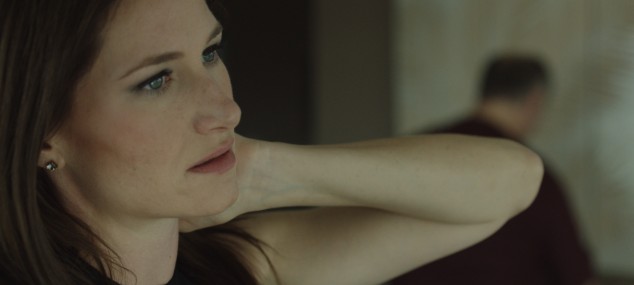
If you're anything like TrustMovies, a new film that features Juno Temple turns immediately into a must-see. And though Ms Temple has one of her best recent roles in AFTERNOON DELIGHT -- a movie that offers a look a modern marriage among the Los Angeles semi-elite -- the real star and driving force of the film is Kathryn Hahn. Ms Hahn is an actress with nearly 50 credits on her resume over a 30-year period, including some popular TV and cable shows, and I believe that she is most often seen in supporting roles. Nothing she has done till now quite matches the opportunity given her here. As with Olivia Wilde in last week's opener Drinking Buddies, Ms Hahn's work in this film would turn the heads of AMPAS, if only its members paid as much attention to intelligent, low-budget films as they do to many of the higher-budget, would-be independents, as well as the lame-brained "blockbusters-for-big-boys."

Written and directed by Jill Soloway (shown at right: this is her first full-length film), Afternoon Delight places us in the mind, body and spirit of its heroine, Rachel, and then slowly lets us watch and experience as she goes to pieces. Ms Hahn, however, is such a fine-yet-tamped-down comedian, as well as a realistic enough actress, that she keeps us entertained and glued to her character throughout, even as we become awfully uneasy about some of Rachel's choices. From the initial scene inside her car as it moves through a car-wash, Rachel is clearly insecure in her life as a stay-at-home mom. In scene after scene, something is always a bit off, yet Ms Hahn (below) handles the acting chores with dry wit and an easy, toss-away manner.

Then, when Rachel, her husband Jeff (a very good Josh Radnor), and another couple go out on a double date to a strip club and Rachel is talked into getting a lap-dance from a stripper named McKenna (played by Ms Temple, below), things begin to change. And not necessarily for the better -- but necessary, all the same.

Ms Soloway seems to know and understand this segment of L.A. society pretty well. She nails it, with humor and satire but also with enough empathy that we don't entirely lose sympathy for these wives/mothers, or for their husbands who maybe have a little too much money but have not, as yet, grown up. This is never truer than the climax of the film, in which polite convention seems irreparably broken and so a price must now be paid.

These scenes skirt melodrama yet stay focused and truthful due to the superb build-up that Soloway has achieved, based strongly on character. Everyone here -- from the husbands (that's Mr. Radnor, above), wives and children to the hooker and her john -- come across as real, even as the juxtaposition of these two sets of characters sometimes seems more than a little bizarre.

Soloway also shows us sex as industry, along with an interesting mix of class and economic differences. (The religion here is mostly Jewish, and Soloways's take on this, too, is both timely and smart.) If the McKenna character proves more a catalyst than anything else, due to smart writing and a sweet, sour, spot-on performance from Ms Temple (above, left), she comes to beautiful and moving life. When she is seen as a friend and helper, this is how she behaves; when treated as a whore, she gives you exactly that.

The movie also possesses an interesting arc: When things are going well -- or at least OK -- for the characters on view, they can seem eminently resistible. It's when things begin to fall apart that they grow more interesting and empathetic. You'll change your mind about a lot of these people as the movie moves onward. By the end, I think, you've be glad to have met them.

Afternoon Delight, from The Film Arcade and running 93 minutes, opens this Friday, August 30, in L. A. (at The Landmark) and New York (at Landmark's Sunshine Cinema. The following week and throughout September, it will roll out to some 20 more cities nationwide. To view all currently scheduled playdates, cities and theaters, click here and scroll down.

Friday, September 14, 2012

A "date movie" for adults. Really? Yes! Jim Hemphill's THE TROUBLE WITH THE TRUTH


While TrustMovies calls this one (as does its own press release) a "date movie for adults," let's be a bit more specific. Those dating adults had better be able to handle the idea of marriage gone bad and the long time it takes to recover from this. Maybe older adults -- ah-hah, another movie for seniors! -- might be the best match for this unusual new film. Those of us who've been through the marri-age mill once or more, have had children and are even now perhaps still coming to terms with our failures as a husband or wife, and as a father or mother, are the real audience for the engaging and challenging workout titled THE TROUBLE WITH THE TRUTH, brought to us by writer/director Jim Hemphill, shown below.

I would wager that a number of people connected with the film-- specifically the filmmaker and his two stars John Shea and Lea Thompson -- have had a background in the legitimate theater. I know Mr. Shea has, for I enjoyed his work off-Broadway in decades past. Ms Thompson I know more from movies, but am told that she too has worked extensively in theater. And though I cannot find reference to this in the press materials, I'd bet that Mr. Hemphill comes from theater, and that this film, in fact, began its life as a theater piece. It probably did, and he must. Anyone with this terrific an understanding of how to write great dialog -- this movie is almost all dialog -- either began in legitimate theater or is channeling the spirit of some theater "legends." Hemphill also understands scene construction, pacing and flow, where this dialog is concerned: yet more virtues possessed by theater folk.

The result of all this "theater-like" business is a movie that beigns in a coffee shop, as Shea (above, left) meets his daughter (a brief but very nice turn by Danielle Harris, above, right) for breakfast. An announcement is made that sets off an argument, recriminations and the soon-arranged dinner meeting (at the very restaurant where the Shea character is a musician) between mom dad, the divorced-some-time-ago characters played by Shea and Ms. Thompson (shown below, and further below).

That meeting (over drinks, dinner, dessert and then more drinks in an upstairs lounge) makes up the remainder of the movie -- which is simply stunning in its single-minded pursuit of who these people are and why they are no longer together. The writing is first-rate, carrying us (and the twosome) into the past and back to the present, divulging character traits and history along the way, all with such elan that it make the screenwriting almost accidental, hovering as it seems to between dialog and improv. It is such a pleasure to listen to this conversation, and to watch such solid professionals as Shea and Thompson strut their stuff. (The superb cinematography is from Roberto Correa.)

While this dialog and the performances are easy and always believable, what is not always so believable is the volume at which our characters are speaking. I wish the director had thought to suggest to his actors that they remember that they are in a public place and should tone it down just a notch. The few other other diners that we are able to see do seem to occasionally acknow-ledge the presence of this pair, but if I were in that restaurant, I'd have turned to the two and asked them to button it, please.

Once the two adjourn to the lounge, where they are alone, the credibility grows, and it does so even more when they reach their final destination and their characters are revealed more fully. This is some of the best sustained and meaningful dialog (quick, funny, moving, surprising) coupled to excellent acting that I have seen in some time, and I can certainly understand why the film won the awards it did at film festivals in Las Vegas and Sedona.

This is a look at how two very real, often amusing, sophisticated and witty characters, who are firmly middle class (he's lower, she's upper), live now. As such, it deserves a place in any time capsule of culture we might be readying. Shea has allowed the years to do their work on him, yet he still looks as intelligent and sexy as ever, while Thompson is simply stunning. She looks more beautiful now than she did a decade or so earlier. (That's Keri Lynn Pratt, above, as the Shea character's latest squeeze,)

The Trouble With the Truth, running a perfectly-timed 96 minutes, opens today, Friday, September 14, in both New York City (at the Quad Cinema, where Mr Shea will make a personal appearance tonight, 9/14, at the 7:30 show and do a Q&A after the screening) and in the Los Angeles area at the Egyptian Theatre in Hollywood, and for one performance only this Sunday, September 16, at the Aero Theatre in Santa Monica. Hemphill, Shea and Thompson will appear for a Q&A at the Aero screening, and they, along with DP Correa, will appear at various times during the week's screenings at the Egyptian. Click the theaters' links above for further information.

The photos above come courtesy of the movie's 
web site and were taken by Evelyn Sen.