Showing posts with label musical genius. Show all posts

Wednesday, January 3, 2018

With the musician bio-pic DJANGO, writer/ producer Etienne Comar directs his first film


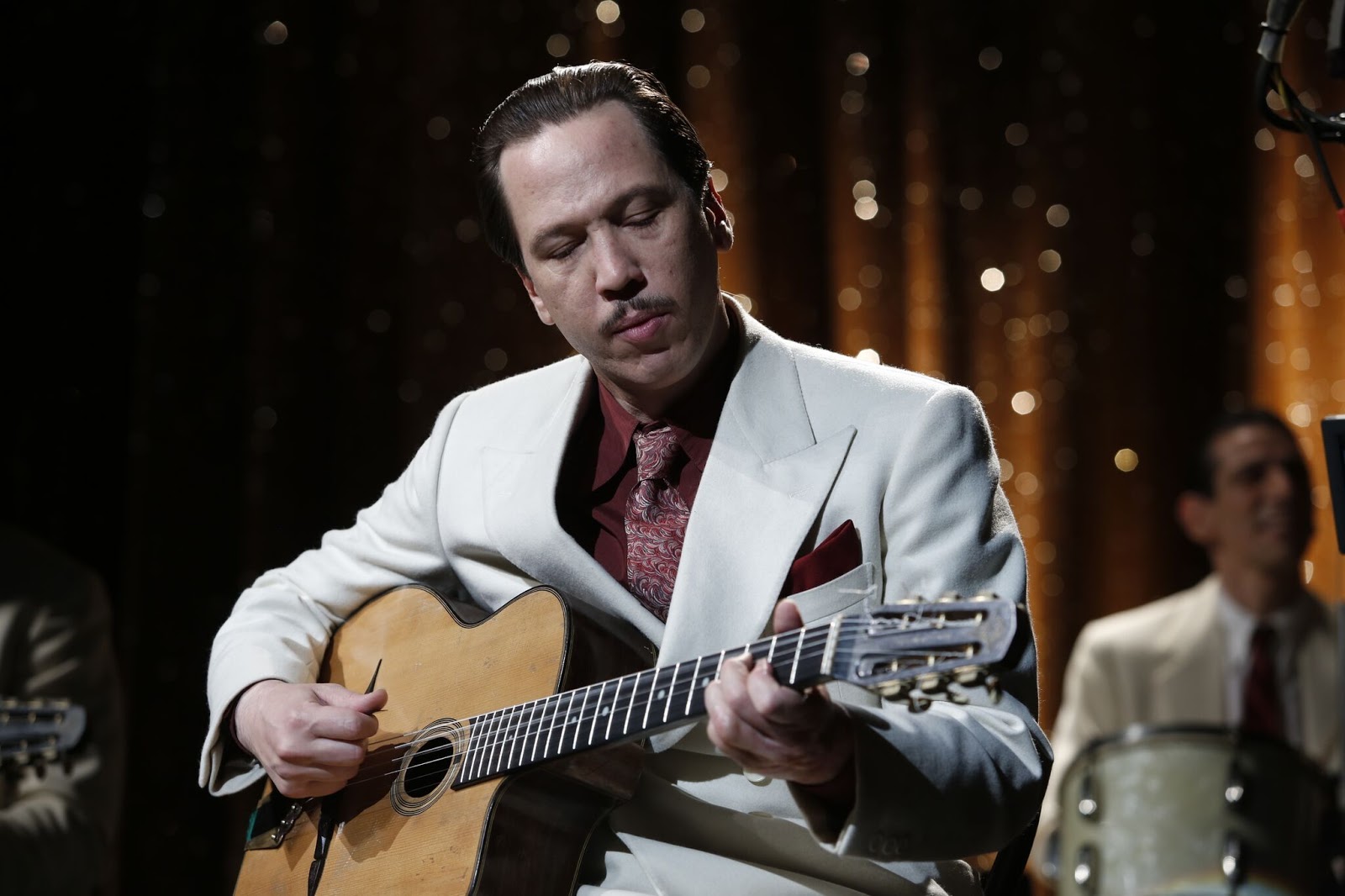
Paris-born filmmaker Etienne Comar has written a half-dozen fine films (from Of Gods and Men to Haute Cuisine and My King) and produced a bunch more (Timbuktu, for one). Now, he has directed his first film, and it's a good, but not great, one entitled DJANGO, which gives us but a single chapter in the life of the internationally famed guitarist, composer and musician, Django Reinhardt.

That chapter concerns the time in France during World War II when Django, although a huge success and popular even among the Germans, because he was of Roma/gypsy stock and thus on the Nazi hit list, had to leave Paris and somehow reach -- along with his pregnant girlfriend and his mother -- the "neutral" haven of Switzerland.

M. Comar, shown at right, begins his movie in a forest with a fraught but well-done scene of a sudden massacre of Roma that includes, as we later learn, Django's blind mentor. We then meet our musician, brought to very believable, surprisingly thoughtful and quiet life by a French actor who ought to be better known on these shores, Reda Kateb (shown below, of L'astragale and Far From Men).  M. Kateb seems more than comfortable with the instruments he is supposed to be playing, and he brings his usual skill at subtlety and under-playing to bring to life and evolution the character of this oddball artist. (Yes, that's a monkey on Django's back, but fortunately it's a real one rather than any symbolic drug addiction.)

The time frame covered here is a relatively small one -- only a matter of months, I think -- as Django does concerts, a grand one in Paris and later more improvised "musicales" when he moves to a town on the lake shore across from Switzerland. The Nazis, more threatening at certain times than at others, are nonetheless ever-present, adding a tension to the movie that never dissipates.

Comar's directorial style is on the quiet side, avoiding melodrama, even at key moments. This may make the movie, which runs just under two hours, seem slow at times, but it is never uninteresting.

The film is also filled with music in Django's signature jazz style (his quintet is said to have been among the first to feature the guitar as lead instrument) and with fine performances, too. Chief among these is that of Belgian actress Cécile de France (above, right), who plays a character -- created from whole cloth, it seems -- who acts as our hero's lover and guardian angel who herself turns out to need some help.

Ms de France is fine, as always, but the really impressive female role here is that of Jango's mother, Negros, who is played by a knockout actress doing her very first narrative role, Bimbam Merstein, above, center, who proves every bit as memorable as her name. Ms Merstein brings to the movie its funniest, most energetic and alive moments, and thus becomes its not-so-secret weapon. (That's Beata Palya, above left, who plays Django's ever-loving, pregnant girlfriend.)

Django is not, as I say, a great film. But it is a good one that should keep your interest throughout, as well as bring into focus a chapter of the life of a musician who could be better know here in the USA. (He recorded in France with visiting American musicians, including Coleman Hawkins and Benny Carter, and briefly toured the United States with Duke Ellington's orchestra.) In any case, I'll look forward to M. Comar's next directorial effort.

From Under the Milky Way and running 117 minutes, Django opens this Friday, January 5, in New York City at the IFC Center and then on January 19 in Los Angeles at Laemmle's Music Hall, and on January 22, at several other Laemmle locations.

Saturday, February 9, 2013

PAUL WILLIAMS STILL ALIVE: Stephen Kessler's celebrity doc works on all levels

How rare is it to watch a documentary about a celebrity that manages to avoid just about every pitfall in the book? The beauty of Stephen Kessler's documentary about the diminutive song-writer/singer/enter-tainer/celebrity Paul Williams, out now on DVD and elsewhere, rests in its willingness to tackle its subject every which way -- including the manner in which the filmmaker wants to tell it and the way Williams himself insists on it -- resul-ting in a documentary that adheres to the rules (this is no hybrid narrative/docu mash-up) and ends up seeming extraordinarily honest about, well, everything it touches.

The filmmaker (shown at right) doesn't touch everything, mind you -- Mr. Williams won't go into certain subjects, which is his call, and he flat out argues with the director about certain other ones -- but what the documentary does encompass, it makes genuine and in-the-moment. And it gives us a remarkably rich look at a very talented celebrity, then and now, and lets the man (and us) muse on the rewards, drawbacks and meaning of this kind of in-the-spotlight life.

The surprise here, and it is quite a surprise, is how Mr. Williams looks at his past career, his present one (yes, he's still going fairly strong), and what has happened in between. He turns out to be not just a talented guy but a smart one, too, and some of the things he has to tell us are more than a little thoughtful and rewarding. My favorite is his off-the-cuff remark about his current (and, I believe, third wife): "She got the man that the former two wives imagined that they had gotten." Only with a lot of growth and change, however, has the younger man becomes his older and more responsible counterpart.

What about those terrific songs Williams wrote, and all the famous celebrities with whom he was constantly rubbing shoulders? Ah, they're here, and we get to revel in those 70s TV shows and hair styles, and the smart, often touching lyrics and memorable tunes the composer came up with. The movie is impressionistic, as it jumps from this to that and the next big thing, and although Kessler is a huge fan of Williams, the latter never allows the former to gush. Hence the tone, which is admiring (hell, there's a lot to like about this guy and his work) is kept nicely in check by the subject of that admiration.

As documentaries about celebrities (particularly living celebs) go, PAUL WILLIAMS STILL ALIVE, may be the one to beat. It just about perfectly balances nostalgia with now, and at 86 eminently watchable minutes, it's a model of intelligent concision and inclusion. It also demonstrates how a filmmaker can approach and work with a celebrity to produce something of which both can be proud -- and viewers can bask in and learn from.

The documentary is available now on DVD, VOD and various digital sources. Or you can download it here.

Saturday, July 7, 2012

Stan Warnow's DECONSTRUCTING DAD: The Music, Machines and Mystery of Raymond Scott (né Harry Warnow)

The DNA that makes for genius doesn't seem to kick in much where parenting is concerned. Or so history tells us. I'm sure there are exceptions to this rule, but Raymond Scott (born Harry Warnow, of Russian-Jewish parents), the music man most probably famous as the orchestra leader of the mid-century television  program Your Hit Parade (1950-59), was certainly not among those exceptions. The documentary that his son Stan Warnow has put together about his father's rather amazing life and character is a fascinating one, full of history and memorabilia, invention and genius, and people we knew in one manner (the late Dorothy Collins) now shown in quite another. It's a shame that Miss Collins died long before this film was made. Her viewpoint might have proven rather broadening.

Filmmaker Warnow, at left, and his sister Carolyn Makover have a number of interesting and sad things to say about their dad and their lives with him (mostly without him). As Carolyn makes clear, he was an absentee parent, even when he was in the same room with them. As much as they appreciate his genius, and I think they do, the heartache of a missing parent is always present in the documentary, hovering quietly around its edges. This could make for some heavy going, but because Stan has filled the film with such surprising information, plus the same kind of energy his dad must have had for music and invention, these 98 minutes mostly fly by. Further, his use of talking heads -- while kept to a very few -- combines family, fans and music professionals in a manner that weaves Scott's story and talents together quite interestingly. And because the filmmaker's timeline, rather than flipping back and forth always moves ahead, we know where we are -- on one level, at least -- at every point along the way.

The character of Raymond Scott (he's shown at right, below, at bottom and on poster, top) is certainly a complex one, full of ironies and hypocrisies, along with brilliance and creativity. A musician/composer control freak who was almost pathologically shy, he insisted on using jazz musicians and yet wouldn't allow them to improvise once he'd gotten the kind of sound he wanted. As gifted as Scott was musically, he seemed to love equipment and technology above all else (shades of Glenn Gould).

In your standard modern-day musician documentary or docudrama, at the center is often, if not almost always, a fellow or gal with substance-abuse problems -- from the hero of Walk the Line to the latest Hank Williams movie that opened a couple of weeks back. Not here. This guy was clean but, in his way, mean. Foremost, he was a man whom his children saw little of and knew even less. So Warnow's movie becomes a compiling of facts about the man, his life and interests that tell us a great deal, while never getting close to the core of the individual -- even though we hear from those family members who were "closest" to him and other musicians (multi-Oscar-winner John Williams, below, and Mark Mothersbaugh, further below) who admired him profusely. This is not surprising, as I suspect Raymond Scott/Harry Warnow never got close enough to himself (nor had any interest in doing so) to achieve what we might call self-knowledge.

A Jew who turned his back on his own culture -- he changed his name, got a nose job, and took, for his second wife, a shiksa (at least this young woman, known at the time as America's Sweetheart certainly looked the role). Yet Scott, as a bandleader, insisted on hiring the best musicians, no matter what their color, and consequently had himself the first integrated band in American broadcast history.

His music was clever and original -- popular, too -- predating other, later stuff that seems to have been copied from Scott's work. Along the way, we get a wonderful animated short by Scott SanGiacomo, showing us how he and his band "composed" his song, War Dance of the Wooden Indians, along with some nifty vintage footage of the few times Scott and his musical group appeared on film. Without even realizing it, you'll probably recognize much of Scott's music because it was used so often in the old Warner Brothers Looney Tunes and Merrie Melodies cartoons.

When the filmmaker gets into Scott's work as an inventor (this was the guy who made the first synthesizer -- and even mentored the now more famous Robert Moog), the movie grows almost amazing. To think that Scott knew so much and was able to do so much, and yet his own paranoia and unwillingness to share prevented him from moving ahead. For a time -- this came as quite a shock to me -- he was hired by Berry Gordy at Motown (Gordy purchased Scott's "Electronium," above, a machine that allowed one to simultane-ously compose and perform), which should have ensured his success. But, no: He was let go from the company some time later.

Oddly, even as Scott's health was failing, his reputation was back on the rise, due to some of the men -- music historians and musicians -- who helped Warnow with this original, fine and finally quite moving documentary. DECONSTRUCTING DAD: The Music, Machines and Mystery of Raymond Scott opens this coming Friday, in New York City at the Quad Cinema. I don't know of any other theatrical playdates around the country, but to order the film, along with its host of "extras," on DVD, click here.