Showing posts with label personal filmmaking. Show all posts

Tuesday, November 1, 2016

Barry Jenkins' groundbreaking MOONLIGHT: It's everything you've heard it is -- and more


Personal filmmaking raised to about as high a level as TrustMovies has so far seen, MOONLIGHT proves as quietly magnificent, immediately engrossing and enormously powerful as any film in years, if not memory. How does writer/director Barry Jenkins manage this?  Rather than expound at great length (so much of this has already been done by others), I'll first ask that you see for yourself. You'll be glad you did. (And now I'll expound just a little.)

I must admit that having seen and semi-enjoyed Mr. Jenkins' earlier Medicine for Melancholy, I would not have expected anything this momentous. What this filmmaker, shown at right, has done is give us the Black experience in a way that seems both utterly specific and hugely encompassing. That he has chosen to show us this via a character who is gay (something not exactly considered a "plus" in the Black community) makes it all the more amazing. Further, he has used three very different actors -- who look almost nothing alike facially or in body type! -- to portray the character as a boy, an adolescent and a young man.

Here they are, at left (Alex R. Hibbert, as the boy), below (Ashton Sanders as the adolescent version), and further below (Trevante Rhodes, as the young adult),

What unites these three so disparate-looking males is their very "essence," which Jenkins and his actors have captured beautifully and profoundly via the situations, the dialog (kept to a minimum) and the all-round filmmaking skills. This essence is what holds the film together and slowly allows us to understand the meaning of "character."

The movie is also about identity, where it comes from and what it means to each of us, and how, in terms of responsibility, it is up to us to form our own.

Character building and identity are ongoing things, which Moonlight also helps us understand. The movie begins in media res and ends there, too, In between, we get all we need to enter, understand, and live in the life we encounter here. This is no small potatoes, particularly where the Black experience is concerned, and it's what makes Moonlight such an achievement.

Further, I suspect that this achievement will impact both the black and white communities. Whites will come away from the film more empathetic to the black experience than via any other fictional tale except perhaps The Wire (which still holds the prize for showing us that experience more fully and empathetically than anything else).

The mainstream Black community also has a surprise in store, as it should come away from Moonlight with its own richer and more empathetic understanding of the Black gay male.

Sure, there are all kinds of lessons to be learned here, yet Moonlight seems anything but dogmatic and "teacher-y."  It engulfs you from its first scene and holds you fast through smart storytelling and expert performances. How Jenkins worked with his actors to gain their trust and let them discover that "essence" is an award-winning move all by itself.

The drug culture is a large part of this movie, too, though you will not have seen it expressed in quite the way it is here. (Again, only The Wire can top it in this respect.) That fine actor Mahershala Ali, shown above and below (from House of Cards), plays Juan, the mentor of our youngest iteration, and he's both a drug dealer and father figure.

Women play their own major roles here, too, with Naomie Harris (below) alternately horrifying and heartbreaking as our boy's drug-addled mom, and Janelle Monáe (at bottom) as his more caring, surrogate mother.

There's so much that can be said about this unusual film, the main thing being: Experience it yourself. For its penultimate scene alone, in the restaurant, below (that's André Holland, at right, as our boy's longtime best friend, Kevin), the movie will have you hanging on every heartbeat.

From A24, who clearly has another major Oscar contender here, and running 110 minutes, Moonlight -- after huge critical and box-office response to its NYC and L.A. openings -- hit the Miami area this past weekend at the O Cinema Wynwood, Regal South Beach & AMC Aventura Mall.

Friday, November 11, it opens here in Boca Raton and in the West Palm Beach and Fort Lauderdale areas, as well as expanding further around the entire country. In Dade County, it will play the Cinepolis Grove 15 in Coconut Grove; in Broward County at the Cinemark Paradise 24 in Davie and the Gateway 4 in Fort Lauderdale; in   Palm Beach County at Cobb's Downtown at the Mall Gardens Palm 16 in Palm Beach Gardens and at the Cinemark Palace 20 in Boca Raton. Click here to find the theater nearest you. Then go!

Wednesday, July 13, 2016

Laura Israel's DON'T BLINK -- ROBERT FRANK returns this singular artist to Film Forum


Back in 2009, New York City's indispensable arthouse cinema Film Forum offered a wonderful double bill: An American Journey: In Robert Frank's Footsteps coupled to a swell little short, In the Street, that featured photos taken in Spanish Harlem back in the 1940s. Beginning today, Wednesday, July 13, and running for a full two weeks at Film Forum, photography/art-film connoisseurs can get their fill of Robert Frank via the new documentary from Laura Israel entitled DON'T BLINK -- ROBERT FRANK.

During the course of this 82-minute documentary, Mr. Frank, now 91 years old and shown above and throughout below, muses that his moving pictures are not as accessible to most audiences as were his photographs. TrustMovies must count himself among those audiences, as he find the photos, especially those from The Americans, simply phenomenal, while the movies range, in his opinion, from slapdash fun to not much at all.

Still, TM would just about give up his left ball to be able to see Frank's legendary movie, Cocksucker Blues, about and with The Rolling Stones, which has never been released theatrically but will have two screenings at Film Forum at 9:50 PM on Wednesday and Thursday, July 20 and 21. (Order soon, if tickets even remain available.)  One might imagine that any film about Robert Frank ought to be generously endowed with gorgeous black-and-white cinematography, and sure enough, Ms Israel (shown at right, and the director of the surprising and disturbing 2012 wind-energy documentary, Windfall) has given us a good dose of exactly that.

Her movie about Frank, his life and career, also manages to capture much of the looney-ness, charm and oddball, alternately under-wraps/exhibitionistic kind of talent Frank had in his younger days. Now, in his more-than-senior years, the guy seems to have grown jollier and less angry (or maybe he's just worn down). Israel also captures the rhythm -- jazzy, beatnik, playful -- of the man and his work, making the film seem even more of a collaboration than the principals might have imagined.

Don't Blink bounces from scene to scene, decade to decade, oeuvre to oeuvre, giving us finally more of an overview than anything in-depth. We view snippets of Frank's films -- from his first, Pull My Daisy, to About Me: a Musical and Candy Mountain (the latter appears to have been Frank's one attempt at a full-length, 35mm, more-or-less independent/vaguely mainstream movie).

We get less of a sense of what's these films entailed than we do of the constant struggle the filmmaker had as he was making them. Of the man's personal life, we learn a lot -- of his decades-long relationship with wife and fellow artist, June Leaf, above, and of his (their?) two children Pablo and Andrea, both of whom died young (the latter in a plane crash, the former I am not certain, but perhaps via suicide?) -- but again without going deeply into anything.

Frank-ophiles should come away from the movie pleased at having seen so much of their hero, while those of us less familiar with the man than with his early photography will still find a lot to like and learn. Intercut with present day and archival footage is one particular interview that Frank gave decades earlier that Israel returns to time and again, in which the artist seems annoyed at having to do the interview yet eventually spills some interesting beans about his life, art and raison d'etre.

In terms of Frank's artistic quest, Don't Blink may put you in mind of Samuel Beckett, had Sam been a bit more manic. Toward the end of this odd little romp, the artist tells us, "Keep your eyes open, don't shake, don't blink," which may be his advice to budding photographers, even though he long ago gave up his career (and for many of us his crown) as a, maybe the, great photo journalist.

From Grasshopper Film, Don't Blink--Robert Frank opened today, July 13, at Film Forum in New York City for a two-week run. Here in South Florida, it opens on July 22 at the Miami Beach Cinematheque, and on July 29 in the Los Angeles area at Laemmle's Monica Film Center. To see all currently scheduled playdates, with theaters and cities listed, click here.then scroll way down and click on WHERE TO WATCH.

Monday, March 28, 2016

SAM KLEMKE'S TIME MACHINE: Matthew Bate offers up a sad, beautiful, profound bombshell


Every so often (more like few years), it seems, comes along a movie so original, so different from anything else you've seen that it seems to speak to something quite profound about our humanity, our strivings and our limitations. Back in 2014, it was a small documentary entitled Magical Universe; this year it would seem to be another small-budget-but-huge-in-its-concerns doc called SAM KLEMKE'S TIME MACHINE.

Sam Klemke, the film's "star," as well as one of the filmmakers here, is a rather ordinary fellow (that's he with cat, above in teenage days, and below, as an young adult) who hoped to become a well-known filmmaker when he was younger, back in the early 1970s. To this end he began filming himself and his surroundings from that time onwards (the invention of affordable home video equipment made this more possible and practical), and has ended up with what is perhaps the largest archive of film-about-oneself that exists today.

When Klemke posted a condensed YouTube video of his filming over the years that went viral, one of its viewers was Australian-based filmmaker/pop-culture excavator, Matthew Bate, who with his co-writer Sandy Cameron, made this 90-minute movie that distills Klemke's oeuvre into an amazing portrait of himself, his world, our world and humanity's strivings, foibles, needs and desires. Mr. Bate has assembled something so different and profound that it will be like little you've so far experienced from movies.

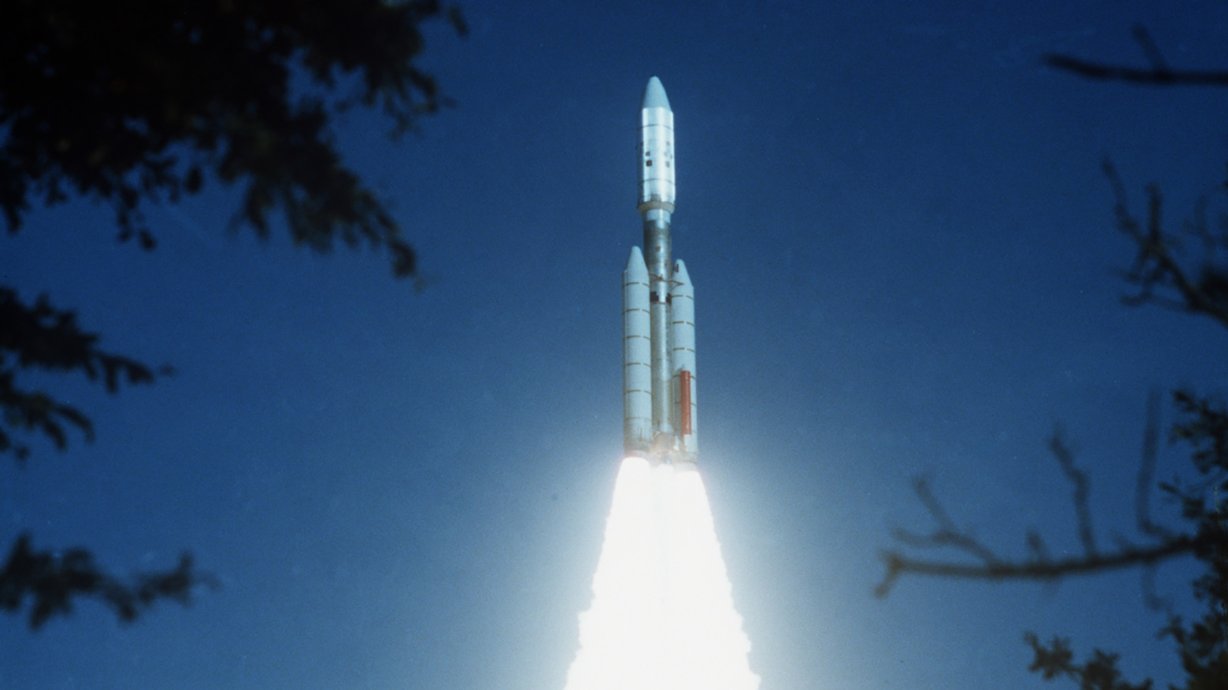
Someone -- I would guess this to be Bate, Cameron or both -- had the just-about-perfect notion of placing Klemke's story against that of the famous space probe, Voyager, with its Golden Records that supposedly demonstrate mankind's glorious achievements.

The Voyager was sent into space in the same year -- 1977 -- that Klemke began his filming and was sent, it was said, in hopes that some other life forms would eventually find it and learn all about mankind and what we have accomplished. (Conveniently left out, as the narration notes, were "accomplishments" such as The Holocaust.) Oh, the chutzpah! And I mean this in terms of both projects: the Voyager's and Klemke's.

To his everlasting credit, Bate had the good sense not to ram home the incredible differences in those Golden Records and Sam's home movies. He simply alternates the stories of Sam and Voyager, bringing up various facts and tales about each and letting us draw our own conclusions. Yet the manner in which all this is threaded and unfurled allows us to reach some pretty interesting assumptions on the way to being amused, moved and provoked into thinking about, oh, so many things.

One of the funniest and most telling of these involves the fact that the late scientist/entertainer Carl Sagan wanted to include photos on the voyager of a man and woman completely nude so that other life forms could see and understand how human beings of both sexes were built. Oh, the ruckus this began amongst Republicans and religious fundamentalists who felt that nudity was not to be tolerated. So the idea is scrapped, and guilt, shame, stupidity, hypocrisy and denial triumph -- as usual.

Contrast this with our Sam, who not only features himself nude and full frontal but with an erect cock -- both in his younger and his middle-age years. (From the look and size of his member, our guy might have had a more productive career making porno films.) The contrast here of western culture's hypocrisy and denial against an ordinary guy with a camera is breathtaking. As it is, almost consistently, all the way along in this fascinating film.

Whether Bate found (or had made) the soundtrack voice we hear narrating the Voyager footage, it was a brilliant notion to have it all in French, so that we can then take in the beauty of spoken French, even as we read the lovely, poetic subtitles that build a case for the importance of the voyager and its golden records. Without undue pushing, all this makes ever stranger, funnier and sadder the contrast with Klemke's life and "art."

So who is Sam Klemke and what has he achieved? On one level he is a sad and deluded young, then middle-aged, then finally elderly male. We meet, briefly, many of the women who pass through his life as an "entitled" man (patriarchy is ever-present). but it is not in Sam's interest to allow us to get to know them or their attitudes beyond the cursory.

Sam does not finally achieve much of anything -- he fails at everything except his knack for good caricature, which he markets at locals malls -- and he often has to move back in with his parents. (How mom and dad felt about all this goes mostly unexplored.)  And yet Sam persists. And endures. The movie may bring to mind Samuel Beckett -- but with a lot more blather than minimalist poetry.

In any case, this juxtaposition of Klemke and Voyager is a brilliant move. Even as the documentary draws inward into Sam's tiny world, it simultaneously opens out into so much else. (The few moments in which we experience 9/11 through his and his girlfriend's eyes are remarkable.)

Again and again we are drawn up short and made to think, contrast and compare. Sam Klemke's Time Machine is a singular experience, one that should not be missed by thinking/feeling adults and very probably by their teenage children, as well. It has been a long, long while since I have witnessed a movie so ripe for discussion and exploration, both during and after its viewing.

From Virgil Films and Visit Films and running just 90 minutes, the movie is available beginning tomorrow, Tuesday, March 29, on DVD and Digital HD -- for purchase or rental. To view the movie (via either rental or purchase), simply click here and then click on WATCH NOW.

Monday, October 5, 2015

Dreams, desires, naughty taboos: Guy Maddin and Evan Johnson's THE FORBIDDEN ROOM


Who else but Guy Maddin would hand us a Jesus quote to begin his film then follow this with enough degradation, deprivation and bizarre behavior to send a fundamentalist crazy. And crazy is the operative word for Mr. Maddin's latest lulu, THE FORBIDDEN ROOM, which, beginning with the opening credits -- that use the title backgrounds of several different, old-fashioned movie genres to introduce each new set of names -- proves as funny, fun, probing and as Maddining (to add a much-needed word to your movie lexicon) as his work always is.

Except that this time (the filmmaker is pictured at left), he's aglow with two-strip Technicolor, rather than his ususal black-and-white, and he seems to have abdicated altogether any hint of central theme or story and instead, Scheherazade-like, spun out tale after tale after tale until they seem to wrap around and turn in and on each other like wily, sometime deadly serpents.

This may be the movie-meister's funniest and most appealing work to date. It certainly boasts his starriest cast -- from
Canada's Roy Dupuis (below) to England's Charlotte Rampling to France's Mathieu Amalric and many more. Maddin has also, this time 'round, taken on a co-director, Evan Johnson (shown at right: the pair co-wrote, as well, along with a few others), who appears to have been responsible for the special effects, which are pretty much non-stop, though nothing like what Hollywood consistently gives us. There is not one car chase nor explosion to be seen, though a valcano -- the movie, in its use of silent-film titles and old-fashioned writen narration, uses intentional misspelling now and again -- does errupt a couple of times.

Subjects along the way include everything from bathing and bottoms to lobotomies and flapjacks, and we meet everyone from mad doctors (of course, just about everyone else is nutty, too) to doppelgangers and Janus-like Jekyll & Hydes.

There's the quest, 'natch, this time to save a beautiful young woman from... well, a number of differing fates worse than death, a mustache (worn first by Udo Kier, below) that manages to span three generations, and perhaps the most unusual kind of vampire you will have ever encountered.

There is a lot of fun to be had (my favorites include the aviatrix/lawyer and what particular objects are sacrificed to that valcano) and, as always with Maddin, there is the sensation that we are in the middle of this guy's own special and really bizarre dreams -- sexually, psychologically, emo-tionally and especially family-wise. The filmmaker, like Hitchcock but in such a different manner, is a voyeur who makes willing voyeurs of us all.

How inventive and imaginative can Maddin be? Very. However, can the guy keep all this up for a full two hours and eleven minutes? (The movie is now said to be be two hours flat, but the screener I viewed proved a tad longer.) I think this will depend on just how Maddin-crazy you are. I didn't flag, although I thought the movie occasionally did -- before quickly bouncing back with some new/old oddity and delight.

The Forbidden Room (every one of Maddin's movies is full of the forbidden) is one long fever dream of nostalgia, silliness, buried (as well as overt) sexuality and film references. If you've never seen a Maddin movie, this one should be a fine starting point -- and perhaps ending point if you're not impressed. That's Jacques Nolot, below, who has a ratther meaty role in the festivities.)

From Kino Lorber (and, I expect, unrated), the film opens this Wednesday, October 7, at New York City's Film Forum, and then in the weeks to come in a number of other cities. Click here then scroll way down to see all currently scheduled playdates.

Wednesday, February 17, 2010

Cindy Kleine's PHYLLIS AND HAROLD shocks, stuns, moves and amuses; filmmaker Q&A


Joining the ranks of top-notch docs about family -- Must Read After My Death, Life Support Music and Capturing the Friedmans -- is this week's opener PHYLLIS AND HAROLD, in which filmmaker Cindy Kleine tells the story of her family, especially that of the title characters -- her mom and dad. Neither as dark/
dysfunctional as "Must Read" nor as functional/
positive as Life Support Music, Phyllis and Harold nonetheless occupies a place all its own in the overcrowded documentary field. As it quietly unfolds, it shocks, moves, educates and entertains in about equal measure.

Beginning with some cute but appropriate stop-motion photography/animation, Ms Kleine (shown at left) sets us up for her role as our grown-up-child guide who's trying to figure out the relationship between her parents. Haven't we all done that at some point in our own lives -- though without, I suspect, either the interest, resources or the skill for unearthing and connecting that this woman possesses?

The less you know going in to this documentary, the more surprises will be in store.  No less a famed documentarian than Ken Burns is on record noting that, while he was viewing the film, various people who happened into the screening room were so caught up with this film that they simply stayed there and watched the entire thing. Yes, it's that addictive.  Part of its attraction stems from its very homemade quality. Not that it isn't professionally mounted in most ways, but it is also so "chatty," warm and real-seeming that, as you might do with a film a friend had made, you first watch out of ease or maybe duty.  Within a few minutes, you're hooked.

A combination of straightforward talking-head interviews, animation, old photos (what a treasure trove here!), home movies, and old songs, the movie's 84 minutes fly.  Seeing her parents both young (above) and old (below) is a revelation -- as much to them as much as to us: "This is like a stranger to me!" marvels her father upon reading one of his old love letters to this young wife.  Just when we're thinking how very salutary this is -- and would be for most oldsters -- Kleine drops the bomb.  From here on, surprise topples surprise, as we discover secrets, war, the family's black nanny and more.  My goodness: how complicated people are, and mysterious, problematic, impossible and sad.

If Phyllis and Harold has at least one ending too many, I think you'll easily forgive Kleine her need for "closure" and sentiment.  She and her family deserve it. And maybe we do, too.  The movie opens Friday, February 19, at NYC's Cinema Village.  For further screening dates, click here.

*******

Once you see the film, you'll have you own set of questions for Ms. Kleine.  Below are ours, with TrustMovies in boldface, Cindy in standard type.  There are spoilers ahead, so perhaps see the film first  and then come back to this.

When and why did you decide to tell your parents’ story?

In a specific way, I decided to tell their story about ten years before I shot the first interviews with them, and I spent years writing a script for what I thought would be a fiction film. In a more abstract way, though, even my earliest work was preparing me to tell their story. My earliest videos and films were all about love relationships, both familial and romantic (Dinosaur, 1979, Secrets of Cindy, 1983, Doug and Mike, Mike and Doug, 1984, Nana, 1987, Passage, 1991, etc...)

Did you always plan to hold it back until both of them were gone? (I would guess so.)


Once I decided the film would be a documentary, I knew I could not tell the whole story until my father was gone. (My mother, on the other hand, would have LOVED it, but that's another story!) So I conceived it as a film that would be made in sections, and got excited about the idea of making a feature length film of three or four sections that could also be shown as shorts, without the other parts. "Til Death Do Us Part" (1998, 20 minutes) was the first section. It premiered at the Telluride Film Festival, and showed in a handful of other choice festivals (Seattle, Vancouver, Rocky Mountain International Women's Film Festival, etc), though I had to hold it back from distribution because my father was alive at the time. The section of my parents reading their love letters was "Part 2", and "Part 3" was supposed to be my parents getting old together. But my father died suddenly while I was shooting that section, and then, inevitably, the direction of the film changed.

Did you and your mom ever talk about her “neglect” of you and your sister when you were kids? If so, how did she respond?

Late in her life, she admitted to some degree her emotional neglect of my sister with great shame and sadness. She couldn't really hear my own feelings, but then, she was a much better mother to me than she was to my sister, I would say.

Your use of old photos was sublime and fascinating. Did you always have access to these or did you spend months trying to find them? 

Thanks. I inherited the trove of 40,000 slides my Dad shot from 1939 until 1990 when he died. The home movies my grandfather shot were given to me in a box by my grandmother after he died.

What was the most difficult part of the filmmaking process for you?

Besides spending so much time with my parents? Well, the most difficult part was after my father died, trying to pick up the pieces of myself, my family, and my film; to find the energy again to resume shooting, and to shoot with my mother through those long months of her shock, her falls and illnesses and her mental decline. It was poignant and painful.

When did the idea to use animation hit you?  The animation, by the way, is delightful and very well thought-out and applied. 

 Thanks. I knew I wanted to use animation pretty early on in the editing process of the full length film, which began to approach it's final form sometime around 2005 or 2006. I asked Lisa Crafts to do an animation of the "Mom meeting the lover for the first time" story very early on, so that was in the cut from way back. The rest of the animation didn't find it's place until very late in the game, in the last nine months of editing with Jonathan Oppenheim.

Do you think your mom realized that you were finally going to make her “famous’? If so, how did she feel about this?

She could never have known or guessed that the film would be as widely seen as it has been and is about to be, but she LOVED being a movie star, and I hope is somewhere up there looking down on opening night at Cinema Village in her designer gown and borrowed Harry Winston jewels, with a gorgeous young man on her lap! It is truly heartbreaking to me that she did not live to see the film, and to be at that opening. My husband, Andre, says she deserves, and he hopes she will win the Posthumous Oscar for Best Performance in a Documentary.

Your dad reminded me of my dad (and myself -- and so many men who tend to hold back). Did it occur to you that he might have had affairs of his own? Did you ever question him about this? (Probably not, because he was not to know about your mom’s)

Sure I did!! Are you kidding? How could I have resisted? Though he never admitted to anything outright, I know he did have affairs, but I don't think he ever was in love with anyone else the way my Mom was. His were purely sexual flings, I'm sure. He was a hot guy, and he wasn't getting steak at home.

How did Andre Gregory come into the picture? 

Very short version: I was introduced to Andre* by an old friend who had been working with him. Four days later we kissed and the rest is history.

I realize that you did one shorter film earlier (Inside Out) that was about half the length of Phyllis and Harold. How was, other than dealing so closely with your own family, this film different for you as a filmmaker: twice the work because of its being twice the length? Or maybe ten times the work? (Is it like the difference, as I have been told, between having one child and two: not twice the work but four times the work.)

I did many short films earlier than P and H. (see my website).   Having two cats and no kids, I can't relate to the child analogy, but suffice to say, this film was 12 plus years in the making, all my others were 2 to 5 years in the making, approximately. I would guess it is like the difference between writing a short story and writng a novel.

Anything else you want to talk about that I did not cover?

No...thank you, but please encourage everyone to come out to see the film during its run at Cinema Village, beginning February 19th.
(All photos. courtesy of Ms Kleine)
* Cindy Kleine is married to playwright/producer/actor Andre Gregory (pictured above a couple of times).