Showing posts with label philosophical movies. Show all posts

Friday, December 13, 2019

Blu-ray debut for the under-appreciated George Roy Hill/Stephen Geller adaptation of Kurt Vonnegut's SLAUGHTERHOUSE-FIVE


Back in the 60s and 70s, when TrustMovies endured his late-coming-of-age period, Kurt Vonnegut was one -- maybe the --most favored novelist of those of us in or near the boomer generation. I think his work holds up pretty well, and so does the movie version of one of his most popular and enduring novels, SLAUGHTERHOUSE-FIVE, directed by George Roy Hill (shown below, an Oscar-winner for The Sting and a nominee for Butch Cassidy and the Sundance Kid), with a good screenplay that follows the book well yet not too slavishly from Stephen Geller.

What might seem missing from the movie -- this being but an adaptation rather than the original -- is the peculiar, particular Vonnegut tone. For instance, the refrain that echos through the novel, So it goes, is nowhere to be found in the film. Not literally, and yet Hill and Geller find their own right tone that carries through their movie so that So it goes -- which you can interpret as icy irony, a kind of capitulation, or perhaps an acceptance of things as they are rather than how you might like them to be -- is there in the film without ever having to be spoken aloud. Via the manner in which this movie builds and coalesces, this now famous phrase seems absolutely part and parcel.

Slaughterhouse-Five is a combination time-travel sci-fi/philosophical treatise novel, and it works equally well as both. One of the things that Hill and Geller get right and handle extremely well is the constant zipping back and forth from past to present. This is so quietly and subtly managed that audiences back in 1969 may have been unprepared for something this skillful. Even today, some 47 years later, it seems fresh.

The movie also brought to filmgoers' attention a new actor named Michael Sacks (above), who then and now seems a perfect fit for Vonnegut's based-upon-himself-as-a-young-man hero. Sacks never had a long nor hugely memorable career in films but his performance here in the role of Billy Pilgrim was about as good as could be.

The supporting cast includes the late Ron Liebman (above, center), nastily impressive as usual, and a luscious and sparkling Valerie Perrine (below), along with a host of fine character actors, all doing some of their best work.

Although I saw the film when it first came out, watching it again became a new experience. Yet as much as I was enjoying it, Slaughterhouse-Five seemed as though it lacked a certain depth and raison d'être as it moved along. Then, around three-quarters of the way through -- the point at which Billy's explanation of the philosophy of the time tripping Trafalmador coincides with the burning of the corpses found after the WWII fire-bombing of Dresden, for this viewer at least, the movie took on the profundity that the novel sometimes reached.

And from that point until the spectacular, moving, charming and funny finale, Slaughterhouse-Five did indeed seem wonderfully profound, finally serving up a philosophy by which one might profitably live. (That's fine character actor Eugene Roche, above, right, as Billy's mentor, protector and best friend during his time as an American POW in Germany.)

From Arrow Video (distributed here in the USA via MVD Visual/MVD Entertainment Group) and running a mere 104 minutes, the movie hit the street last week in a pretty good Blu-ray transfer -- for purchase (and, I hope, rental).

As usual with Arrow product, the Bonus Features are well worth watching. The best here is a lovely, smart, and very entertaining interview about/appreciation of the film with author/critic Kim Newman, as well as a interesting present-day interview about the filming and how he came to this film by Perry King (who plays Sacks' son in the film; in real life, the two actors were the same age, but the make-up department did a fine job in aging Mr. Sacks in surprisingly believable fashion, considering what was possible back in the 1970s).

Thursday, August 15, 2019

Love/sex/identity/time mix in Lucio Castro's alluring, beguiling END OF THE CENTURY


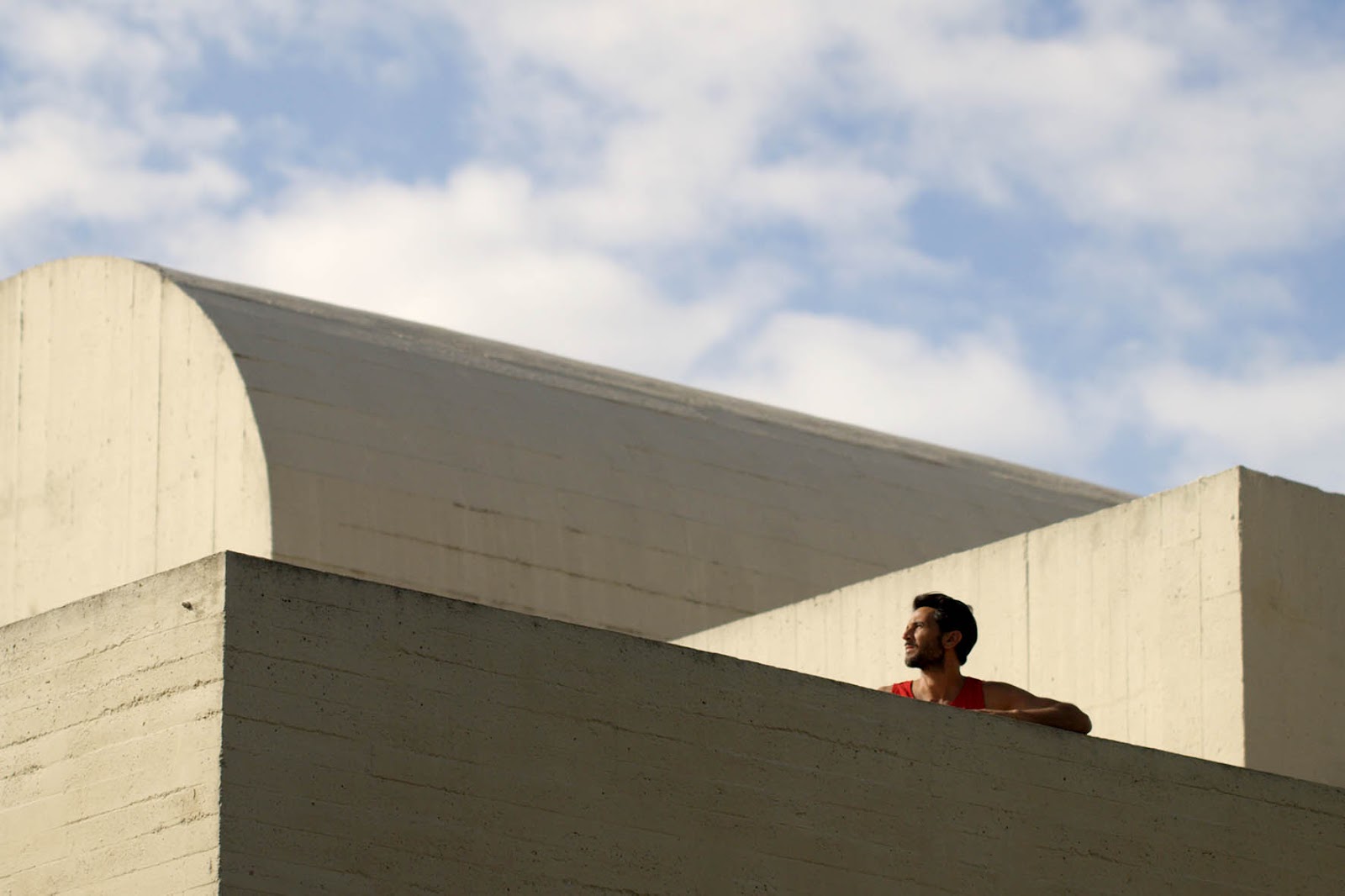
If nothing else -- and believe me, this movie does a lot else -- END OF THE CENTURY, the first full-length film from Argentina's Lucio Castro, should increase the tourist trade in Barcelona, Spain (particularly the gay variety), by leaps and bounds.

So gorgeous are the parks, plazas, streets, museums, architecture -- even the single beach scene we see here -- that it is difficult to imagine any viewer not getting up from such a lovely little movie firmly persuaded to visit this remarkable city ASAP.

Señor Castro, pictured at right, and his fine cinematographer, Bernat Mestres, show us all this with so little fuss and bother that it almost seems as though around every single street corner in Barcelona, something beautiful and special awaits. Speaking of beautiful and special, those words equally well describe the film's two leading men and its single leading lady -- the last of whom -- Mia Maestro, shown below -- will be familiar to film fans from movies such as Timecode, Frida, The Motorcycle Diaries and Poseidon (as well as the TV series The Strain).

As for those two leading men -- Juan Barberini (below, left) and Ramon Pujol (below, right) -- TrustMovies should think that after being seen in this film, they'll be more in demand internationally, too. These guys are not simply handsome and sexy, they look surprisingly real, too: no washboard abs, perfect teeth (nor perfect anything, really), yet the way it all works together makes for a very nice package in both cases.

They're excellent actors, as well. Moment to moment, they play off each other like they were some new same-sex pairing of Lunt and Fontanne, Olivier and Leigh, or Cronyn and Tandy. Any time Barberini and Pujol are together on screen, things sparkle and crackle. Alone, for the marvelous scene in which the two dance together after a day spent sightseeing and then drinking, the movie's worth seeing.

What the filmmaker has concocted here is a tale of cruising, meeting, remembering, and falling in lust and love -- maybe not in that order, exactly, but then the film's uniqueness comes from the manner in which our two protagonists come to realize not simply what they want but who they are. Or more likely, who they actually want to be. Or maybe can be. No, already are. Well, you'll see....

GLBT love stories have, over the years, come in a number of varieties -- from the tragic (Brokeback Mountain) to the poetic/pornographic (Paris 05:59: Théo & Hugo) to the comic (The Birdcage) to the simply mainstream feel-good (Love, Simon). Few if any have proven as philosophically oddball, interesting and even moving as End of the Century (the film's closing title moment is a special delight).

I don't want to say too much more for fear of spoiling or overpraising things. The movie certainly has its audience built-in. But I hope that its ambitions and reach might pull in an ever larger, cross-over crowd. Released via Cinema Guild and running just 84 minutes, End of the Century opens tomorrow, Friday, August 16, in New York City at the IFC Center, on September 6 here in Miami at the Tower Theater, on September 20 in Los Angeles at the Landmark NuArt, and then over the weeks to come in another ten cities. Click here and then scroll down to see all currently scheduled playdates, cities and theaters.

Friday, July 21, 2017

Little-known Joseph H. Lewis diamond-in-the-rough, TERROR IN A TEXAS TOWN, gets the Blu-ray treatment via Arrow Academy


A director with some 54 credits on his resume, whose films, a few of which -- Gun Crazy, The Big Combo, The Undercover Man -- are oddball gems that are much better known than he is, Joseph H. Lewis (shown below) was one of those filmmakers whose served his material, rather than the other way around. TrustMovies grew up greatly enjoying some of this fellow's films without being aware of who he was or how he fit into the world of movie-making.

All that is beginning to change these days, as Lewis'
better films continue to be more fully recognized and appreciated. One of these is TERROR IN A TEXAS TOWN (from 1958) which has just arrived on Blu-ray in a smackingly good edition from Arrow Academy -- with some first-class Special Features in tow. Starring that always-capable actor Sterling Hayden (below), playing the son of a recently murdered father who arrives in the titular town to take over his dad's home, the movie proves an unusually low-key and philosophical western about the meanings of freedom and justice.

The movie's excellent screenplay was written, under a pseudonym, by Dalton Trumbo, and it bears a number of this blacklisted writer's hallmarks, starting with its low-key approach and interest in ideas, as much as in action -- all of which director Lewis serves up to a tee.

Once in town and having learned of his father's death, Hayden's character encounters the suave-if-tubby lead villain, essayed with classy smarm by Sebastian Cabot (above, right), along with his hired-gun henchman, played by a crackerjack performer new to me named Nedrick Young, a blacklisted actor/writer who would give us the following year (using yet another pseudonym) the Oscar-winning screenplay for The Defiant Ones.

Mr. Young (shown above and further above) makes a simply terrific villain: intelligent but frightening and as impressive in his own way as is Hayden in his. The pair makes a fine set of adversaries, and the change that occurs in Young's character (I hesitate to call it growth, but yet I think it is) once he encounters a man who is unafraid to die (the fine Victor Millan, below, right), provides a death scene of such simplicity, intelligence and strength that it instantly becomes one of the more memorable that movies have given us.

The women in the film are quite interesting, as well, particularly the our villain's "kept woman" who does not seem to quite have to strength to stand on her own. As played by an actress also new to me, Carol Kelly (below, left, and at bottom center), this character proves to be another of the movie's memorable people with some interesting things to tell us.

Terror in a Texas Town, while adhering to practically every last one of the cliches of the movie western, still manages to often be quiet, thoughtful, and sometimes surprising -- never more so than in the scene (below) in which three bad guys work over our hero, and instead of the expected all-out, razza-ma-tazz fight scene, we get something quite other.

Conversations between characters are equally low-key and telling; they make us listen and consider. And director Lewis serves the intelligent screenplay exceedingly well, drawing expert performances from all, and keeping the relatively taut story-line moving along at a decent pace.

At most, I suppose, this is simply a very good example of the B movie that used to show up on double bills and sometimes proved better than the main attraction. But it is yet another feather in the late-arriving cap of this unusual and far-too-unheralded film director.

From Arrow Academy (distributed here in the USA by MVD Visual and running a lean 80 minutes. Terror in a Texas Town arrived on Blu-ray disc on July 11 in a new 2K hi-def restoration from the original film elements, with an uncompressed mono soundtrack. Also worth watching and included on the Blu-ray is the excellent introduction to the film (and its director) by Peter Stanfield.

Wednesday, April 19, 2017

James Gray's amazement, THE LOST CITY OF Z, tells of British exploration in the Amazon


An unusual combination of intimate family drama, adventure spectacle, and thoughtful, sometimes near-mystical philosophy in which these genres, which could hardly be more different, meld in a most beautiful and affectionate manner, THE LOST CITY OF Z is the kind of movie that will probably stick in the minds (and hearts) of intelligent audiences long after other, more heralded attractions have come and gone.

The work of writer/director James Gray (shown at left) -- whose earlier family dramas from Little Odessa (1994) through Two Lovers (2008) were always fraught and fascinating, until he hit that weirdly-phony-but-gorgeously-photographed bump in the road from 2013, titled The Immigrant -- this new film is not only his best yet, it may very well become a part of the movie canon in terms of exceptional "exploration" films.

What Mr Gray chooses to show and tell us, as his movie moves back and forth between early 20th Century England and several trips to the Amazon jungle in South America, gives us a rich and surprisingly deep portrait of British family life and in particular one man's (the explorer Percy Fawcett) desire to discover what he can about earlier civilizations, along with his deeply help conviction that what unites the world's many "tribes" is their common humanity.

This, of course, runs afoul of the then-held belief of white male British superiority over all else, just as it runs counter to the prevailing notions of the United States' crass and despicable current leader and his money-grubbing, white-supremacist notions. Yet, so strongly does explorer Fawcett believe in this, and so thoroughly does he abide by this in his words and deeds, that this character, played with great strength and precision by actor Charlie Hunnam (above and below) in what is certainly his finest role so far, is finally, if strangely, triumphant. (What a blessing for us and for him that Hunnam didn't have to star in the crapola Fifty Shades of Gray and its sequel, as was initially announced.)

Whether this actor is addressing a roomful of his peers, as below, or engaging in family discussion or discipline, Hunnam is always on target, and his combinations of strength and generosity, manliness and honor combine to form a unusually memorable character. He is able to convey both period believability and the kind of inner character turmoil that neither knows nor demands any particular time frame.

In the able and vast supporting cast are Robert Pattinson (below and barely distinguishable, so immersed is this actor in the role) as Fawcett's second-in-command,

Sienna Miller (below) as his able and enduring wife,

and Tom Holland (below, at right) as the older version of Fawcett's eldest son, who is initially angry with his father but eventually accompanies him on his final journey.

If there's a villain in this mix, it would the character of James Murray (played with a subtlety that turns encouragement into menace by Angus Macfadyen, below), who initially backs financially and even accompanies Fawcett on the voyage until his fear and irresponsibility take over. (Note to explorers: Never allow an overweight crybaby to join your party.)

Certain critics (The New Yorker's for one) have objected to the lack of "madness" in this adventure film. Yet Gray offers both suspense and surprise on these Amazon journeys. But because he is more interested in ideas than action (Percy Fawcett's actions are as much of the mind as of the body), the filmmaker keeps his movie grounded in these ideas, the major one being of our common humanity.

Offering up the typical fighting between the natives and the white explorers/colonizers would have only delivered the usual us vs them, good vs evil -- which is exactly what he entire idea of this film is against.

Instead Mr. Gray gives us one of the most memorable, beautiful finales in the canon of exploration. The final scenes will haunt your memory -- but in the most mysterious and hopeful of ways.

Mr. Gray has always been most interested in telling a good story, and in The Lost City of Z he has finally given us a great one -- and told it in the manner most appropriate and remarkable.

From Bleecker Street and Amazon Studios, the movie opened in a limited run last week and this Friday hits theaters all across the country. Here in South Florida, it will play the Miami area at the AMC Aventura Mall 24, AMC Sunset Place 24, Regal South Beach 18, CMX Brickell City Center 10, O Cinema Miami Beach, Tropic Cinema Key West; in  Broward at the Classic Gateway Theater, Regal Oakwood 18, AMC Pompano Beach 18; and in West Palm Beach-Ft. Pierce at the Cinemark Palace 20, Regal Shadowood, Movies of Delray 5, Movies of Lake Worth,Paragon Wellington 10 AMC City Place 20, Downtown at the Mall Gardens Palm 16 and the AMC Indian River 24 (in Vero Beach). Wherever you are, to find a nearby theater, simply click here.

Friday, December 9, 2016

FIAF's Rabah Ameur-Zaïmeche series closes with his latest film, STORY OF JUDAS


Last year turns out to have been a banner one for movies about Jesus. Not only did we get Rodrigo Garcia's excellent and unusual Last Days in the Desert, with Ewan McGregor as a questioning, caring Christ, but from France came the most recent work of Rabah Ameur-Zaïmeche, the fellow whose five-film series comes to a close this Tuesday at New York's French Institute/Alliance Française (FIAF) with THE STORY OF JUDAS.

TrustMovies covered the series last month but had not yet seen this last of Ameur-Zaïmeche's movies. As expected, it's a good one, with a view of both Jesus and Judas that is unlike much of anything we've so far seen. Perhaps it takes a Muslim moviemaker to explore Christianity's leading figure with a new eye and mind. (I suspect Ameur-Zaïmeche, shown at left, to be not particularly religious, at least so far as any fundamentalist attitude is concerned. He seems too humane & intelligent for that.)

Above all, this guy is a good movie-maker, as the other four films in this series attest. His take on Jesus and his story is both fresh and fascinating. Beginning with a buzzing fly on the soundtrack and then a glorious shot of a hut atop a hill, we then move inside that hut as one man lifts another onto his shoulders and carries him out and down. "Four days of fasting, and you're as heavy as ever!" notes the carrier to his burden, and the moment, though clearly set in ancient times, seems as intimate and modern as you could want.

Yes, it's Jesus and Judas, together again, but in a very different re-telling. Here are the teachings, the little children, the crowds, even music, song, and a new cloak. And weeping, too, after some of his pronouncements. Pieces of this filmmaker's loveliest writing can be found in Judas' description of Jesus' words: what they achieve and how they do this.

Ameur-Zaïmeche is less interested in those popular and surely imagined "miracles" than in Jesus' humanity and search for social justice. Look for no Lazarus here, but you will see the money-changers tossed from the temple and the woman taken in adultery (below). Even in the latter, we get the admonition to "Go" but not a mention of "Sin no more." Often the movie may put you in mind of the Pasolini version in its simplicity and honor, but without the overlay of Marxism. Not that the movie is not political, but Story of Judas doesn't wear its politics quite so blatantly.

And though M. Ameur-Zaïmeche plays Judas (he seems to appear prominently in all his films), this is really more of an ensemble piece. Particularly arresting scenes include that of our man washing his disciples feet ("Why?" indeed!) and most especially the scribe, who wants to write down everything "The Master" is saying, and what happens to him. This may be the most unusual and surprising part of the movie, and I think the key might be found in Jesus' (and the filmmaker's) need to place "the thing itself" above all else. (As well as a nod, maybe, to the disastrous results of "transcribing" the scriptures.)

The filmmaker's version is highly telescoped, of course, with the last and major portions given over to the arrest, trial (the most interesting philosophically of any version I've yet seen) and death. Not to worry: Ameur-Zaïmeche does not pull a Mel Gibson here and decide that torture, pain and bloodshed must trump everything. Instead, his imagining of the tale gives us a kind of grand tragedy played out in the most humble of means, with the humanity of all involved at the forefront.

Remember that the "gospels," as we like to refer to them, were all written well after the fact. So why not go with Ameur-Zaïmeche's version. I certainly would. It's beautiful, thoughtful, intelligent and real.

Story of Judas -- in French with English subtitles and running 99 minutes -- will play at FIAF's Florence Gould Hall this coming Tuesday, December 13, at 4pm and 7:30pm. Click here for further information and/or tickets.