Showing posts with label political films. Show all posts

Saturday, December 22, 2018

On Netflix: HAPPY AS LAZZARO, Alice Rohrwacher's fable of Capitalism Italian-style, then and now


The holy fool/wise fool has a long and storied history in novels, theater and film, and the current addition of a fellow named Lazzaro -- in the new film, HAPPY AS LAZZARO, written and directed by Alice Rohrwacher -- burnishes the image a bit more brightly. A good friend of mine dislikes holy fool movies intensely and so did not care for this one (though he admitted there were good things about it). TrustMovies found the film very much worth seeing on a number of levels, beginning with the performance of the title character by a first-time actor named Adriano Tardiolo, shown below.

Signore Tardiolo has a marvelous face and body, both of which are used by Ms Rohrwacher in precisely the right way that allows us to see this character more fully than do those around him. Lazzaro is guileless and beautiful; he's a helper. Though he is sometimes referred to as a saint, that is certainly not his intention. (Saints don't try; they simply do and are.) And if you suspect that Lazzaro's character is too good to be true, the filmmaker (shown below) has that objection covered, too.

Midway through the movie an event occurs that shows quite clearly that our Lazzaro -- as lovely and amazing as he and Tardiolo both are -- is a construct: someone who must hold together the movie and its two tales, one of "then" (the 1970s, more or less: were cell phones available, even to the wealthy?) and "now," a present day in which the hoi polloi are becoming ever more redundant.

I can't remember if I even heard the word Capitalism spoken in the movie, but the film is such an indictment of that much-loved/hated system, as it has worked in both past and present, that Happy as Lazzaro takes it place as a major political statement, as well as a fine film.

And while the movie indicts the behavior of the ruling class, whether it is individual, would-be royalty of yesteryear or today's banks and corporations, neither does it allow the masses to get off the hook. They are, as ever, docile, if sometimes scheming, sheep.

Within her framework of fable, Ms Rohrwacher brings to wonderful life all the many supporting characters who circle Lazzaro. One of the delights of the film is how these characters grow and age from the first section to the second. Despite the intervening decades, Lazzaro, of course, changes not a whit.

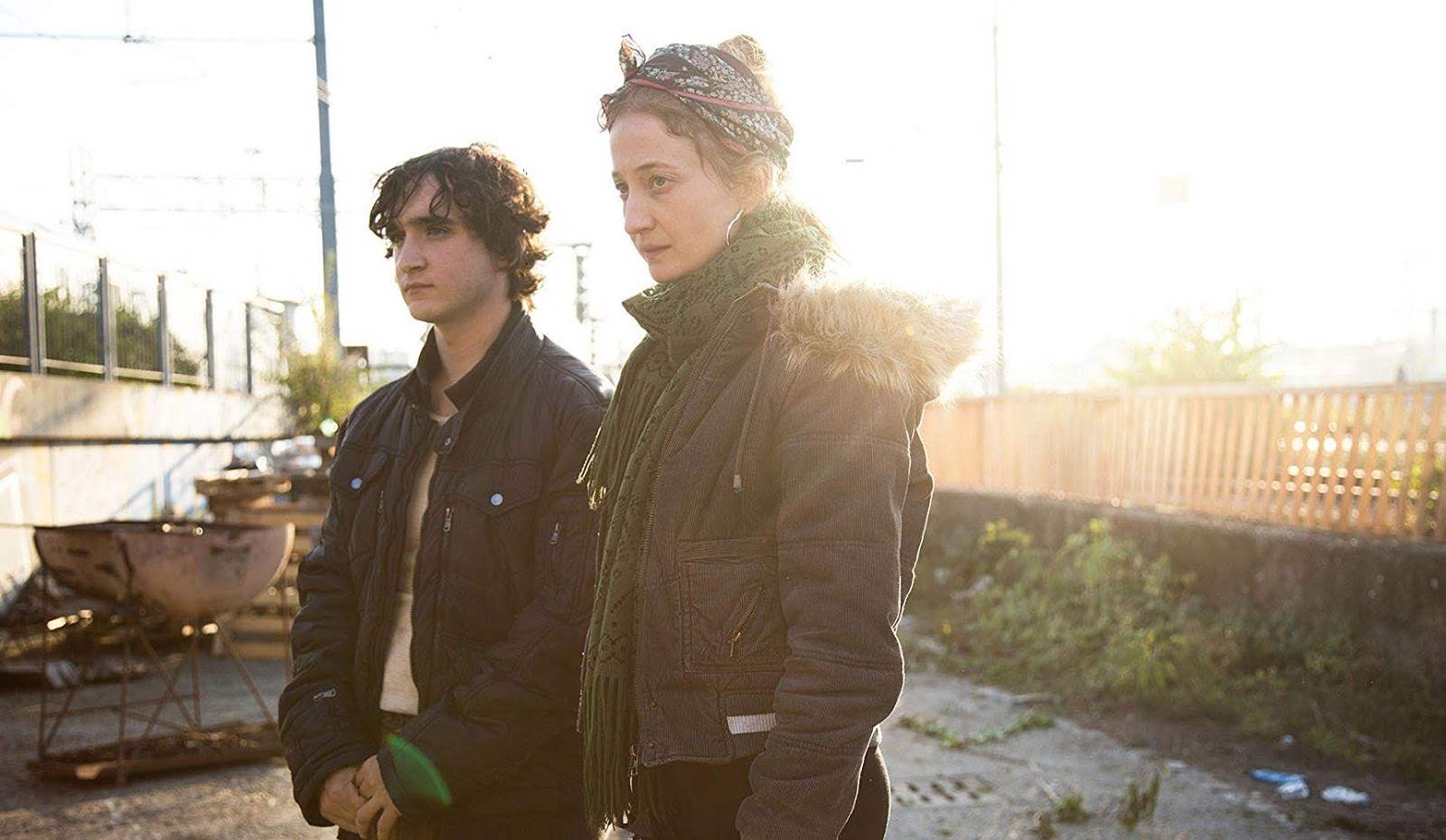
Every performance here is on the mark, whether from the non-professionals that make up much of the cast) to luminaries the likes of Sergi López, Nicoletta Braschi (above), and one of Italy's finest actors, Alba Rohrwacher (the filmmaker's sister), shown below with Tardiolo.

Streaming now via Netflix, after a very limited theatrical roll-out, the movie is a must-see for fans of Italian cinema, particularly those who fondly recall that country's ground-breaking, post-WWII neo-realism movement. 

Thursday, June 15, 2017

In Nick Hamm and Colin Bateman's fine docu-drama, THE JOURNEY, imagination fills the bill


The pre-credit information we read as THE JOURNEY begins tells of the 40 years of conflict in Northern Ireland, the thousands of deaths (and-who-knows-how many-more-wounded) that was known collectively as "the troubles." In 2006 two leading players in this conflict -- Ian Paisley and Martin McGuinness -- met in Scotland to try to work out some kind of final, lasting peace. When the pre-title information then tells us that the film we are about to see "imagines" this journey of the two men, red flags immediately went up in TrustMovies' mind.

They needn't have. As it turns out, this terrifically conceived and executed movie -- written by Colin Bateman and directed by Nick Hamm (the latter is shown at right) -- is a fine example of how imagination, when rendered this well, can produce a richly layered look into an event in which the "facts" may be unknown but the spirit of the event, as well as its outcome, is captured believably and thoughtfully. In the process, we are made to see and understand things from both points of view, while being forced to mull over what that past history -- much of it damaging and awful -- has encompassed. Oh, yes: I should also tell you that the film is often surprisingly funny, unexpectedly moving and vastly entertaining, too.

If we see better ensemble acting this year, not to mention the film's two remarkable leading performances, I shall be very surprised. Paisley, in all his gruff, self-righteous anger, is played by a somewhat trimmed-down Timothy Spall, above, who is as splendid as always. Weight loss does not seem to have diminished his amazing abilities. In the role of McGuinness, I would says that the under-sung actor Colm Meaney (above, right, and below, left) gives the performance of his life -- except that he always does this. He brings such feeling and intelligence, with so much subtlety, to the proceedings, that he all but steals the show. Granted, it is his character with whom we most identify. And yet these two men make such fine foils for each other that they both keep the audience constantly on its toes.

The third actor who figures cleverly into things is Freddie Highmore, (above, right), playing the delightfully naive driver of the car that takes our two men on their most important journey. Highmore discovers so much fun and wit in this role, in which our driver proves to have a surprise up his sleeve (and others over his ears and under his belt), that it took me half the movie before I realized I was watching the actor who has incarnated so well our modern-day Norman Bates.

That ensemble mentioned earlier includes the likes of Toby Stephens, playing a concerned but not especially competent Tony Blair; the late John Hurt, simply grand as one of Blair's uber-competent enablers; Ian Beattie (below, and practically the spitting image of Gerry Adams); and Catherine McCormack as the lone woman among the backroom bunch.

How all this plays out, and how the powers-that-be try to control the journey itself makes for suspense, surprise and a good deal of humor. But it is finally the two main men, who they are, what they stand for, and how they reach their destination that makes this movie so riveting and important.

There was a time, decades ago, that I believed the situation in Northern Ireland was an impossible one. Well, no. Perhaps, the same will be true someday of the situation in Israel. Except, of course, for the concurrent ones regarding America's ever-increasing plutocracy and appalling non-leadership, and the little being done to alleviate climate change.

From IFC Films and running a just-right 95 minutes, The Journey opens tomorrow, Friday, June 16, in New York City at the IFC Center and Lincoln Plaza Cinema. On Friday, June 23, it will hit Los Angeles at Laemmle's Royal, Playhouse 7 and Town Center 5. Elsewhere? Sure hope so, but as it's from IFC, we'll certainly see DVD and streaming opportunities semi-soon.

Friday, October 7, 2016

Pablo Agüero's EVA DOESN'T SLEEP: a smart, surprising political treat from Argentina


Eva Perón certainly does not sleep. She seems to be forever with us, whether in her very this way/that way political life or and in her various theater and screen incarnations (Madonna? Really?). What a gal. What an icon -- even if what the hell she actually symbolizes is still up for grabs. My opinion is that she represents, as have so many politicians and/or their wives, near-total narcissism and self-aggrandizement set to a very smart reading of the desires of the general populace.

In the new and visually ravishing Argentine film, EVA DOESN'T SLEEP, from writer/ director Pablo Agüero (shown at left), Eva is back again. Or at least her corpse is, along with a good deal of history provided by newsreel footage and smartly written and staged drama that places that body front and center. In fact, I don't think we've witnessed a movie in which a corpse took so much part -- physically, emotionally, intellec-tually, politically -- since the terrific little revenge/ thriller sleeper from Spain, The Corpse of Anna Fritz was released earlier this year.

Adhering somewhat closely to fact (and then pulling a full-out fantasia on those facts), Senor Agüero begins by introducing us to a narrator in the midst of stealing Eva's corpse, an Argentine military man from the navy (Gael García Bernal) for whom this woman is everything worthless and slutty and yet who (as she does for just about everyone we meet in the movie) exerts an all-powerful pull nonetheless.

From our Navy man we go to the corpse's Embalmer (Imanol Arias) in the most visually compelling scenes in the film. These combine psychology, politics and beauty to simply amazing ends. We are taken from the height of Perón's early career to 1955, under the military dictatorship, when even the mention of Perón or Eva was forbidden.

From the Embalmer we move to the Transporter, as that body is on the move once more, via one of the more bizarre and riveting actors on the planet, Denis Lavant (above, of Holy Motors), who, along with his young military aide (Frédéric André, below), has orders to take that corpse to parts unknown, and to kill anyone who learns who the corpse really is. This leads to more scenes that combine -- with surprise and weight -- politics, history, adulation, and physical force .

From 1969 to to '74, '76 and onward, we meet The Dictator, an all-powerful fellow who, unfortunately for him, has been kidnapped by the rebels and made to give up the whereabouts of the long missing corpse. These scenes rely on tight close-up and some formidable acting skills of the man who plays that Dictator (Daniel Fanego, below), along with those who play his interrogators.

Agüero views all this with a gimlet eye and ear, never more so that when our Dictator hears a radio broadcast about his own death, and the announcer follows this with the words, "And now, back to our afternoon romances on LV10, the voice of freedom."

Eva Perón as symbol has never been made better use of than here, I think. Eva Doesn't Sleep forces us to confront our need for these symbols: How the left wing must endow its leaders with near-magical powers, personalities, goodness and strength until, of course, they end up disappointing us. And how the right wing will ever demonize them as contemptible whores and common dirt. Eva may still be experienced as the heroine of the people, someone who must necessarily go up against the rich and right-wing, not to mention the military and its motto, as that young aide expresses it, "God, the nation, science and sports." But, hey, she's really just another apparition, after all.

From Film Movement and running just 85 minutes, this terrific little movie made its U.S. debut on home video this past week, and is now available on DVD, VOD and streaming via Netflix.

Saturday, August 8, 2015

Sandra Hochman's YEAR OF THE WOMAN -- way ahead of its time and still reverberating


What a delicious time capsule is YEAR OF THE WOMAN, a combo documentary/fantasy (with the accent on the former) by poet/novelist/filmmaker Sandra Hochman. This is one of those "lost films" we often hear about, but -- unlike so many of them that, once viewed in the light of modern day, don't hold up -- this one absolutely strums with excitement, intelligence, humor and surprise. The biggest surprise in fact, is how poetic and prescient it turns out to be.

Ms. Hochman was certainly feeling her oats at the time -- 1972 -- that the film was made. At one point along the way she confesses, "I've never had so much fun as when I'm making trouble." And, boy, do we believe it -- whether she's cornering a very young and beautiful Warren Beatty or getting fabled humorist Art Buchwald to confess to his male-chauvinist-pig tendencies. She's in heaven all right, and the guys seem to enjoy being bullied almost as much as Hochman loves doing it.

She's more than merely angry, however, and her movie demonstrates this is spades, as it weaves together her poetry, her passion for feminism and her amusing occasional animation with the many interviews she conducts at and around the political conventions of the day -- trying to get men to understand the place and predicament of the "modern woman."

Do they get it? Hardly. The movie's funniest and most outrageous scene involves Hochman (in a crocodile costume) along with a small group of women who face down the male press at the convention (including an oh-so-young Mike Wallace) with demands to be heard and accepted. And sure, these women are annoying as hell. But their point is a perfectly valid one, which, being constantly shunted side, is now getting the in-your-face treatment bound to stir up anger and discussion. If the film were only proselytizing, it would still be worthwhile. But it is so much more: funny and poetic and full of folk who -- more than four decades later -- are still worth seeing and hearing.

Best of all, maybe, is a woman named Liz Renay (above), a writer, actress and stripper who's happy to share her life and thoughts with Hochman. (She's a Republican, too! Of course, that political party, ever an arm of the rich and entitled, was a lot more mainstream and intelligent in olden days). Ms Renay's appearance (in a skin-tight, va-va-voom dress) at the political convention brings out the usual male prerogative. The question she is most asked? "What are your measurements?"

We encounter the usual suspects of the day -- from Bella Abzug and Pierre Salinger (remember him, below?) to the smart and funny Flo Kennedy (above, left, and what a woman!) -- and get snippets of interviews with the likes of Edmund Muskie and John Kenneth Galbraith (at bottom).

But the heart of the film involves the fine poetry Hochman delivers, along with a lovely flair for visuals, music and the kind of confrontation that refuses to let us men so easily off the hook, whether we be the incipient politically-inclined Beatty, the poet Ed Skellings or activist Charles Evers (all of whom the filmmaker forces to confront their own MCP tendencies).

When this one-of-a-kind documentary first debuted in 1973, it played only a handful of performances in New York, the capital of culture, where it was considered too radical and weird. But no: It was simply ahead of it time, and time is now catching up with it. The film works as both a wonderful trip down memory lane and as a ever-current call to arms.

As the choice song we hear sung (to the tune of the Battle Hymn of the Republic), "Move on Over, or We'll Move on Over You," makes clear, women had a long way to go back then. They still do. But when you get the chance to see something possessing this much art, smarts and sass, you realize how necessary and worth it the struggle for equal rights was and is. (The final "fantasy" scene -- with Hochman and Buchwald in an observatory, supposedly looking down on an earth where equality has at last triumphed -- is a knockout punch, delivered with a lovely combination of humor, simplicity, imagination and grace.)

After a 42-year hiatus, Year of the Woman is finally back with us again, thanks to a combination of The Huffington Post and the digital streaming service, Vimeo -- on which you can watch it now, via either purchase or rental. Just click here for details and acccess. 

Thursday, June 5, 2014

At last! Marco Bellocchio's thoughtful end-of-life movie DORMANT BEAUTY hits American theaters


I first saw and covered this moving and surprising film two years ago, expecting it would open soon in a limited release. No such luck. Now, finally, adult movie-lovers will have the chance to see and ponder the film that is one of its director's -- Marco Bellocchio's -- best. I've re-posted my original coverage below, with a few updates. Watching DORMANT BEAUTY a second time makes me realize anew how very fine a film it is.

Euthanasia may not seem the hot-button issue in America that abortion always is, but float it into a conversation -- anywhere, anytime -- not simply as a subject for discussion but with real specifics attached and you'll discover disagreement and shock followed by flaring tempers before you know what has hit you. Imagine the same topic in Italy, home of the Vatican and its I'd-better-abdicate-before-the-shit-hits-the-fan former Pope, not to mention the oh-my-god-he's-a-Communist (who maybe helped the Argentine military "disappear" leftists) current Pope, and you'll no doubt end up with that disagreement, shock and flaring tempers squared.

All of which makes Marco Bellocchio's newest film DORMANT BEAUTY (Sleeping Beauty is a closer translation, but I guess that one's been used a few too many times) such a strong and satisfying film. A surprising one, too -- and not in terms of what Signore Bellocchio (shown above) is capable of and usually gives us. Rather, the surprise comes from the fact that this writer/director does not take a side but instead shows us several sides. (Yes, in life, there exists more than merely "pro" and "con.") This forces us to confront human beings in specific situations, rather than mere ideas.

The film takes place in 2009, during the fraught period just prior to an Italian father's pulling the plug on his daughter, Eulana Englaro, who had been in a coma for some 17 years. (For an American version of this, think back to 2005 and the case of Terri Schiavo.) While Italians demonstrate on both sides, Bellocchio zeroes in on a handful of disparate people.

Among these are a Senator (Toni Servillo, above left) whose personal feelings and conscience go against those of his party, and, in fact, of his own daughter (Alba Rohrwacher, below, right) who is adamantly pro-life. His conversations with his peers, as well as with a "therapist to the politicians," are among the film's most trenchant and sometime darkly amusing.  When she becomes suddenly involved in an incident provoked by the other side, her life takes a drastic change, as she finds herself drawn to the brother of one of the protesters on the opposite side (Michele Riondino, below, left). This situation -- fodder, it might seem, for a smart rom-com -- is here used in a way that allows these characters, along with us, to try for some growth and change.

The dormant beauty of the title, in addition to the real Eulana, is found in the home of a famous French/Italian actress, played by Isabelle Huppert, below. Her daughter, too, is comatose, and while the father and brother might like to see that plug pulled, the actress, who has renounced theater, has submerged herself in the Catholic faith. That this section, though believable enough, is the least persuasive should not be surprising, for all-or-nothing religious faith must, I think, be experienced to be truly understood.

Elsewhere, a drug-addicted woman (Maya Sansa, below, left) is taken notice of by a doctor (the filmmaker's younger brother, Pier Giorgio Bellocchio, below, right) and a dance of death/life ensues, and again, thanks to first-rate writing, directing and performing, we're able to understand things from both sides of the war. Will the movie change any viewer's viewpoint from one side to the other? Probably not. But it probably will make the "other" a little more understandable.

From Emerging Pictures and Cinema Made in Italy and running 115 minutes, Dormant Beauty opens tomorrow in New York City exclusively at the Lincoln Plaza Cinema. In the Los Angeles area, the film will open in Friday, June 13, at Laemmle's Music Hall 3, Town Center 5 and Playhouse 7. Elsewhere? Yes, and you can find the cities and theaters by clicking here, and then clicking on Show all dates worldwide for this title.

Tuesday, January 22, 2013

Bill Guttentag's KNIFE FIGHT hits theatres & VOD: Politics makes typical bedfellows


Was there really a time when the statement, "Politics makes strange bedfellows," seemed at all surprising? These days, one would be hard put to think of any bedfellow, no matter how bizarre, as out of the realm not just of possibility but of probability, nay, expectation. Ah, well: Whatever it takes, matey!

These thoughts, among others, came to mind while watching the new political, feel-good comedy KNIFE FIGHT, directed and co-written (with political consultant Chris Lehane) by Bill Guttentag, shown below, who has made a number of documentaries over the past many years, from Crack USA: County Under Seige to the more recent Nanking.

Among the good things about Knife Fight is that is gives the usually pleasurable and always photogenic Rob Lowe (on poster above and in the four final stills, below) his best movie role in years, as Paul Turner, a political consultant/strategist most often involved in getting his candidates out of the hot water of scandal and into the political office of their choice.

Sometimes this means getting them into office for the first time  -- as in the case of the beautiful female physician practicing in a low-income San Francisco community who decides to run

for governor (she's played by Carrie-Anne Moss, above) -- or keeping them in office when they're cocksmen extraordinaire, and all too willing to destructively prove this to their muse of the mo-ment. Two examples of the latter would be the Kentucky governor with intern problems (who brings to mind John Edwards and Bill Clinton) played by a Southern-accented Eric McCormack (below), and the California senator (David Harbour) currently being blackmailed by a very ambitious little blond masseuse.

On Paul's team are an adorable and smart assistant, played by Jamie Chung, and a charmingly seedy, older operative (Richard Schiff). This savvy threesome seems enough to ensure continued success. What makes the movie an example of feel-good comedy is the notion, put forward by Paul and brought to fruition by the filmmakers, that whatever it takes to win is somehow appropriate and fair game, so long as the candidate you are working for is the "good guy" -- or at least the ever-present "lesser of two evils."

This, of course, completely ignores our current-and-growing-worse-with-each-election political process, in which money in the form of political contributions continues to buy elections, so that no matter which candidate wins, decisions that affect the general populace badly but are to the benefit of the wealthy and corporate continue to be made. This renders the simple-minded attitude of Paul and his team more than faintly ridiculous. 

The reality that Knife Fight gives us is the shallow, superficial variety that fits right in with our current comedy mode of appearing to tell the truth while simply plying on the feel-good. Sure, it's believable, so far as it goes, which is maybe halfway down the block. That said, the movie is often immensely enjoyable, thanks to its clever plotting; quick, funny dialog; and performances that are spot-on in just about every case.

Look for Modern Family's Julie Bowen (above, right) in the role of the reporter happy to play either side of the street, so long as there's a good story for her; Jennifer Morrison, very funny as the masseuse from hell; and the always welcome Saffron Burrows as McCormack's hell-of-a-lot-better half. If I wish Knife Fight were a lot better, too, and I do, it's only because of movies like last year's Grassroots, which so beautifully gave us the ups and downs of real politics on a community level, or -- as a more distant example -- Mike Nichols' superb but under-rated adaptation, Primary Colors, which offered up the Clintons like nothing else has captured them before or since. 

This new movie, from IFC Films and running 103 minutes, opens Friday, January 25, in New York at the IFC Center, and in the Los Angeles area at Laemmle's Noho 7.  Starting January 28, the film will be available to view on VOD, iTunes, Sundance Now, XBOX, Playstation, Amazon, Google Play and You Tube.

Sunday, December 9, 2012

SCN: Xavi Puebla's THE COLD CALL offers a sad, sick slice of Spain's current sales world

A kind of early obituary for Capitalism, as practiced Spanish-style today, THE COLD CALL (A puerta fría) is a must-see movie on a number of levels. The FSLC's Spanish Cinema Now series often includes an near-overtly political movie (remember The Method?) concerning the times we inhabit, and I doubt that this year's roster will offer anything better than this quietly profound wake-up call about salesmen that makes the oft-lauded Arthur Miller sledge-hammer ("Attention must be paid," indeed) seem hugely obvious and annoying by comparison.

According to the IMDB, after winning several festival prizes (for actor, screenplay and a Critics' Award), the film has yet to be commercially released in its home territory, Spain itself. Given the current political and economic situation there, I guess this should come as no surprise, for the movie simply nails its target to the wall gracefully and completely. No contest. As directed and co-written (with Jesús Gil Vilda) by Xavi Puebla, shown at left, the film is as strong in characterization as it is on plot, pace, place and dialog. If the finale feels suddenly truncated and the last line unnecessary, that's little concern -- considering all that has come before. The NY Post's Kyle Smith would shit a brick having to sit through this particular indictment of everything Smith loves about big business.

The movie opens with our well-into-middle-age "hero" Salva (above, right) -- and he is one, of sorts, if you consider trying to hold onto a job these days anything like heroic -- arising, somewhat befogged (from drink perhaps?) and getting on with his day. That day will be devoted to attending a trade show for electronics (TVs, DVD players, cameras, and all the rest), and in the course of the day, as his sales are clearly down, it becomes clear that our guy may be replaced by younger blood.

Salva is played by one of Spain's treasures, actor Antonio Dechent (above), who has graced SCN for a decade or two now in roles large and small. He's always first-rate, and here, in his Willy Loman mode (though he's brighter than Loman ever was), he is radiant: smart, scared, nimble, sad, and trying desperately to succeed in an environment in which any kind of honestly-attained success is just about impossible. (The screenplay is very smart about how and why this is the case.)

In the course of Salva's dealings, he connects with a young hostess at the convention named Inés, played with a lovely combination of innocence, need and youthful smarts by María Valverde (above, center left, of King of the Mountain). How these two bond and work together is beautifully handled. The third wheel -- an American big-wig with whom Salva needs to connect -- is played by Nick Nolte, below, who gives a just-right, barely-there performance that packs quite a subtle punch.

That's it on plot -- and everything else. This movie deserves to be seen and to surprise you. Fortunately, it plays one more time at Spanish Cinema Now, next Sunday, December 16, at 5:45 pm at the Walter Reade. (Click here for tickets.) A U.S. release? One would hope so, particularly with Nolte in one of the roles. And let's also hope even more that it can be seen soon on its home turf. Like the great, nearly unseen and highly political Italian film Valzer by Salvatore Maira, this one appears also to be a prophet without honor in its own country.