Showing posts with label post World-War II. Show all posts

Monday, June 27, 2016

The movie of the year? Anne Fontaine's amazing THE INNOCENTS might very well be it.


Feminist in a whole new way, Anne Fontaine's latest triumph, THE INNOCENTS, is also her finest, most important and most encompassing movie so far, not least because it takes that feminism, for which this movie-maker has long been noted (in my book, anyway) so far beyond the usual or typical that it expands into a grand and embracing humanism.

Said to be based on real events, the movie will make clear to any thinking person who knows history and the aftermath of World War II, that what happened at the convent here in Poland probably happened at many other convents around the world -- during wartime and afterward. But so horrifying are these events that "civilized" folk like us would prefer not to imagine such things.

One of the great strengths of Ms Fontaine (shown at left) as a director and often adaptor is that -- from Dry Cleaning through Nathalie...The Girl from Monaco to Adore -- whether she is working in comic or dramatic mode (sometime both simultaneously), she insists on putting us in touch with feelings and actions we'd prefer to keep buried. (Sometimes she does this with a light comic touch, as in last year's delightful Gemma Bovery.)

With The Innocents (post-viewing, you may want to consider to whom that title refers), Fontaine is working in firmly dramatic mode. There's little humor here. What surfaces is provided by an ironic, been-through-hell-and-back doctor (very well played by Vincent Macaigne, below, left, of 2 Autumns 3 Winters) who works with our heroine (the lovely Lou de Laâge, below, right, of L'Attesa and Breathe) for the French Red Cross in post-war Poland.

Initially, once we learn what has happened at the convent, the movie seems to be mostly about rape and its awful consequences. Fontaine, her co-writers and her cast bring this home with a ferocity and reality that is striking. Yet we have not seen the original horror but instead experience it via the condition of the nuns, as we meet and grow to know them.

And then the filmmaker serves up a double whammy, as our heroine experiences her own introduction into the condition of these nuns. And we're with her during every step of this, the movie's single violent scene.

But then, slowly, The Innocents turns its attention to the idea and experience of faith -- how it works and what it can or can't accomplish. I have no idea whether Ms Fontaine is a person of faith (I would guess she is not, as I am not) but she certainly gives faith its due here. She is able to see events and personalities from angles that allow us viewers to enter the lives and minds of these nuns, each of whom is differentiated surprisingly well, so that we understand and feel their viewpoints.

Soon, however, Fontaine's film becomes less about rape or faith and more about life (and death) and parenting and what all this might mean to a group of nuns -- of whom, by now, we have grown hugely fond and protective -- just as has the character played by Ms de Laâge.

Granted, this is one humdinger of a tale to begin with, but I can't credit too highly the manner in which Fontaine has told it so that we encounter viewpoints that conflict enormously and yet we are made to fully understand and appreciate them all. As my spouse said, while the end credits rolled, "What a tolerant movie this is!" Indeed. For us to understand the shocking actions of certain characters here, we must enter into ideas quite foreign to what we would ordinarily encounter.

The filmmaker's great accomplishment is that she helps us do this with no lecturing or hectoring, simply by allowing us entry to as many viewpoints as necessary to make the leap. In the remarkably varied and equally talented cast, those with the most screen time are two Agatas: Agata Buzek (above), who plays the nun who initially translates and then becomes the most helpful to our heroine, and Agata Kulesza (below), as the convent's Abbess, whom foreign film fans will remember as the title character's helpful but depressed aunt in the Oscar-winning Ida of two years back.

Dramatically, Fontaine's film is aces all the way. From the initial scenes that are a mystery (and clearly an urgent one) to a finale that, in terms of how this movie began, is rather like moving from hell to heaven, the filmmaker keeps us glued both intellectually and emotionally. And the feel-good we experience at the end of this film seems utterly "earned," bringing us back to the movie's opening scenes in a manner most surprising and genuine. If a better film than The Innocents hits theaters this year, I'll be surprised -- but grateful. (Below is the lovely Katarzyna Dabrowska, as one of the nuns.)

From Music Box Films and running just under two hours, the movie opens this Friday, July 1, in New York City at the Angelika Film Center and the Lincoln Plaza Cinema, and in Los Angeles at The Landmark. In South Florida, look for it on July 8 at the Coral Gables Art Cinema, Miami, and The Classic Gateway, Fort Lauderdale. On July 15 it hits The Living Room Theaters and the Regal Shadowood in Boca Raton, and in Delray and Lake Worth at the Movies of Delray and the Movies of Lake Worth. Over the weeks and months to come, The Innocents will open in across the nation in some 60 cities and theaters. Click here and then click on THEATERS on the task bar midway down to view all currently scheduled playdates, with cities and theaters listed.

Sunday, February 7, 2016

Sunday Corner with Lee Liberman: Foyle's War -- our war from across the pond


You may have watched some of this British series (2002-2015) on PBS filled with absorbing stories and British acting elite. But a serial watch on Netflix of all 28 feature-length episodes is better. Taken as a whole it feels like 3-D immersion into World War II years (later of the post-war and early Cold War) in bucolic Hastings by the sea, while combat rages in Europe.

Every chapter of FOYLE's WAR has an intriguing mystery, several layered story-lines, believable conversation, and memorable imagery. At end you've grown completely fond of the exacting, self-effacing Chief Inspector Christopher Foyle (accomplished actor Michael Kitchen), his plucky, quirky, entrepreneurial assistant Sam (Samantha) Stewart (Honeysuckle Weeks), and their mate, Sergeant Paul Milner, home from defeat at Trondheim missing half a leg, to help Foyle solve crimes (Anthony Howell).

Foyle has an RAF pilot son, Andrew, played by charming Julian Ovenden, below, left (Lady Mary Crawley's suitor, Charles Blake, in Downton Abbey). Ovenden left the scene before Andrew and Sam had progressed beyond 'will they, won't they', but several RAF-related stories unfold first. In one, a pilot who loves Andrew conceals his homosexuality and pays with his life; in another, an airforce officer (Roger Allam) resorts to crime to cover up sexual abuse of a young subordinate. But Andrew doesn't leave the scene before we share his flying experiences testing radar technology and experiencing "battle fatigue."

Our affection for the main characters is maintained by side-trips into their private lives and vicarious participation with Foyle in the moral choices he must make in each case -- he is the foil of wrong-doing, the moral center, our better selves. There's satisfaction also in the body of work as a whole -- the circumstances of war are so deeply, accurately embedded in the story lines that one absorbs history by osmosis, aided by many guest stars such as below (l to r) a youthful Rosamund Pike, David Tennant, and Emily Blunt from early episodes.

The stories begin in 1940 with pro-fascist, anti-Semitic views rife in the British upper classes and general hostility brewing as refugees pour into England to escape the Nazi's. The authorities are detaining enemy aliens and the public is griping about foreigners. In tracking down the killer of 'the German Woman', Foyle discovers that his superior (Edward Fox) had previously pulled strings enabling his judge colleague's German wife to avoid internment as an enemy alien. Meanwhile, a renown Jewish musician is locked up for shamefully trivial reasons.

Another episode is led by Charles Dance (Game of Thrones) as Guy Spencer, self-styled British patriot, who whips public opinion and schmoozes pro-Nazi political elites. Spencer is relishing his glorious future under the Nazi's; Foyle needs to take him down without violating his right to free speech -- fortunately there's treason.

And onward, episode by episode, to the abuse of conscientious objectors (and anyone with a whif of socialist leanings), food shortages and other privations. Land girls tend the fields and kids collect trash (a chop bone yields enough glycerine to make cordite for two cartridges). Random bombs fall on Hastings and secret installations are multiplying. One hides the building of coffins; another conceals anthrax experiments. A Hastings murder leads Foyle to the secret SOE -- Special Operations Executive, MI5's branch of 'secret ops and dirty tricks' and (below) agent Hilda Pierce (Ellie Haddington), a spinster of complexity.

We meet English tycoon, Sir Reginald Walker, doing illegal business with the Germans. Sir Reginald's son Simon has built himself a Nazi shrine in the basement of the family estate where he meditates on German greatness. Below, Laurence Fox (nephew of Edward Fox, episode 1) has a juicier part in Simon than ever he did as the sidekick of Inspector Lewis.

After Pearl Harbor, American troop arrivals upset Hastings. A landowner has his acreage paved over for an American air base. The Yanks are paid more and they eat more. Racism against black soldiers creates incidents and Yanks impregnate local girls. One episode features Charlotte Riley as a young mother dying to emigrate to America with her baby's black father and maliciously blocked by red tape and violence.

At last, VE day, but not all flags and balloons; folks are exhausted, poor, and lives have to be rebooted. Now come the post-war stories. One is the repatriation of prisoners of war, except that our wartime ally Stalin has revenge in mind. Returning Russian POW's who had fought with the Germans are massacred fresh off the Ship Almanzora in Odessa -- a famously open secret. Foyle, assigned to recover a Russian escapee, finds that the Russians do not want to leave. And he doesn't want to see them murdered off the boat in Russia either.

Special mention goes to Andrew Scott (below, who also plays Moriarty in Benedict Cumberbatch's Sherlock), for his moving portrayal of a soldier who as a boy saw his aristocrat father murder his mother. Aiming to des-troy his father's reputation, he faces hanging, refusing to defend himself against false charges. (Hints are that Foyle himself may be his real father.)

The last season finds Foyle induced into working for MI5 in London where the mood and color of espionage is gray. I agree with creator Anthony Horowitz who says this may be some of his best work especially 'Elise', the very powerful final episode, in which MI5 contributed to the deaths of many agents dropped into France. The testing of the atomic bomb in New Mexico is recreated and Cold War engaged, and Sam gets a life of her own. Now the question is will prolific mystery maker Anthony Horowitz and his endearing policeman Christopher Foyle be coaxed back for more? Will Foyle's War ever be recognized here for the exceptional work it is?

Anthony Horowitz (shown above, right, with Prince Charles) is also the author/adapter of Agatha Christie's Poirot in the 1990's and early Midsomer Murders; he was commissioned by the estate of Arthur Conan Doyle to pen Sherlock Holmes novels (The House of Silk and Moriarty) and to add to the Ian Fleming list of Bond novels with Trigger Mortis. He has many screenplays to his credit and has made himself a national treasure with all, as is now Michael Kitchen's Christopher Foyle, himself.

Click HERE for Anthony Horowitz's excellent discussion of the making of the last series, which I think can be taken to mean that he's got more Foyle in him before he quits.

The above post is written by TrustMovies' 
monthly correspondent, Lee Liberman

Wednesday, December 23, 2015

Amazon's most popular series so far: Frank Spotnitz's THE MAN IN THE HIGH CASTLE


Give THE MAN IN THE HIGH CASTLE a few points for having a fascinating subject: What might have happened had Germany and Japan won World War II (for whatever reason, Italy and Mussolini are thoroughly left out of the equation). That subject must be credited in large part to the late, great sci-fi writer Philip K. Dick, and his original novel. What show-runner and lead series writer, Frank Spotnitz (shown below) has done is to dumb things down and attenuate them -- for more intelligent audiences, at least -- to something near the breaking point.

Gazes are held far, far too long, the camera lingers on important moments until you'll want to scream, "I get it!" and what appears, in this initial season, at least, is such a drawn-out and rather paltry story that, after ten episodes and around ten hours of time, you could have finished any number of much better novels (or other cable series) in the meantime.

But if you don't mind the very obvious story-telling, along with the kind of coincidence that boggles an intelligent adult's brain, by all means give this show a shot. It has proven the most popular of any of Amazon's cable TV/streaming creations so far -- outdoing even the fine, awards-laden Transparent and the unusual, quietly provocative series, Mozart in the Jungle. But, as we've long been told, there is simply no accounting for (mainstream) taste, so if this is your bowl of cherries, dig in. But be prepared to spit out, regularly and often, the pits.

The story has to do with a resistance effort on America's west coast, controlled by Japan; on the east coast, controlled by Nazi Germany; and in and out of the so-called neutral territory, located in the middle. There is also a series of movies being produced (above) -- by whom and for whom is noticeably unclear -- that purport to show an alternative view of what might have happened, had the Allies won the war, and that maybe show the future, to boot.

"And...?" you might whisper under your breath, as episode after episode piles up, involving various kinds of betrayals in which the good guys/gals and bad guys/gals begin to overlap. How the U.S.A. has been reorganized to fit the Nazi and Japanese desires is certainly interesting in itself, but the direction is so slow and heavy-handed that this leaches out much of the suspense and enjoyment.

The plot machinations may keep you going, however, and the acting is as good as it can be, given the rather ham-handed and slovenly execution. In the lead role, Alexa Davalos (two photos up) makes a spunky and highly-put-upon heroine, while Rupert Evans (at right, above, with DJ Qualls) plays her somewhat-too-whiny boyfriend and Luke Kleintank (below, left) provides a sexy, conflicted, not-quite-hero.

In the actual lead role is the excellent British actor Rufus Sewell (standing, below), who, as the Nazi-in-charge, brings most of the low-key pizazz to the proceedings.

A sub-plot involving a sleazy antiques dealer and his relationship to a wealthy Japanese couple offers some of the more interesting moments. But little comes of this by the first season's end. (That's Cary-Hiroyuki Tagawa -- below, right -- as one of the "good" Nipponese.)

As with almost all of these new cable series, there is not an ounce of closure by the finale (the producers obviously hoped for a sequel; given the popularity so far, I think they'll get their wish. Congratulations are in order, I guess, but this is one sequel with which I shall not be bothered.

The Man in the High Castle (the title refers to a much blabbed-about-but-nowhere-to-be-found character involved with those bizarre "alternate universe" movies) streams on Amazon. It's free if you are an Amazon Prime member.

Monday, April 20, 2015

Holocaust-lite: Roberto Faenza and Edith Bruck scamper down memory lane in ANITA B.


Its poster heralds this new film as coming from "the producers of Life Is Beautiful." That alone could send many of us running for the hills, as it brings back memories of a truly appalling movie, as well as of one of the most embarrassing acceptance speeches/performances in the history of the Oscars. I might not have bothered watching nor covering this new film, except that I am an admirer of its director, Roberto Faenza, who earlier gave us Someday This Pain Will Be Useful to You, and his still-unreleased-in-the-USA, The Soul Keeper.

I have interviewed Signore Faenza (shown at right) and heard him speak quite intelligently and well about various matters concerning filmmaking here and abroad, and so -- even though the man is credited as both directing and helping to write ANITA B. (along with others, including Edith Bruck, the woman upon whose supposedly autobiographical novel the film is based) -- I cannot help but think that this may have been simply a for-hire project for the talented filmmaker.

Whatever. The end result is something bizarre in the extreme: a kind of fairy-tale, post-Holocaust film in which its mis-cast leading lady, playing a young Holocaust survivor, keeps a smile on her face through thick, thin and otherwise, while insisting that everyone around her -- including a two-year-old child -- learn and/or remember what happened during those terrible times.

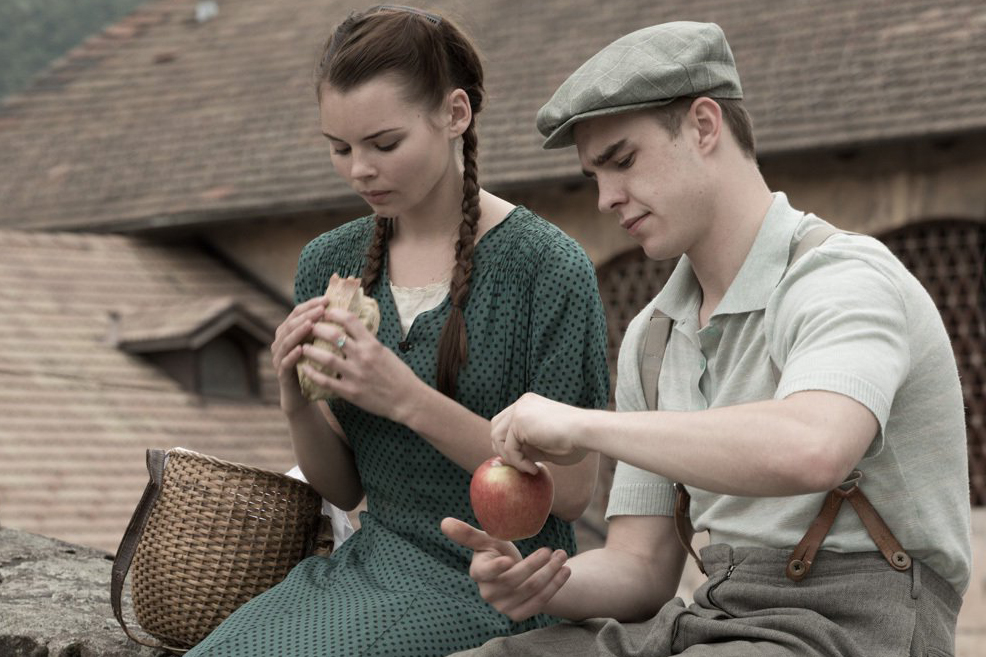
That actress, a young woman named Eline Powell (above, who was much better in a smaller role in last year's Private Peaceful), tries her best to get a handle on her character, but as composited by the various writers, she seems more like a girl who stumbled in from some Disney-level fairy-tale and has decided to act as a therapeutic cheerleader in getting her surviving friends and family to face up to things.

The movie is not uninteresting, so far as it offers up a rather wide range of incidents in the lives of Jewish Holocaust survivors in the immediate post-war years. Yet almost all of these incidents come across as overly sanitized and thus not very believable.

Further, the screenplay manages to over-explain and over-do just about everything we see and hear. This might be serviceable for younger viewers who have little knowledge of history and World War II, but for those of us who do, the film quickly grows tiresome.

Certain lines stand out like the proverbial sore thumbs: "What wrong with being Jewish?!" asks Holocaust-surviving Anita, when her aunt suggests not parading this fact before the new Russian conquerors. Since our girl has been warned about this previously, you begin to wonder if the character has a death wish or has maybe come out of the concentration camp with a few marbles missing.

In addition. the movie tackles everything from the Holocaust to teenage sex, pregnancy and abortion in an utterly simplistic, storybook manner. If this is really how Ms Bruck (née Steinschreiber, who now lives and works in Italy) recalls her history, there is something drastically wrong.

Perhaps the resulting film is more due to its producers' insisting on a Hollywood-ification of Bruck's story. Once you've seen the movie (if you do), click here to read a bit about what really happened -- without the feel-good, fairy-tale overlay. Unlike Life Is Beautiful, which -- for all its glossy, big-budget look -- proved a poor attempt at turning the Holocaust into a feel-good film, Anita B. seems less offensive than just plain silly.

The movie -- via DigiNext and Four-of-a-Kind Productions and running just 88 minutes -- opens this Friday, April 24, in New York City at the Quad Cinema and on April 30 at the Pelham Picture House.