Showing posts with label prejudice. Show all posts

Wednesday, November 11, 2020

Prime Video discovery: Simone Godano's delightful AN ALMOST ORDINARY SUMMER


More than mere coincidence, almost every time TrustMovies sees the Warner Brothers logo on a film from Italy, that movie turns out to be a good one: fun, intelligent, mainstream entertainment. But when that same logo appears on an American movie, it is likely to be one of that studio's schlock blockbusters and a major waste of time for any thinking adult. How can two such divergent reactions keep occurring? Well, Italy has long been known for making wonderful films about family, which this new one -- directed by Simone Godano (shown below) and written by Giulia Louise Steigerwalt (with some input from Signore Godano) -- definitely is. 

AN ALMOST ORDINARY SUMMER (its Italian title is Croce e Delizia, which translates as Cross and Delight) tracks the journey of two Italian families in which the fathers/grandfathers of each have fallen in love (and lust) with each other. 

One family, headed by that highly talented icon of sexy smarts, Alessandro Gassman (below, left), is salt-of-the-earth working class with ultra-traditional values, while the other, under the rule of suave Fabrizio Bentivoglio (below, right), is wealthy, elitist but maybe only a tiny bit "woke."


These patres familias may be in love with each other, but the two families are definitely not. So when one grown child of each -- played by Jasmine Trinca, below left, and Filippo Scicchitano, right -- decides to work with the other to sabotage his and her parent's relationship, the movie grows consistently funnier, earthier, sadder, smarter and simply tons of fun. 


The clever screenplay lets us explore the Italian look at prejudices of all sorts, sexual to class-related, and nobody here comes out super-clean. One of the great strengths of the movie is how mixed a bag each of the characters really is. Yet thanks to the clever plotting, smart writing and excellent performances from the entire ensemble, we end up rooting for them all. 


An Almost Ordinary Summer
is mainstream and feel-good, all right, but it never loses its hold on a reality in which the divergent must be brought together somehow. Boy, we could use this in the USA these days, but instead we have Donald Trump, his lock-step Republicans, and his idiot base doing all they can to hijack this past election -- chanting  "Stop the Vote" in one state while screaming "Count the Vote" in another. Can somebody please pass out a few spare brains to these folk in need?


But I digress. If you need something lovely -- set in a gorgeous locale with sumptuous interiors, verdant seaside exteriors, and lots of delicious-looking food -- that will make you think and laugh and feel very nice indeed, Croce e Delizia  is the film for you. 

From Wolfe Releasing (and available to view via Amazon Prime), in Italian with English subtitles and running  just 100 minutes, give this Italian mainstream gem a whirl.

Saturday, August 11, 2018

An all-time great? Very probably. Leo Hurwitz's amazing, ever-current doc, STRANGE VICTORY


It says things that were simply never spoken of on film at the time. Couple this with visuals of gorgeous, harrowing power and you have a documentary -- a hybrid way ahead of its time -- that appears as current today as it must have seemed shocking, unforgettable and (unfortunately for the filmmaker and his subsequent career) unforgivable when it first was shown back in 1948.  STRANGE VICTORY is a hybrid documentary film I had not even heard of until I received a press release from its Blu-ray distributor, Milestone Films. Now, having experienced the movie (and a number of fine Bonus Features on the disc), I can attest -- along with a bunch of other critics -- that this is one film I shall never forget.

Though initially receiving a good-to-magnificent reception from early screenings, once the "establishment" had weighed in on the film, its writer/director Leo Hurwitz (shown at right) found himself pretty much blacklisted from being able to work in either television (in its early stages) or film.

This was because he told the truth about prejudice and racism in America back at the near-mid-20th-Century, and the powers-that-be did not want to hear this. Nor did they want the American people to hear it. They still don't. And this fact makes the movie, if this is even possible, more timely than ever.

It is just post-World War II America, and the Allies have won. So why, Hurwitz asks, does the voice and message of Adolf Hitler still pursue us? He answers this in a number of different ways and using differing means: gloriously filmed black-and-white images -- some archival (below), others shot for this movie (his cinematographers were Peter Glushanok and George Jacobson) -- that resonate with both meaning and art, and a beautifully written narration narration by Hurwitz himself that quietly, steadily, sorrowfully implicates us all in the continual holding down and back of the "others."

These would be, of course, blacks, Jews, Asians, even Catholics. Anyone who was not White Anglo-Saxon Protestant. The narration sways and rolls, coming back again to prejudice in the film's most haunting sequence, taking place in a hospital room full of newborns, as our narrator explains to them what they can expect from life -- and why. This is such strong, powerful stuff that the fact that it was gifted to us 70 years ago and then not given the chance to be seen seems close to criminal. As you view the film, your realization of how little has changed in so many ways should be at least salutary, if not, finally, a call to action.

How and why Hitler was able to rise to power is also part of the narrative here. The message -- of demagogues, racism and the death of democracy -- is a vital one. But for the simply amazing visuals alone -- beautiful/ugly and resonating like crazy -- the film is a must-see. Talk about "telling it like it is." This is the documentary that first nailed it.

Strange Victory lasts only 64 minutes (on the IMDB, the doc's length is said to be 71 minutes, so I am assuming seven minutes were lost to this 2K new restoration/transfer from the original 1948 nitrate interpositive), which may also partially account as an excuse for why a theatrical run proved more difficult. But it is here now -- and really must be seen

From Milestone Films and The Milestone Cinematheque, the documentary hits the street on DVD and Blu-ray this coming Tuesday, August 14 -- for purchase and (I would hope) rental.

The disc's bonus features include the 2K restoration of Strange Victory from the original 35mm nitrate fine grain master; Leo Hurwitz’s surprising 1964 epilogue to the film, celebrating Martin Luther King and the Civil Rights Movement; Leo Hurwitz speaking about Strange Victory, courtesy of Ingela Romare, from her 1992 film, On Time, Art, Love, and Trees: A Meeting with Leo T. Hurwitz; Barney Rosset (who produced the documentary) speaking about Strange Victory, courtesy of CUNY TV City Cinematheque and interviewer Jerry Carlson; plus six films from Hurwitz’s years as a member of the Worker’s Film and Photo League and Nykino, Courtesy of the Museum of Modern Art, NYC: National Hunger March 1931, Bonus March 1932, Hunger March 1932, America Today, World in Review, and Pie in the Sky (a funny, cogent, "silent" film co-starring Elia Kazan, and made prior to his sell-out).

Sunday, July 3, 2016

July's Sunday Corner With Lee Liberman -- PUZZLES: When Hate Came to Town


A puzzle ends in a rainbow 


When economic pain is widely felt, hate crimes result -- 250,000 annually. The 53 minute documentary, PUZZLES, by Tami Gold and David Pavlovsky of Hunter College, NYC, is a small engrossing tale of the collision between poverty and homophobia in the charming coastal town of New Bedford, MA, a once-upon-a-time rich whaling and industrial hub. In February of 2006, the mixed gay and straight bar Puzzles suffered a hatchet and gun attack by a troubled youth on 3 bar patrons, shaking the community from top to bottom. (The perpetrator fled the attack scene and died by his own hand 3 days later in Missouri, having killed two others.)

You can smell the salt and the sea, tread the cobblestones, and witness the faded industrial past of this now blue-collar, rough-hewn, but engaging small city that has fallen from its heyday but remains close-knit and resilient. The filmmakers take you there.

The voices of a middle-age victim of Jacob Robida, the hatchet-wielding 18-year-old perpetrator, members of his teen gang, the Juggalos, and both gay and straight patrons of the bar Puzzles immerse you intimately into the ugliness of the attack and its ripple effect on the community.

It may seem that the film will focus only on the personal stories of the traumatized attack victims, bar patrons, and bereaved teens shocked by the violent act of their friend, Jacob, but the filmmakers spend the right amount of time on the reparative work done in New Bedford -- the fight back via words and community action. Special efforts by political leaders, police, schools, and the advent of Gay Pride events (above and below) have begun to heal wounds and improve harmony in the city. One bar patron explains that the event helped make things right for gay people in town who began to stop hiding. It is thought that 75% of gay residents were closeted at the time. Bob Perry, one of the 3 victims, had come out only a month before the attack at age 47.

The bar, Puzzles, and its successor, Rainbow's End, have since closed, but ten years later New Bedford has a different social climate. Bev Baccelli, a gay activist in the film from nearby Mattapoisett, commented to SouthCoastToday on the 10th anniversary of the attack: "Out of a tragedy like Puzzles, as horrifying as it was, comes change.....Gay people and straight people started talking to each other. Is it a perfect place?...No, but it's a lot better than...10 years ago."

PUZZLES is about as complete, poignant, and meaningful a story of hate and its consequences as 53 minutes allow, but it's worth referencing here to former openly gay House of Representatives members, Barney Frank and Gary Studds, (the latter deceased in 2006), both of whom represented New Bedford in Congress at different times; Frank and Studds add to the picture of a community not innately homophobic but subject to the pressures of poverty and hate propaganda.

Following the recent attack on gay bar Pulse in Orlando and to mark the 2016 anniversary of the Puzzles event, filmmaker and Hunter College faculty member Tami Gold has made available a free link to the documentary through July. So you can stream this film with no charge through the end of July, simply by clicking here.

The above post was written by 
our monthly correspondent, Lee Liberman

Thursday, June 16, 2016

Father's Day doc: Emily Abt's DADDY DON'T GO explores four guys trying to be good dads


Being marketed as a Father's Day opportunity, the new documentary by Emily Abt (Toe to Toe) entitled DADDY DON'T GO can be recommended mostly if you are looking for something really depressing to view on this manufactured, would-be holiday to honor "dad." The film's subject is two-fold: missing dads and men in prison coupled to the story of four different fellows -- two black men, one hispanic and one white -- all of whom are having major trouble bringing up baby. With almost everything stacked against three out of four of these guys -- only the white one has something approaching a secure place to raise his son -- one can only wonder how and why these subjects were chosen. The choices here certainly make for compelling if frustrating viewing, but as we move along, we can't help but question an awful lot of choices these guys make, as well as some that the filmmaker herself has made.

If one wanted to quickly offer up major differences between how whites and minorities live, you'll certainly find them here. And in this respect, the movie seems truthful about America and the opportunities it presents to the majority of its minorities. But perhaps because Ms Abt (shown at right) wanted to appear non-judgmental (some critics have used this term to describe her doc), she questions nothing we see or hear -- which most thoughtful, discerning viewers will want to do over and over again as the movie unfurls. The most egregious case of this is found when we discover almost halfway along that one of the guys appears to be a criminal who is facing prison for his role in a past mugging. Did Abt not know this? In any case, our suddenly learning this cannot help but change the way we view one of these dads.

As we're told at the film's beginning, Daddy Don't Go was filmed over two years and is the story of four disadvantaged men in New York City trying to be decent fathers against all odds. Then we meet Nelson (above), 26, from the South Bronx, a single dad whose wife was a cocaine addict with no flair for mothering (all our dads seems to have chosen really bad wives or girlfriends), and whose major problem seems to be unemployment. Omar (below), a 34-year-old black man from the North Bronx, has been disabled since childhood (there is no real diagnosis given us here, but since some of his children seem to suffer from this, as well, I am guessing it may be hereditary.) His women -- one abusive, the other incarcerated -- are no help, and so Omar is on disability for himself and his children.

Roy, 28 and shown below, is a white man from Long Island who is clearly from a middle class family. Trouble is, he has been in prison and is finding it difficult to land any kind of job. He is concurrently going for counseling at the Forestdale Fathering Institute, and has, as we will learn, some major issues with his own father (he's living for economic reasons with his son at the home of his parents).

Finally we have Alex, shown below, a 26-year-old black man from Harlem who has recently gained custody of a son whose mother has been deemed an unfit parent. We end up spending perhaps the most time of any with this young man and also perhaps feel the most jerked around by his increasingly what's-next-and-can-we-believe-any-of-this attitude. Ms Abt combines interviews and fly-on-the-wall camerawork with occasional statistics that provide some background but little that I, at least, didn't already know. But can we trust what we see and hear?

In the course of the film Nelson moves to Florida for employment. And then promptly loses it. But did he really lose the job down there simply because he had long hair? And why does a hugely problemed man like Omar keep having kids? Alex is clearly not the man we were initially led to believe (in one scene he is suddenly behind the wheel of a car. Where did this come from?), and only Roy seems to have leveled with us in any way completely. Three of these four talk a good game about fatherhood, yet they don't seem able to play it. But here we get into problems of race and class and history and economics and prejudice and all the rest that Ms Abt refuses to address or perhaps feels it is best to ignore. Being non-judgmental is one thing, but this documentary strikes me as more like sloppy. (Out of all the people on view, your heart will go out most strongly, I suspect, to Omar's daughter Milagros.)

From Pureland Pictures, Daddy Don't Go premieres on Vimeo-on-Demand this coming Sunday, Father's Day, June 19th. You can find it by clicking on this link. 

Tuesday, July 8, 2014

Underdogs of the century! Mary Mazzio's UNDER-WATER DREAMS tracks an unusual competition


If ever a movie suffered from a split personality, it's this one. Fortunately, rather than possessing any Jekyll & Hyde kind of thing, UNDERWATER DREAMS , a new documentary by Mary Mazzio (shown below) is definitely more Jekyll & Jekyll, as both sides of the coin -- a underwater robotics competition that took place back in 2004 and a tale of immigrant rights that has unfurled in Arizona since then -- are benign, important and very much worth knowing about. Maybe just not in the same documentary.

As  you're watching this enjoyable and sometimes surprising movie, you'll be aware, around the midway point, that the climax has been reached and you're suddenly into a rather long denouement. That's because the story of the unusual team of robotic students from Carl Hayden Community High School (from here on known as CHCHS) in the Phoenix, Arizona, area -- where 92 % of the students live below the poverty line and and 90% of them are Hispanic -- is also about the fact that a number of them and their families are also undocumented. This lends everything an even dicier cast. One of this quartet of student's teachers -- Fredi Lajvardi -- has encouraged his group to take part in the underwater robotics competition in Santa Barbara, California, while simultaneously trying to lower their expectations somewhat. Lajvardi hopes that the team might possibly beat out one or two other high schools, if it's lucky.

We get to know these four kids and their teacher (above) and some other teachers and counselors, as well as the kids from the major university against which they are competing (and whose members often win the competition): MIT. Yes, that MIT. We actually come to like both teams: The MIT kids -- shown below with the CHCHS team -- do not seem the entitled snobs one might imagine, while the Arizona kids -- and their robot they name Stinky -- grow and blossom before our eyes. I think we'd be fortunate indeed to be able to call any one of them our friend. "These kids' biggest obstacles are low and/or wrong expectations," one of their counselors explains, and we can also understand this.

How the actual competition plays out involves to a large degree simplicity versus complexity, and while the CHCHS kids' robot is indeed pretty simple, each team member truly and deeply seems to understand Stinky (below) and how he works. This pays off. As I noted above, the actual climax occurs around the midway point, and from then on the documentary toys with other things: a ten-year reunion of the CHCHS and MIT teams, a piece on where-are-they-now, and then a whole section involving our country's ever-changing immigration laws and a protest by the students that attempts to change these laws.

All this is way too scattershot and organized rather badly, seeming more like an attempt to make Underwater Dreams a full-length piece, rather than a shorter, better and stronger version that stuck with the competition and its aftermath and ran maybe an hour in length. The immigration theme is equally important, but another entirely separate documentary could have been devoted to this, too.

Still, I wouldn't have wanted to miss learning about what these students did and how they did it. Their work is genuinely inspiring. What we're seeing here seems like the result of good teaching and true learning. As one of the advisers at the competition states: "These boys fundamentally understood what they had built!" For all its faults, the documentary is the best thing I've seen to come out of Arizona (a state usually full of anger, inequality, prejudice and the Gabby Giffords assassination attempt) in a very long time. I hope the entire population of the state gets the chance to sit through this film -- and hold a discussion afterward.

Underwater Dreams -- running 86 minutes -- opens July 11 in New York City (at the AMC Empire 25: Showtimes 10am, 12:20pm, 2:40pm, 5pm, 7:20pm, and 9:40pm) and in Los Angeles (AMC Burbank Town Center 6: Showtimes 12:45pm, 3pm, 5:15pm, 7:30pm, 9:45pm, with additional morning shows at 10:30am Fri-Sun.)

Beginning July 19, AMC Theatres will host, free of charge, up to 100 community screenings across the U.S. to enable school and non-profit groups to enjoy the film on the big screen this summer and fall.
If you represent a community group, non-profit, or school and can gather at least 100 people for a screening, please click the AMC logo below to request a screening. All requests must be submitted by October 1, 2014 and all screenings must happen by October 15, 2014. This offer is limited to the first 100 qualified requests that arrive by deadline. (Shown above is Michael Peña, who narrates the film.)

Wednesday, May 8, 2013

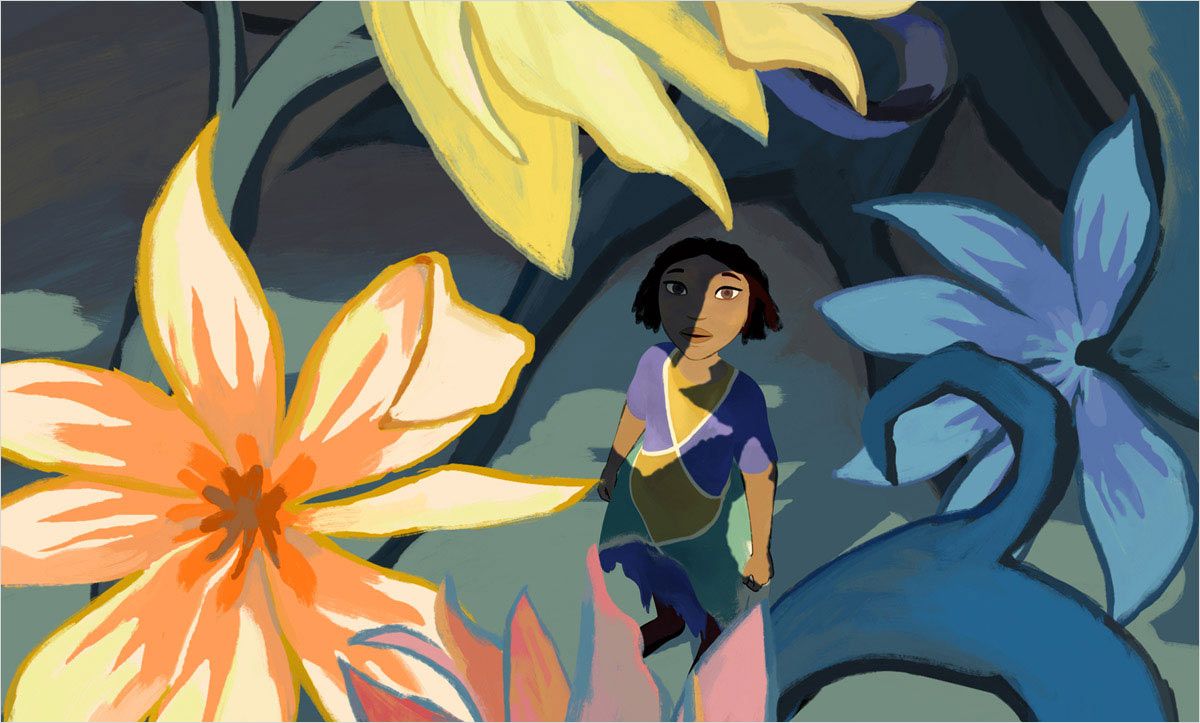
Jean-François Laguionie's THE PAINTING opens -- GKIDS' best animated film so far!

At first, the must-see piece of French animation THE PAINTING, from co-writer/director Jean-François Laguionie (shown below), seems like a terrific parable about racism, classism, prejudice and justice. In a painting which its artist has left unfinished, the characters -- those who are completely drawn and colored, those half-drawn and others barely sketched -- break into severely formed classes, with the completed figures ruling the other two. When a "finished" Romeo falls in love with an "unfinished" Juliet, all hell break loose.

But then, ah, the movie goes after so much larger game that it becomes its own creation myth. TrustMovies and his ex-wife first saw this film at last year's Rendez-vous With French Cinema, where we both found it quite special -- enchanting, beautiful, intelligent and engrossing. Seeing it again a year later, it holds up marvelously. This time our 8-year-old granddaughter viewed it, too (the film is being released by GKIDS and marketed to children). Sure enough, our granddaughter loved it -- and insisted on watching it again the next day.

The animation is old fashioned and at all times graceful, lovely and occasionally laugh-out-loud funny; the story is exciting but sweet (kids should love it, particularly those with a budding interest in art), while adults will find it almost shockingly relevant in its themes and content -- not to mention its being a superb entryway into a discussion with kids about subjects such as who are we, where do we come from, who's really in charge and why?

The big question our granddaughter wanted answered was, why does that one group, who've been colored-in and completed, have to be so mean to the others? (Why, indeed. Let's hope, by the time you reach high school, honey, that times will have changed.)

For anyone who has studied history, the movie will bring to mind everything from royalty, peasants and the French Revolution to Jean Valjean and that loaf of bread. Younger kids will look to their own experience and find plenty of examples.

This is a brilliant concept that M. Laguionie and his crew have brought to witty, charming, even profound life. And, ah, those colors! The movie must be considered a don't-miss -- especially, but not only, for lovers of animation.

The Painting, running just 75 minutes, opens Friday, May 10, in New York City at the Village East Cinema, where it will be shown (for kids) in an English-language version all day and early evening, and in-the original French-with-English-subtitles version at the 9:30pm showing daily. The film is also said to be coming to various Landmark Theaters around the country in the weeks/months to come. So keep watch and don't let this one slide by you.

Sunday, October 16, 2011

Rumor has it: Williford/Marcarelli's THE GREEN heads straight for VOD and DVD

Talk about stacked! And I am not -- though I very well could be -- speaking of one of the hunky leading men, the borrowed-from-Broadway Cheyenne Jackson, who co-stars in THE GREEN. Instead, I'm referring to the film's screenplay (by Paul Macarelli), an increasingly paint-by-numbers affair that sets up a semi-happy gay couple (a high school teacher and his caterer companion) in a small New England town suddenly beset with a nasty accusation of inappropriate behavior, after which nearly everyone turns against them -- including the twosome itself. Soon a deep dark secret from the past is revealed, and by the time the movie comes, via one over-wrought scene after another, to its feel-good conclusion, we're drowning in cliché.

This is too bad. The filmmakers (TV soap maven Steven Williford of All My Children, shown at right, directed, and legit theater vet Daryl Roth is one of the executive producers) have rounded-up a good group of actors -- some "name," some not-so -- all of whom deliver as best they can. They all have  their moments, but with a screenplay that seems as increasingly contrived as this one, those moments appear just part of all the melodrama that's coalescing into a very deep pile of sturm und drang.

In the cast are some real stalwarts, particularly on the femme side. Julia Ormond (above, right) does another fine job as the accused’s smart, genuine and realistic attorney;

Illeana Douglas (above, right: always great to see her on-screen) is nudgy, funny and vey real as our hero’s best pal; and Karen Young (shown at bottom) is aces as the confused and put-upon mother of the young student whose “accusation” (except that it isn’t quite that) sends everyone into conniptions.

It’s the male members who are more problematic, but this, I suspect, is due to their not being so easily able to rise above a screenplay that piles on the angst-filled events with a shovel, in the process, stacking its deck a little too heavily against the protagonist. In the leading role Jason Butler Harner (above) is mostly dour and single-note, though a nicely ironic sense of humor does show through at times. Mr. Jackson, shown at right, as his partner, provides a pleasant change from the glum (and some eye-candy).

As the troubled student, Jason, Chris Bert (being bullied, above center) performs impressively as the kid who's utterly beside himself, even if his character must finally rely on a back story that is a little too standard. In the role of the kid’s stepfather, Bill Sage is properly pig-headed, venal and nasty, but the finale’s “surprise” revelation, accompanied by the most melodramatic events possible under this fraught situation, will come as a shock only to those who have not seen this particular character -- a favorite boogeyman of gay fiction for years now -- maybe thrice-too-often.

The movie wants to tell us that, despite the many gains gays have made over the past few decades, we’re still under the guns of prejudice and homophobia once an accusation is raised. So instead of retreating into silence and fear, a stand must be taken. Well and good. And younger gays, with much less experience in art or life may just bite.

But those of us who’ve been around the block a few times will probably not be satisfied with a movie that unreels like an increasingly schlocky melodrama coupled to an after-school-special featuring a dollop of extra dirt.

The Green, from FilmBuff, goes straight to VOD this Tuesday, October 18, and then to DVD one month later on November 22 -- available for purchase or rental.