Showing posts with label psychology. Show all posts

Thursday, June 25, 2020

DVDebut for DARK FORTUNE, Stefan Haupt's quiet, psychologically astute drama of family, trauma, repression and loss


A very dear friend of mine, a psychologist whose life ended abruptly and far too soon, once told me that the children of psychologists are some of the most screwed-up people on earth. The doctor/parent may minister quite well to patients, yet for whatever reason(s), his/her own children are often in certain ways left at the starting gate. Why this should be -- the age-old choice of placing job ahead of family or maybe simple hypocrisy/denial -- may not matter as much as the fact that, all too often, this cliche proves true.

TrustMovies thought about his old friend and that theory while viewing the very fine, almost-new (2016) Swiss film, DARK FORTUNE, directed and adapted by Stefan Haupt from Finsteres Glück by Lukas Hartmann.

Herr Haupt (pictured at right), who gave us the unusual documentary/ narrative combo, The Circle, back in 2014, here offers up a film full of events -- seen or remembered and some of these truly awful -- in such a quiet, considered manner that he, along with his excellent cast, manages to preclude melodrama while still giving us the necessary drama, allowing us to feel all of the emotion that goes along with it.

Events include a horrendous car accident that destroys a family and leaves one orphaned child, a fight between relatives over the care of that child, an excellent psychologist who is given temporary care of the orphan, and her own family that is going through -- yep -- its own "children issues."

Dark Fortune covers a lot of ground, but its near-two-hour running time allows that ground to be explored properly. If you appreciate stories of family, trauma, astute psychology and believable resolution, you won't be bored and will finish the film is a state of pleasurable relief.

The role of the child is taken by the appealing and talented young newcomer, Noé Ricklin (above), who combines vulnerability, fear and anger into quite a personality. His psychologist and helper, Eliane, is played by Eleni Haupt (above and below) with such a strong sense of conviction and understanding that she'll win you over just as she does her young patient.

Slowly, carefully we learn more about the boy's departed family members, as well as his remaining aunt and grandmother, and simultaneously we meet Eleni's two daughters and her estranged second husband (a very good job by Martin Hug, below, right).

Together, these quiet, beautifully observed scenes build up quite a head of steam and emotion, mostly by not allowing the characters to do so. The tightly constrained script, direction and performances combine to create a tale of trauma, loss and family secrets. Most interesting of all is how the film's center of interest moves from one family to the other -- and then brings it all together via a kind of off-the-cuff, spontaneous psychology and therapy that not only seem believable but also work. This is an all-around lovely, moving job of movie-making.

From Corinth Films, in German with English subtitles and running 116 minutes, the film hit the street on DVD -- for rental or purchase -- this past Tuesday, June 23, and can also be seen via Amazon Prime Video.

Sunday, June 7, 2020

Nudity, sex, dance (and a little psychology) combine in Boaz Yakin's unusual fim, AVIVA


If I can help it, I will never miss a film by Boaz Yakin. This fascinating, accomplished director and writer (not always within the same film) has given us a raft of good movies, with each of his directorial efforts in a different genre. What his films have in common, seems to me, is their placing an outsider at the center and having him/her eventually -- often at great, if not pyrrhic, cost -- win the day. His latest, AVIVA, as per usual, is not simply in another genre; it mashes up several into something that seems pretty much sui generis.

Mr. Yakin, shown at right (some years back), is always as interested in content as in visuals, but Aviva may be the most visual of all his films, even if not nearly his best.

There's a stunning shot of hands on mugs on a table early on followed by several of the kind of memorable images that, when you think of this film later on, you will probably call to mind -- one of which appears just below. (His cinematographer this time around is Arseni Khachaturan, with film editing by Holle Singer.)

For a good while during this film, thanks to everything from the very hot looking men and women, the copious amounts of nudity (often male and full-frontal, prudes be warned), the sex scenes, the openness to both hetero-and homosexuality and the enormous contribution of dance (much of it quite good) to the film, this seemed to TrustMovies to be the most fun he has had at the movies all year. Then, somewhere around the midway point, repetition begins to set in (along with the nagging sense that there is less here, content-wise, than meets the eye and mind), and Aviva comes subsequently only fitfully to life. Though when it does, it can still prove pretty magical, off and on.

The problem, to my mind, is that the movie's strengths and weaknesses go hand in hand with its director's own, because, I suspect, this film is giving us Yakin's own story and struggle. Although there are four actors credited with playing, sort of, two roles -- that of the titular Aviva (both the female and male versions) and Eden (again, the male and female) -- really, I think, these are all just sides of Yakin himself, who wrote and directed the piece and who is clearly struggling with identity, sexuality, commitment, growth and all the rest of it. (Who of us is not? Though some of us maybe don't realize this yet.)

The biggest problem here is that Yakin seems to identify most, and understandably so, with the male version of Eden (played by a most attractive and nicely hung actor/dancer named Tyler Phillips, above, who is making his movie debut) and who has to deal throughout with a kind of hang-dog attitude in which guilt, coupled to the inability to rise above this and grow up, leads to his growing tiresome and beginning to bore the bejesus out of us. He waffles and he wavers and he can't commit and he's pretty much of an asshole, overall.

While the female Eden, played by Bobbi Jene Smith (above, center left) rather echoes her male counterpart, Ms Smith at least supplied the choreography and some of the fine dancing, she also supplies a lot more energy and pizzazz than does Mr. Phillips, and so watching her is not such a drag. She, along with her companion and co-choreographer Or Schraiber (see below) also appeared together in the 2017 documentary, Bobbi Jene.

The title role, female version is essayed by an attractive and appealing Russian-born actress, Zina Zinchenko (above), while the male version is played by hottie, dancer and co-choreographer (the aforementioned Mr. Schraiber, below), who brings a vast quantity of sex appeal and dance knowledge to the proceedings. (Don't worry if all these sexes and characters seem confusing. Eventually they run together into a kind of sameness, some of which is no doubt intentional on the part of Yakin; the rest of it simply follows.)

Dance is just about everywhere here, and sex is, too. (To his great credit, the filmmaker does not stint on the homo over the supposedly more important role of the hetero, the point being that it is all one.) The production design is spectacular, with locations in Paris, New York and Los Angeles. Unfortunately, the word love is tossed about so carelessly and often that you'll realize the filmmaker -- like so many of us -- is perhaps vamping, while he learns the meaning of the word.

And when, toward the end, a character screams out, "Please! We can't do this anymore," you'll probably agree. At a near two-hour running time, shorter would have been better. Particularly when that male version of Eden is, to use Bill Maher's description of Donald Trump, such a "whiny little bitch." Still, as with just about everything Yakin has given us, when it's good, it is so good, that I would watch it all over again.

From Outsider Pictures and Strand Releasing, Aviva, in all its too-long glory, will hit virtual theaters this coming Friday, June 12. Click here and then scroll down to find the virtual theaters across the country in which the film will play. (There will be a free live-stream Q&A on Saturday, June 13; Sunday June 14; and Saturday, June 20. Click here for more information.)

Monday, March 30, 2020

CAPITAL IN THE TWENTY-FIRST CENTURY: Justin Pemberton's necessary documentary of Thomas Piketty's even more necessary book


If ever a tome was needed to help correct the world's ever-growing inequality between the wealthy and the rest, it was Thomas Piketty's CAPITAL IN THE TWENTY-FIRST CENTURY, published in French in 2013 and the following year in an English-language translation.

Though an immediate best-seller internationally, TrustMovies suspects it was one of those books more talked about than actually read by the intelligent masses (yup, I didn't read it either). For those of us who didn't -- and even maybe for those who did -- here comes the movie version (a documentary, 'natch) directed by Justin Pemberton that, after a bit of a shaky start, goes on to become one of those must-see movies that may change the attitude of many lucky enough to view it.

Mr. Pemberton (shown at left), along with M. Piketty (shown below), make
their point via history, economics, statistics and even psychology. Regarding that last, the experiment shown here involving wealth, entitlement and the results of a Monopoly game played without anything resembling a level playing field should open your eyes and leave your mouth agape. That aforementioned point is how hugely the gap in western countries between the very wealthy and the remaining populace continues to widen -- along with how unhealthy this situation clearly is.

Piketty, who, along with Pemberton and Matthew Metcalfe, adapted his own book to the screen, has certainly managed to make his information come across as intelligent, important and more than a little timely.

It is Piketty himself who acts as initial narrator, speaking to us in French (with English subtitles) and popping up from time to time, along with a number of other smart, well-spoken talking heads (including economic analyst Rana Foroohar, above) who, together, make a very good case for why this enormous income disparity is so destructive for so many.

Initially, the documentary took some time to involve me and to lift off. I suspect this is because the film spends a good half hour offering a look at history and telling us things that, if we've also seen other fine docs such as Capitalism and No Gods, No Masters, we'll already know. Add to this, Mr. Pemberton's penchant for filling up the screen with so much of everything as to be distracting (see above and below).

Yet, as Capital in the Twenty-First Century moves along, it gathers such a head of steam that is soon becomes so vitally interesting and packed with more and more with succulent examples and pertinent information that, once finished, you may want to watch it all over again, just to make sure you got the whole thing.

By the time it gets to -- and sticks with -- this twenty-first century,  you'll be absolutely hooked, as Piketty and company explore everything from globalization and its discontents to the country of China (above) -- and why the Chinese (below) are faring better than are we in the west.

This is not simply a slap on the wrist or some dire warning without an accompanying solution. Piketty offers some good ones -- involving taxation and the monitoring of offshore tax havens, among others. Yes, this'll take work. But what that is worthwhile does not?

More to the point, this change demands both the will and the work. But with so many of our current politicians (just as those of the past, above) --- of either stripe -- in hock to the wealthy and the corporate, will and work are, as ever, in short supply. And now we have the current Corona virus to makes it all more difficult. Still, this is a documentary that demands to be seen, discussed and acted upon. We shall see.

From Kino Lorber and running 103 minutes, Capital in the Twenty-First Century was supposed to open theatrically this Friday, April 3 (click here, then click on PLAYDATES, to see the should-have-been theatrical venues). If not available theatrically, surely the film will soon be seen via digital streaming. I'll try to keep you posted with any updates here....

Sunday, October 27, 2019

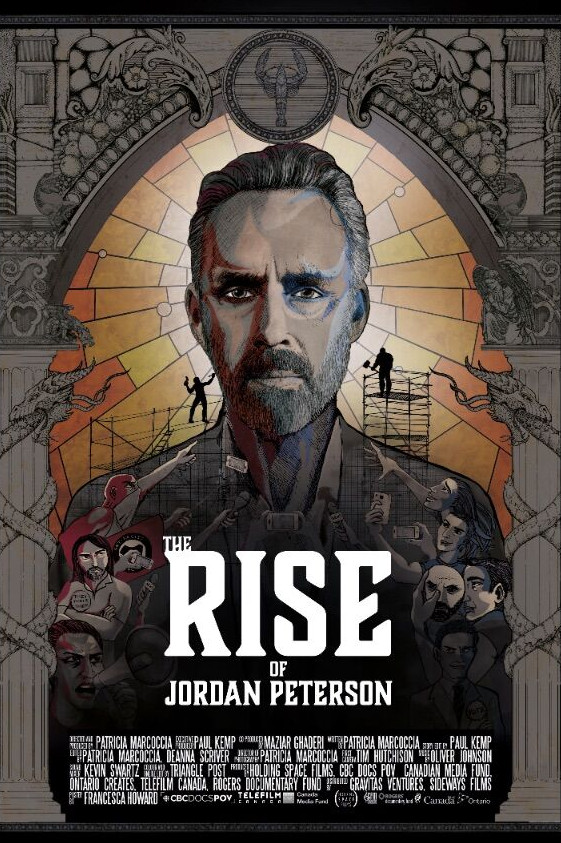
Must-see documentary: Patricia Marcoccia's look at a vitally important academic/author in THE RISE OF JORDAN PETERSON


Why isn't Jordan Peterson -- clinical psychologist and professor of psychology at the University of Toronto -- better known here in the USA? Sure, he may be beloved by certain members of the alt-right (until he tweeted that, if confirmed, Brett Kavanaugh should step down), and although he speaks out against political correctness, so does Bill Maher, and look where that has gotten him. Peterson is a hugely best-selling author, so one might imagine that he would have been invited onto the likes of an Oprah-type TV show or perhaps The View.

The main reason, TrustMovies suggests, is that Mr. Peterson is not simply controversial, he is also... from Canada. As we know (or actually don't know, since this is seldom mentioned in polite society), most things Canadian -- especially those having to do with culture -- are often ignored or found wanting by our cultural guardians here in the USA.

In her new documentary, THE RISE OF JORDAN PETERSON, filmmaker Patricia Marcoccia (shown at left) explores this very interesting fellow, his ideas, history, family, friends (and some no-longer-friends) and has pieced together a believable and (it seems to me) relatively trustworthy account of Peterson's life and times. (You might also want to read the worthwhile article Ms Marcoccia has written about why she made this film.)

As popular and successful as Peterson (seated, above) certainly was, what made him so suddenly controversial was his huge and angry objection to Canada’s gender identity rights Bill C-16, and a certain section of it that appeared to criminalize behavior, whether than behavior was intentional or not, along with the forced use of new pronouns (below) when referring to the transgendered.

This was taken to heart by many in the trans community as something anti-trans -- rather than merely anti-unnecessary politically correct speech. And thus was born yet another "Let-see-how-much-more-divisive-we-can-be!" pro vs con campaign. TrustMovies thinks of himself as thoroughly pro-trans, but he suspects that he will never be able to refer to a single individual as a "them." Grammar just doesn't permit such a stupid lapse, the use of which, by the way, does trans folk no favors, in any case. Rather, it singles them out for further attention as "oddities" rather than helping them fit into society at large. This constant concentration on what we say -- the "n" word or the use of a "correct" pronoun -- comes at the expense of and takes attention away from what we do -- murdering blacks and the transgendered. This is political correctness at its most stupid and useless.

Ms Marcoccia, who spent a lot of time with her subject, clearly finds him a worthwhile one, but she gives noticeable weight to his naysayers, too, without, I think, tipping the balance toward them. From what we see and hear here, Peterson himself is rather quick to question his own motives and ideas, trying to keep himself on track despite the siren calls of fame, adulation, and all the selfies taken with and by his many fans.

Helping him with that task is his seemingly close-knit family -- wife (above) and kids, along with his still-living mom (below, left) and dad. We also discover all the art Peterson has accrued, some of it redolent of the Marxist/Lenin/Stalin era (see four photos up), a time and a politics which the man clearly loathes yet simultaneously finds fascinating.

If a person is to be judged by the amount of alt-right followers he has attracted, then Peterson is surely guilty of something. Yet seeing him interacting with fans who look and act anything but alt-right, and hearing him speak about how to take charge of one's own life in ways intelligent and certainly possible would seem to contradict that.

When the film was shown in Canada last year, it's full title was Shut Him Down: The Rise of Jordan Peterson. This probably makes more sense up north where the man was and is a household name. It also brings to the fore how angry and unsettled his very identity makes so many people -- not, perhaps, as much because of what he thinks and says as because of what certain people make out of what he thinks and says.

Yes, this is something of a conundrum, yet Ms Marcoccia has done a sterling job of marshalling the evidence, pro and con, and bringing it all together into a thoughtful, entertaining whole. I want to know more about Jordan Peterson and his ideas, and after seeing this fine documentary, I suspect you will, too.

From Gravitas Ventures and running 91 minutes, The Rise of Jordan Peterson will play a few venues around the country in day/weeks to come --click here to see all current and past playdates, cities and theaters -- and will be available On Demand tomorrow, Tuesday, October 29, for purchase and/or rental.

Friday, September 21, 2018

MUSEO: Alonso Ruizpalacios' follow-up to Güeros hits South Florida theaters today


When Güeros, the first-full-length film from Mexican writer-director Alonso Ruizpalacios reached U.S. theaters back in 2014, it looked as if a stunning new talent was upon us via this tale of disaffected Mexican youth told in a fresh and exemplary manner.

Ruiz Palacios (shown below) is back in 2018, with a new movie entitled MUSEO, which is again about disaffected youth. But here, that youth is lingering well into middle age.

Our "hero," Juan (also known derisively as "Shorty"), is a spoiled, entitled product of the Mexican bourgeoisie circa the mid 1980s.

As played with his usual sexy charm, coupled this time to more negative aspects of his character, by Gael García Bernal (below), Juan is quite the little asshole, as he and his partner-in-crime, Benjamin (Leonardo Ortizgris, two photos below) plan and then execute a whopping burglary (based on a real incident) involving a number of priceless artifacts located in a Mexican museum.

Folk who saw the recent hybrid documentary/narrative film, American Animals, should immediately note the similarities between the two. in which a heist of museum artifacts is attempted by some hugely unprofessional thieves. American Animals was pretty amazing: smart, beautifully acted, directed and written, with a wonderful combination of narrative characters and their actual counterparts in reality. It was thrilling, funny and bizarre, with a style that turned it into an art film without its even trying.

Museo, however, clearly wants to be an "art film," and so announces its intentions, as well as its themes and concerns, with a little too heavy a hand. It is certainly an interesting exploration of the Mexican culture of its time, along with the everlasting Hispanic ability to spoil its male children rotten, even as its makes clear (a little too clear) that we can rarely be sure of a person's true motives, including those we think we know best.

Ruizpalacios gives us a combo of history, philosophy, psychology, and a kind of heist thriller that would be much more thrilling had it been shortened by 20-to-30 minutes. Instead the movie just goes on and one and on, giving us an entire section devoted to a supposed "contact," a night club, and an over-the-hill performer (nicely played by Leticia Brédice) -- clearly someone on whom Juan has had a major crush -- that may be interesting but drains the suspense and pace rather crushingly.

Better is the scene with Simon Russell Beale (above, left) playing an international "fence" who must apprise our boys of the stupidity of their actions and expectations.

Clearly, Ruizpalacios had a much larger budget this time around (the credit sequence alone looks quite ravishing), but the spirit, freshness and life -- not to mention the ability to offer up so many ideas and themes so offhandedly yet strongly -- that inhabited Güeros has mostly gone missing. Well... next time!

From Vitagraph Films and running two hours and eight minutes, Museo opened today, Friday, September 21, here in South Florida -- in Miami at the AMC Aventura 24 and the Coral Gables Art Cinema, in Fort Lauderdale at the Cinema Paradiso-Hollywood, and in West Palm Beach at the Lake Worth Playhouse.  Click here and scroll down to find all the currently scheduled playdates, cities and theaters.

Friday, September 15, 2017

In the loop: Gareth Tunley's compelling puzzler, THE GHOUL, arrives on Blu-ray/DVD


A knockout -- even if it may leave you more puzzled going out than you were going in -- THE GHOUL, a movie written and directed by Gareth Tunley so consistently genre-jumping that it's probably sui generis, proves a kind of enigmatic mystery-thriller with over/undertones of everything from the occult to a master class in psychology. Think Repulsion meets... oh, hell, comparisons are pretty useless here. Just watch and wonder. And enjoy. Whatever your opinion at film's end, you'll be hooked throughout and thoroughly enjoying yourself, TrustMovies suspects.

The name most bandied about in the film's advertising is that of Ben Wheatley, who acted as executive producer. And why not -- since his is the most famous of anyone connected with the movie? Yet this is quite unfair, as the movie is better than literally anything Mr. Wheatley has so far accomplished. If any justice remains in the movie world, we shall be hearing from Mr. Tunley (shown at left) again and again.

What this filmmaker has done is to give us the movie equivalent of a Möbius strip or an M.C. Escher drawing. And yet The Ghoul is no mere stunt (or if it is, it's one of the better stunts in film history). It is also a living breathing, beautifully conceived, executed, written, directed and acted tale of... what?

That is the question that will dog you as you watch. The possible answers are plenteous, with character dissolution and/or the take-over of one person's mind and actions by another the most prominent. Our leading man, Chris, played by the unforgettable Tom Meeten (shown above and below) is the film's central character, and he is on-screen for practically the entire movie. Mr. Meeten possesses a face and a body that manage to be, by turns, dowdy, handsome, plain, sexy, riven, graceful, graceless, and always compelling.

The movie is Chris's journey, and Meeten makes it -- thanks to camerawork (Benjamin Pritchard) that consistently finds the right subject and view and editing (which seems to be divided amongst several folk) that couples all this with precision and speed -- something from which you cannot avert your gaze. As writer and director, the filmmaker provides smart detail after detail in the foreground, background, and via the strange and varied cast of supporting characters that makes that journey utterly riveting.

The plot make perfect sense. For awhile. From the opening scene, in which we learn of a bizarre double murder to the penultimate one that provides a kind of climax that explains (and yet maybe doesn't) all that has gone before, Mr. Tunley is able in something like 85 minutes to bring us full circle and yet keep us going even farther (afield).

Along the way we meet a would-be girlfriend (Alice Lowe, two photos up), a bizarre best friend (James Eyers, above), a therapy companion (Rufus Jones, below, right), and especially a couple of very strange but interesting therapists (beautifully brought to life by Niamh Cusack and Geoffrey McGivern) who, together, bring the movie its most unsettling blend of kind, charming compassion and utter manipulation.

There is even an oddball character (Paul Kaye, below) whose entire job in the movie, it seems, is simply to tell a most interesting and funny shaggy-dog story. What drives the film forward (and may simultaneously drive you nuts) is how believable everything seems. Until it is clear that -- yes? no! -- something quite else is wrong here. Still, we and Chris persevere until we've reached... ummm, you'll see. What you'll make of it all is up for grabs.

On the Blu-ray disc's Special Features is a delightful short film featuring the director and much of his cast -- all of who, it tuns out, are comedians known for their character-driven, stand-up comedy routines. Considering that The Ghoul may be one of the most dour, dark creations ever to hit video, this seems particularly intriguing. It's like that clown who so wants to play Hamlet (and then does it damned well) -- times ten.

From Arrow Video and released here in the USA via MVD Entertainment, The Ghoul arrived on Blu-ray (in a fine transfer) and DVD last week, and is available now for purchase and/or (I hope) rental. For folk who demand something different, compelling and lots of fun, this one's a don't-miss deal.